
Executive Summary
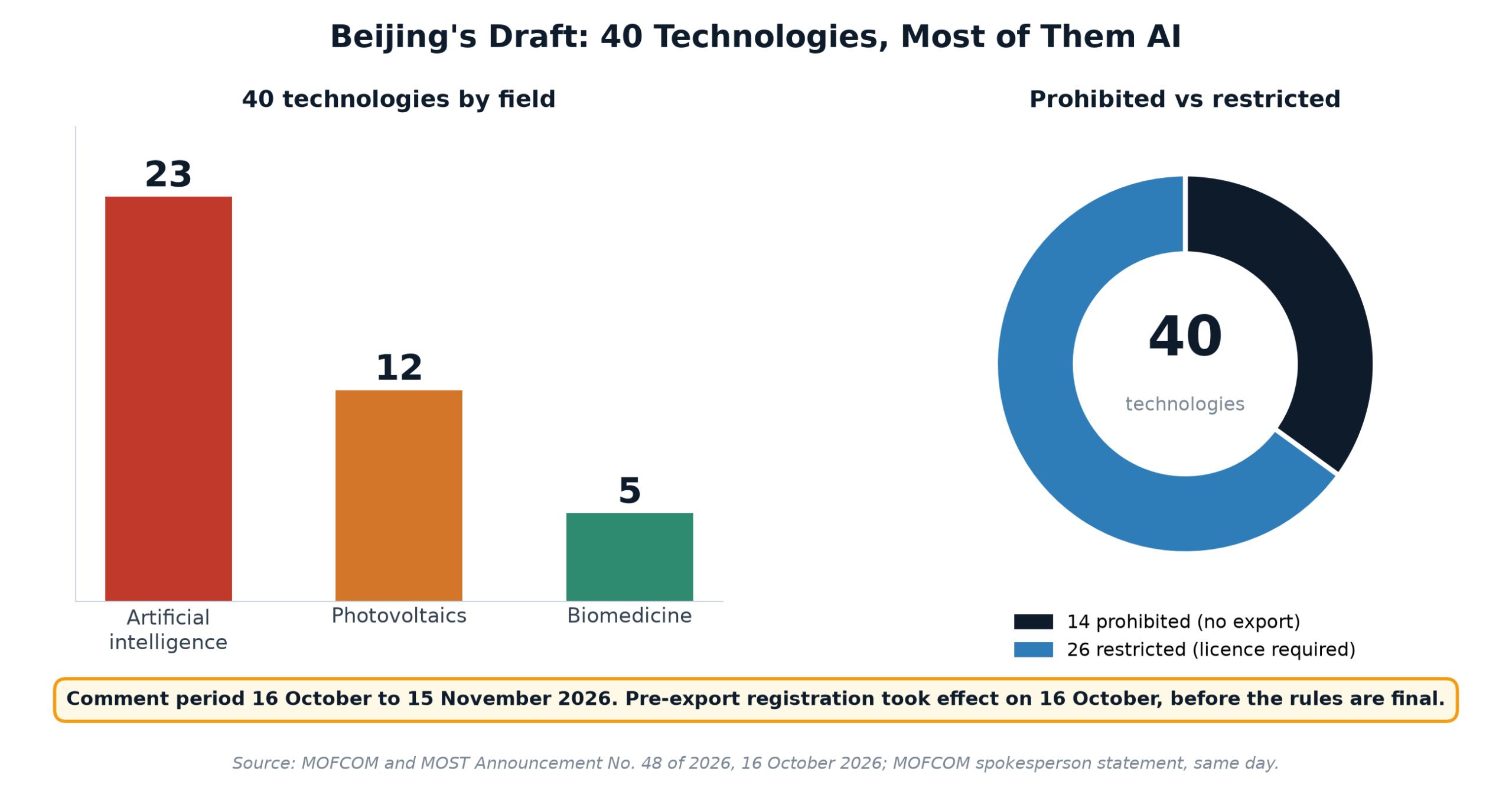
On 16 October 2026, China’s Ministry of Commerce and Ministry of Science and Technology published Announcement No. 48, a draft revision of the Catalogue of Technologies Prohibited and Restricted from Export. It proposes adding 40 technologies in three fields: 23 in artificial intelligence, 12 in photovoltaics and 5 in biomedicine. Fourteen would be prohibited outright and 26 would require a licence. Comments close on 15 November. A pre-export registration requirement took effect the same day, before the rules are final, and reaches transactions already under way.
The AI thresholds are familiar. Core technology for models trained with 1026 floating-point operations, carrying 2 trillion or more parameters, or ranking in the global top ten on a public benchmark would need a licence to leave China. The 1026 figure is the same line the United States drew for model weights in its January 2025 AI Diffusion Rule, which Washington rescinded four months later. Two of China’s flagship open-weight models, Kimi K3 and Qwen3.8-Max, sit above the parameter line on published figures.
The draft is less than a ban and more than a formality. Open-source releases, API access and already-public research are carved out or fast-tracked. But the registration regime captures licensing deals, overseas deployments and any change of foreign control over a Chinese technology owner, with no transfer of code required. It arrives three weeks after a trade truce was extended to January and a month before the public-comment window closes. This report sets out what the text says, how it compares with the US rules it mirrors, what it means for the companies on both sides, and what it does not yet resolve.
This analysis draws first on the official announcement and spokesperson statement from China’s Ministry of Commerce, the US Bureau of Industry and Security’s published rules, and the Hugging Face open-source report, with wire coverage used only for context and analyst quotes. The author’s views are his own.
What the Draft Says
The catalogue has existed since 2001 and has been revised in 2008, 2020, 2023 and July 2025. The ministry spokesperson described the new revision as routine, said the scope is “limited,” and stated that it is “not aimed at any specific country, region or entity.” The stated purpose for the AI items is to “reinforce the security bottom line, guard against misuse and abuse, and ensure that AI always remains under human control.”
The 23 AI items fall into four prohibited categories and six restricted areas. The full annex is in the official text; the structure, as summarised by trade-law analysts who have read it, is as follows.
Prohibited, meaning no overseas transfer: models trained on “core data” as defined by China’s Data Security Law; high-performance agents built for critical infrastructure, defence or core government systems; AI that generates or mutates malicious code; and certain high-performance detection of AI-generated content tied to cross-border data security.
Restricted, meaning a licence is required:
| Area | Trigger (any one applies) |
|---|---|
| Foundation models | Training compute of 1026 FLOPs; 2 trillion or more parameters; or a top-10 ranking on a qualifying public benchmark, including coding, maths, usage, safety and training efficiency. Covers weights, checkpoints, source code, architecture, training optimisation and inference acceleration. |
| Agents | Systems that break a task into 20 or more executable steps, coordinate more than 60 agents, autonomously use more than 200 external tools, or outperform 90 percent of humans on standardised planning benchmarks. |
| Chip and memory design | AI processor architectures, instruction sets, software stacks, advanced packaging and interconnects at 14 nm or below; advanced DRAM and multilayer flash design. |
| Computing clusters | Clusters above 10,000 accelerator cards: cross-chip communication, failure recovery, unified scheduling of chips from two or more vendors, and geographically distributed training. |
| AI-assisted cybersecurity | Autonomous vulnerability discovery, exploitability assessment and attack-chain construction. |
| Speech and detection | High-accuracy voiceprint recognition, deepfake-audio detection, recognition and translation for Chinese minority languages and dialects, and steganography detection in images and video. |
The draft also lists 12 photovoltaic technologies, including a prohibition on perovskite and tandem cell module production and a restriction on polysilicon lines of 30,000 tonnes a year or more, and 5 biomedicine technologies covering cell and gene therapy platforms and small nucleic acid drugs. Those fields are outside this report’s scope but matter for one reason: they show the revision is a package across China’s export strengths, not an AI-only measure.
What Is Carved Out
The carve-outs are as important as the controls, and the ministry emphasised them. Three stand out.
Already-public technology is excluded. Anything in the public domain through open-source release or academic publication is proposed to fall outside the controls. That covers every Chinese open-weight model released to date.
Future open-source releases get automatic licensing. The spokesperson described the procedure for open-sourcing restricted AI technology as, in practice, “report and export.” The same automatic track applies to overseas self-operated compute centres, overseas chip tape-out, joint research using overseas resources, and international standards work.
Serving a model is not exporting it. Providing a restricted model through an API, a web or mobile app, software-as-a-service, or lightweight on-device deployment is not treated as a technology export. Local deployment abroad is covered, but deployment on a Chinese company’s own overseas cloud may qualify for the automatic track.
What is not carved out is the registration regime. From 16 October, before any export of a listed technology, the exporter must register the technology, counterparty, destination, end use and transaction value on the ministry’s platform. The requirement covers sales, overseas licensing, and any change that places a Chinese technology owner under foreign control. It applies to deals already in progress. Companies decide for themselves whether they are in scope, and the ministry may request more information or impose temporary restrictions. Legal practitioners quoted in regional press flagged cross-border acquisitions, IP restructurings and international licensing as the transactions most likely to be caught. No transfer of code is needed to trigger it.
Which Models Cross the Line
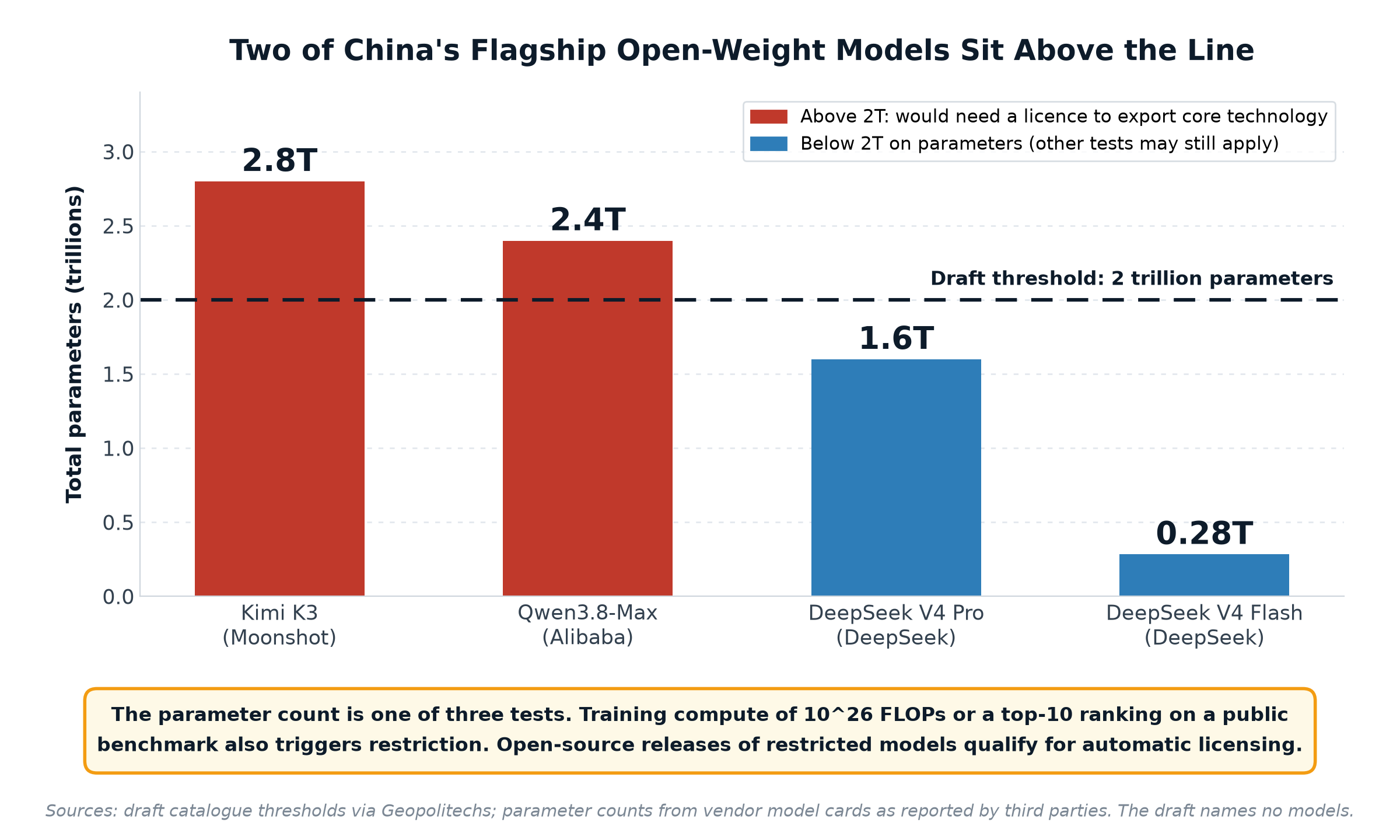
The draft names no models. On parameter counts reported by the vendors and third-party trackers, Moonshot’s Kimi K3 at roughly 2.8 trillion and Alibaba’s Qwen3.8-Max at roughly 2.4 trillion exceed the 2 trillion line. DeepSeek’s V4 Pro, at roughly 1.6 to 1.7 trillion, sits below it. All three are mixture-of-experts models whose active parameters are a small fraction of the total, and the draft counts total parameters.
The parameter test is the easiest to read and the least decisive. A model below 2 trillion parameters can still be caught by the compute test or by the top-10 ranking test, and the ranking test is the one trade lawyers are most concerned about: rankings move, benchmarks multiply, and a company must classify itself. One analyst reading the draft proposed that a reference list or a good-faith safe harbour would matter more in practice than the simplified licence.
For the models already released, the practical effect is limited. Their weights are public and therefore excluded. The question is the next release. A Chinese lab that wants to open-source its next frontier model would, under the draft, file a notification and proceed. A lab that wants to license that model’s weights privately to a foreign cloud provider, or sell a controlling stake to a foreign investor, would need a licence.
The Mirror: Six Years of Reciprocal Controls
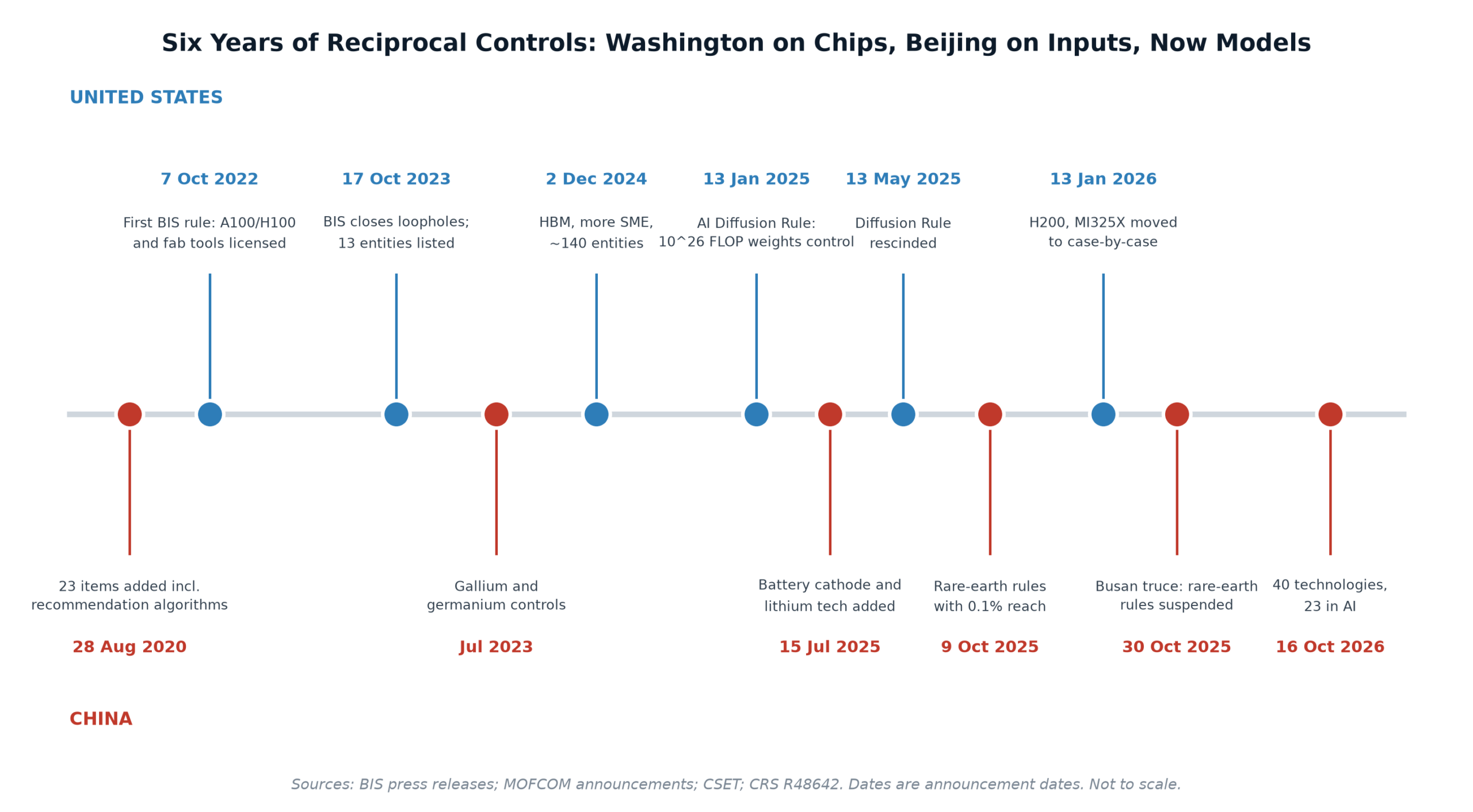
The US side of the ledger is the better known. The Bureau of Industry and Security’s October 2022 rule placed Nvidia’s A100 and H100 and advanced-node fabrication tools under licence. October 2023 closed the China-specific variants and added 13 entities. December 2024 added high-bandwidth memory, more equipment and roughly 140 entities. In January 2025 the AI Diffusion Rule created a control on closed model weights trained above 1026 operations, with licences presumed denied. The new administration rescinded that rule in May 2025, calling it “overly bureaucratic,” and in January 2026 moved the H200 and AMD’s MI325X from presumption of denial to case-by-case review, subject to third-party testing and customer screening. Blackwell-class chips remain under denial.
The Chinese side has been building in parallel, and the October draft is its first move on models rather than inputs. The 2020 catalogue revision, which added 23 items including personalised recommendation algorithms, was widely read as giving Beijing a veto over a forced TikTok sale. Gallium and germanium controls followed in 2023, lithium battery cathode technology in July 2025, and in October 2025 a rare-earth regime with a 0.1 percent de minimis rule reaching foreign-made products. The rare-earth rules were suspended for a year under the Busan truce on 30 October 2025, and the suspension runs to 10 November 2026.
The 1026 threshold is not a coincidence. It is the number the US chose for the model-weight control in the AI Diffusion Rule, and the EU’s AI Act uses 1025 as its systemic-risk presumption. Beijing has adopted the American line for the American instrument, a week after the comment window opened. Where the two regimes differ is direction: the US rule restricted who could receive American weights; the Chinese draft restricts who can receive Chinese ones, while fast-tracking the open-source channel that has given Chinese models their global reach.
Why Open Source Is Protected
The open-source carve-out is the clearest signal of what Beijing is trying to do. Hugging Face’s Spring 2026 report found that Chinese-developed models accounted for 41 percent of downloads on the platform over the preceding year, a plurality ahead of the United States, and that Alibaba’s Qwen family alone has more than 113,000 derivative models, more than Google and Meta combined. That reach was built on free weights. A regime that choked it would surrender the one channel in which Chinese AI leads.
The draft therefore controls the parts of the stack that open weights do not reveal: training optimisation, inference acceleration, cluster orchestration above 10,000 cards, chip-design software, and the agents layer. The Omdia analyst Lian Jye Su told the Associated Press the move “can be seen as a response to Western countries posting sovereignty requirements” on AI and related technologies. The ministry’s own framing is domestic: misuse, critical infrastructure, and keeping AI “under human control.” Both readings fit the text.
The Timing
The draft arrived 22 days after Treasury Secretary Scott Bessent announced, as Xi Jinping began a state visit to Washington, that the trade truce due to expire in November would run to 10 January 2027. The truce carries forward the Busan terms: lower tariffs than would otherwise apply, the rare-earth suspension, and Chinese commitments on soybeans and fentanyl precursors. China has since confirmed that the first bilateral AI talks have taken place. On the chip side, Nvidia’s latest guidance assumes no data-centre revenue from China, and Beijing had not formally approved H200 imports despite US clearance for more than ten Chinese buyers.
Wendy Cutler of the Asia Society Policy Institute, a former US trade negotiator, told The National that the truce’s fragility “cannot be overstated” and that a US response is “only a matter of time.” Leonhard Xu of the Berlin consultancy Sinolytics called the announcement “extremely expansive” while noting that export control “is usually not an export ban.” Both are consistent with the text: the draft is broad in registration and narrow in prohibition.
What This Means for Companies
Chinese AI labs keep the open-source channel and gain a compliance step. The cost is self-classification against moving benchmarks and a notification before each release. The risk is the ranking test, which could capture a model that neither the compute nor the parameter test would.
Foreign cloud and enterprise buyers can keep calling Chinese models through APIs and keep downloading public weights. Private licensing of restricted weights, and on-premises deployment of them outside China, now need a licence or an automatic-track filing.
Investors and acquirers face the broadest new exposure. A transaction that moves ownership or actual control of a Chinese AI, biotech or solar technology owner to a foreign entity triggers registration today, whether or not any technology moves. Deals in progress are included.
US policymakers now face a counterpart regime using their own thresholds. The AI Diffusion Rule sits in what one analysis called “regulatory purgatory,” rescinded in announcement but never formally replaced. Beijing’s draft, if finalised, will be a live control on the same class of technology.
What This Analysis Does Not Establish
The final text. This is a draft. The comment window runs to 15 November and the ministry has said it is consulting on scope, thresholds, control measures and facilitation. The 2025 revision changed between draft and final.
The detailed thresholds. The spokesperson statement and Xinhua give the counts and named examples but not the numeric triggers. The 1026, 2-trillion, top-10, agent and cluster figures come from a trade-law analysis of the annex. They are consistent across the secondary coverage but should be checked against the official annex before any compliance decision.
Model parameter counts. Kimi K3, Qwen3.8-Max and DeepSeek V4 figures are vendor-reported and relayed by third-party trackers that do not fully agree on active-parameter counts. The total counts, which the draft uses, are consistent.
Intent. The ministry says the revision is routine and not aimed at any country. Analysts read it as a response to Western controls. The text supports both, and this report does not choose between them.
Two claims in circulation that this report does not use. A figure of $30 billion in tariff cuts attached to the September truce appears in one outlet and could not be verified against the Treasury announcement. A report that Washington is holding off on blacklisting DeepSeek appeared in a single wire headline without a confirmed source.
What to Watch
- 15 November. Comments close. Watch whether the ranking test survives, whether a reference list of covered models appears, and whether the agent thresholds are tightened or loosened.
- 10 November. The rare-earth suspension expires five days earlier. Whether Beijing extends it is the first test of the truce’s durability before the AI rules are final.
- The next frontier release from a Chinese lab. If it is open-sourced with a notification and no delay, the automatic track works as described. If it is delayed or released closed, the regime is biting harder than the ministry says.
- A US response. Cutler expects one. The forms available are a revived model-weight control, new entity listings, or changes to the January case-by-case policy.
- 10 January 2027. The truce expires. Both sides have said they want the presidents to meet before then.
Conclusion
Beijing’s draft is the first Chinese export control aimed at AI models rather than the minerals and components beneath them. It borrows Washington’s compute threshold, adds a parameter test and a ranking test, and protects the open-source channel that has made Chinese models the most downloaded in the world. It prohibits little, licenses much, and registers everything, including deals that move no technology at all.
Read against the US record since 2022, it completes a symmetry that was missing: both governments now claim the right to decide who may receive their frontier models. Read against the truce, it is a test of whether that symmetry can coexist with a trade settlement that both sides say they want to keep. The answer will be visible by 15 November in the final text, and by 10 January in whether the truce survives it.
Sources
Official
Ministry of Commerce of the PRC, spokesperson statement on revising the Catalogue of Technologies Prohibited and Restricted from Export, 16 October 2026 (Chinese). https://www.mofcom.gov.cn/syxwfb/art/2026/art_a4acff07e134447fbe7bbeb486df3ea6.html
Xinhua, “Ministry of Commerce explains the revision of the Catalogue,” 16 October 2026 (Chinese), including the 40/14/26 and 23/12/5 counts and named examples. https://www.news.cn/20261016/1a2537e95a6148c896e4c7543f48ceb3/c.html; Xinhua on the public comment period, 16 October to 15 November. https://www.news.cn/fortune/20261016/a36da321bae240ce896803485f9a52cb/c.html
US Bureau of Industry and Security, “Department of Commerce Revises License Review Policy for Semiconductors Exported to China,” 13 January 2026. https://www.bis.gov/press-release/department-commerce-revises-license-review-policy-semiconductors-exported-china; BIS press releases of 7 October 2022, 17 October 2023 and 2 December 2024 on advanced computing and semiconductor manufacturing equipment.
Congressional Research Service, R48642, “U.S. Export Controls and China: Advanced Semiconductors.” https://www.congress.gov/crs-product/R48642; CSET, “Revisions to the Content of the Catalog of Prohibited or Restricted Technology Exports” (translation of the 2020 revision). https://cset.georgetown.edu/publication/revisions-to-the-content-of-the-catalog-of-prohibited-or-restricted-technology-exports/
Hugging Face, “State of Open Source on Hugging Face: Spring 2026.” https://huggingface.co/blog/huggingface/state-of-os-hf-spring-2026
Legal and policy analysis
Geopolitechs, “China’s Proposed AI Export Controls and New Temporary Export Registration Requirements: Initial Thoughts,” October 2026 (source for the numeric thresholds in the annex). https://www.geopolitechs.org/p/chinas-proposed-ai-export-controls; Morrison Foerster on the AI Diffusion Rule and ECCN 4E091, February 2025; Wiley and Freshfields on the May 2025 rescission.
Press
Associated Press via PBS NewsHour, “China says it will curb tech exports, including AI, citing national security risks,” 16 October 2026 (Lian Jye Su and Gary Ng quotes). https://www.pbs.org/newshour/world/china-says-it-will-curb-tech-exports-including-ai-citing-national-security-risks; Bloomberg via Taipei Times, 17 October 2026. https://www.taipeitimes.com/News/biz/archives/2026/10/17/2003866098; The National, 16 October 2026 (Cutler, Xu and Peng quotes). https://www.thenationalnews.com/future/technology/2026/10/16/china-targets-ai-technology-exports-with-new-controls-as-us-trade-truce-frays/; CNBC, “U.S.-China trade truce extended for two months, Bessent says,” 24 September 2026. https://www.cnbc.com/2026/09/24/us-china-trade-truce-bessent-trump-xi.html; CNBC, “China suspends some critical mineral export curbs,” 10 November 2025. https://www.cnbc.com/2025/11/10/china-suspends-some-critical-mineral-export-curbs-to-the-us-as-trade-truce-takes-hold.html; MLex on Nvidia’s China outlook, May 2026.
Model parameter counts: vendor model cards as relayed by DeepInfra, Kingy AI and Wikipedia entries for Qwen and Kimi.