
Executive Summary
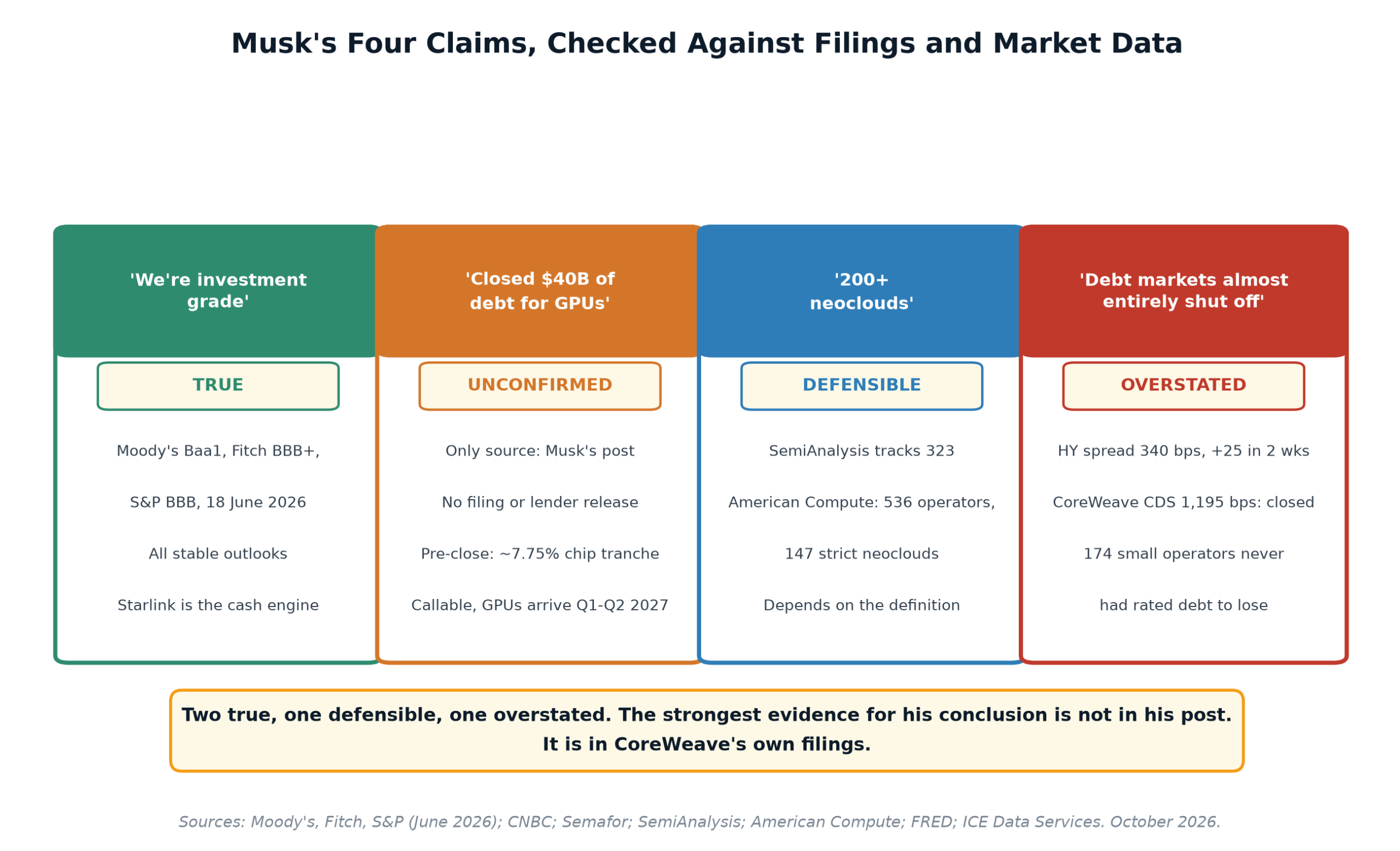
On 25 October, Elon Musk replied “Pretty much” to a post by Chamath Palihapitiya calling neoclouds “disorganized and poorly capitalized,” and added four claims of his own: debt markets have “almost entirely shut off” to companies without substantial non-AI revenue; SpaceX closed $40 billion of debt for GPUs; it could do so because it is investment grade with Starlink and launch revenue; and the “200+ neoclouds” face “guppy-level death and consolidation.”
Tested against primary sources, the four claims score two true, one defensible, and one overstated. SpaceX’s investment-grade ratings are documented. The $40 billion close rests on Musk’s post alone. The neocloud count is defensible under any broad definition. The claim that debt markets have shut is overstated for the market, where the high-yield spread widened 25 basis points in two weeks, and accurate only for the largest pure-play neocloud, whose credit default swaps hit a record 1,195 basis points, and for the long tail of operators that never had rated debt to lose.
The forecast of mass consolidation is shared by Gartner and by Crusoe’s own chief executive. No neocloud of scale has failed or been acquired as of this writing. Sector revenue is growing faster than almost any other in technology, and GPU rental prices rose through 2026. The problem the filings reveal is not demand. It is that the largest independent operator’s interest bill now exceeds its adjusted operating income by five times, and the gap is guided to persist.
This analysis draws on SEC filings from CoreWeave, Nvidia and Nebius, Federal Reserve credit-spread data, rating-agency announcements and the posts as published on X. The author’s views are his own and he holds no position in any company named.
The Exchange
Musk’s post was a reply in a thread that began with his own remark that “we’re going to see a lot of stranded compute in partially complete data centers.” Palihapitiya, who said he was speaking “as someone with a portfolio of energized land assets,” replied that neoclouds are “disorganized and poorly capitalized. Some are definitely better than others however,” that hyperscalers “take 3 months to do an NDA,” and that 2027 “will be a turbulent year because it will clear out a bunch of wrong/bad bets. It will also be a consolidation year for a few.”
Both men have positions. Palihapitiya sells energized land to the operators he is describing. Musk runs a company that just borrowed to buy the same GPUs neoclouds rent out, and clarified in a later reply that “SpaceX is not buying any neoclouds. Pointless.” Neither disclosure makes the claims wrong. Both mean the claims should be checked.
Claim One: Debt Markets Have “Almost Entirely Shut Off”
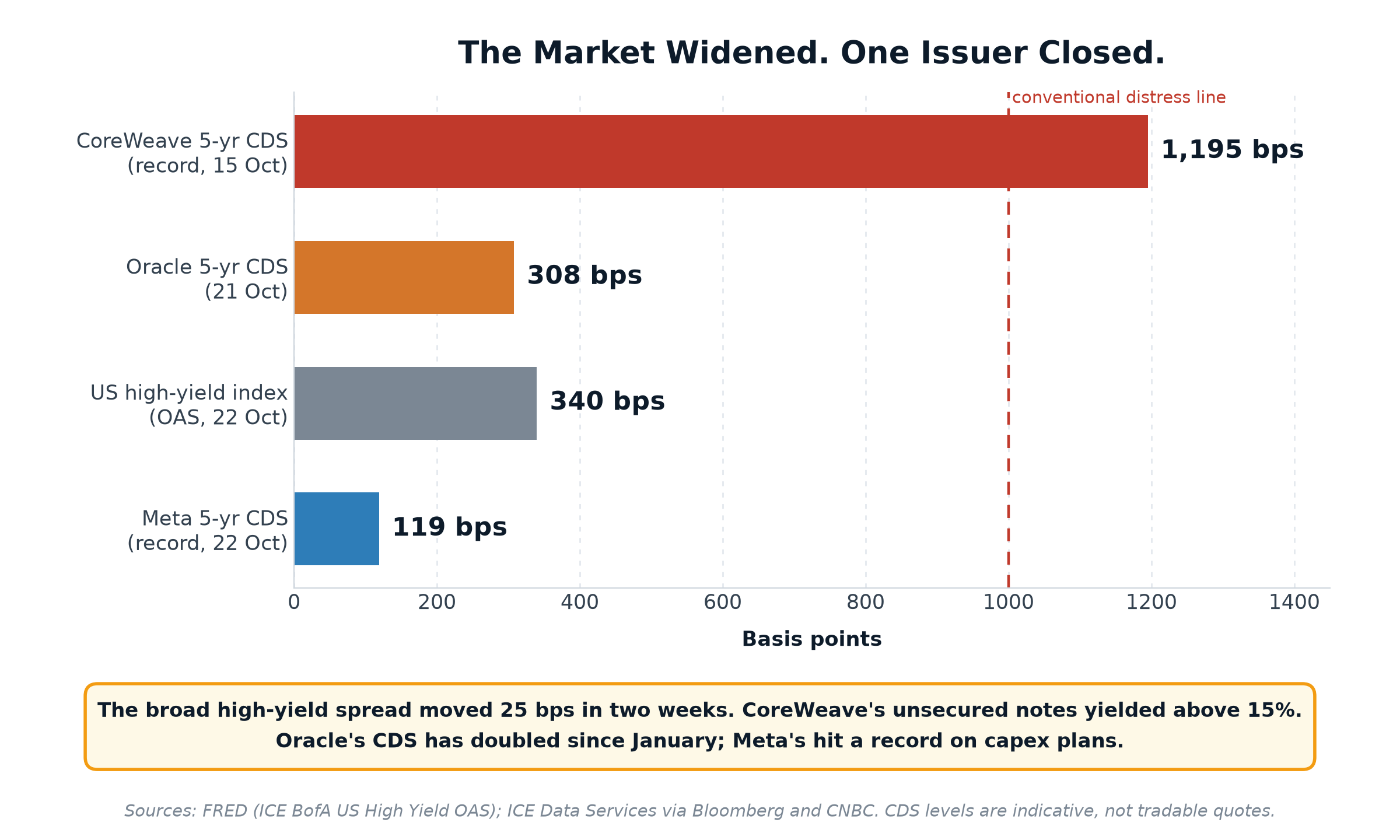
What the broad market shows. The ICE BofA US High Yield Option-Adjusted Spread, the standard measure of what below-investment-grade borrowers pay over Treasuries, was 340 basis points on 22 October, up from 315 on 8 October. That is a two-week widening of 25 basis points. It is not a closed market. Penn Mutual Asset Management’s August analysis found that high-yield data-centre bonds, which traded 220 basis points wide of the broad index in December 2025, had compressed to almost no premium by mid-2026 and only began widening again in late July. Hyperscaler bond issuance this year is reported near $220 billion, and SpaceX’s own $20 billion June bond drew close to $85 billion in orders.
What the top of the neocloud sector shows. CoreWeave’s five-year credit default swaps reached a record intraday 1,195 basis points on 15 October, per ICE Data Services, a level conventionally read as distress. Its 2031 and 2032 unsecured notes traded to yields above 15 percent before settling near 14.5 percent. Nebius announced a Citi facility on 22 October that matures in under a year, which management described as a bridge ahead of longer-term asset-backed borrowing; the shares fell 6 percent on the news. CoreWeave, Nebius and IREN each lost more than 30 percent of their market value in October. For the week ended 19 October, CoreWeave fell 23.9 percent and Nebius 19.0 percent.
What the middle shows. American Compute’s 15 October census of 536 GPU cloud operators found that 63 disclose equity raised, totalling $16 billion, with a median raise of $26 million. Ten operators hold 87 percent of that. The report identifies 174 GPU-native operators with between 11 and 200 employees as “too small for rated loans or bonds.” For that group, Musk’s description was true before October and remains true now. The market did not shut on them. It never opened.
Verdict. The accurate version of the claim is that unsecured debt has repriced to distressed levels for the largest pure-play neocloud, secured GPU-backed lending continues at a premium for operators with contracted revenue, and the long tail is funded by equity or not at all. “Almost entirely shut off” describes the first and third groups. It does not describe the broad credit market, where spreads moved 25 basis points in a fortnight.
Claim Two: SpaceX Closed $40 Billion of Debt for GPUs
Musk wrote that SpaceX “closed $40B of debt for GPUs” and, in a reply, that it is “primarily callable debt for GPU purchases that will arrive in Q1 and Q2. Not a major factor this quarter.” A person familiar with the talks told CNBC the debt would likely use the GPUs as collateral, with Apollo in a leading role. Semafor’s pre-close reporting put the chip-backed portion near 7.75 percent and the lowest-rated portion near 8.3 percent.
No press release, Form 8-K, or lender statement confirming the close has been found. The figure is Musk’s. Two points follow if it is accurate. First, SpaceX would have borrowed at a rate within roughly a point of what secondary reports attribute to CoreWeave’s GPU-backed facilities, which weakens the implication that investment-grade status transforms the cost of chip finance. Second, S&P’s rating rationale in June projected negative free cash flow through 2029 and leverage peaking at 1.2 times in 2028, and Oppenheimer projected net debt above $400 billion by 2031 if AI spending continues at the current pace. SpaceX’s access to credit rests on Starlink, which Moody’s named as the primary cash-flow generator. It does not rest on AI revenue, which is Musk’s point and also the reason the comparison with neoclouds is not a comparison between two AI businesses.
Claim Three: Investment Grade
True and documented. On 18 June 2026, less than a week after the IPO, Moody’s assigned Baa1, Fitch BBB+ and S&P BBB, all with stable outlooks. Fitch cited launch dominance, with SpaceX carrying more than 80 percent of global mass to orbit since 2023. Moody’s flagged the capital demands of the AI build-out and dependence on Starship V3. The ratings sit one to three notches above the lowest investment-grade rung.
Claim Four: 200-Plus Neoclouds and “Guppy-Level Death”
The count. There is no agreed definition. SemiAnalysis’s ClusterMAX 3.0 tracks 323 GPU cloud providers, up from 209 in the prior edition and 169 before that. American Compute counts 536 operators in 45 countries, of which 399 are GPU-native and 147 are neoclouds in the narrow sense; 231 are classified as GPU cloud and bare-metal operators, 64 as sovereign AI clouds, 25 as bitcoin miners pivoting to AI. Musk’s “200+” sits inside every broad count and above the strict one.
| Source | Definition | Count |
|---|---|---|
| American Compute, Oct 2026 | Neoclouds, strict sense | 147 |
| SemiAnalysis ClusterMAX 2.0 | GPU cloud providers tracked | 209 |
| SemiAnalysis ClusterMAX 3.0 | GPU cloud providers tracked | 323 |
| American Compute, Oct 2026 | GPU-native operators | 399 |
| American Compute, Oct 2026 | All GPU cloud operators, 45 countries | 536 |
The forecast. Gartner’s chief forecaster John Lovelock said on 20 October that more than 80 percent of independent neoclouds “will stop operating independently by 2030,” adding: “We are not saying that these companies are going out of business.” His reasoning is a return hurdle. An AI server asset base needs enough cash flow to earn 18 percent on invested capital; Lovelock does not expect simple-model neocloud revenue to reach that until 2032, while GPUs depreciate and borrowing costs accrue. Crusoe’s chief executive has said the sector will consolidate into a handful of large operators. Nebius executives have said in interviews that they expect to be acquirers.
The record. No neocloud of scale has filed for bankruptcy or been acquired in 2026. Lambda closed a Series E above $1.5 billion in November 2025 and a $1 billion secured facility in May 2026 and is preparing an IPO. The consolidation Musk predicts is a forecast endorsed by analysts and some operators. It has not started.
Verdict. The count is defensible. The forecast is widely shared and not yet evidenced. “Guppy-level death” is a colourful phrasing of Gartner’s “cease independent operations,” which Gartner itself says means mergers more than failures.
What the Filings Actually Show
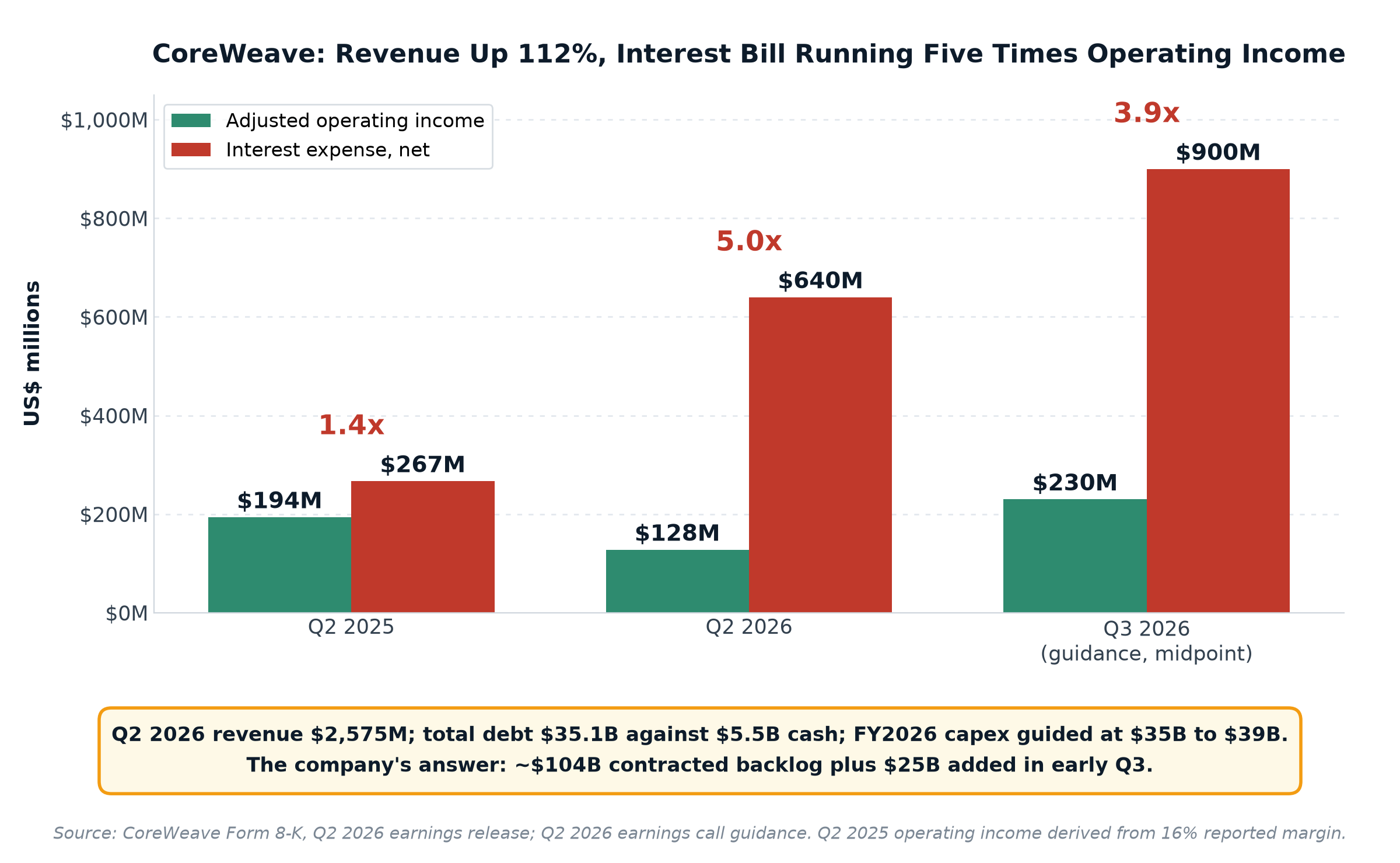
The strongest evidence for stress is not in Musk’s post. It is in CoreWeave’s own Form 8-K for the second quarter and the guidance given on its earnings call.
| CoreWeave | Q2 2025 | Q2 2026 | Q3 2026 guidance |
|---|---|---|---|
| Revenue | $1,212M | $2,575M (+112%) | $3,450M to $3,600M |
| Adjusted EBITDA margin | 62% | 59% | n/a |
| Adjusted operating income | ~$194M (16%) | $128M (5%) | $200M to $260M |
| Interest expense, net | $267M | $640M | $860M to $940M |
| Net loss | n/a | $(626)M | n/a |
| Capital expenditure | n/a | $6,422M | $11,500M to $13,500M |
Interest expense exceeded adjusted operating income by five times in the second quarter and is guided to exceed it by roughly four times in the third. Full-year guidance calls for $12.4 billion to $13.2 billion of revenue, $960 million to $1.15 billion of adjusted operating income, and $35 billion to $39 billion of capital expenditure. Total debt at 30 June was $35.1 billion, of which $31.4 billion is recourse, against $5.5 billion of cash. The company’s answer is its backlog: approximately $104 billion at 30 June plus more than $25 billion of net new commitments in the early weeks of the third quarter, which management says more than covers its obligations. It also says it has cut its average cost of debt by almost 300 basis points, saving about $1.1 billion a year.
Nebius, the second-largest listed pure play, reported second-quarter revenue of $582 million, up 454 percent, an annualised run rate of $3 billion, and an adjusted EBITDA margin of 41 percent. It reaffirmed 2026 capital expenditure of $20 billion to $25 billion against roughly $8 billion of cash and about $10 billion of convertible debt. It says customer prepayments will exceed $9 billion this year.
The demand side is not in dispute. Synergy Research puts 2025 neocloud revenue above $25 billion, with the fourth quarter at $9 billion, up 223 percent. Silicon Data’s H100 rental index rose from $2.00 an hour in December 2025 to $2.88 in late October 2026. CoreWeave raised prices about 25 percent in July. Nebius’s first capacity auction cleared 15 percent above its previous high. Jensen Huang said this month that “the demand of the capital is much greater than the availability of the capital.” That sentence, from the sector’s largest supplier and financier, is the most precise statement of the problem: the constraint is funding, not customers.
Nvidia’s Position
Nvidia’s Form 10-Q for the quarter ended 26 July 2026 lists $36 billion of future commitments under “AI cloud agreements,” phased from $6 billion in fiscal 2028 to $9 billion in 2032 and beyond, plus $20 billion of data-centre leases not yet commenced, for $56 billion of total commitments. The filing says Nvidia has “entered into arrangements to assist select customers with securing the land, power, shell, and data center capacity needed to support their growth” and warns that these commitments “are dependent on the performance of our customers and partners.” The best-known is the agreement to buy up to $6.3 billion of CoreWeave capacity through April 2032 if no other taker is found, alongside an equity stake reported at 10 to 13 percent after a $2 billion addition in January.
CNBC has reported Nvidia’s total exposure to AI cloud providers at roughly $171.5 billion, comprising $7 billion of direct investment and $164.5 billion of guarantees and commitments. That figure is far larger than the $36 billion in the 10-Q and the gap is not explained in the reporting. This analysis uses the filed number and notes the discrepancy.
What This Analysis Does Not Establish
That SpaceX’s $40 billion closed on the terms described. The only source is Musk. Rates are from pre-close reporting.
CoreWeave’s current debt. Figures in circulation range from $35.6 billion to $51.6 billion. The $35.1 billion carrying value is from the 30 June balance sheet in the 8-K and excludes leases. The 12 November report will update it.
The split of CoreWeave’s debt between GPU-backed and unsecured, or the rate on the secured portion. The 80 percent and 9 percent figures appear in secondary coverage only.
That consolidation is under way. It is forecast. No transaction evidences it.
Who the “ONE” exception is in Palihapitiya’s post. He did not say.
What to Watch
- 12 November. CoreWeave’s third-quarter report. The numbers to read are interest expense against adjusted operating income, backlog conversion, and any change in the cost of debt.
- Nebius’s term-out. The Citi bridge matures in under a year. Whether it is replaced by long-dated asset-backed debt, and at what rate, is the cleanest test of whether the secured market is open.
- A SpaceX filing. An 8-K or lender announcement would confirm the $40 billion and its terms.
- The first transaction. A distressed sale, a merger, or a lender taking GPUs as collateral would move consolidation from forecast to fact.
- The H100 index. If rental prices keep rising, the demand case holds and the problem is purely balance-sheet. If they turn, the sector has two problems.
Conclusion
Musk’s post was right about his own company and directionally right about the bottom of the neocloud market. It was wrong about the credit market as a whole, which has widened, not closed, and it stated as fact a consolidation that analysts forecast and no transaction yet shows. The strongest evidence for his conclusion is not in his post but in CoreWeave’s filings, where a company growing revenue at 112 percent a year is guided to pay four times its adjusted operating income in interest next quarter.
That is a solvable problem for a company with $129 billion of contracted backlog and a supplier willing to guarantee $6.3 billion of its capacity. It is not solvable for the 174 operators too small to be rated. The shakeout, if it comes, will not be a guppy-level death. It will be an acquisition cycle in which the operators with contracted revenue and secured lenders buy the ones without.
Sources
Elon Musk on X, 25 October 2026. https://x.com/elonmusk/status/2114434646914068862; Chamath Palihapitiya on X, 25 October 2026. https://x.com/chamath/status/2114389987563381004
CoreWeave, Inc., Form 8-K, second-quarter 2026 earnings release. https://www.sec.gov/Archives/edgar/data/0001769628/000176962826000362/coreweave2q26earningspress.htm; Q2 2026 earnings call guidance as reported by Yahoo Finance and 24/7 Wall St.
NVIDIA Corp., Form 10-Q for the quarter ended 26 July 2026. https://www.sec.gov/Archives/edgar/data/0001045810/000104581026000075/nvda-20260726.htm; Nebius Group N.V., Form 6-K, Q2 2026 shareholder letter, 12 August 2026. https://www.sec.gov/Archives/edgar/data/0001513845/000110465926094568/tm2622968d1_ex99-2.htm
Federal Reserve Bank of St. Louis, ICE BofA US High Yield Index Option-Adjusted Spread, 22 October 2026. https://fred.stlouisfed.org/series/bamlh0a0hym2; Penn Mutual Asset Management, AI Infrastructure Bonds: A Full Picture of Spreads, 6 August 2026. https://www.pennmutualam.com/market-insights-news/blogs/chart-of-the-week/2026-08-06-ai-infrastructure-bonds-a-full-picture-of-spreads
American Compute / AC Research, State of the Neoclouds 2026: 536 GPU Cloud Operators, 15 October 2026. https://www.amcompute.com/blog/state-of-the-neoclouds-2026; SemiAnalysis, ClusterMAX 3.0. https://newsletter.semianalysis.com/p/clustermax-30-the-industry-standard
Gartner forecast via Yahoo Finance, 20 October 2026. https://finance.yahoo.com/technology/ai/articles/gartner-80-neocloud-firms-face-134223382.html; SpaceX ratings, Bloomberg via The Spokesman-Review, 18 June 2026. https://www.spokesman.com/stories/2026/jun/18/spacex-gets-investment-grade-ratings-with-stable-o/
CNBC, SpaceX closes $40 billion debt deal for AI chips, Elon Musk says, 26 October 2026. https://www.cnbc.com/2026/10/26/spacex-closes-40-billion-debt-deal-for-ai-chips-elon-musk-.html; CNBC, Turmoil hits AI buildout as neoclouds face pressure, 23 October; Nvidia’s role as AI financier faces first big test, 24 October; Nebius says AI computing prices are rising, 21 October 2026.
Synergy Research via Data Center Dynamics, Neocloud revenue exceeds $25bn in 2025; Silicon Data H100 rental index via FourWeekMBA, October 2026; SiliconANGLE, Elon Musk predicts neocloud shakeout, 25 October 2026. https://siliconangle.com/2026/10/25/elon-musk-predicts-neocloud-shakeout-as-credit-for-ai-infrastructure-dries-up/