
Data centers are leaving Earth. What was science fiction two years ago is now backed by billions in capital, prototype hardware in orbit, and the biggest names in technology.
Executive Summary
The AI boom has created an energy crisis on Earth. U.S. data center electricity consumption grew from 76 TWh in 2018 to 176 TWh in 2023, roughly 4.4% of national electricity use. By 2028, that figure could reach 325 to 580 TWh, or 6.7% to 12% of the entire U.S. grid (Belfer Center, 2026). Grid power demand from data centers alone is forecast to nearly triple to 134.4 GW by 2030 (S&P Global/451 Research, 2025).
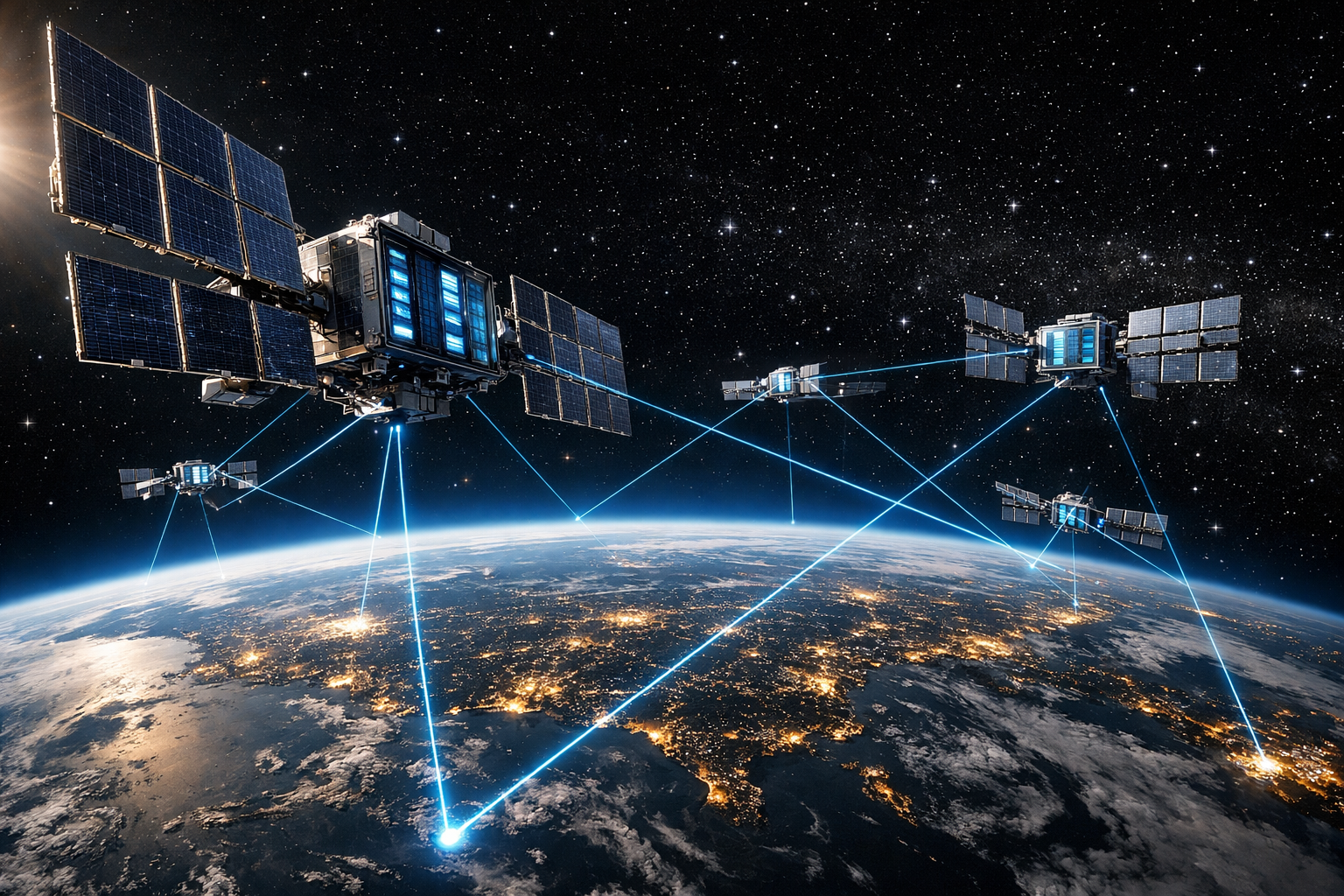
The terrestrial solution has limits: land, water, permitting, community opposition, and finite grid capacity. A growing coalition of companies is pursuing a radical alternative: putting data centers in space, where solar energy is continuous, cooling is passive, and permitting constraints do not exist. This is no longer a thought experiment. In November 2025, the NVIDIA-backed startup Starcloud trained the first AI model in orbit using an H100 GPU (Y Combinator, 2026). SpaceX has filed with the FCC to launch up to 1 million orbital data center satellites (Reuters, 2026). Google’s Project Suncatcher envisions TPU-equipped satellite constellations connected by free-space optical links (Google Research, 2025). And NVIDIA just announced its Space-1 Vera Rubin module at GTC 2026, purpose-built for orbital AI workloads (NVIDIA Newsroom, 2026).
Section 1: Why Earth Is Running Out of Room
The numbers tell the story. Global data center investment hit $61 billion in 2025 (CNBC, 2025), with debt issuance in the sector nearly doubling to $182 billion. Virginia alone requires 12.1 GW of grid power for data centers, and Texas is close behind at 9.7 GW (S&P Global, 2025). The U.S. Energy Information Administration forecasts the strongest four-year growth in electricity demand since 2000, driven primarily by data centers (EIA, 2026).
The bottlenecks are multiplying:
- Energy: AI training and inference workloads consume orders of magnitude more power than traditional computing. Cooling alone accounts for 30 to 40% of a data center’s energy budget.
- Water: Data centers consumed an estimated 7.1 billion liters of water daily in 2024 for cooling, straining communities already facing drought.
- Land and Permitting: Zoning fights, environmental reviews, and community opposition delay construction by months or years. Northern Virginia, the world’s largest data center market, is running out of available land.
- Grid Capacity: Utilities cannot build transmission infrastructure fast enough. In some regions, new data centers face multi-year waits for grid connections.
Space solves all four problems simultaneously. In orbit, solar energy is available 24 hours a day with no atmospheric attenuation. Radiative cooling in the vacuum of space eliminates the need for water. There is no zoning, no community opposition, and no grid to overload.
Section 2: The Major Players
| Company | What They Are Building | Key Milestone | Backing/Partners |
|---|---|---|---|
| SpaceX/xAI | Up to 1 million orbital data center satellites | Filed FCC application; xAI acquired for $1.25 trillion combined entity | SpaceX ($1.5T pre-IPO valuation) |
| Project Suncatcher: TPU-equipped satellite constellations with optical links | Two prototype satellites launching with Planet by early 2027 | Google Research, Planet Labs | |
| NVIDIA | Space-1 Vera Rubin Module, IGX Thor, Jetson Orin for orbital compute | Announced at GTC 2026; 25x more compute than H100 | Axiom Space, Starcloud, Planet |
| Starcloud (YC) | Purpose-built orbital data centers for GPU compute | First AI model trained in orbit (Nov 2025); second satellite launching Oct 2026 | NVIDIA, Crusoe, Y Combinator ($21M seed) |
| Axiom Space | Orbital Data Center nodes on ISS and future Axiom Station | AxDCU-1 deployed on ISS (Fall 2025); 3 ODC nodes by 2027 | Spacebilt, Kepler Space, Skyloom, Microchip Technology |
| Aetherflux | “Galactic Brain” constellation of orbital data center satellites | First commercial node targeted Q1 2027 | Venture-backed |
| China | “Three-Body Computing Constellation” of 2,800 satellites | First 12 satellites launched May 2025; target: 1,000 PFLOPS combined | Chinese government |
Sources: Reuters (2026); Google Research (2025); NVIDIA Newsroom (2026); Y Combinator (2026); Axiom Space (2026); Cutter Consortium (2025).
Section 3: The Economics
The argument for orbital data centers rests on a simple equation: the cost of launching mass into orbit is falling faster than the cost of building energy infrastructure on Earth is rising.
Current launch costs sit at approximately $1,500 to $3,000 per kilogram. For orbital data centers to reach commercial viability, that number needs to drop to $200 to $500 per kilogram (EnkiAI, 2026). SpaceX’s Starship, designed to carry 100 to 150 metric tons to orbit, is the vehicle most likely to achieve this threshold. If Starship reaches its projected per-kilogram costs, the calculus flips: it becomes cheaper to deploy compute in orbit than to build new power plants, transmission lines, and cooling infrastructure on the ground.
Starcloud claims its orbital approach offers 90% lower electricity costs than terrestrial facilities, leveraging continuous solar exposure and passive radiative cooling (Starcloud, 2026). The company expects its second satellite (launching October 2026) to generate more revenue than it costs to build and launch, a breakeven milestone that no orbital computing venture has achieved before.
The terrestrial comparison point is striking. Projected data center CAPEX on Earth is approaching $400 billion (EnkiAI, 2026). Even displacing a fraction of that spend toward orbital solutions represents a market worth tens of billions annually.
Section 4: What Still Needs to Be Solved
Space data centers are real, but they are not ready to replace terrestrial infrastructure at scale. Several engineering and economic challenges remain:
- Thermal Management: In space, there is no convection. Heat can only be dissipated through radiation, which is far slower. Jensen Huang acknowledged this directly at GTC 2026: “In space, there’s no convection, only radiation. We need to devise methods to cool these systems” (CNBC, 2026).
- Latency: Low Earth Orbit satellites at 500 to 2,000 km altitude add measurable latency compared to on-premises compute. This makes orbital data centers well suited for batch training and asynchronous workloads, but less ideal for latency-sensitive real-time inference.
- Bandwidth: Free-space optical links between satellites and ground stations are still maturing. Current capacity tops out around 2.5 Gbps per link, far below the terabits per second that terrestrial data centers handle internally.
- Radiation: Cosmic radiation degrades semiconductor components over time. Google has already begun radiation-testing its TPUs for Project Suncatcher (Google Research, 2025).
- Launch Costs: Until Starship-class vehicles achieve routine commercial service at dramatically lower per-kilogram costs, the economics remain challenging for large-scale deployment.
Section 5: Analysis
The race to put data centers in orbit is not driven by novelty. It is driven by necessity. The terrestrial energy infrastructure cannot scale fast enough to meet AI demand. The numbers are unambiguous: data center power consumption is on track to consume 12% of the U.S. electrical grid by 2028, utilities cannot build transmission lines fast enough, and communities are increasingly blocking new facilities.
The fact that SpaceX, Google, and NVIDIA are all investing real engineering resources into orbital compute means this is past the “interesting research” phase. SpaceX filing for 1 million orbital data center satellites is not a press release. It is an FCC application from a company with the launch capacity to actually execute it. Google deploying prototype TPU satellites with Planet Labs by 2027 is not a white paper. It is a hardware commitment from a company that operates some of the largest data centers on Earth and clearly sees a ceiling approaching.
The timeline is probably longer than the most optimistic projections suggest. Starcloud’s claim that “within 10 years, most new data centers will be built in space” is aspirational. But the directional bet is sound: Earth’s resources are finite, and space’s are not. The companies that solve the thermal management, bandwidth, and launch cost problems will own a market that does not yet have a price tag, because no one has successfully commercialized it. When they do, it will be measured in the hundreds of billions.
For now, the most immediate use cases are processing satellite data in orbit (eliminating the downlink bottleneck), running AI inference for defense and intelligence applications (where latency to ground is acceptable), and training models using solar power that never sets. The first public cloud in space, planned by Starcloud and Crusoe for 2027, will be the real test of whether this market crosses from demonstration to commercial reality.
References
- Axiom Space (2026). “Orbital Data Centers.” Link
- Axiom Space and Spacebilt (2025). “Orbital Data Center Node Aboard International Space Station.” Link
- Belfer Center, Harvard Kennedy School (2026). “AI, Data Centers, and the U.S. Electric Grid.” Link
- CNBC (2025). “Data center deals hit record amid AI funding concerns.” Link
- CNBC (2026). “Nvidia announces Vera Rubin Space-1 for orbital data centers.” Link
- Cutter Consortium (2025). “On-Orbit Data Centers: Mapping the Leaders.” Link
- EnkiAI (2026). “Space-Based AI Data Centers 2026: Winners and Losers Guide.” Link
- Google Research (2025). “Exploring a space-based, scalable AI infrastructure system design.” Link
- NVIDIA Newsroom (2026). “NVIDIA Launches Space Computing, Rocketing AI Into Orbit.” Link
- Reuters (2026). “Musk’s mega-merger of SpaceX and xAI bets on sci-fi future of data centers in space.” Link
- S&P Global/451 Research (2025). “Data center grid-power demand to rise 22% in 2025, nearly triple by 2030.” Link
- Starcloud/Y Combinator (2026). “Starcloud: Data Centers in Space.” Link
- U.S. Energy Information Administration (2026). “Strongest four-year growth in U.S. electricity demand since 2000.” Link