
Executive Summary
The United States has committed more capital to artificial intelligence infrastructure than to any single industrial buildout since the interstate highway system. The Electric Reliability Council of Texas alone had 233 gigawatts of large-load interconnection requests in its queue at the end of 2025, more than 70 percent from data centers, a nearly 300 percent increase from a year earlier. The record all-time peak demand for the entire ERCOT grid is 85.5 gigawatts (Utility Dive, 2026; Electric Reliability Council of Texas, 2023).
Building those data centers requires electricians, plumbers, pipefitters, and heating and cooling technicians. The Bureau of Labor Statistics counts 818,700 employed electricians and projects a 9 percent increase over the decade ending 2034. Fortune, drawing on the International Brotherhood of Electrical Workers and industry analysis, reports the AI buildout alone requires more than 300,000 additional electricians during the same period (U.S. Bureau of Labor Statistics, 2025a; Fortune, 2026a).
Key finding. The AI economy has the capital to expand and the compute to grow. It does not have the wires. Skilled trades wages have already pushed above the national median as builders bid up scarce labor, and the shortage is on track to widen through the late 2020s. This report presents primary-source data and flags where industry estimates exceed what federal statistics confirm.
A twenty-year retirement wave is colliding with the largest single industrial buildout in a generation. Federal wage data, ERCOT interconnection filings, and trade-group forecasts all point to the same constraint: not chips, not money, but the people who install them.
On January 21, 2026, Nvidia chief executive Jensen Huang sat with BlackRock chief executive Larry Fink at the World Economic Forum in Davos and named the trades that would benefit most from the AI boom. In the same conversation, Huang told Fink that the buildout would demand “plumbers and electricians and construction and steel workers and network technicians,” and that these jobs would command six-figure salaries for people building chip factories, computer factories, and AI factories (Bloomberg, 2026; NVIDIA, 2026). In an earlier interview with Channel 4 News in September 2025, Huang had put the point more bluntly: the AI economy would need hundreds of thousands of tradespeople to build these factories (Fortune, 2025).
Two months later, Fortune reported that Darrell West, a senior fellow at the Brookings Center for Technology Innovation, described the electrician shortage as “quite dire” and “a leading barrier to data center construction.” The International Brotherhood of Electrical Workers estimates that electrical work accounts for 45 to 70 percent of total data center construction cost (Fortune, 2026a).
Those two data points frame the analysis that follows. The industry with the most capital in the U.S. economy is dependent on the trade in the shortest structural supply. This report examines what the federal statistics actually show, what industry forecasts add, and where the gap between the two matters.
The Federal Baseline
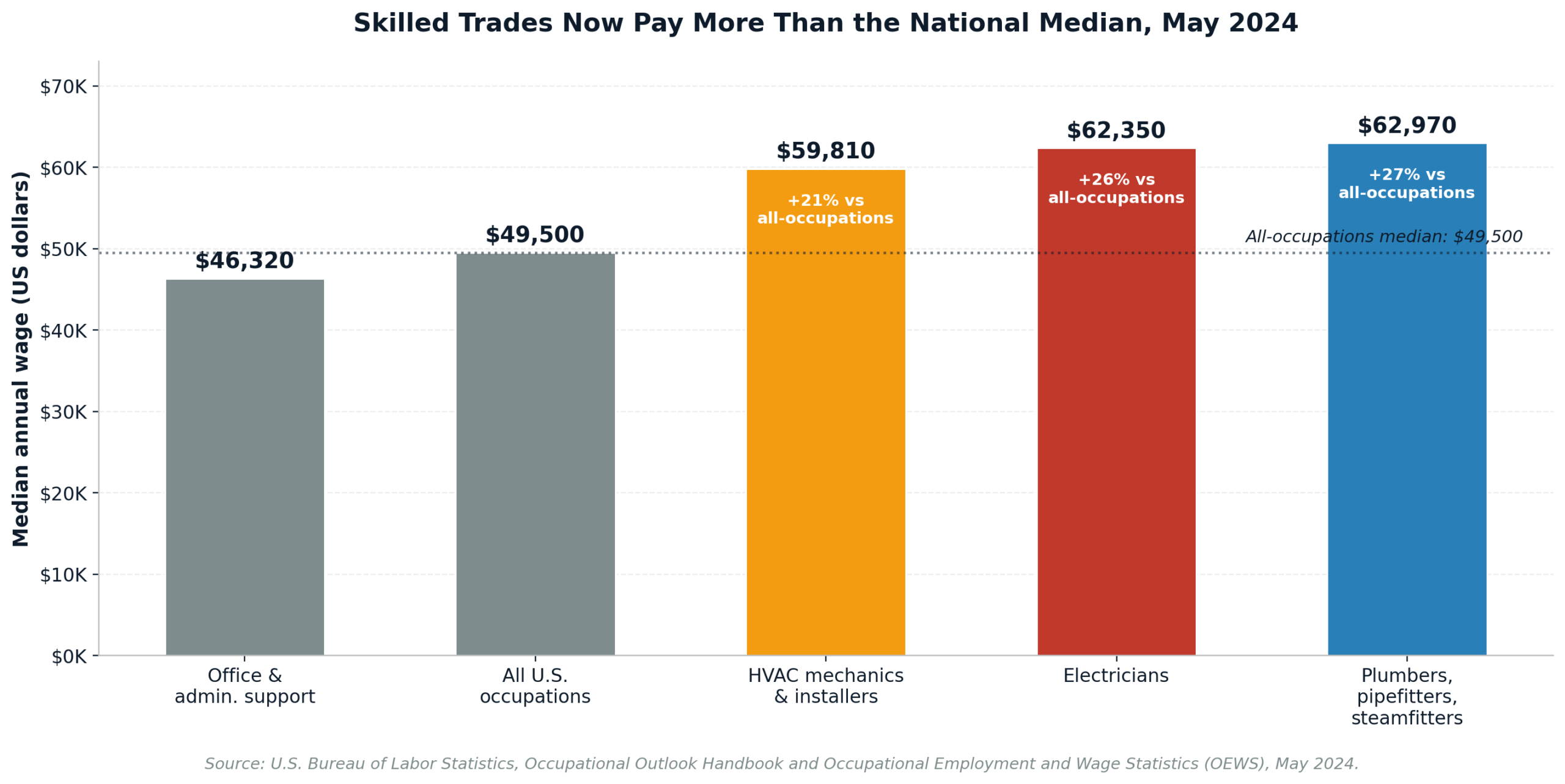
The Bureau of Labor Statistics publishes the definitive federal count of U.S. workers by occupation. Its Occupational Outlook Handbook, updated August 2025 using May 2024 wage data, shows the following for the three trades most directly tied to construction and infrastructure (U.S. Bureau of Labor Statistics, 2025a, 2025b, 2025c):
| Occupation | Median wage, May 2024 | Employed | Projected growth 2024-2034 |
|---|---|---|---|
| Electricians | $62,350 | 818,700 | 9 percent |
| Plumbers, pipefitters, steamfitters | $62,970 | 504,500 | 4 percent |
| HVAC mechanics and installers | $59,810 | 425,200 | 8 percent |
| All U.S. occupations (reference) | $49,500 | 170.0 million | n/a |
All three trades pay above the U.S. median wage. Electricians earn 26 percent more than the average U.S. worker. Plumbers and pipefitters earn 27 percent more. HVAC installers earn 21 percent more. Office and administrative support occupations, the largest single occupational group in the country at 19.3 million workers, have a median wage of $46,320, roughly $16,000 below electricians (U.S. Bureau of Labor Statistics, 2025d, 2025e).
BLS projects about 81,000 electrician openings per year through 2034, driven both by growth and by workers leaving the field or retiring. Multiplied over the decade, that is 810,000 openings. The projected net new employment growth, at 9 percent applied to the current 818,700-worker base, works out to roughly 73,700 additional electricians on top of replacement (U.S. Bureau of Labor Statistics, 2025a). Whether that will be enough to keep pace with AI infrastructure is the central question.
The Load Queue That Needs Wiring
The clearest single data point on how big the AI buildout has become comes from Texas. On December 9, 2025, Kristi Hobbs, vice president of system planning and weatherization at ERCOT, told the grid operator’s board that new interconnection requests had reached 233 gigawatts, up almost 300 percent from a year earlier. More than 70 percent of that queue came from data centers. ERCOT had received 225 new large-load requests over the course of 2025 through mid-November, compared with 152 requests across all of 2022 through 2024 combined (Utility Dive, 2026; Electric Reliability Council of Texas, 2025).
For context, ERCOT’s official all-time peak system demand is 85,508 megawatts, set on August 10, 2023 (Electric Reliability Council of Texas, 2023). The interconnection queue that emerged in 2025 is therefore roughly 2.7 times larger than the entire load Texas has ever consumed at one moment. Every megawatt of that new demand requires transformers, switchgear, cable trays, conduit, cooling loops, and the technicians who install them.
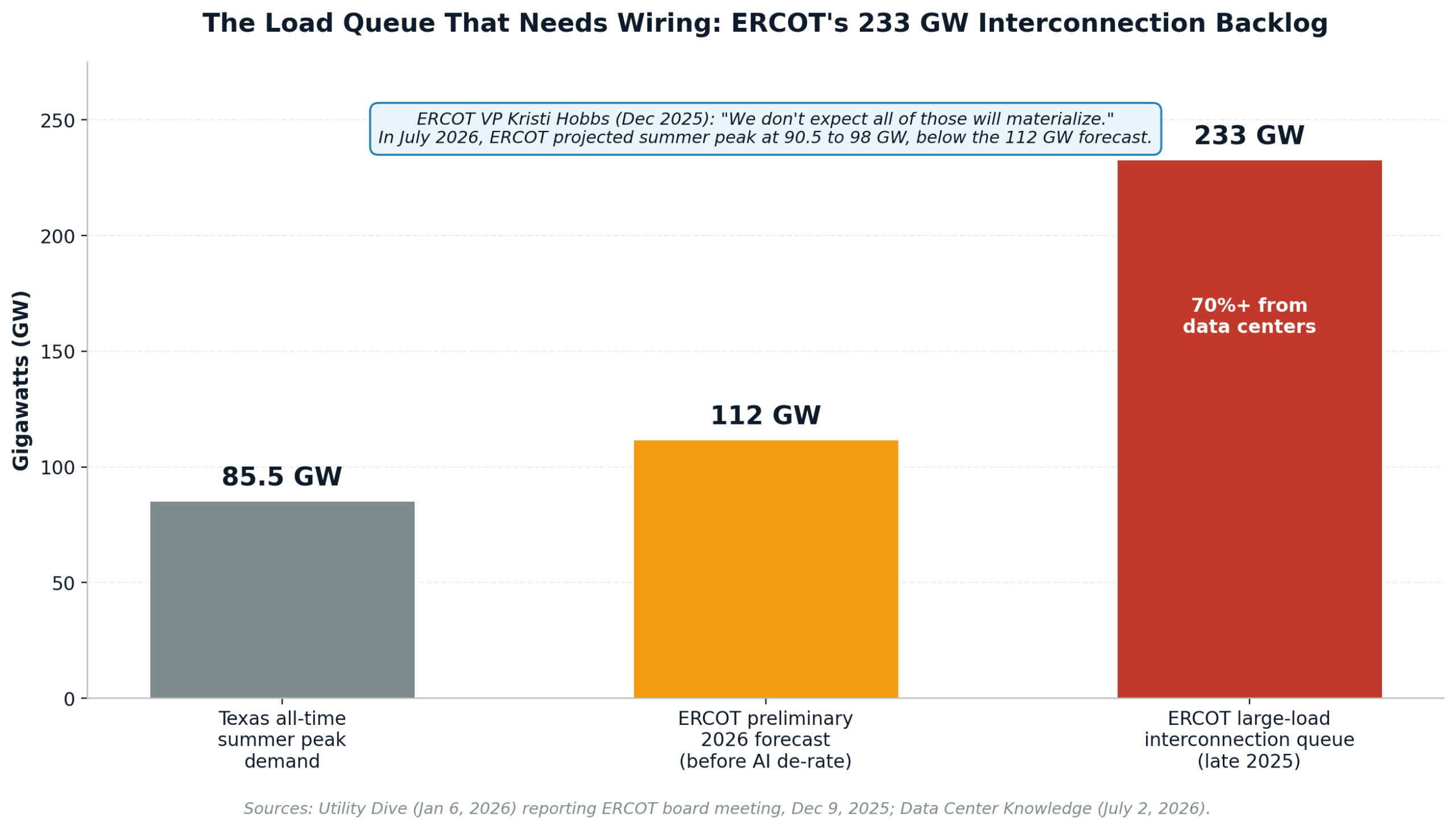
Not all of that queue will materialize. Hobbs herself said in the same December meeting that “we don’t expect all of those will materialize, so it’s very important to get those load forecasting and standardization rules in place” (Utility Dive, 2026). On May 14, 2026, Data Center Knowledge reported that ERCOT had lowered its summer 2026 peak-demand forecast to a range of 90.5 to 98 gigawatts, below the preliminary 112 gigawatt figure embedded in the long-term forecast (Data Center Knowledge, 2026). The interconnection queue is a ceiling, not a certainty. Even at half its stated size, the buildout would still require a labor pipeline that does not currently exist.
The economic context. Supercomputing News reported in June 2026 that data center construction cost rose from $7.7 million per megawatt in 2020 to $10.7 million in 2025, roughly a 7 percent compound annual rate, with another 6 percent rise forecast for 2026 (Supercomputing News, 2026). The single largest line item is electrical work. When the electrical trade is in shortage, project delays and cost escalation are the mechanism by which the labor market transmits its constraint to the AI economy.
The Retirement Cliff
The supply-side story is not only about not enough new entrants. It is about retirements. A January 2026 analysis by Associated Builders and Contractors, a national construction trade association, concluded that the U.S. construction industry needs to attract 349,000 net new workers in 2026 and 456,000 net new workers in 2027 to meet expected demand for construction services. ABC chief economist Anirban Basu attributed the majority of the 2026 demand not to project growth but to retirements of supervisors, foremen, and craft professionals (Associated Builders and Contractors, 2026; ABC Carolinas, 2026).
A separate analysis by JLL, the commercial real estate services firm, projects that 2.1 million U.S. skilled trades positions could go unfilled by 2030, with potential annual economic losses reaching $1 trillion. JLL cites U.S. Department of Education estimates for the underlying figure. In 2025, JLL reports, nearly 600,000 skilled trades jobs were posted, while only about 150,000 new workers entered the labor pool through apprenticeship programs (Fortune, 2026b; JLL, 2026).
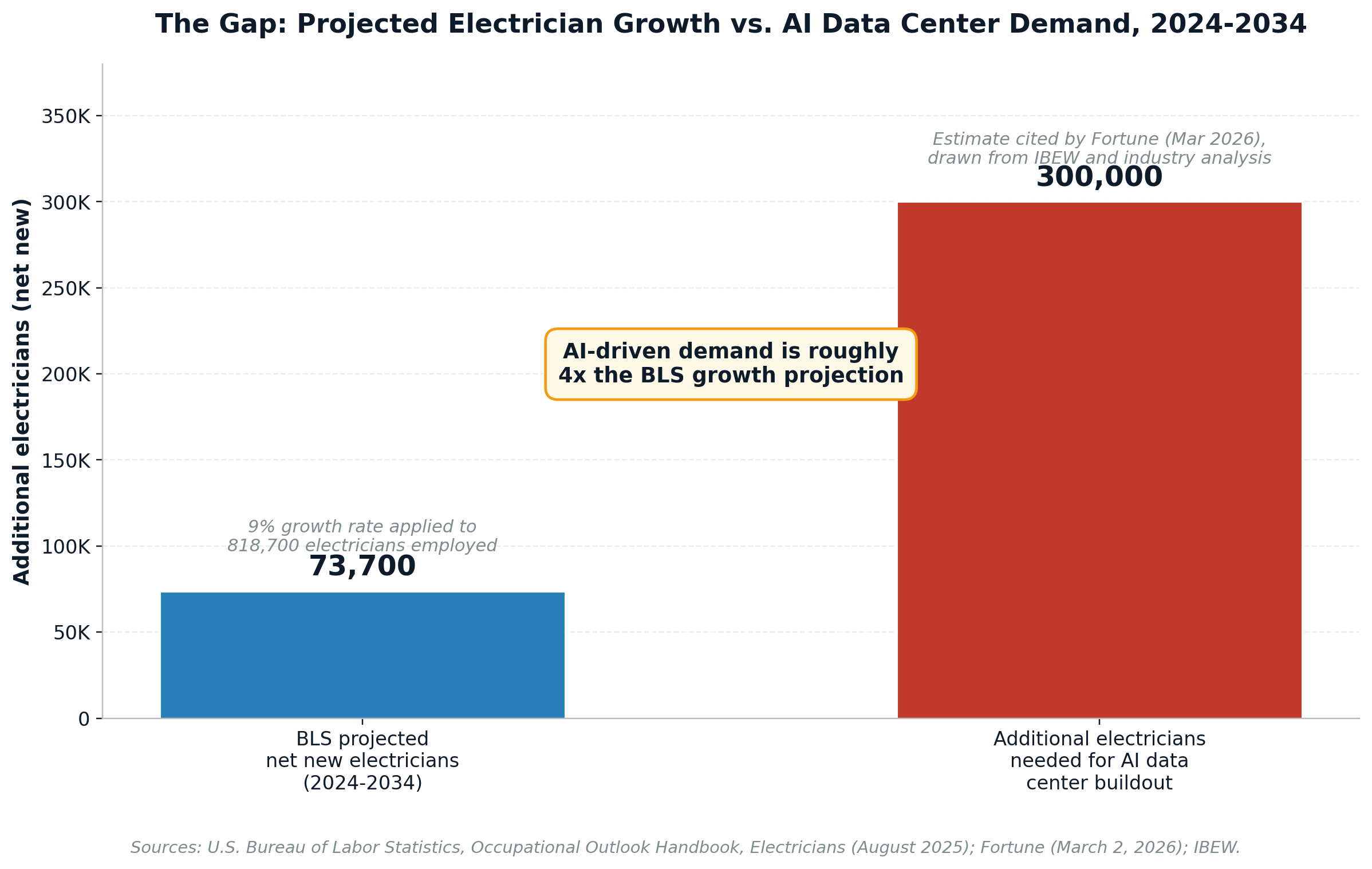
The Bureau of Labor Statistics data, drawn from monthly payroll surveys and forward-looking demographic modeling, projects a 9 percent employment growth for electricians over the 2024 to 2034 decade. Applied to the current 818,700-worker base, that is 73,700 net new electricians. Fortune, in its March 2026 investigation of the AI infrastructure labor market, reported that “more than 300,000 new electricians are needed over the next decade” to meet AI-driven demand, citing IBEW and industry sources (Fortune, 2026a). The BLS baseline and the industry-cited demand estimate differ by roughly a factor of four.
What the Data Does Not Say
Two important caveats apply to the industry figures cited above. The Associated Builders and Contractors methodology for its workforce-gap projections is based on a spending forecast and a fixed multiplier of about 3,450 workers per $1 billion in construction spending, drawn from historical Census Bureau construction outlays and BLS payroll data. It is not a hiring survey and it does not directly measure the number of open positions. The actual 2026 hiring will only be observable from BLS payroll data at year end (Associated Builders and Contractors, 2026).
The 300,000-electrician gap cited by Fortune, and the related 130,000 figure that has circulated in trade-group and commentary sources, is an industry estimate, not a federal statistic. It reflects the IBEW’s own analysis and secondary reporting. This report treats it as a directional signal, useful in framing the gap between what BLS projects and what industry expects, rather than a single verified target.
Similarly, the ERCOT interconnection queue is a request queue. It is a strong signal of intent but not a commitment to build. Industry practice includes speculative queue positioning by developers who may not proceed. ERCOT itself flagged this in its July 2026 forecast revision. The 233 gigawatt figure should be read as an upper bound on plausible new load, not a base-case demand projection.
What to Watch
Four measurable series will indicate whether the U.S. trades pipeline can carry the AI buildout.
- BLS Employment Situation, electricians. Monthly payroll data on employment in NAICS 238210 (electrical contractors) is the highest-frequency federal indicator. Sustained year-over-year growth above 3 percent would signal that the pipeline is expanding materially faster than BLS’s 10-year baseline (U.S. Bureau of Labor Statistics, 2025a).
- Registered apprenticeship completions. The Department of Labor’s Registered Apprenticeship program publishes annual completion data. In construction trades, completions have trailed retirements by roughly 3,000 workers per year in the union electrical segment alone (Supercomputing News, 2026).
- ERCOT quarterly interconnection updates. The Public Utility Commission of Texas is implementing Senate Bill 6 to standardize load forecasting, which should produce cleaner queue data by mid-2026 and clarify which large loads are firm commitments.
- Data center construction cost per megawatt. If the 6 percent projected 2026 increase materializes, and if labor is the driving line item, this becomes the clearest single price signal that the wire bottleneck is binding.
Bottom line. Federal data confirm that skilled trades already pay above the national median wage and are projected to grow through 2034. Industry data suggest the AI infrastructure buildout will require several times the workers that federal projections currently anticipate. The exact size of the gap remains disputed, and this report does not resolve it. What is not disputed is that capital, chips, and land are not the binding constraint on U.S. AI infrastructure. The binding constraint is the person on the ladder pulling the cable. Wages are the market’s early response. Workforce policy will determine whether the response is enough.
References
ABC Carolinas. (2026, February 10). Addressing the construction industry labor shortage: Data, drivers and strategic responses. https://abccarolinas.org/construction-industry-labor-shortage-data-drivers-and-strategic-responses/
Associated Builders and Contractors. (2026, January 15). Construction industry must attract 349,000 workers in 2026 despite macroeconomic headwinds [Press release]. https://www.abc.org/News-Media/News-Releases/abc-construction-industry-must-attract-349000-workers-in-2026-despite-macroeconomic-headwinds
Bloomberg. (2026, January 21). Nvidia CEO says AI will create jobs for electricians and plumbers. https://www.bloomberg.com/news/articles/2026-01-21/nvidia-ceo-says-ai-will-create-jobs-for-electricians-and-plumbers
Data Center Knowledge. (2026, May 14). ERCOT warns Texas AI power boom may not materialize. https://www.datacenterknowledge.com/energy-power-supply/gridlock-or-growth-ercot-warns-texas-ai-power-boom-may-not-materialize
Electric Reliability Council of Texas. (2023). ERCOT yearly peak demand records. https://www.ercot.com/static-assets/data/news/content/a-peak-demand/all-time-records.htm
Electric Reliability Council of Texas. (2025, December 2). System planning and weatherization update [Board of Directors filing]. https://www.ercot.com/files/docs/2025/12/02/16.2-System-Planning-and-Weatherization-Update_Revised.pdf
Fortune. (2025, September 30). Nvidia CEO Jensen Huang says AI is fueling demand for Gen Z skilled trade workers with six-figure salaries. https://fortune.com/2025/09/30/nvidia-ceo-jensen-huang-demand-for-gen-z-skilled-trade-workers-electricans-plumbers-carpenters-data-center-growth-six-figure-salaries/
Fortune. (2026a, March 2). The electrician shortage is a threat to Big Tech’s “life or death” race to build data centers and an opportunity for Gen Z. https://fortune.com/2026/03/02/ai-data-centers-electrician-shortage-gen-z-training-careers/
Fortune. (2026b, April 21). America’s “silent army” of skilled tradespeople are retiring, JLL warns. https://fortune.com/2026/04/21/america-silent-army-jll-report-skilled-trades-job-shortage-cost/
NVIDIA. (2026, January 21). Larry Fink, Jensen Huang talk AI, the future of technology at Davos 2026. NVIDIA Blog. https://blogs.nvidia.com/blog/davos-wef-blackrock-ceo-larry-fink-jensen-huang/
JLL. (2026, April). Skilled trades workforce report 2026. Jones Lang LaSalle. https://www.jll.com/en-us/insights
Supercomputing News. (2026, June 6). Electrician shortage gates the AI supercomputer buildout. https://www.supercomputing.news/ai/electrician-shortage-ai-supercomputer-buildout
U.S. Bureau of Labor Statistics. (2025a, August 28). Electricians: Occupational outlook handbook. https://www.bls.gov/ooh/construction-and-extraction/electricians.htm
U.S. Bureau of Labor Statistics. (2025b, August 28). Plumbers, pipefitters, and steamfitters: Occupational outlook handbook. https://www.bls.gov/ooh/construction-and-extraction/plumbers-pipefitters-and-steamfitters.htm
U.S. Bureau of Labor Statistics. (2025c, August 28). Heating, air conditioning, and refrigeration mechanics and installers: Occupational outlook handbook. https://www.bls.gov/ooh/installation-maintenance-and-repair/heating-air-conditioning-and-refrigeration-mechanics-and-installers.htm
U.S. Bureau of Labor Statistics. (2025d, August 28). Office and administrative support occupations: Occupational outlook handbook. https://www.bls.gov/ooh/office-and-administrative-support/
U.S. Bureau of Labor Statistics. (2025e). Employment by major occupational group [Table]. Employment Projections. https://www.bls.gov/emp/tables/emp-by-major-occupational-group.htm
Utility Dive. (2026, January 6). ERCOT’s large load queue jumped almost 300% last year. https://www.utilitydive.com/news/ercots-large-load-queue-jumped-almost-300-last-year-official/808820/