
Executive Summary
On July 28, 2026, the Federal Communications Commission added two categories to its Covered List: foreign-produced “advanced robotic devices” and foreign-produced connected power inverters. Covered equipment cannot receive FCC equipment authorization, which most electronics require before they may be imported, marketed, or sold in the United States (Federal Communications Commission, 2026a, 2026b).
The action is narrower than “a ban” in three respects and broader in two. It applies only to new device models seeking authorization; previously authorized models may still be imported and sold; already-purchased devices are unaffected; and federal government purchases are exempt entirely. But the FCC states the rule is country neutral — the nationality of the producing entity is explicitly irrelevant — and “foreign-produced” is defined against the Buy American Act’s domestic end product test, which requires U.S. manufacture and domestic content exceeding 65 percent of component cost (Federal Communications Commission, 2026b; 48 CFR § 25.101).
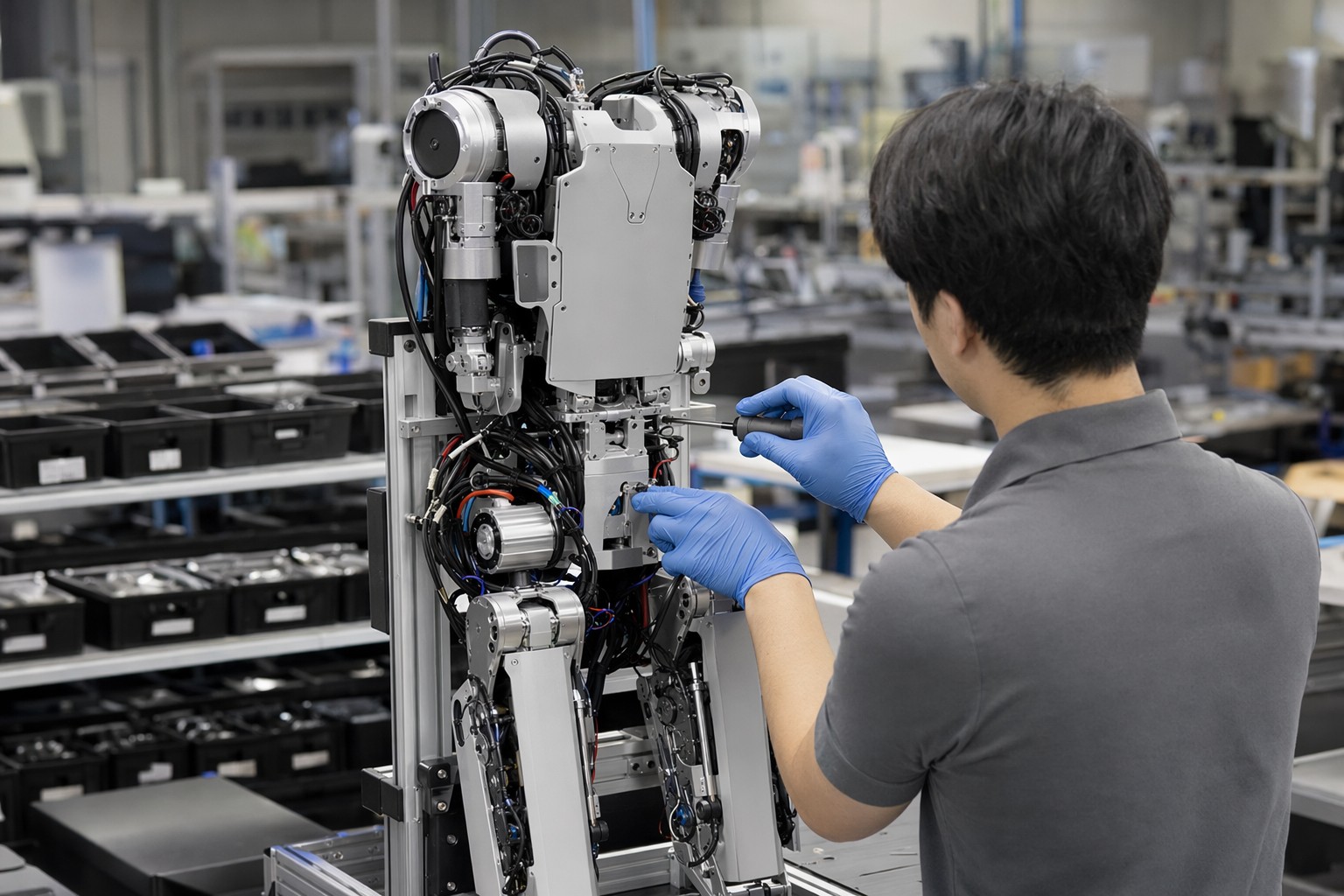
Key finding. This is not primarily an import ban aimed at China, though Chinese firms absorb the overwhelming majority of the impact: they shipped roughly 80 to 90 percent of the world’s humanoid robots in 2025. It is better read as a domestic-content mandate for market access, enforced through the equipment authorization system, with a national security waiver. Its most underappreciated consequence is that it may bind U.S. robot manufacturers too, because a humanoid’s actuators, harmonic drives, rare earth magnets, and cells are largely sourced from Asia.
Headlines have described the FCC’s action as banning foreign robots from America. The operative legal text says something more specific and, in one respect, more far-reaching. This report examines what the rule actually restricts, which markets are structurally exposed, who gains, who loses, and which questions the Commission has not yet answered.
What the FCC Actually Did
The Covered List is a register of communications equipment deemed to pose unacceptable risk to U.S. national security. Under the Secure and Trusted Communications Networks Act, the Commission cannot add to it on its own initiative; it may act only at the direction of a qualifying national security authority. In this case a White House-convened Executive Branch interagency body issued determinations covering both device classes, and the FCC implemented them (Federal Communications Commission, 2026a, 2026b).
The practical mechanism is authorization, not customs enforcement. Covered equipment is barred from receiving new FCC equipment authorizations. Because most electronics require authorization before importation, marketing, or sale, denial of authorization functions as market exclusion — but only prospectively, for models not already approved.
What the rule does not do. It does not prohibit continued import, marketing, or sale of models the FCC previously authorized. It does not restrict consumers’ use of devices already purchased. It does not apply to importation, marketing, or sale exclusively to the federal government. And it permits importing small batches of unauthorized devices for product development or testing, provided they are not marketed or sold (Federal Communications Commission, 2026b). Characterizing the action as an immediate ban on robot sales in America overstates it.
The Definition Is Broader Than the Headline
The FCC’s press materials describe advanced robotic devices as “mobile robots, such as humanoids and quadrupeds.” The operative definition in the National Security Determination is considerably wider. A covered device is a mechanical mobile device — expressly including autonomous mobile robots, humanoid robots, and quadrupeds — that is capable of locomotion, obstacle avoidance, navigation, or ground movement; operates at a distance from a human operator based on commands or sensor data; weighs more than 4.4 pounds combined with any ground or docking station; and contains all three of an environmental sensor, network connectivity of at least 200 kbps, and software or model weights controlling navigation, perception, data collection, or remote command and control (Federal Communications Commission, 2026b).
The exclusions are equally instructive. Carved out are connected vehicles of any weight, rail vehicles, uncrewed aircraft, unmanned underwater vehicles, FDA-regulated medical devices including wheelchairs and walkers, and — importantly for industry — fixed, stationary, non-mobile robots, including articulated, delta, gantry, and SCARA arms intended for industrial or medical use.
Two consequences follow. First, traditional factory automation is untouched: the industrial robot arm market, where Japanese and European suppliers such as FANUC, Yaskawa, ABB, and KUKA are dominant, falls outside the definition entirely because those machines are fixed rather than mobile. Second, the definition’s plain language reaches well past humanoids and quadrupeds. An autonomous mobile robot in a warehouse meets every element. So, on the face of the text, would many consumer service robots — the exclusion list does not mention them. The FCC has not publicly clarified this boundary, and this report treats consumer-robot coverage as an open question rather than a settled fact.
On power inverters, the definition covers bidirectional DC-AC conversion devices including microinverters, string, central, and hybrid battery-based inverters, where the device contains components enabling remote communication, control, sensing, data collection, or monitoring. Connectivity is the trigger; a fully isolated inverter is not covered.
The Country-Neutral Clause and the Content Test
Asked directly whether the action targets any country, the FCC answers that it is country neutral, and separately that the nationality of the producing entity is not relevant to whether a device is foreign-produced (Federal Communications Commission, 2026b). This distinguishes the measure from the Commission’s earlier China-specific Covered List entries, which named particular firms.
What determines coverage is production, defined by reference to the Federal Acquisition Regulation’s “domestic end product” standard. Under that test an article must be manufactured in the United States, and the cost of its domestic components must exceed a threshold — 65 percent for items delivered from 2024 through 2028, rising to 75 percent from 2029 (48 CFR § 25.101).
The analytically significant point. Final assembly in the United States is not sufficient. A robot screwed together in Texas from imported actuators, reducers, magnets, and cells will fail the content test and be treated as foreign-produced. Applying a government procurement standard as a condition of general commercial market access is a substantial extension of the Buy American framework, and it converts the measure from a trade restriction into a supply chain reconstruction mandate.
Market Structure: Robotics
The exposure here is asymmetric to an unusual degree. Global humanoid shipments in 2025 were roughly 13,000 to 15,000 units, and Chinese manufacturers accounted for close to 80 to 90 percent of that volume. Unitree led with approximately 5,500 units and AgiBot followed with approximately 5,168 — meaning two Chinese firms alone outshipped every Western competitor combined. U.S. entrants including Tesla and Figure AI shipped in the hundreds or fewer (Rest of World, 2026; CNN, 2026; TrendForce, 2026).
TrendForce projects Chinese humanoid output to grow as much as 94 percent in 2026, with Unitree and AgiBot together capturing nearly 80 percent of China’s domestic shipments (TrendForce, 2026). In quadrupeds the concentration is starker still: Unitree shipped more than 30,000 units between 2022 and September 2025 and has held the leading global share for years, largely because its price points undercut Western equivalents by an order of magnitude.
The relevant observation for policy is that the U.S. is restricting market entry in a category where it has minimal domestic supply to substitute. This is the inverse of the drone precedent, where a domestic Blue UAS ecosystem existed before restrictions tightened.
Market Structure: Power Inverters
The inverter market presents a different picture, and conflating the two categories produces bad analysis.
Globally, Huawei and Sungrow lead and together hold more than half of shipments, with SMA of Germany, GoodWe of China, and Enphase of the United States rounding out the top ranks (Wood Mackenzie, 2026). But the U.S. market has already diverged sharply from the global one under tariffs and domestic content incentives. In U.S. residential inverters, Enphase, SolarEdge, and Tesla have held roughly 90 percent combined share for several years. Chinese exposure is concentrated in the commercial and industrial segment, where Chint and Sungrow together hold approximately 40 percent, up from roughly 30 percent in the early 2020s (pv magazine USA, 2026).
The market read this as a domestic windfall well before the order issued: Enphase shares rose sharply on reports of the FCC’s draft. The company manufactures substantially in Texas and South Carolina, positioning it comparatively well against the content test — though whether its products clear 65 percent domestic component cost is a determination no public source has made.
Who Benefits
U.S.-manufacturing inverter incumbents. Enphase is the clearest beneficiary, with Tesla and SolarEdge’s domestic lines also advantaged. The commercial and industrial segment, where Chinese share has been growing, is where displacement opportunity is largest.
Domestic humanoid developers — eventually. Tesla, Figure AI, Agility Robotics, Apptronik, and Boston Dynamics gain a protected runway. The benefit is real but deferred: none currently ships at volumes approaching the incumbents they are being shielded from, and the protection accrues only if they can satisfy the content test themselves.
Component reshoring. The genuine structural winners may be upstream. If the content threshold binds, demand appears for domestically produced actuators, harmonic and cycloidal reducers, precision bearings, rare earth magnets, and cells. That is where the 65 percent is won or lost.
Holders of existing authorizations. An overlooked effect: firms with already-authorized models hold an asset that has just appreciated. Grandfathered models can still be imported and sold, creating an incentive to maximize authorized-model inventory and extend product lifecycles.
Who Does Not
Chinese robotics manufacturers. Unitree and AgiBot lose access to new-model launches in a major market. Unitree filed for a Shanghai IPO reported at roughly $610 million; loss of U.S. new-model access is a material fact for that offering. The practical effect is a frozen product line: current models may continue, successors may not enter.
U.S. researchers and universities. Low-cost Chinese quadrupeds and humanoids are the default research platforms in American robotics labs precisely because they cost a fraction of Western alternatives. As current models age out and successors cannot be authorized, U.S. academic robotics faces either substantially higher platform costs or degraded access. The testing and development carve-out permits small unmarketed batches, which mitigates but does not resolve this.
U.S. robot manufacturers with global supply chains. This is the counterintuitive category. Harmonic drives are dominated by Japanese suppliers, rare earth magnets overwhelmingly by China, cells largely by China, Japan, and Korea. A U.S.-assembled humanoid may not clear 65 percent domestic content. The rule can bind domestic champions as readily as foreign rivals.
Solar developers and ratepayers. Removing lower-cost inverter competition from the commercial and industrial segment raises system costs. Those costs pass to project economics and ultimately to electricity customers.
Which Foreign Countries Are Affected Most
China, by a wide margin. It holds the dominant position in both covered categories simultaneously — humanoids and quadrupeds through Unitree and AgiBot, inverters through Huawei, Sungrow, GoodWe, and Chint. No other country is materially exposed in both. China’s Foreign Ministry-aligned press characterized the action as counterproductive and self-defeating (Global Times, 2026).
Allied economies, unexpectedly. Because the measure is country neutral by design, it reaches partners: Germany’s SMA and Austria’s Fronius in inverters; Israel’s SolarEdge for non-U.S.-produced lines; Japan’s TMEIC; Switzerland’s ANYbotics and Norway’s 1X in mobile robotics; Canada’s Sanctuary AI; and South Korean and Japanese component suppliers whose parts count against domestic content. Firms in these countries are not accused of anything — they are captured by a production-location test.
Whether allied producers receive expedited Conditional Approvals is therefore the single most consequential unresolved question. The drone precedent is suggestive: the FCC carved out Blue UAS and Buy American-compliant drones from its earlier restrictions (Morgan Lewis, 2026). An analogous allied-country pathway is plausible but has not been announced.
What the Rule Does Not Settle
Scope at the edges. The definition’s text captures autonomous mobile robots generally, while public communication has emphasized humanoids and quadrupeds. Warehouse AMRs, delivery robots, and consumer service robots sit in territory the FCC has not publicly delineated. Manufacturers in those categories cannot currently determine their status with confidence.
Conditional Approval throughput. Applications go to an FCC mailbox and are forwarded to the Department of War or DHS. No published service standard, decision timeline, appeal mechanism, or evidentiary standard accompanies the process. Entity-level and class-level approvals are permitted, which helps. But a waiver regime without a clock is functionally a prohibition for firms on product cycles.
The evidentiary record is not public. The determinations describe categories of risk — supply chain vulnerability, remote access, data exfiltration, remote commandeering — rather than documented incidents. Some coverage has asserted confirmed backdoors; the published determinations, as quoted in the FCC’s own fact sheet, describe capability-based risk. Readers should not treat the two as equivalent.
Content verification. The FCC indicates applicants may need documentation demonstrating a device was not foreign-produced. Auditing 65 percent domestic component cost across a robot’s bill of materials is a non-trivial compliance burden that the order does not cost out.
What to Watch
The first Conditional Approvals. The FCC will publish granted approvals. Who appears first, and how quickly, will reveal whether this is an allied-friendly content policy or a hard onshoring mandate.
Whether a domestic-content safe harbor emerges. A Blue UAS-style approved list for robotics would resolve most of the ambiguity at once.
Authorization filings as a leading indicator. FCC equipment authorization records are public. A surge of pre-deadline filings, or their absence, will show how the industry is actually responding.
Reciprocity. China has export-control instruments of its own over rare earths and magnets — inputs U.S. robot makers need to satisfy the very content test this rule imposes. Escalation in that direction would tighten the constraint on domestic producers rather than relieve it.
Conclusion. The FCC has not banned robots in America. It has made U.S. market access for new mobile-robot and connected-inverter models conditional on domestic production content, with a national security waiver of undefined speed. China absorbs most of the impact because China holds most of the market. But the mechanism chosen — a procurement content standard applied to commercial authorization, explicitly indifferent to nationality — means the binding constraint for American manufacturers may turn out to be the same one it imposes on everyone else: whether a robot can be built substantially from American parts.
References
CNN. (2026, July 29). China’s humanoid robots have been taking over the global market. Now the US is banning them. https://www.cnn.com/2026/07/29/tech/us-china-robot-ban-intl-hnk
Federal Communications Commission. (2026a, July 28). Fact sheet: FCC updates Covered List to include foreign-produced advanced robotic devices and power inverters (DOC-423682A1). https://docs.fcc.gov/public/attachments/DOC-423682A1.pdf
Federal Communications Commission. (2026b, July 28). FAQs on recent updates to FCC Covered List regarding foreign-produced advanced robotic devices and power inverters. https://www.fcc.gov/covered-list-faqs-robots-inverters
Federal Communications Commission. (2026c, July 28). Public notice DA 26-786. https://docs.fcc.gov/public/attachments/DA-26-786A1.pdf
Global Times. (2026, July). FCC’s ban on imports of Chinese advanced robots, power inverters a ‘counterproductive, self-defeating’ move: expert. https://www.globaltimes.cn/page/202607/1367059.shtml
Morgan Lewis. (2026, January). FCC exempts certain drones and components from Covered List to address national security risks. https://www.morganlewis.com/pubs/2026/01/fcc-exempts-certain-drones-and-components-from-covered-list-to-address-national-security-risks
Nextgov/FCW. (2026, July). FCC blocks approval of new foreign-made robots, power inverters. https://www.nextgov.com/policy/2026/07/fcc-blocks-approval-new-foreign-made-robots-power-inverters/415070/
pv magazine USA. (2026, May 6). U.S. inverter market faces policy, supply headwinds despite safe harbor pipeline. https://pv-magazine-usa.com/2026/05/06/
Rest of World. (2026). China robot maker Unitree files for $610 million Shanghai IPO. https://restofworld.org/2026/unitree-china-humanoid-robot-shanghai-ipo/
TrendForce. (2026, April 9). China’s humanoid robot output to surge 94% in 2026; Unitree and AgiBot to capture nearly 80% market share. https://www.trendforce.com/presscenter/news/20260409-13007.html
U.S. General Services Administration. 48 CFR § 25.101 — General (FAR 25.101). eCFR. https://www.ecfr.gov/current/title-48/chapter-1/subchapter-D/part-25/subpart-25.1/section-25.101
Wood Mackenzie. (2026). Global solar inverter manufacturer ranking. https://www.woodmac.com/press-releases/solar-inverter-ranking-h1-2025/