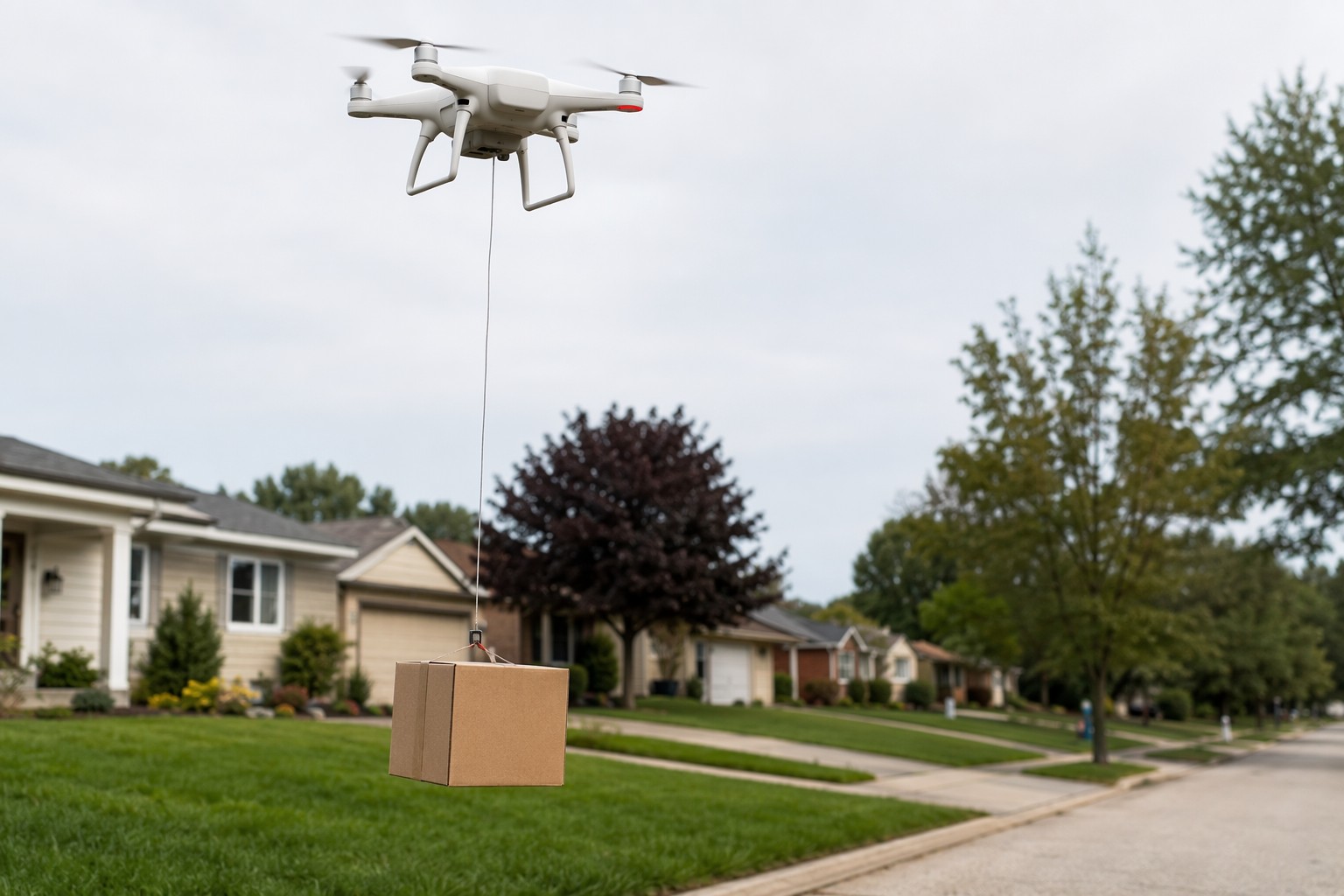

Executive Summary
On July 29, 2026, DoorDash announced that DoorDash Labs had earned Federal Aviation Administration Part 135 air carrier certification and launched DoorDash Air, an in-house drone program. The company describes itself as the eighth drone operator to hold the certificate. That claim checks out against the FAA’s own register of Part 135 package delivery operators (DoorDash, 2026; Federal Aviation Administration, 2026).
The strategic significance is not the aircraft, which has not been shown, nor a service, which has not launched. It is that a demand aggregator has become a certificated air carrier. Every prior holder of this certificate was an aviation or logistics operator selling capacity to someone else’s demand. DoorDash owns the demand and is now buying the capacity in-house — the same vertical integration that Amazon pursued in ground logistics, applied to airspace.
Key finding. Part 135 is not the binding constraint on this market. Beyond-visual-line-of-sight authority is, and the rule that would normalize it — Part 108 — reached White House regulatory review on July 10, 2026 and remains unpublished. Eight certificates now exist for a market whose scaling rule has not yet issued. DoorDash has bought an option on a regulatory outcome, not a running airline.
Walmart’s drone partners crossed one million cumulative deliveries in May. Zipline has passed two million. Into that market, the largest U.S. food delivery marketplace has just certificated itself as an airline — while declining to say what it will fly, where, or when. This report separates the verified record from the announcement.
What DoorDash Actually Received
The certificate is a 14 CFR Part 119 air carrier certificate carrying authority to operate under Part 135 — the same regulatory architecture governing charter and on-demand carriers, applied to unmanned aircraft. DoorDash describes a five-stage FAA evaluation covering aircraft airworthiness, maintenance programs, and safety procedures (DoorDash, 2026).
What the certificate confers is the legal standing to operate commercially as an air carrier and to be compensated for carrying property. What it does not confer is permission to fly wherever the business case points. Routine flight beyond the operator’s visual line of sight still requires separate waivers or exemptions, granted case by case. TechCrunch’s reporting notes operations will likely begin with limited pilots at short distances within visual line of sight (TechCrunch, 2026).
The distinction that matters. Part 135 answers “may this company operate as an air carrier?” It does not answer “may this company fly one drone to many houses without a human watching it?” The second question is where delivery economics live, and it is governed by a different rule that does not yet exist in final form.
Verifying the Lineage: The Eight
The FAA maintains a public register of operators approved for Part 135 UAS package delivery. As of its last update on July 21, 2026 — eight days before this announcement — it listed seven. DoorDash’s claim to be the eighth is consistent with that record, though the agency page has not yet been amended to reflect it.
| # | Operator | Certificated | Notes per FAA |
|---|---|---|---|
| 1 | Wing Aviation (Alphabet) | April 2019 | First ever, as single-pilot operator; amended to standard Part 135 in October 2019. Christiansburg, VA. |
| 2 | UPS Flight Forward | 2019 | First to receive standard Part 135 authority. First commercial delivery September 2019, Matternet aircraft, WakeMed campus, Raleigh, NC. |
| 3 | Amazon Prime Air | August 2020 | First to operate an aircraft over 55 lbs under this authority. Operations began Pendleton, OR. |
| 4 | Zipline International | June 2022 | First fixed-wing Part 135 UAS operator; first to certificate via the BEYOND program. Charlotte, NC. |
| 5 | Causey Aviation Unmanned | January 2023 | On-demand delivery with Flytrex aircraft. Holly Springs and Raeford, NC. |
| 6 | DroneUp | November 2024 | Prism V2 aircraft, Murphy, TX. |
| 7 | Drone Express (DEXA) | April 2025 | On-demand small package delivery, Telegrid aircraft, Dayton, OH. |
| 8 | DoorDash Air | July 2026 | Company-announced; not yet reflected on the FAA register at time of writing. |
Two clarifications are worth making because they are frequently muddled. Wing was first to hold any Part 135 UAS authority, but as a single-pilot operator; UPS Flight Forward was first to hold standard Part 135 authority. And the FAA’s description of Amazon “beginning commercial operations” in Pendleton, Oregon in August 2020 refers to activity at a test range; Amazon’s consumer-facing deliveries did not begin until considerably later, in Lockeford, California and College Station, Texas. The certificate date and the service date are not the same event — a distinction that applies squarely to DoorDash today.
What Was Announced, and What Was Not
DoorDash disclosed the certification, the program name, its leadership under Harrison Shih, and the intent to build both aircraft and ground infrastructure in-house at DoorDash Labs. It stated the aircraft is American-designed and built with the majority of components made in the United States (DoorDash, 2026).
It did not disclose the aircraft, its payload, its range, launch markets, or a service date, saying only that more would follow later this year. Independent reporting confirms no such specifics were provided (TechCrunch, 2026; CNBC, 2026). Readers encountering headlines about DoorDash drone delivery should understand that nothing is currently flying under this certificate.
The company’s supporting statistics also warrant precision. The “tens of thousands of drone deliveries completed to date” were flown by partners — Wing and Flytrex — not by DoorDash aircraft. The claim that some participating locations saw order volume grow roughly 30 percent, sustained across nine weeks, is self-reported, drawn from selected locations in partner pilots, with no absolute baseline disclosed. The 25-minute average delivery time is described by the company as an estimate. None of these figures is implausible; none is independently verified.
Why a Marketplace Decided to Become an Airline
The most substantive disclosure in the announcement is an operational statistic. DoorDash states that more than 20 percent of its 2025 orders travelled three to five miles, and that those orders took on average nearly 25 percent longer than shorter deliveries — largely because matching a courier to a mid-range trip is harder. Couriers prefer short hops that keep them dense among merchants and maximise orders per hour (DoorDash, 2026).
That is a genuine structural inefficiency, and it defines the target. Drones are poorly suited to dense urban cores and to the last hundred feet of an apartment building. They are well suited to exactly the three-to-five-mile suburban corridor that human courier economics serve worst. DoorDash is not proposing to replace couriers; it is proposing to remove from the courier pool the segment that degrades courier utilisation.
The strategic logic for owning rather than renting follows from that. A marketplace that routes orders across couriers, sidewalk robots, and aircraft needs the routing layer to be the point of control. DoorDash already operates that layer as its Autonomous Delivery Platform, alongside its sidewalk robot Dot. Owning an air carrier certificate converts drone capacity from a negotiated partnership into an internal cost line — while, notably, the company retains its Wing and Flytrex partnerships rather than replacing them.
The Market DoorDash Is Entering
Drone delivery moved from demonstration to routine operations during 2025 and 2026, and the volume leaders are retail rather than restaurant.
Walmart announced its one millionth drone delivery in May 2026 (Walmart, 2026). Zipline, which raised $600 million in January 2026 at a reported $7.6 billion valuation, has surpassed two million lifetime deliveries and is expanding into Houston and Phoenix (TechCrunch, 2026b). Wing and Walmart announced an expansion to roughly 150 additional stores, with reporting indicating coverage scaling toward 270 locations and more than 40 million potential customers; Wing’s delivery volume tripled in the second half of 2025 against the first half, with average fulfilment under 19 minutes (Supply Chain Dive, 2026; Wing, 2026). Flytrex, DoorDash’s other partner, has passed 200,000 deliveries and opened a Dallas-area factory (DroneDJ, 2026).
Market sizing estimates for delivery drones cluster around $1 billion in 2026 growing to roughly $12 billion by 2033, implying compound growth above 40 percent. Such forecasts are extrapolations from a small base and should be treated as directional. The verifiable signal is the delivery counts, and those are compounding fast.
The Real Constraint: Part 108
Eight Part 135 certificates exist. The number that matters more is zero — the number of final rules normalising beyond-visual-line-of-sight operations.
The FAA published its BVLOS proposed rule, widely known as Part 108, in the Federal Register on August 7, 2025, drawing roughly 3,100 comments. The agency reopened comment on right-of-way and electronic conspicuity provisions in early 2026. The final rule reached the Office of Information and Regulatory Affairs for review on July 10, 2026 — the last major step before publication — and had not been published at the time of writing. OIRA review of significant rules can run up to 90 days, and operational implementation typically follows publication by six to twelve months.
Why this governs everything. Under visual-line-of-sight rules, each aircraft requires observers, which makes the labour cost per delivery comparable to or worse than a human courier. The entire economic case for drone delivery rests on one operator supervising many aircraft over a wide area. Part 108 is what converts that from a waiver granted site by site into a licensable operating model. Until it publishes, every operator — DoorDash included — is scaling against a permission regime, not a rulebook.
Who Gains, Who Is Squeezed
DoorDash gains optionality and negotiating position. Even if DoorDash Air never reaches meaningful volume, holding a certificate and a credible in-house aircraft programme changes the terms on which it contracts with Wing and Flytrex. A buyer that can build is a better-positioned buyer.
Pure-play drone operators face demand disintermediation. The structural risk for Wing, Zipline, Flytrex, and DroneUp is not that DoorDash outflies them. It is that their largest potential customers — the aggregators holding consumer demand — become competitors. Zipline and Wing are partly insulated by deep Walmart relationships; the smaller operators are less so.
Domestic drone component suppliers gain. DoorDash’s emphasis on an American-designed and American-built aircraft with a majority of U.S. components is not incidental marketing. Uncrewed aircraft systems and their critical components already sit on the FCC’s Covered List, and the FCC’s July 2026 robotics action explicitly excludes UAS because they are handled under that separate track. Building domestically is the way to stay clear of that regime — a reflex the whole sector is now developing.
Couriers face a segmented, not eliminated, role. DoorDash is explicit that Dashers handle the vast majority of deliveries and remain essential for apartment access and large orders. But the stated plan removes mid-range trips from the courier pool. Whether that raises courier earnings by improving density, or lowers them by removing higher-value trips, depends on per-order pay structure and is not resolvable from the disclosed data.
Uber Eats is the competitive mirror. Uber has pursued drone delivery through partnership with Flytrex rather than certification. If DoorDash’s vertical integration proves out, the pressure on Uber to follow rather than rent will be substantial.
What the Announcement Does Not Settle
Unit economics are entirely undisclosed. No operator in this market has published a credible cost-per-delivery at scale. Aircraft amortisation, energy, maintenance, ground infrastructure, insurance, and supervision staffing all remain opaque. Delivery counts are not profitability.
Certification does not imply readiness. Amazon held this certificate in 2020 and struggled for years to convert it into consumer service at scale. The certificate is necessary, not sufficient.
Community acceptance is unpriced. Noise complaints and local restrictions have constrained operations in several markets. The FAA is separately developing a programmatic environmental assessment for Part 135 drone delivery, a process whose outcome could shape siting and operating conditions.
Restaurant delivery is the harder case. The volume leaders are moving retail and pharmacy goods — stable, packable, tolerant of a few minutes’ variance. Hot food is temperature-sensitive, awkwardly shaped, and unforgiving of delay. DoorDash is entering at the difficult end of the payload problem, not the easy one.
What to Watch
Part 108 publication. The single most consequential event for this market. Watch for OIRA clearance and Federal Register publication, then the compliance date.
The aircraft reveal. DoorDash promises detail later in 2026. Payload and range will indicate whether it is targeting the three-to-five-mile corridor it described or something broader.
Whether the partnerships survive contact. DoorDash says it will keep working with Wing and Flytrex. If in-house volume grows, watch whether those relationships persist, narrow, or end.
Uber’s response. Certification takes years. If Uber files, it will signal that aggregator-owned air capacity is becoming table stakes rather than a differentiator.
Conclusion. DoorDash’s certificate is real, its position as the eighth holder is verifiable, and its diagnosis of the three-to-five-mile inefficiency is the most persuasive part of the announcement. But it has announced a capability, not a service. The competitive question this raises is bigger than food delivery: when the companies that own consumer demand start certificating themselves as carriers, the independent operators who spent a decade solving the flying problem may find that solving it was never the position of strength.
References
CNBC. (2026, July 29). DoorDash launches in-house drone delivery program after FAA certification. https://www.cnbc.com/2026/07/29/doordash-launches-drone-delivery-faa-certification.html
DoorDash. (2026, July 29). DoorDash is cleared for takeoff: Launches DoorDash Air, our in-house drone delivery program. https://about.doordash.com/en-us/news/doordash-air
DroneDJ. (2026, May 21). Drone delivery company Flytrex expands with new Texas factory. https://dronedj.com/2026/05/21/flytrex-drone-delivery-texas-factory/
Federal Aviation Administration. (2026, July 21). Package delivery by drone (Part 135). https://www.faa.gov/uas/advanced_operations/package_delivery_drone
Federal Aviation Administration. (2025, August 7). Normalizing unmanned aircraft systems beyond visual line of sight operations (Notice of proposed rulemaking). Federal Register. https://www.federalregister.gov/documents/2025/08/07/2025-14712/
Supply Chain Dive. (2026). Walmart, Wing to scale drone delivery operations to 270 stores. https://www.supplychaindive.com/news/walmart-wing-drone-delivery-coverage-expansion/809326/
TechCrunch. (2026a, July 29). DoorDash is building its own drone delivery business. https://techcrunch.com/2026/07/29/doordash-is-building-its-own-drone-delivery-business/
TechCrunch. (2026b, January 21). Zipline charts drone delivery expansion with $600M in new funding. https://techcrunch.com/2026/01/21/zipline-charts-drone-delivery-expansion-with-600m-in-new-funding/
Walmart. (2026, May 29). Walmart celebrates 1 million drone deliveries. https://corporate.walmart.com/news/2026/05/29/
Wing. (2026). Wing and Walmart announce world’s largest drone delivery expansion ever. https://wing.com/news/wing-and-walmart-announce-world-s-largest-drone-delivery-expansion-ever