

Executive Summary
Seagate’s 2026 Data Infrastructure Readiness Report, released 14 September and based on a Recon Analytics survey of 2,712 enterprise technology decision-makers across the United States, China, India, the United Kingdom, Germany, France and Japan, contains two findings that belong in every infrastructure planning meeting this quarter.
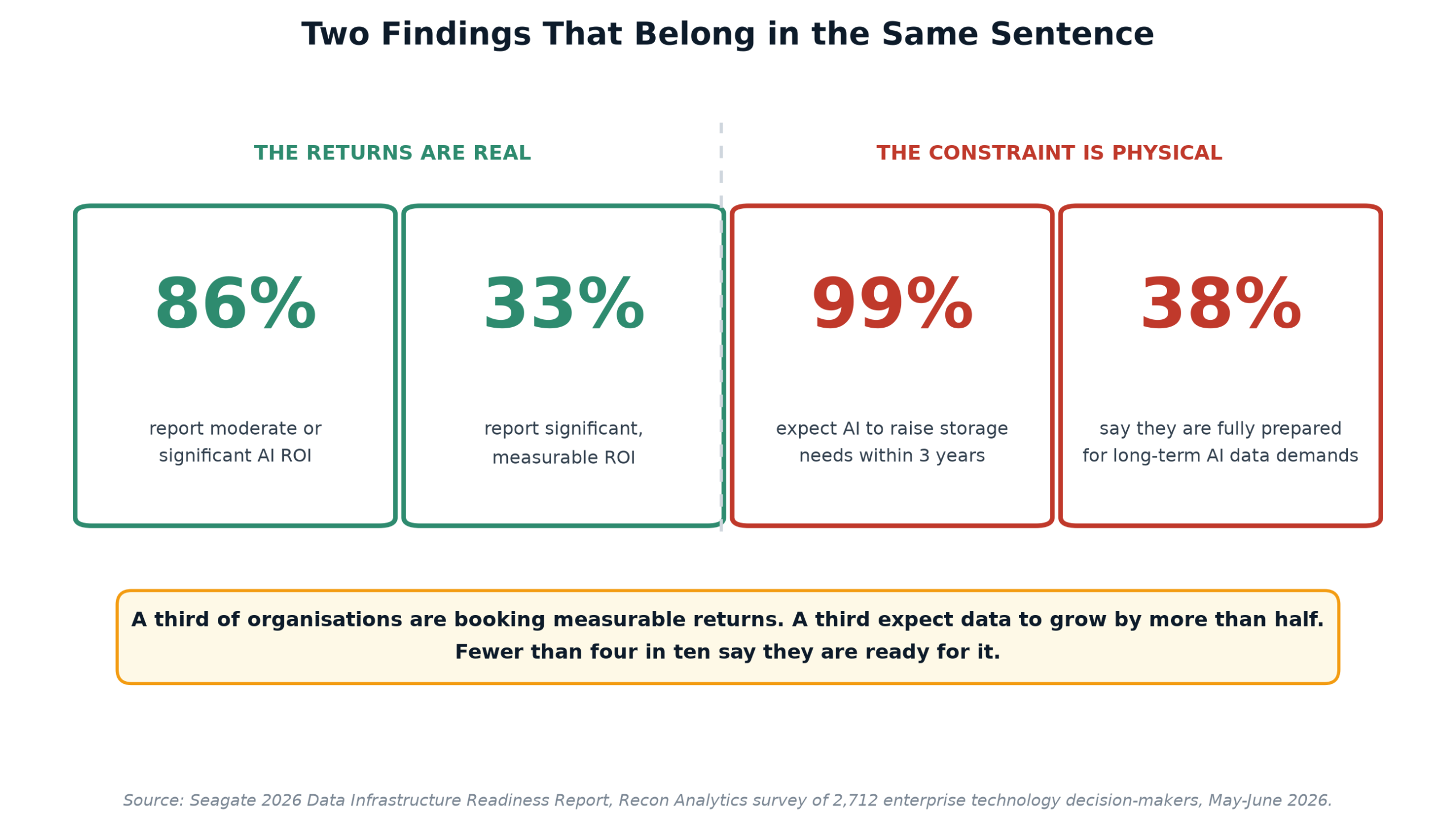
First, the returns are real. 86 percent of organisations report moderate or significant return on their AI investments, and 33 percent report significant, measurable ROI. The question of whether enterprise AI pays for itself has been answered by the people who approve the spending.
Second, the constraint is physical. 99 percent expect AI to increase their storage requirements over the next three years, 32 percent expect that increase to exceed 50 percent, and only 38 percent say they are fully prepared for AI’s long-term data demands. Storage infrastructure ranks as the second-largest AI deployment challenge, ahead of compute and energy.
Read together, those findings describe a market in which the returns are real, the constraint is physical, and most organisations have not yet planned for it. This analysis sets out why the binding constraint on private AI has shifted from model choice to supply chain, examines the case for cloud-first infrastructure honestly, including where it fails, and offers three questions for the next planning cycle.
The author leads technology, AI and security at a large professional services firm. The views here are his own and the cloud-first conclusion is his, not Seagate’s.
The ROI Argument Is Over
For two years the enterprise conversation about AI has been dominated by pilots, proofs of concept and boards asking whether any of it would pay for itself. The Seagate data answers that question at scale.
The finding is not “we see promise” or “we expect returns eventually.” A third of surveyed organisations report significant, measurable ROI today, and 86 percent report at least moderate returns. These are the executives who write the cheques, across seven economies and both sides of the AI race.
That shifts the risk calculus. When AI was speculative, waiting was prudent. When a third of peers are booking measurable returns, waiting is a competitive decision, and the evidence now says it is a poor one. Organisations still waiting for proof will spend the next three years explaining to their boards why competitors secured a two-year head start on productivity gains that turned out to be real.
The conclusion is direct. An organisation without an AI investment is falling behind. That is no longer a forecast. It is a survey result.
The Constraint Nobody Budgeted For
The second finding should concern anyone running significant on-premises infrastructure.
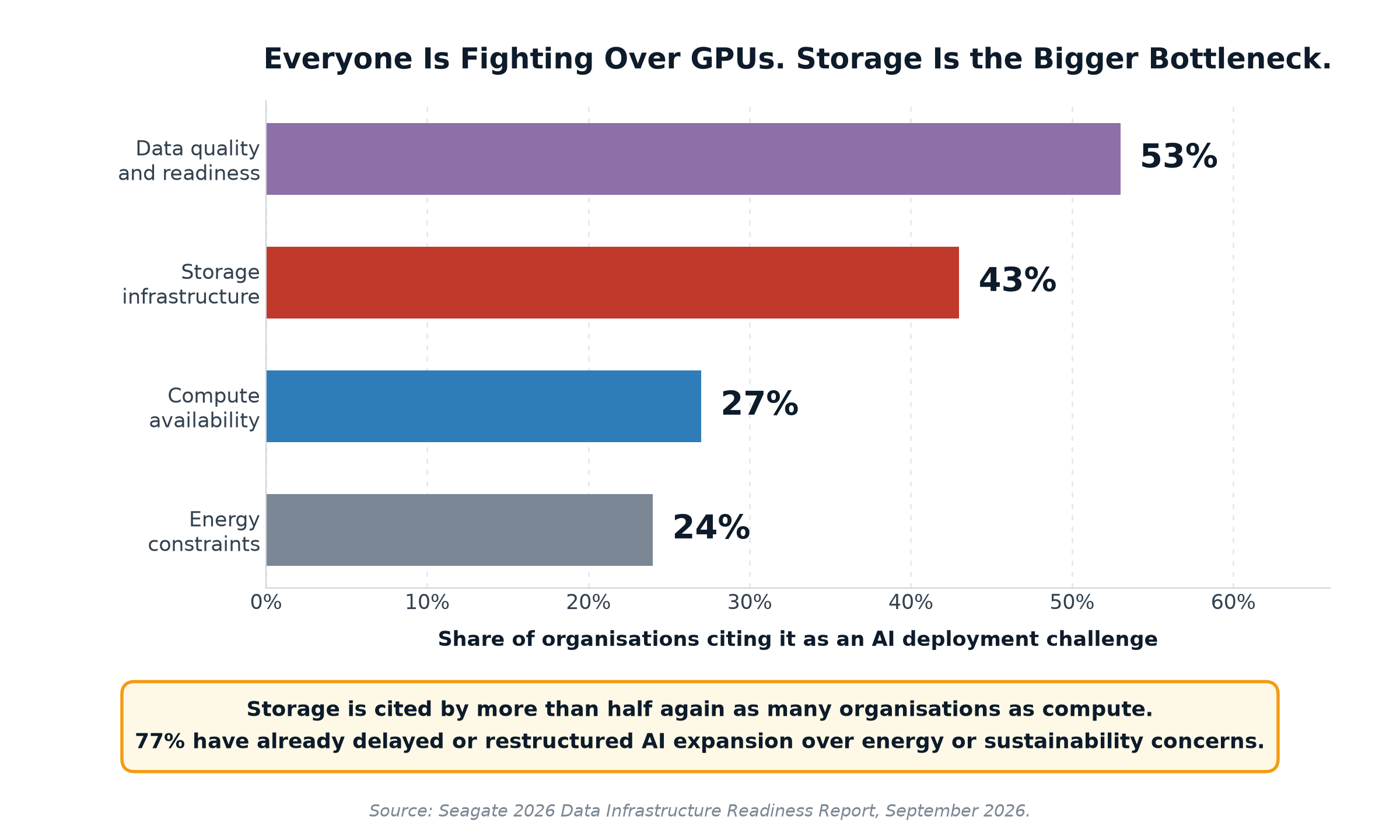
Ninety-nine percent of respondents expect storage requirements to rise. A third expect growth above 50 percent. Only 38 percent consider themselves fully prepared. The report ranks the deployment challenges as follows.
| AI deployment challenge | Share citing it |
|---|---|
| Data quality and readiness | 53% |
| Storage infrastructure | 43% |
| Compute availability | 27% |
| Energy constraints | 24% |
The ordering is the story. Public attention for two years has been on GPUs, and compute remains a real constraint. But storage infrastructure is cited by more than half again as many organisations. The factor quietly capping AI growth is where the data lives, and the power and floor space required to keep it accessible.
The report adds two figures that reinforce the point. Seventy-six percent of respondents rank data centre investment among their top three infrastructure priorities. And 77 percent say they have already delayed or restructured AI infrastructure expansion because of sustainability or energy concerns, with 36 percent describing that restructuring as significant. The constraint is not theoretical. Three-quarters of organisations have already changed plans because of it.
For an organisation that operates its own data centres, 50 percent data growth is not a line item. It is a procurement cycle, a capacity plan, a power and cooling review, a refresh budget, and a lead time the organisation does not control. Capacity cannot be provisioned out of a problem in a single quarter. Orders are placed, deliveries are awaited, and the forecast built six months earlier is expected to still resemble reality when the hardware arrives.
This Is the Scaling Problem With Private AI
This publication has argued before, in its analysis of the open-weights debate, that the practical answer to open versus frontier models is routing, not allegiance: send each workload to the model that serves it best. Private and on-premises AI is a legitimate part of that answer. It offers cost control at steady state and it is the only option for data that cannot leave the building. Nothing in the Seagate report changes that.
What the report does is name the ceiling. Private AI does not scale without physical resources. When those resources are scarce, expensive or slow to acquire, AI capability becomes a function of the supply chain rather than the strategy. An organisation that cannot add storage cannot add workloads, and an organisation that cannot add workloads cannot grow its AI programme regardless of how good its models are.
That is a different constraint from the one most IT leaders planned for. The planning assumption of the past two years was that the hard part was choosing and integrating the model. The survey says the hard part is now keeping up with what the model generates.
The Fair Objection, and Why Cloud-First Still Wins
The obvious objection is that cloud providers buy from the same suppliers and face the same physics. That is correct. Drives, power and cooling do not become more available because the logo on the building changed. Seagate sells to hyperscalers and enterprises alike, and the report makes no recommendation between them.
What changes is who absorbs the volatility.
Hyperscalers purchase at a scale that secures supply priority. They refresh on a cycle most enterprises cannot fund. They run at utilisation rates that make the unit economics work. Most importantly, they convert a capital problem with an eighteen-month lead time into an operating expense that can be adjusted monthly. When data grows 50 percent faster than forecast, that is the difference between a budget conversation and a project that cannot be delivered.
Cloud-first is not cheaper in every scenario. Anyone who claims otherwise has not priced egress or examined steady-state workloads closely. The report’s own respondents cite budget and resources as a barrier to preparedness, and a poorly governed cloud estate can consume budget faster than any on-premises array. What cloud-first buys is elasticity, and the survey data indicates that elasticity is currently the scarce commodity.
The recommendation is not to abandon on-premises infrastructure. It is to stop treating on-premises as the default and to require each workload to justify its placement.
What This Analysis Does Not Establish
The ROI figures are self-reported. Respondents were asked to characterise their returns; the survey did not audit them. “Moderate” ROI is a low bar, and the 33 percent reporting significant, measurable returns is the figure that carries weight.
The sponsor sells storage. Seagate commissioned the survey, and its commercial interest lies in organisations concluding they need more of what Seagate makes. The fieldwork was conducted by an independent firm and the sample is large, but the framing of the questions is the sponsor’s.
Storage growth is expected, not measured. The 99 percent and 32 percent figures are forecasts by respondents about their own organisations. Forecasts of data growth have historically been conservative rather than inflated, but they remain forecasts.
The cloud-first conclusion is the author’s. The report does not recommend a deployment model. The argument that elasticity outweighs the cost premium is this analysis’s reading of the data, and it will not hold for every workload.
Three Questions for the Next Planning Meeting
- If data volume grows 50 percent in three years, what breaks first? Storage capacity, power, cooling, or budget? The answer determines which conversation to start now.
- What is the actual lead time to add capacity on-premises, and does it match the pace at which the business is adopting AI? If the business can adopt faster than infrastructure can be provisioned, the infrastructure is already the constraint.
- Which workloads genuinely require on-premises placement, and which are there because that is where they have always lived? The third question is usually the expensive one, and it is the one most organisations have not asked.
Conclusion
Organisations need AI; the survey confirms the returns are real. AI needs storage; the survey confirms the growth is coming and most organisations are not ready for it. The organisations that treat storage as a strategic constraint rather than a back-office line item are the ones that will still be able to say yes to the next AI initiative in 2029.
For most enterprises, the way to preserve that ability is cloud-first infrastructure: not because it is always cheaper, but because it converts a physical constraint with an eighteen-month lead time into a monthly decision. In a market where a third of organisations expect their data to grow by more than half, the ability to make that decision monthly is worth more than the premium it costs.
Sources
Seagate Technology, Global Seagate Research Finds Nearly All Organizations Expect AI to Increase Storage Requirements, but Only 38% of Organizations Say They Are Fully Prepared, press release, 14 September 2026. https://investors.seagate.com/news/news-details/2026/Global-Seagate-Research-Finds-Nearly-All-Organizations-Expect-AI-to-Increase-Storage-Requirements-but-Only-38-of-Organizations-Say-They-Are-Fully-Prepared/default.aspx
Seagate Technology and Recon Analytics, 2026 Data Infrastructure Readiness Report, survey of 2,712 enterprise technology decision-makers in seven countries, fielded May–June 2026.
AcadeResearch, Open Weights and the Open-Closed Choice, 24 July 2026. https://acaderesearch.com/open-weights-american-ai-leadership-huang-nvidia-analysis-2026/