

Editor’s note (July 28, 2026): This report has been updated to correct the letter’s hosting attribution. The canonical text of “Open Weights and American AI Leadership” is hosted on Microsoft’s corporate responsibility page and mirrored as a PDF on Nvidia’s image servers. Microsoft chief executive Satya Nadella and Nvidia chief executive Jensen Huang both amplified it on X. Earlier phrasing referred to the document as “the Huang letter” and “Nvidia’s letter”; that framing has been revised to reflect the joint Microsoft and Nvidia hosting.
Executive Summary
On July 24, 2026, a joint industry letter titled “Open Weights and American AI Leadership” was published on Microsoft’s corporate responsibility page and simultaneously mirrored as a PDF on Nvidia’s servers. Microsoft chief executive Satya Nadella and Nvidia chief executive Jensen Huang both shared the letter on X, with Huang’s post the first of his career. The letter was signed by 25 organizations spanning Microsoft, Nvidia, Meta, IBM, Mistral, Perplexity, Andreessen Horowitz, The Linux Foundation, Hugging Face, Mozilla, and others. It argues that open-weight AI models, defined as models whose parameters can be downloaded, inspected, modified, and run on local infrastructure, are essential for American AI leadership and should be encouraged rather than restricted (Microsoft, 2026; Nvidia, 2026; Huang, 2026; American Innovators Network et al., 2026).
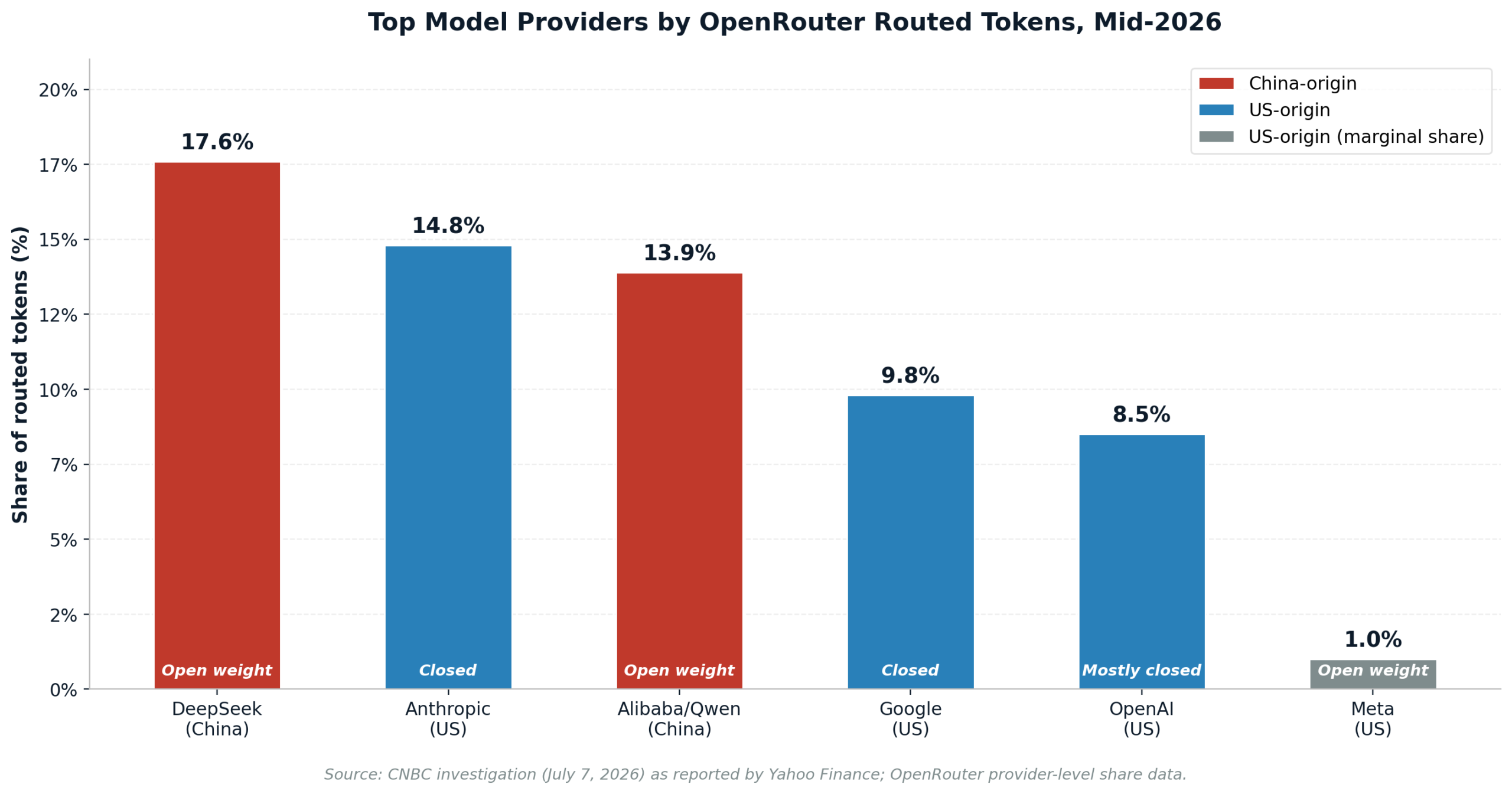
The letter arrives against a measurable shift in the global AI market. As of mid-2026, Chinese-origin models account for 46.4 percent of tokens routed through OpenRouter, the largest neutral model marketplace, according to a CNBC investigation published July 7, 2026. That is up from 4.5 percent in the first half of 2025. DeepSeek at 17.6 percent is now the single largest provider on the platform, ahead of Anthropic at 14.8 percent and Alibaba’s Qwen family at 13.9 percent. Six of the eight leading Chinese AI labs release their core models under permissive open-weight licenses, while the top U.S. frontier systems from OpenAI, Anthropic, and Google DeepMind remain closed with the exception of OpenAI’s August 2025 gpt-oss release (Yahoo Finance, 2026; SecNews, 2026; OpenAI, 2025).
Key finding. The debate over open-weight AI has moved from principle to policy. Both the July 2025 White House AI Action Plan and this week’s Microsoft- and Nvidia-hosted coalition letter frame open-weight models as strategically important. Independent data confirm rapid Chinese lead in this segment. What remains contested is whether wider release of frontier weights strengthens American technology leadership on balance or introduces security exposure that closed development can better contain. This report presents the arguments, the numbers behind them, and the questions the data does not settle.
A coalition letter co-hosted by Microsoft and Nvidia, signed by 25 companies and institutions, argues that open-weight AI models should be the foundation of American technology policy. Independent data show open weights are already the foundation of global usage, though the largest providers are increasingly Chinese. What the letter asks, what the data shows, and what remains unresolved.
On July 24, 2026, the letter titled “Open Weights and American AI Leadership” was published on Microsoft’s corporate responsibility page and mirrored as a PDF on Nvidia’s own image servers. Microsoft chief executive Satya Nadella shared the letter on X, and Nvidia chief executive Jensen Huang used his first-ever X post to circulate the same document. Huang’s post drew millions of views on its first day (Microsoft, 2026; Nvidia, 2026; Huang, 2026). The letter itself carried 25 signatories, including Microsoft, Nvidia, Meta, IBM, Palantir, Perplexity, Andreessen Horowitz, Y Combinator, The Linux Foundation, Hugging Face, Mistral, Mozilla, Dell Technologies, CrowdStrike, Box, ServiceNow, Reflection, Replit, and several venture and startup entities (American Innovators Network et al., 2026).
The letter’s argument follows a specific analogy. In the 1980s and 1990s, open-source software gradually replaced closed proprietary code as the base layer of the internet, of government computing, and of the world’s largest technology companies. The letter argues that open-weight AI models occupy the same position in the current moment. The signatories propose four benefits: broader access to the AI economy, stronger competition, more control for enterprises and governments deploying models, and better security through the ability of many teams to inspect and remediate vulnerabilities (American Innovators Network et al., 2026, pp. 1-2).
The letter also acknowledges what it calls “real and distinct risks” of open release. Once weights are downloaded, the original developer loses control. Modified versions become difficult to trace. The letter argues, however, that the right response is not prohibition but expanded compute access, shared training resources, and legal frameworks that distinguish legitimate distillation from unlawful extraction. This report examines the argument, the data behind it, and where the disagreement lies.
The Terms of the Debate
The terminology matters. An open-weight model is a model whose trained parameters, the numerical values that determine its behavior, are made publicly downloadable. This is distinct from open-source software in a strict sense, because most open-weight releases do not include the training data or the complete code used to produce the weights. OpenAI, in its August 2025 release, made this distinction explicit: gpt-oss-120b and gpt-oss-20b were “open-weight” not “open-source” in the strong meaning of the term (OpenAI, 2025). The industry has settled on open-weight as the working label for models where the trained parameters are freely downloadable under a permissive or semi-permissive license.
Closed models, by contrast, are accessed only through the developer’s API. Users cannot download the weights, cannot inspect the internal parameters directly, cannot run the model on their own infrastructure, and cannot fine-tune it except through the developer’s tools. GPT-5, Claude Opus 4.6, and Gemini 3 Pro are the three flagship examples of closed models as of mid-2026.
Between these two categories sits a spectrum. Meta’s Llama family shipped for years under a permissive license that allowed commercial use. Mistral began open and shifted portions of its output to closed access. DeepSeek releases its weights under an MIT license. Alibaba’s Qwen family releases under Apache 2.0. OpenAI’s gpt-oss family released in August 2025 under Apache 2.0. Google, Anthropic, and OpenAI’s flagship models remain closed (OpenAI, 2025; Yahoo Finance, 2026).
What the Usage Data Shows
OpenRouter is a neutral marketplace that routes user requests to more than a hundred AI models from dozens of providers. Because it charges no premium for any particular model, its routed-token data captures market preference at scale. A CNBC investigation published July 7, 2026 and reproduced by Yahoo Finance reported that Chinese-origin AI models accounted for 46.4 percent of OpenRouter’s routed tokens by mid-2026, compared with 35.7 percent from U.S.-origin models (Yahoo Finance, 2026).
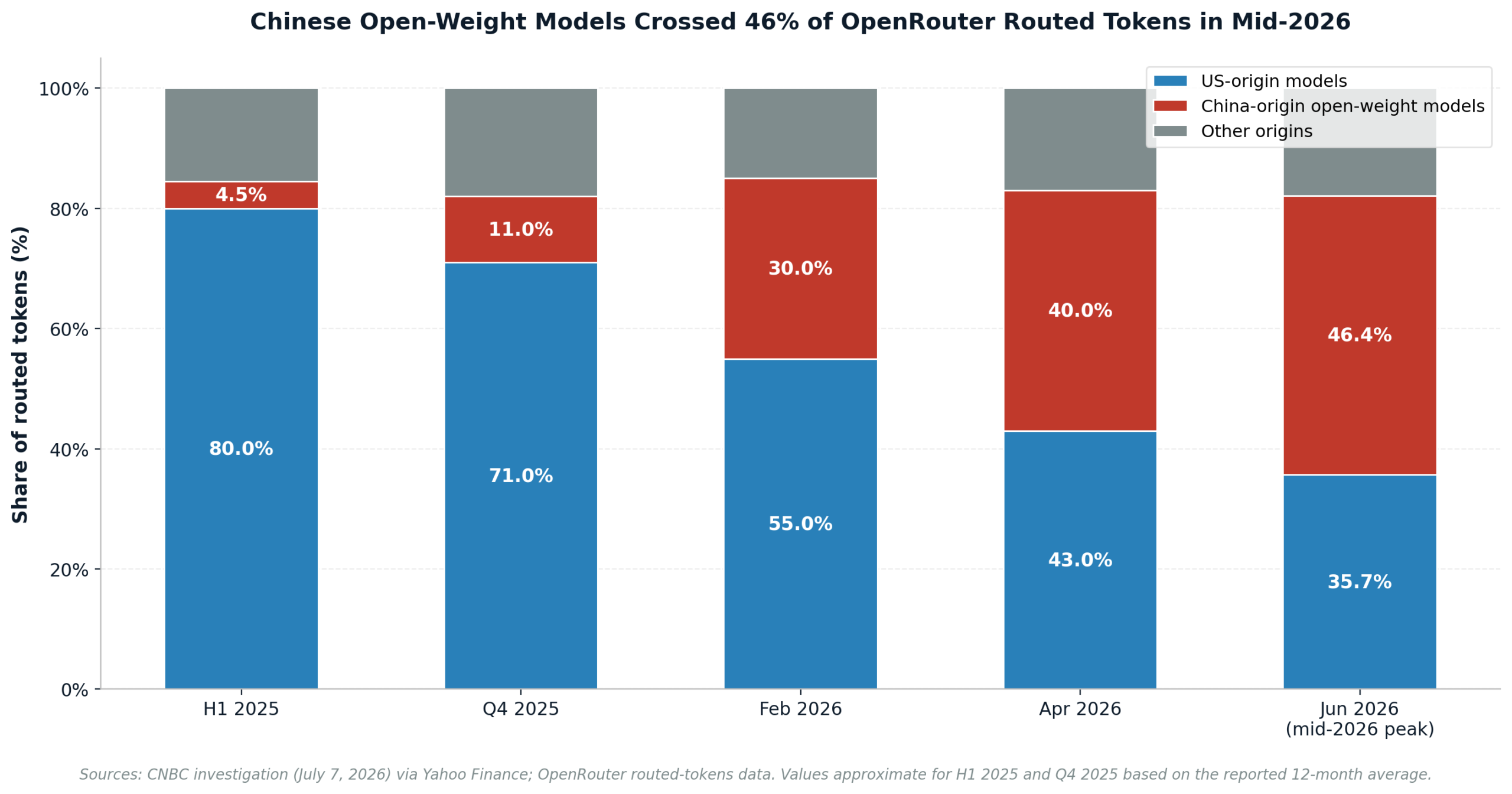
The trajectory is the more striking figure. As recently as the first half of 2025, U.S. models accounted for roughly four in five routed tokens on the platform, with Chinese models near 4.5 percent. Weekly readings show Chinese share crossed 30 percent by February 2026 and has held above that level ever since (Yahoo Finance, 2026; FuTu News, 2026).
At the provider level, DeepSeek is now the single largest vendor on OpenRouter at 17.6 percent of routed tokens, roughly 5.13 trillion tokens per week. Anthropic, the largest U.S.-origin provider, is second at 14.8 percent. Alibaba’s Qwen family is third at 13.9 percent. Meta, whose Llama family defined open-weight AI in 2023 and 2024, has fallen below 1 percent of routed volume as its release cadence slowed and Chinese labs shipped newer, better-priced alternatives (Yahoo Finance, 2026; Data Gravity, 2026).
Hugging Face, the largest open-source model repository, provides a second view of adoption. Alibaba’s Qwen family crossed 700 million cumulative downloads on Hugging Face by early 2026, according to the South China Morning Post; DeepSeek passed 200 million cumulative downloads in the same period; Meta’s Llama family reached approximately 350 million cumulative downloads by August 2024 (Alibaba Cloud, 2026 via SecNews; Presenc AI, 2026; Meta AI, 2024). A joint MIT and Hugging Face analysis published in late 2025 estimated that Chinese organizations accounted for 17.1 percent of open-source AI model downloads globally, ahead of U.S. organizations at 15.8 percent (CHOSUNBIZ, 2026).
The Price Signal
Behind the volume shift is a pricing gap. Open-weight Chinese models compete on price aggressively, and the aggregate pricing gap versus U.S. frontier closed models is roughly an order of magnitude at the flagship tier and larger below that.
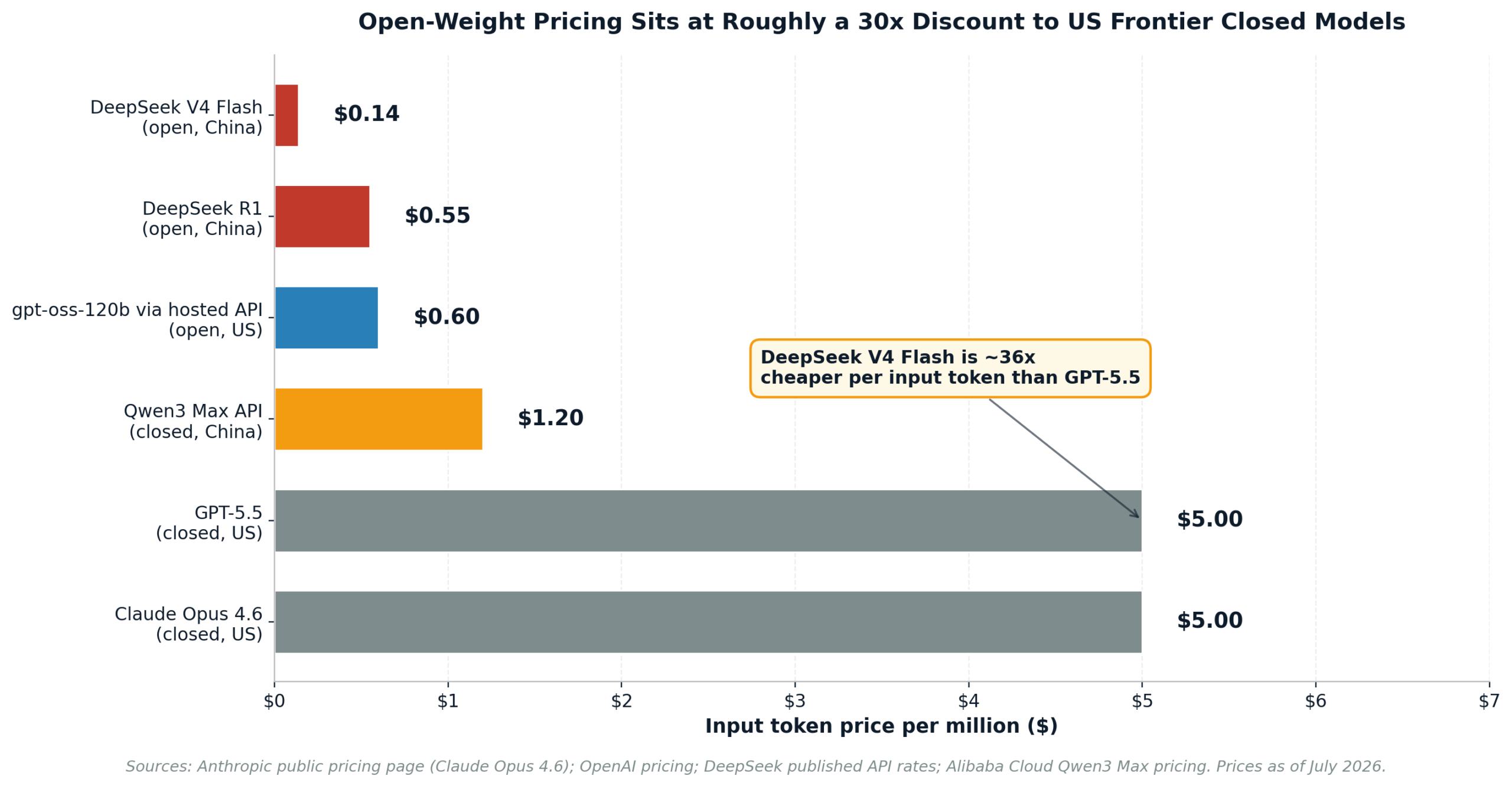
DeepSeek V4 Flash lists at 14 cents per million input tokens; GPT-5.5 and Claude Opus 4.6 both list at 5 dollars per million input tokens on their respective public pricing pages, roughly a 36-fold gap. Even OpenAI’s own open-weight gpt-oss-120b, priced by third-party hosts at around 60 cents per million input tokens, is roughly an order of magnitude cheaper than the US frontier closed models. Whether the pricing gap reflects lower training costs, subsidized compute, aggressive commercial positioning, or a combination is not resolved by the public data. What is not disputed is that customers responded (Yahoo Finance, 2026; Anthropic, 2026; OpenAI, 2025).
The policy context. On July 23, 2025, the White House released “America’s AI Action Plan,” which explicitly identified open-source and open-weight AI models as having “unique value for innovation” and directed federal agencies to expand compute access for researchers and startups, incentivize open dataset release, and avoid regulatory restrictions that would push AI development overseas (The White House, 2025). Twelve days later, on August 5, 2025, OpenAI released gpt-oss-120b and gpt-oss-20b under an Apache 2.0 license, its first open-weight release since GPT-2 in 2019 (OpenAI, 2025). The July 24, 2026 coalition letter now aims to translate that policy direction into a legislative agenda.
The Argument For
The letter’s proponents put forward four measurable benefits.
Access to the AI economy. Startups, small businesses, universities, and government agencies can build with advanced models without paying frontier prices or training from scratch. The letter argues this diffuses AI into the workflows of “factories, hospitals, farms, classrooms, and main street businesses” (American Innovators Network et al., 2026, p. 1).
Competition. By allowing many organizations to build, adapt, and deploy advanced models, open weights foster rivalry across model developers, chip vendors, cloud platforms, and application layers. This is the argument that ties both Microsoft’s cloud interest and Nvidia’s chip interest to the open-weight cause. A world where dozens of open-weight models compete tends to spread compute purchases across many buyers, all of whom need chips and cloud capacity.
Customer control. Open weights give enterprises and governments deploying AI systems the ability to run models on their own infrastructure, keep sensitive data in-house, and avoid vendor lock-in. The letter notes that many businesses and public agencies have data they cannot legally or securely send to a closed API vendor. Six months of MIT-Hugging Face survey data supports this: government and regulated-industry demand for on-premises deployment options was a leading purchase driver in 2025 (Massachusetts Institute of Technology and Hugging Face, 2025).
Reasoning about that argument, the letter cites the 1980s open-source software analogy: transparency became more secure than obscurity for the internet’s infrastructure, and openness enabled a much larger community of defenders to identify vulnerabilities than a closed model would have permitted (American Innovators Network et al., 2026, p. 2).
The Argument Against
Critics of open-weight release cite three broad concerns.
Loss of control after release. Once weights are downloadable, the developer cannot recall them. If a downstream user removes safety fine-tuning or adds harmful capabilities, the modified model is beyond the original developer’s remediation. The letter itself acknowledges this: “Once released, the weights are beyond the original developer’s control, and modified versions are difficult to trace or reverse” (American Innovators Network et al., 2026, p. 1). The disagreement is over whether this risk is best managed by prohibiting release or by other means.
Strategic-competition concerns. Open-weight releases from U.S. developers can be freely used by any downstream party, including foreign firms and foreign governments. The U.S. government’s July 2025 AI Action Plan navigates this tension by encouraging open-weight release for economic and research purposes while maintaining export controls on the most advanced training compute. Whether the current settlement fully addresses the concern is debated (The White House, 2025).
Safety evaluations. Closed frontier models can be safety-tested and adjusted between versions in a way that open-weight models cannot. Once weights are public, all future fine-tunes and derivatives inherit the base model’s underlying capabilities, including capabilities that a closed developer might have withheld through fine-tuning. Advocates of restricting open-weight release argue that this asymmetry justifies retaining more capability behind closed access.
This report does not take a position on which side of the argument is more persuasive. It records that both sides are represented in mainstream policy discussion, that the July 2025 Action Plan settled the current U.S. federal position in favor of encouraging open-weight release, and that the July 24, 2026 coalition letter argues that position should be reinforced legislatively.
What the Data Does Not Say
The OpenRouter data cited above measures token routing on a single, though influential, marketplace. It is not a direct measure of enterprise deployment share, of end-user preference, or of revenue. Some U.S.-origin closed models are used at scale outside OpenRouter through direct enterprise contracts that do not appear in the marketplace data. Anthropic’s total enterprise footprint, for example, includes very large deployments through its own API and through Amazon Bedrock that do not route through OpenRouter.
Similarly, Hugging Face download counts measure interest and experimentation but do not measure sustained production use. A researcher downloading a model to evaluate it counts equally with a business embedding it in a live system. Both metrics are useful directional signals; neither is a full accounting.
The letter does not disclose which signatory funded, drafted, or coordinated its production. Reasonable inference, given that the canonical text is hosted on Microsoft’s corporate responsibility page while the PDF is mirrored on Nvidia’s image servers and both companies’ chief executives amplified it on the same day, is that the effort was jointly organized by Microsoft and Nvidia, but the letter itself does not state that. The commercial interests of the signatories are not uniform: Nvidia sells chips, Microsoft sells cloud capacity and Azure AI services, Meta and Mistral distribute open-weight models, Andreessen Horowitz has funded multiple open-weight startups, and IBM and Palantir sell services that benefit from both open and closed model deployment. Readers should weigh those interests in interpreting the letter’s arguments.
What to Watch
Four measurable series will indicate how the open-weight debate evolves over the second half of 2026.
- OpenRouter monthly provider share. Whether U.S.-origin share stabilizes near 36 percent, recovers on the strength of gpt-oss and any follow-on U.S. open-weight releases, or continues to slip.
- Congressional activity on the AI Action Plan. Whether the coalition letter’s specific policy asks, expanded NAIRR compute, shared training assets, avoidance of premature restrictions, and legal frameworks distinguishing distillation from misappropriation, appear in legislative or agency implementation over the next twelve months.
- New open-weight releases from U.S. labs. Meta’s next Llama release, any additional gpt-oss releases from OpenAI, and possible open-weight moves from Anthropic or Google. Each would test whether the U.S. share on OpenRouter can rebound.
- Chinese labs’ license terms. Whether the leading Chinese labs continue releasing under MIT or Apache 2.0, or shift toward more restrictive licensing as their commercial reach expands. A shift in either direction would materially change the openness landscape.
Bottom line. The Microsoft- and Nvidia-hosted coalition letter argues that open-weight AI models are the foundation of American technology leadership. Independent OpenRouter, Hugging Face, and MIT-Hugging Face data show that open-weight models are already the foundation of global usage, but the largest single provider is now Chinese, not American. Whether wider U.S. open-weight release strengthens or weakens American AI leadership is a policy question that the current data does not resolve. What the data does establish is that the closed-versus-open choice is not an abstract debate. It is the choice that has already reshaped the model market between the first half of 2025 and mid-2026.
References
American Innovators Network, Andreessen Horowitz, Arcee AI, Arena, Black Forest Labs, Box, CrowdStrike, Dell Technologies, Emergence Capital, Hugging Face, IBM, The Linux Foundation, Mariana Minerals, Meta, Microsoft, Mistral, Mozilla, NVIDIA, Palantir, Perplexity, Reflection, Replit, ServiceNow, Telnyx, & Y Combinator. (2026, July 24). Open weights and American AI leadership. Microsoft Corporate Responsibility (canonical) and NVIDIA (PDF mirror). https://images.nvidia.com/pdf/Open-Weights-and-American-AI-Leadership.pdf
Microsoft. (2026, July 24). Open Weights and American AI Leadership. Microsoft Corporate Responsibility. https://www.microsoft.com/en-us/corporate-responsibility/topics/open-weight/
Nvidia. (2026, July 24). Open-Weights and American AI Leadership [PDF]. https://images.nvidia.com/pdf/Open-Weights-and-American-AI-Leadership.pdf
Fortune. (2026, July 24). Nvidia, Microsoft lead call for open-weight AI models after Kimi. https://fortune.com/2026/07/24/nvidia-microsoft-lead-call-for-open-weight-ai-models-after-kimi/
Anthropic. (2026, February 5). Introducing Claude Opus 4.6. https://www.anthropic.com/news/claude-opus-4-6
Check.AI. (2026, May 10). Best Chinese AI model 2026: DeepSeek, Qwen, Kimi, GLM. https://checkaimodels.com/en/articles/china-ai-models-landscape-2026/
CHOSUNBIZ. (2026, February 8). China leads AI open source as DeepSeek spurs global shift. Chosun Biz. https://biz.chosun.com/en/en-it/2026/02/08/PHMHAGLWUZHGJA4PFFA4WIJTTU/
Data Gravity. (2026, June 24). China’s open-weight takeover. By Chris Zeoli. https://www.datagravity.dev/p/chinas-open-weight-takeover
FuTu News. (2026, February 27). Chinese open-source models overtake the United States in OpenRouter usage. https://news.futunn.com/en/post/69364404/the-token-price-is-too-high-and-chinese-open-source
Huang, J. [@JensenHuang]. (2026, July 24). For my first post, I’m sharing a letter @NVIDIA signed on why open models matter [Post]. X. https://x.com/JensenHuang/status/2080643682408321103
Meta AI. (2024, August 29). Llama models pass 350 million cumulative downloads. https://www.computerworld.com/article/3499062/metas-llama-models-get-350-million-downloads.html
Massachusetts Institute of Technology, & Hugging Face. (2025). 2025 open-source AI adoption survey. Referenced in Chosun Biz, February 2026.
OpenAI. (2025, August 5). Introducing gpt-oss-120b and gpt-oss-20b. https://openai.com/index/gpt-oss-model-card/
Presenc AI. (2026, May 23). Top organizations on Hugging Face 2026 by downloads. https://presenc.ai/research/top-organizations-on-huggingface-2026
SecNews. (2026, July 8). Chinese AI models 2026: DeepSeek, Qwen, GLM and the rest of the top ones. https://www.secnews.gr/en/720190/kinezika-ai-montela-2026-deepseek-qwen-glm/
TokenMix. (2026, April 23). Best Chinese AI models 2026 comparison guide. https://tokenmix.ai/blog/best-chinese-ai-models-2026-comparison-guide
The White House. (2025, July 23). America’s AI action plan. Office of Science and Technology Policy. https://www.whitehouse.gov/wp-content/uploads/2025/07/Americas-AI-Action-Plan.pdf
Yahoo Finance. (2026, July 9). Chinese AI models now capture up to 46% of US enterprise token usage. https://finance.yahoo.com/technology/ai/articles/chinese-ai-models-now-capture-020440715.html