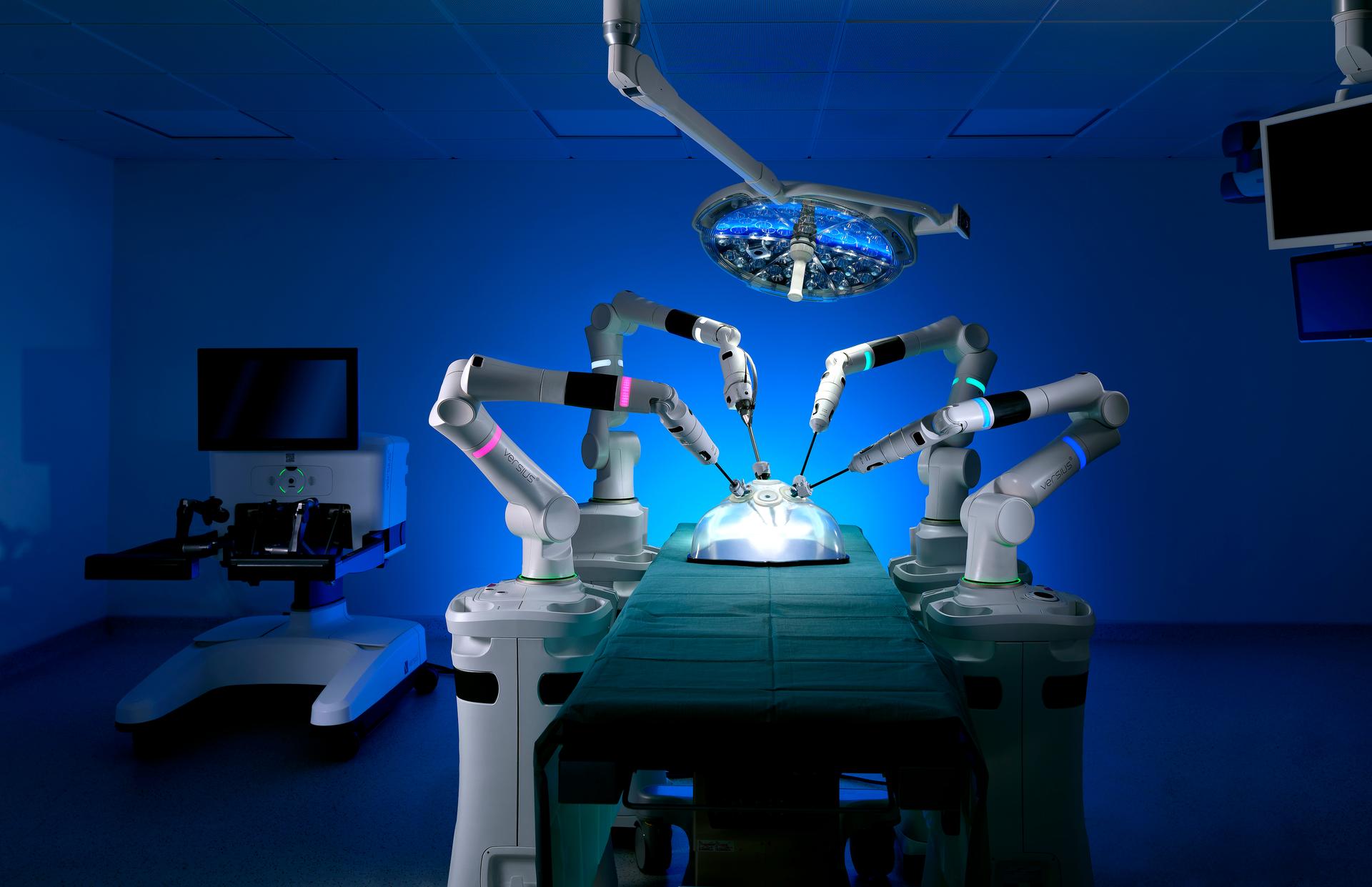

CMR Surgical is challenging the dominant model in robotic surgery by building a modular, portable, and affordable platform designed for the hospitals that the current generation of surgical robots has left behind.
In a hospital in Cambridge, England, a surgical robot the size of a human arm is performing a cholecystectomy. Unlike the room-filling systems that dominate operating theaters worldwide, this one rolls between rooms on wheels, costs a fraction of the competition, and just contributed nearly 500 hours of surgical data to train the next generation of AI surgical models. This is Versius, and the company behind it is betting that the future of robotic surgery is not bigger machines but smarter, smaller, more accessible ones.
Section 1: The Company
CMR Surgical was founded in 2014 in Cambridge, United Kingdom, with a mission that reads as a direct rebuke of the status quo in robotic surgery: to make robotic minimally invasive surgery “universally accessible and affordable.” That mission statement is not merely aspirational. It is a deliberate competitive positioning against Intuitive Surgical, the $180 billion American company that has dominated the market for more than two decades with a high-cost, high-margin business model built around the da Vinci system (Cambridge Innovation Capital, 2025).
Since its founding, CMR has raised $1.32 billion in total funding across multiple rounds, making it the best-funded surgical robotics startup in the world according to data from Dealroom, as cited by Cambridge Innovation Capital (Cambridge Innovation Capital, 2025). The company achieved a $3 billion valuation as of its 2021 Series D round.
The funding journey tells a story of accelerating investor conviction. An early Series A of $12 million in 2016 established the foundational research base. A $100 million Series B in 2019, led by Ally Bridge Group, signaled that institutional capital was beginning to take the robotic surgery challenger thesis seriously. Then SoftBank Vision Fund arrived: a $240 million Series C in 2020, followed by a landmark $600 million Series D in 2021 alongside Ally Bridge, vaulting CMR’s valuation to $3 billion and cementing its position as Europe’s preeminent surgical robotics company (Surgical Robotics Technology, 2025).
The most recent financing round, announced in April 2025, raised over $200 million in a combination of equity and debt capital. Existing major investors including SoftBank, LightRock, and Ally Bridge participated. Trinity Capital provided $68 million of the debt component. The round drew public endorsement from the UK government: Lord Vallance, the UK Science Minister, stated that the financing was “a clear vote of confidence in the company, the potential of surgical robotics, and in the UK’s life science ecosystem, which continues to produce innovative companies at an impressive rate” (Cambridge Innovation Capital, 2025).
CMR Surgical employs approximately 800 people and is led by CEO Massimiliano Colella, who described the company’s current moment as “a pivotal stage, poised to capitalise on significant opportunities for market expansion, including in the US, while continuing to penetrate deeper into existing markets” (Surgical Robotics Technology, 2025).
Section 2: What Versius Solves
The clinical case for robotic minimally invasive surgery is well established. Compared to open surgery, robotic-assisted procedures are associated with reduced blood loss, shorter hospital stays, lower rates of wound infection, and faster patient recovery. A comprehensive clinical assessment published in the Journal of Clinical Medicine confirmed these outcomes across colorectal, visceral, and gynecological procedures performed with the Versius system, finding no procedure-related mortalities across 328 patients and median hospital stays of one to six days depending on procedure type (Alkatout et al., Journal of Clinical Medicine, 2022).
The problem is not clinical efficacy. The problem is access. Intuitive Surgical’s da Vinci systems carry price tags of $1.5 to $2.5 million per unit, require dedicated operating rooms, and carry expensive per-procedure consumable costs. These economics exclude the majority of hospitals worldwide, particularly in emerging markets, community hospital settings, and health systems operating under tight capital budgets. Intuitive has built an installed base of more than 9,500 systems across more than 25 years, but that installed base represents a small fraction of the surgical volume that could benefit from robotic assistance (Cambridge Innovation Capital, 2025).
Versius was designed from the ground up to solve these structural barriers. Several design decisions distinguish it from conventional robotic surgery systems:
- Modular and portable architecture: Each robotic arm sits on its own wheeled base. Arms can be added or removed depending on procedure requirements, and the entire system can be moved between operating rooms. No dedicated OR is required; hospitals can switch between robotic and conventional laparoscopic procedures in the same space.
- Open console design: The surgeon uses 3D glasses at an open console rather than being enclosed in a viewing pod. This preserves line-of-sight communication between the surgeon and the operating room team, a feature that surgeons who train on da Vinci systems often cite as a limitation of that platform.
- 5mm instrument diameter with 7 degrees of freedom: The V-wrist technology permits 360 degrees of wrist motion, enabling the full range of laparoscopic instrument movement. The 5mm instrument size is consistent with conventional laparoscopic port sizes, meaning port placement can duplicate laparoscopic setups without modification (Alkatout et al., Journal of Clinical Medicine, 2022).
- Haptic feedback: Versius provides the surgeon with force feedback, allowing them to physically sense tissue resistance during manipulation. The da Vinci system has historically lacked haptic feedback, a gap that some surgeons consider a meaningful limitation for tasks requiring delicate tissue handling (Alkatout et al., Journal of Clinical Medicine, 2022).
- Reusable instruments: Versius instruments are reusable, pre-programmed with a maximum number of uses, which meaningfully reduces per-procedure consumable costs compared to systems relying on single-use instrumentation (FDA De Novo Review DEN230078, 2023).
Versius has now been used in more than 40,000 procedures globally, spanning colorectal, gynecology, thoracic, urology, and general surgery (Surgical Robotics Technology, 2025). It is installed in hospitals across Europe, Asia, the Middle East, and Australia. The most recent generation, Versius Plus, incorporates vLimeLite fluorescence visualization for indocyanine green (ICG) imaging, enabling surgeons to assess tissue perfusion and identify anatomical structures with greater precision.
For U.S. market access, CMR received FDA De Novo marketing authorization for cholecystectomy in October 2024. The De Novo submission (DEN230078) classified the Versius Surgical System as a Class II modular electromechanical surgical device, establishing a new product code (SCV) for this category of system (FDA De Novo Review DEN230078, 2023). Versius Plus is now 510(k) cleared and available in the United States.
Section 3: The NVIDIA Partnership and GTC 2026
At NVIDIA’s GTC 2026 conference, CMR Surgical announced its participation in NVIDIA’s Physical AI healthcare initiative, a development that signals a strategic ambition beyond hardware manufacturing. The announcement reframes CMR not just as a surgical robot company, but as a surgical data company with the potential to shape the AI infrastructure of the next generation of robotic surgery (GlobeNewswire, 2026).
CMR contributed nearly 500 hours of anonymized surgical data from the Versius system to Open-H, described as the world’s largest open dataset for healthcare robotics. This contribution represents the largest single share of data in the initiative, drawn from real-world surgical procedures across CMR’s global installed base (Medical Device Network, 2026). Open-H combines real-world surgical video, robotic telemetry, and multimodal data from leading healthcare and robotics organizations.
Open-H underpins Isaac GR00T-H, described as an open vision-language-action model for healthcare robotics. Isaac GR00T-H combines computer vision, natural language processing, and robotic control into a single foundation model. It is designed to enable robotic systems to better interpret complex surgical environments and tasks, and to accelerate the development of intelligent surgical systems while maintaining safety and clinical oversight (Medical Device Network, 2026).
In parallel, CMR is using NVIDIA Cosmos-H, a simulation platform for healthcare, to generate physically accurate synthetic surgical data and to train and evaluate new robotic policies for future Versius development prior to clinical deployment. This means CMR can iterate on robotic behaviors in simulation before those behaviors ever reach a patient (GlobeNewswire, 2026).
Chris Fryer, Chief Technology Officer at CMR Surgical, articulated the strategic rationale: “Surgical robotics generates a rich understanding of how procedures are performed. By contributing real-world surgical data to collaborative initiatives like Open-H, we are helping build the foundations for the next generation of intelligent surgical systems. Because Versius is the most software-driven robot on the market, we were well-placed to share our data with the wider ecosystem. Our focus is on technologies that support surgeons and expand access to minimally invasive surgery. Combining clinical data with advances in AI and simulation creates a powerful opportunity to accelerate innovation responsibly” (GlobeNewswire, 2026).
NVIDIA’s head of healthcare business development, David Niewolny, reinforced the broader vision: “The next generation of surgical robotics will be powered by data, simulation and AI working together. By responsibly contributing surgical data and training open models on NVIDIA’s physical AI platform, medical technology leaders like CMR Surgical are accelerating a new generation of intelligent robotic systems that can assist surgeons, scale surgical expertise and ultimately expand access to high-quality care” (GlobeNewswire, 2026).
The strategic implication is considerable. Every Versius procedure generates anonymized data on how surgeons interact with tissue, how instruments move, and how procedures unfold in real time. At scale, this data corpus becomes a proprietary asset that informs the training of AI systems that could guide, assist, or eventually augment future surgeons. CMR’s willingness to contribute to the Open-H commons positions it as a founding data contributor to an infrastructure that will likely define the field for the next decade.
Section 4: The Flagship Product
Versius is sold on a business-to-business basis, targeting hospital systems, surgical centers, and healthcare networks. The pricing is not publicly disclosed, but industry positioning places it at roughly 40 to 60 percent of the cost of a comparable da Vinci system, which would represent a purchase price in the range of $600,000 to $1.5 million depending on configuration. The revenue model combines capital equipment sales with recurring income from consumables, service contracts, and training programs.
The system’s modular architecture means hospitals can start with a smaller configuration and add arms as procedure volume grows, lowering the effective entry price compared to monolithic systems. The absence of a dedicated OR requirement also reduces facility infrastructure costs, which in many cases can approach the cost of the robot itself when building out a conventional robotic surgery suite.
Versius is now the second most-adopted soft tissue surgical robot in the world, behind Intuitive Surgical’s da Vinci, according to CMR’s own characterization and independent market observers (Cambridge Innovation Capital, 2025). Its installed base spans multiple continents, with particularly strong penetration in European health systems where procurement frameworks are more receptive to alternatives to Intuitive.
Competitors in the broader robotic surgery landscape include:
- Intuitive Surgical (da Vinci Xi/SP): The dominant market incumbent with approximately 9,500 installed systems and 25 years of surgeon training data.
- Medtronic (Hugo RAS): A modular system from the world’s largest medical device company, also targeting the affordability gap.
- DistalMotion (Dexter): A Swiss startup offering a robotic assistance platform designed to be used with existing laparoscopic instruments.
- Moon Surgical: An early-stage robotic system focused on laparoscopic assistance with a different form factor and deployment model.
The launch of Versius Plus represents CMR’s most significant product iteration to date. In addition to the vLimeLite fluorescence visualization capability, the platform reflects software-driven improvements to the robotic intelligence layer, consistent with CMR’s self-description as “the most software-driven robot on the market.” FDA 510(k) clearance for Versius Plus in the United States positions CMR to compete in the world’s largest and most lucrative medical device market as it expands beyond the initial cholecystectomy indication.
Section 5: Funding and Market Context
CMR’s financing history reflects both the capital intensity of the surgical robotics sector and the level of institutional conviction behind the accessibility thesis. The table below summarizes the company’s funding rounds:
| Round | Year | Amount | Lead Investors |
|---|---|---|---|
| Series A | 2016 | $12M | Cambridge Innovation Capital |
| Series B | 2019 | $100M | Ally Bridge Group |
| Series C | 2020 | $240M | SoftBank Vision Fund |
| Series D | 2021 | $600M | SoftBank, Ally Bridge |
| Series D Extension | 2025 | $200M+ | PFM Health Sciences, SoftBank, LightRock, Trinity Capital |
| Total Raised | $1.32 Billion | ||
| Valuation (2021) | $3 Billion |
Sources: Surgical Robotics Technology (2025); Cambridge Innovation Capital (2025); TexAu (2026).
The broader market context in which CMR is operating is one of significant growth and structural disruption. The global surgical robotics market was valued at approximately $8 to $10 billion in 2025, with Intuitive Surgical commanding a market capitalization of roughly $180 billion as the dominant player. The table below provides a snapshot of key market metrics:
| Metric | Value |
|---|---|
| Global surgical robotics market (2025) | ~$8–10 billion |
| Versius procedures globally | 40,000+ |
| Countries with Versius installations | Multiple (Europe, Asia, Middle East, Australia, US) |
| CMR employees | ~800 |
| Intuitive Surgical market cap | ~$180 billion |
| Average da Vinci system cost | ~$1.5–2.5 million |
Sources: Cambridge Innovation Capital (2025); Surgical Robotics Technology (2025).
Section 6: Risks and Concerns
Any rigorous assessment of CMR Surgical must weigh the company’s strategic ambitions against a set of meaningful risks that investors, hospital procurement teams, and clinical administrators should consider.
Limited U.S. commercial footprint. The FDA De Novo authorization received in 2024 covers cholecystectomy only. The United States represents the world’s most lucrative surgical device market, and CMR’s current approved indication is a relatively narrow entry point. Expanding into colorectal, urological, thoracic, and gynecological procedures in the U.S. will require additional regulatory submissions and approvals, each of which takes years and carries execution risk (FDA De Novo Review DEN230078, 2023).
Competing against a deeply entrenched incumbent. Intuitive Surgical’s installed base of more than 9,500 systems, combined with more than 25 years of surgeon training and institutional familiarity, creates significant switching costs. Surgeons trained on da Vinci systems must retrain to use Versius, and hospital administrators who have already made the capital investment in da Vinci infrastructure have limited financial incentive to adopt a second platform. CMR’s competitive window is primarily in hospitals that have not yet adopted robotic surgery at all (Cambridge Innovation Capital, 2025).
Valuation uncertainty. CMR’s $3 billion valuation was established at the 2021 Series D. The April 2025 round of over $200 million was conducted at undisclosed terms. In the intervening period, the valuation has not been publicly re-marked, meaning the headline figure may not reflect current market pricing for the company’s equity (Surgical Robotics Technology, 2025).
Capital consumption without revenue transparency. CMR has raised over $1.32 billion since its founding, but the company does not publicly disclose revenue figures. For a company of this funding scale, the absence of revenue disclosure makes it difficult for external observers to assess capital efficiency, gross margins, or the timeline to profitability. The burn rate implied by the funding history is significant.
AI ambitions are a long-term journey. The NVIDIA partnership and Open-H contribution are strategically compelling, but the path from surgical data contributor to commercially deployed AI-powered surgical intelligence is a multi-year development and regulatory journey. Isaac GR00T-H and NVIDIA Cosmos-H represent foundational infrastructure; translating that infrastructure into clinical products that can be approved, adopted, and billed requires a separate and lengthy process.
U.S. market is where the real revenue is. CMR has demonstrated genuine traction in European markets and across emerging markets in Asia, the Middle East, and Australia. However, the U.S. represents a disproportionate share of global surgical device revenue, and CMR’s U.S. commercial launch is genuinely early-stage. The competitive dynamics in the U.S. are also more challenging, given the depth of Intuitive’s institutional relationships with American hospital systems.
Conclusion
CMR Surgical is playing a different game than Intuitive. Where Intuitive built a high-margin monopoly over two decades of installed base accumulation, CMR is building a modular, affordable platform designed for the 90 percent of the world that cannot afford a da Vinci system. The design principles of Versius, including portability, reusable instruments, open console communication, and haptic feedback, directly address the structural limitations that have kept robotic minimally invasive surgery out of reach for most hospitals globally.
The NVIDIA partnership and Cosmos-H integration suggest CMR’s long-term competitive moat may not be the hardware at all, but the surgical data it collects from every procedure. With nearly 500 hours of real-world surgical data already contributed to the world’s largest open healthcare robotics dataset, CMR is positioning Versius as the platform that trains the surgical AI of the future (GlobeNewswire, 2026; Medical Device Network, 2026).
The risks are real: a narrow U.S. regulatory footprint, a formidable incumbent, and a valuation that has not been publicly re-marked in four years. But the addressable market is vast, the clinical case for Versius is supported by peer-reviewed evidence, and the combination of modular hardware, software-driven architecture, and an accumulating surgical data corpus gives CMR a differentiated foundation that few competitors can credibly replicate. For hospital systems in markets underserved by current robotic surgery technology, and for investors tracking the convergence of physical robotics and AI, CMR Surgical is a company that merits close attention.
References
- Alkatout, I., Salehiniya, H., & Allahqoli, L. (2022). Assessment of the Versius Robotic Surgical System in Minimal Access Surgery. Journal of Clinical Medicine. https://pmc.ncbi.nlm.nih.gov/articles/PMC9267445/
- Cambridge Innovation Capital. (2025). SoftBank backs surgical robotics startup CMR Surgical in $200M+ round. https://www.cic.vc/softbank-backs-surgical-robotics-startup-cmr-surgical-in-200m-round/
- CMR Surgical. (2026). CMR Surgical Advances Physical AI to Support the Future of Robotic Surgery with NVIDIA. GlobeNewswire. https://www.globenewswire.com/news-release/2026/03/17/3256875/0/en/cmr-surgical-advances-physical-ai-to-support-the-future-of-robotic-surgery-with-nvidia.html
- CMR Surgical US site. https://us.cmrsurgical.com
- FDA. (2023). De Novo Review: DEN230078, Versius Surgical System, CMR Surgical Limited. https://www.accessdata.fda.gov/cdrh_docs/reviews/DEN230078.pdf
- Law, R. (2026). CMR Surgical outlines role in NVIDIA’s surgical robot training initiative. Medical Device Network. https://www.medicaldevice-network.com/news/cmr-surgical-outlines-role-in-nvidia-surgical-robot-training-initiative/
- NVIDIA. (2026). NVIDIA and Global Robotics Leaders Take Physical AI to the Real World. https://investor.nvidia.com/news/press-release-details/2026/NVIDIA-and-Global-Robotics-Leaders-Take-Physical-AI-to-the-Real-World/default.aspx
- Surgical Robotics Technology. (2025). CMR Surgical Closes Over $200M to Accelerate Growth. https://www.surgicalroboticstechnology.com/news/cmr-surgical-closes-over-200m-to-accelerate-growth/
- TexAu. (2026). CMR Surgical company profile. https://www.texau.com/profiles/cmr-surgical