
A $2 billion bet on an AI system that herds cattle from a smartphone is either the most prescient investment in agriculture’s history, or a cautionary tale waiting to happen. Peter Thiel appears to believe it is the former.
A rancher in Colorado taps a button on his phone. Across 5,000 acres of open pasture, 800 cattle wearing solar-powered smart collars begin moving toward a fresh grazing paddock. No cowboys. No horses. No fences. Just an algorithm that speaks cow. Halter, a New Zealand startup, calls it the “cowgorithm,” and Founders Fund, the venture firm co-founded by Peter Thiel, just valued it at $2 billion.
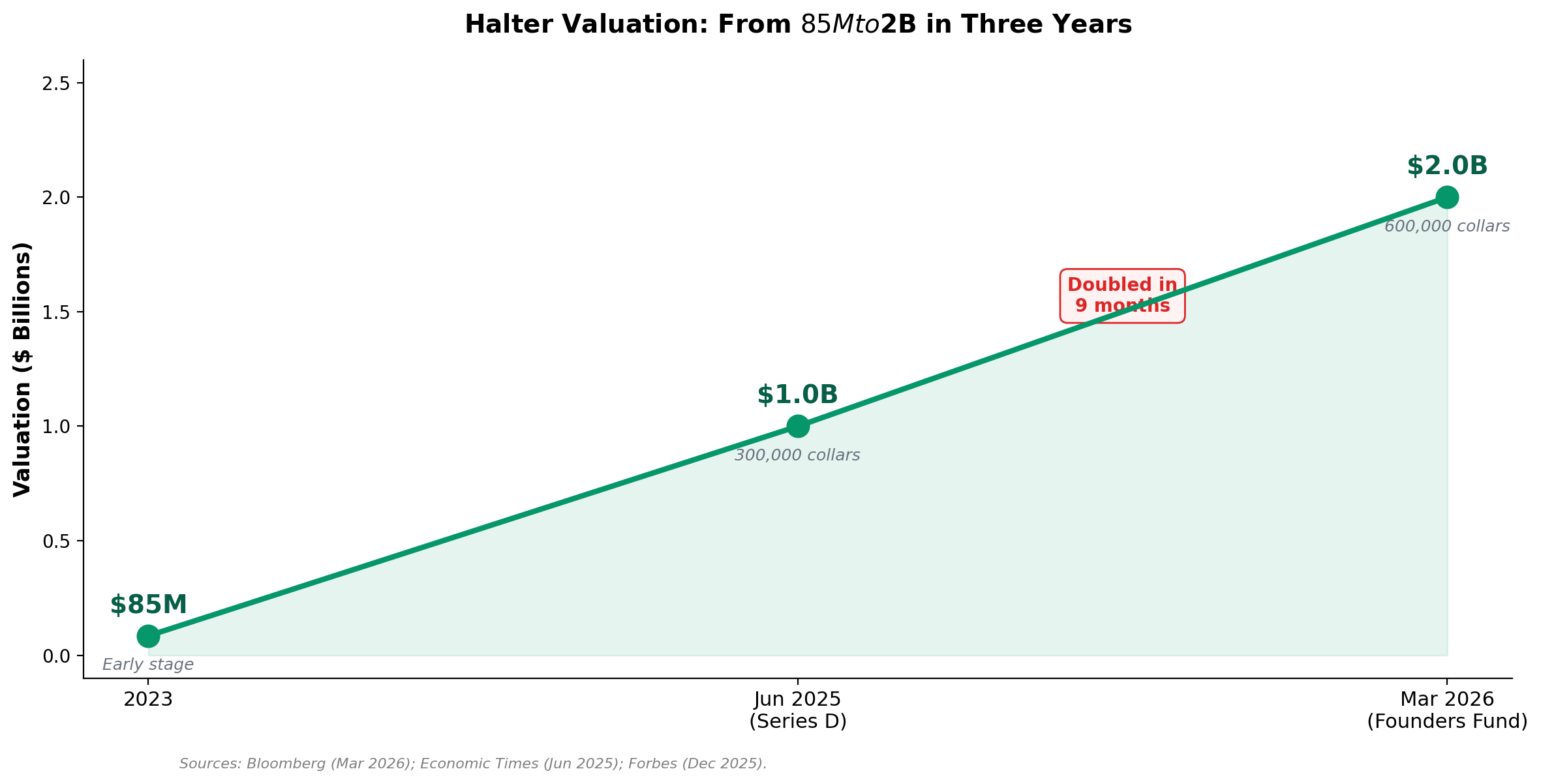
That valuation, reported by Bloomberg in March 2026, doubles Halter’s previous unicorn milestone reached just nine months earlier. The round is reportedly oversubscribed, with investor demand exceeding available allocation. In an agtech sector littered with failed startups and retreating venture capital, that kind of conviction demands scrutiny.
The Company Behind the Collar
Halter was founded in 2016 in Auckland, New Zealand, by Craig Piggott, who grew up on a dairy farm in the Waikato region. His upbringing was not a pastoral idyll: his parents began their workday at 4 a.m. and regularly logged more than 100 hours a week. That experience shaped both his appreciation for farming and his conviction that it needed to change.
Piggott studied Mechanical Engineering at the University of Auckland, graduating in 2016. He then spent roughly nine months at Rocket Lab, Peter Beck’s satellite launch company, where Beck later described him as “one of those individuals who clearly had the potential for success in any endeavor he pursued” (Forbes, 2025). The pull of farming was stronger than the pull of aerospace, and Piggott departed to start Halter with a university friend.
“I kept thinking about farming,” Piggott told Halter’s own blog. “It’s in my blood, and I wanted to use what I’d learned to help farmers like my family” (Halter, 2025).
The Forbes 30 Under 30 Asia honoree (2021) is now 31, leading a company with more than 180 staff across New Zealand, Australia, and the United States. Halter launched U.S. operations in Colorado in August 2024 and now operates across 22 U.S. states, with more than 1,300 dairy and beef farms total across its three markets (Forbes, 2025). Perhaps the most striking metric: the company had deployed approximately 300,000 collars by mid-2025. By March 2026, that figure had crossed 600,000. The collar count doubled in nine months.
How the Technology Works
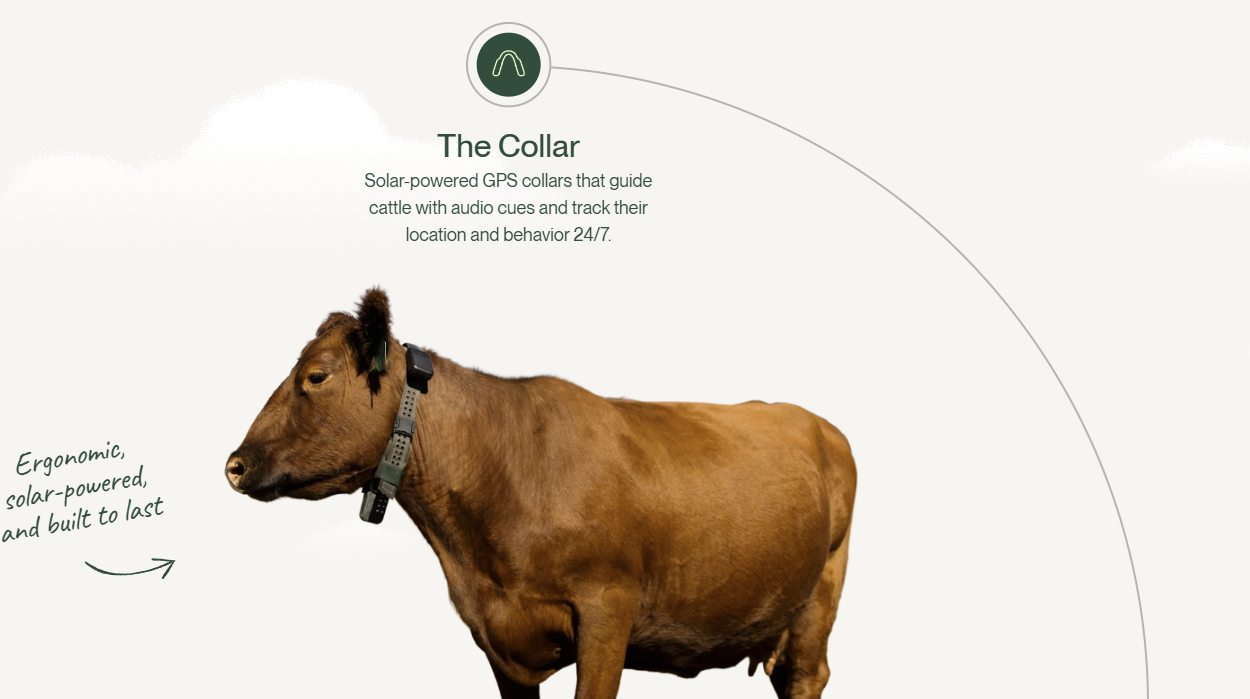
At first glance, the product is a black plastic collar with a solar panel buckle. Under the surface, it is a purpose-built sensing and actuation platform with a communication architecture designed for the physical constraints of remote ranching.
Each collar is GPS-enabled and solar-powered, eliminating the need for battery replacements across thousands of animals. The collars communicate via LoRaWAN (long-range wireless area network) towers installed on the property. The communication loop runs collar to tower, tower to app, and app commands back through towers to collars. This design keeps latency low and reliability high even across tens of thousands of acres with no cellular infrastructure (Halter, 2025).
Virtual fencing is the headline feature. A rancher draws boundaries directly on satellite imagery in the app. When a cow approaches a boundary, the collar emits a directional audio tone on the side toward the boundary, signaling the animal to turn away. If the animal ignores repeated cues, a low-energy electric pulse, roughly one-tenth the strength of a conventional electric fence, is applied. Most cattle respond to sound cues alone after an initial training period of two to three days (Halter, 2025).
The directional audio system is what distinguishes Halter from simpler virtual fencing products. Instead of a single cue that tells an animal it has crossed a line, the collar gives left and right audio signals, providing guidance rather than just correction. Cattle learn which way to move, not just that they have reached a limit. This is what enables the herding function: vibration cues prompt animals to move toward fresh feed, allowing full paddock rotations without human presence.
Beyond fencing, each collar continuously monitors digestion via jaw movement patterns, fertility cycles for heat detection, overall movement, and behavioral anomalies. Halter reports that its system captures 6,000 data points per minute per cow. The company’s machine learning system, the “cowgorithm,” translates those data streams into two directions simultaneously: farmer intent into signals the animal understands, and animal behavior into decisions the farmer can act on. The collars can detect health issues days before a human observer would notice visible symptoms, enabling early intervention that reduces treatment costs and mortality rates.
The Problem It Solves
The case for Halter rests on a confluence of structural problems in modern agriculture that have no obvious conventional solution.
Labor scarcity is the most acute. “Over half of U.S. ranchers and farmers are over 55, and rural labor shortages are severe,” CEO Craig Piggott told the Economic Times in 2025. “Halter enables smaller teams to manage herds more efficiently, without constant physical presence.” The company estimates that adopting farms save 20 to 40 hours per week in labor. At scale, that arithmetic is compelling: a single operator managing a herd of 800 on 5,000 acres becomes operationally feasible.
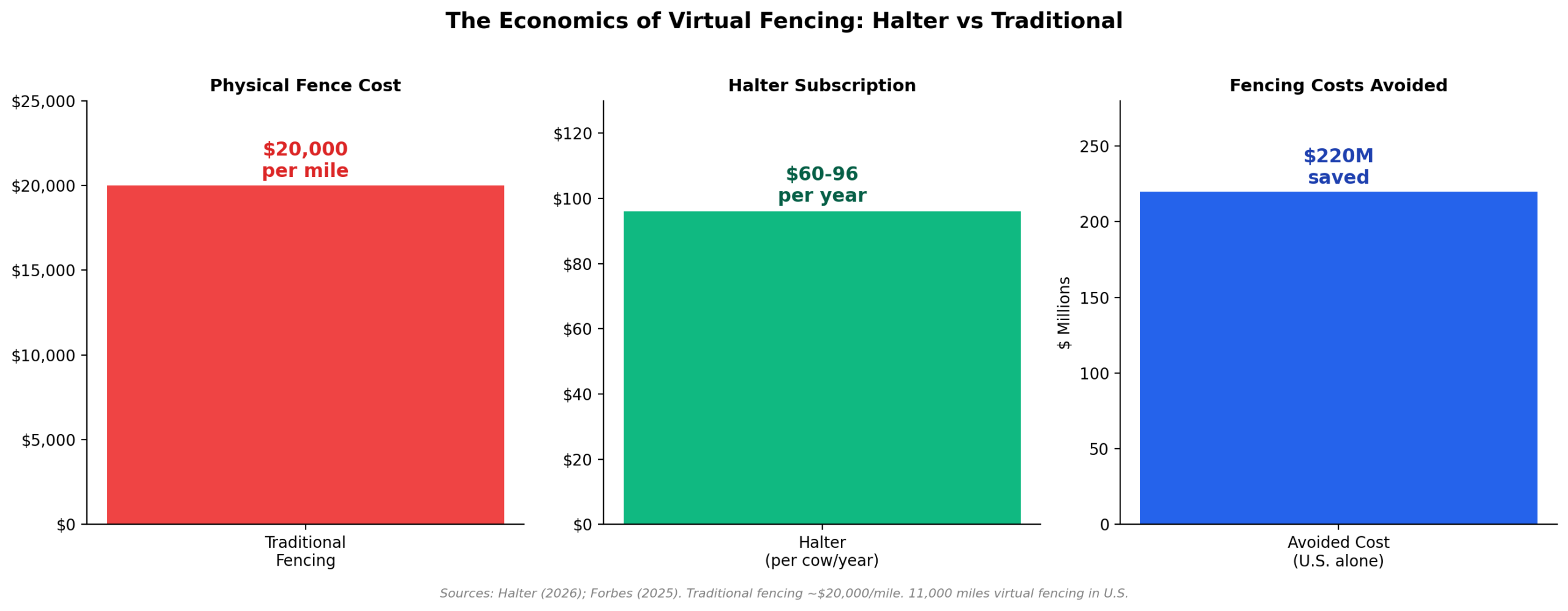
Fencing costs present a second structural barrier. Traditional fencing runs approximately $20,000 per mile to build and maintain. Halter’s U.S. customers have created more than 11,000 miles of virtual fencing, representing an estimated $220 million in avoided fencing costs (Moneycontrol, 2026). For context, physical fence lines also constrain how land can be used: a virtual boundary can be redrawn in seconds, enabling rotational grazing strategies that rigid infrastructure makes prohibitively expensive.
Pasture utilization is the third structural gap. Beef farms typically achieve only 40 to 70 percent pasture utilization, compared to 80 to 90 percent on dairy operations. The difference comes down to management intensity: dairy farmers visit their animals twice a day; beef ranchers may check on a herd once a week. Virtual fencing allows beef operations to adopt the precise rotational grazing patterns that have historically required intensive labor on dairy farms.
The reproductive performance data is among the most commercially significant findings to date. A DairyNZ study analyzing 141 herds using wearables against 1,150 herds without found that farms using Halter technology achieved a median 70.9 percent six-week in-calf rate, compared to an industry median of 66.8 percent. For a 400-cow herd, that 4.1-percentage-point improvement translates to approximately 16 additional calves per season (CMK, 2026).
Environmental benefits add a regulatory dimension. Precise grazing management reduces overgrazing, improves soil health, and enables ranchers to keep cattle out of waterways with virtual boundaries that can be adjusted instantly in response to seasonal conditions. In jurisdictions where water quality regulations are tightening, that capability may shift from a value-add to a compliance requirement.
The Funding Trajectory
Halter’s funding history reflects the conviction investors have built as the company has scaled from a New Zealand startup to a global platform:
| Round | Date | Amount | Lead Investor | Valuation |
|---|---|---|---|---|
| Series C | 2023 | Undisclosed | Bessemer Venture Partners | ~$85M |
| Series D | June 2025 | $100M | Bond (San Francisco) | $1 billion |
| New Round | March 2026 | TBD (oversubscribed) | Founders Fund (Peter Thiel) | $2 billion+ |
The Series D syndicate that backed the unicorn round included Bessemer Venture Partners, DCVC, Blackbird Ventures, Icehouse Ventures, Promus Ventures, and NewView Capital, according to the Economic Times (2025). The current round, led by Founders Fund, doubles that valuation in under a year, as reported by Bloomberg (2026).
The business model is a subscription, priced at $5 to $8 per cow per month in the United States. Collars are included in the subscription; the only capital expenditure for a new customer is the LoRaWAN tower infrastructure, which is a one-time cost that covers the property permanently. This structure creates recurring revenue that scales directly with collar deployment, with near-zero incremental cost for each additional animal added to a farm already fitted with towers (Moneycontrol, 2026).
With 600,000 collars deployed at $5 to $8 per month, Halter’s estimated annual recurring revenue runs approximately $36 million to $58 million. New Zealand revenue data from the company’s most recent filing shows subscription income surging 45 percent year-over-year to NZ$49.9 million, with after-tax profits of NZ$8 million on total revenue of NZ$71.8 million (Forbes, 2025).
The Competitive Landscape
Virtual fencing is not a monopoly, but Halter’s competitive position is considerably stronger than the funding table alone suggests. The field breaks into two categories: pure virtual fencing, and health monitoring with or without fencing.
| Company | Technology | Backing | Key Differentiator |
|---|---|---|---|
| Halter | Virtual fencing, health monitoring, directional herding | Founders Fund, Bessemer, Bond, Blackbird | Full herd management from one collar; directional audio guidance |
| NoFence | Virtual fencing for cattle, sheep, goats | $35M Series B (September 2025) | European focus; multi-species support |
| Vence | Virtual fencing | Acquired by Merck Animal Health (2023) | Integrated into Merck’s global distribution network |
| eShepherd (Gallagher) | Virtual fencing | Gallagher (NZ fencing company) | Backed by established fencing infrastructure giant |
| Merck Allflex SenseHub | Health monitoring, heat detection | Merck ($2.4B Antelliq acquisition, 2019) | 2 million dairy cows monitored globally; 500M+ ID tags annually |
| CowManager | Ear tag monitoring | Undisclosed | European focus; ear-based sensor form factor |
Samantha Wong, a partner at Blackbird Ventures, put it directly in an assessment cited by Forbes (2025): “Their technological advantage is significantly ahead of the competition. It’s Halter’s game to lose.”
The critical differentiation is not virtual fencing per se; competitors offer that. The differentiation is the combination of virtual fencing, directional guidance, health monitoring, and herding from a single collar and single platform. Merck’s SenseHub monitors two million dairy cows globally and produces more than 500 million animal identification tags per year, but it does not move animals. Vence, now owned by Merck, moves animals but does not provide the health monitoring depth. Halter’s BOND investor Daegwon Chae drew the comparison to Tesla: the competitors are “like diesel buggies from the ’50s,” whereas Halter integrates hardware, software, and continuous learning into a unified system (Forbes, 2025).
The Bigger Picture: Physical AI at Agricultural Scale
The precision farming market reached $11.67 billion in 2024 and is projected to grow to $24.09 billion by 2030 at a compound annual growth rate of 13.1 percent, according to Grand View Research. Precision livestock farming specifically, the narrower market Halter addresses, was valued at $7.94 billion in 2025 and is projected to reach $12.12 billion by 2030, per MarketsandMarkets.
But the investment thesis at Founders Fund likely extends beyond agriculture’s market size. The $7 trillion global agriculture industry is the largest physical-world industry that has received the least AI investment relative to its economic weight. Halter is demonstrating, at 600,000 units across three continents, that a specific AI architecture works on biological systems at industrial scale.
That architecture follows a three-stage logic: sense current state (what is each cow doing, where is it, what are its health indicators), predict future state (is this animal about to get sick, when is it in heat, where will the herd be in two hours), and control future state (move the herd, alert the farmer, isolate the sick animal). The insight reflected in the Founders Fund bet is that this architecture is not specific to cows. The same stack, with different sensors and different actuators, could manage vehicle fleets, warehouse robotics, or logistics networks. As one LinkedIn analysis circulating in early 2026 put it: “The cow is the sensor. The collar is the compute. The cowgorithm is the model.”
BOND general partner Daegwon Chae offered a concise framing when announcing the Series D: “We live in a world where it seems like every AI company is targeting every possible software opportunity. However, farming and ranching represent a massive market ripe for innovation” (Forbes, 2025).
Legitimate Concerns
A $2 billion valuation on an estimated $36 to $58 million in ARR implies a revenue multiple somewhere between 35x and 55x, which is aggressive even by software company standards. For a hardware company with supply chain exposure, manufacturing risk, and remote-field support requirements, that multiple deserves scrutiny.
The agtech graveyard is real. Dozens of precision agriculture startups attracted significant venture capital in the 2018 to 2022 period, only to collapse under the weight of slow farmer adoption, high customer acquisition costs, and hardware unit economics that never improved. Farm Progress (2025) noted that cost remains a primary barrier for family-scale producers considering virtual fencing: getting the per-head price down further is still a prerequisite for mass-market penetration below the large-operation threshold.
Hardware at scale introduces failure modes that software companies do not face. Manufacturing and distributing 600,000 devices across remote ranches in three countries, then supporting them when they fail in environments with mud, dust, heat, and snow, is operationally complex. Halter offers a lifetime warranty, which manages the farmer relationship but concentrates warranty liability on the company.
Regulatory uncertainty adds another layer. Virtual fencing legality varies by jurisdiction: some regions require physical perimeter fencing by law, limiting the addressable market until regulations catch up. Animal welfare concerns about even low-energy electric pulses have drawn scrutiny from advocacy groups in several markets, a reputational risk that could complicate regulatory approval in new territories.
Competition from Merck is not trivial. Merck has $2.4 billion already deployed in animal health technology through its Antelliq acquisition, owns Vence for virtual fencing, and has a global distribution infrastructure that Halter cannot match from Auckland. A strategic decision by Merck to integrate and price aggressively across its combined portfolio would pressure Halter’s unit economics.
The most nuanced concern comes from the DairyNZ research itself. While the headline reproductive performance data is positive, the same study found that lower-performing herds showed no reproductive gains after adopting wearables. The technology appears to amplify good farm management rather than compensate for poor management (CMK, 2026). That finding matters for growth projections: the farms most likely to pay $5 to $8 per cow per month are already well-managed operations, which limits the addressable market to a subset of the total farm population.
Conclusion
Halter is not a cow collar company. It is a physical AI company that started with cows because cows represent an accessible, commercially viable, and globally scalable test case for a technology architecture that has much broader applications. The cowgorithm is a proof of concept for something larger: the capacity to sense biological systems at individual-unit resolution, model their behavior with predictive accuracy, and intervene at scale with precision.
The risks are genuine: the valuation is stretched, the hardware challenges are real, and the competitive moat against a well-resourced incumbent like Merck will require constant innovation to maintain. The DairyNZ finding that the technology amplifies rather than creates good management is a meaningful constraint on total addressable market.
But 600,000 collars, doubled in nine months, across three continents, with 45 percent subscription revenue growth and positive after-tax earnings in its home market, is not a hypothesis. It is a track record. Peter Thiel has made a career of identifying companies that look expensive until you understand what they are actually building. If the physical AI stack works at 600,000 cows, the same architecture can manage anything at scale. That is the bet. The rancher in Colorado, moving 800 cattle across 5,000 acres from his phone at 7 a.m., is the evidence.
References
- Torrence, R. (2026, March 20). Thiel’s Founders Fund Backs AI Cow Collar Startup at $2 Billion Valuation. Bloomberg. https://www.bloomberg.com/news/articles/2026-03-20/peter-thiel-s-founders-fund-backs-ai-cow-collar-startup-at-2-billion-valuation
- Wang, C. (2025, December 11). Smart Collars For Cows: How A 31-Year-Old Is Transforming Cattle Farming. Forbes. https://www.forbes.com/sites/catzxwang/2025/12/11/smart-collars-for-cows-how-this-31-year-old-entrepreneur-is-transforming-cattle-farming/
- Chakrabarti, R. (2026, March 22). Peter Thiel is betting big on a $2B AI cow collar startup powered by cowgorithms. Yahoo Finance. https://finance.yahoo.com/sectors/technology/articles/peter-thiel-betting-big-2b-222000722.html
- Economic Times. (2025). Agritech startup Halter becomes New Zealand’s latest unicorn in $100 million fundraise. https://economictimes.com/tech/funding/agritech-startup-halter-becomes-new-zealands-latest-unicorn-in-100-million-fundraise/articleshow/122031120.cms
- Shubham, S. (2026, March 22). AI cow collar startup Halter raises funding at $2 billion valuation, led by Peter Thiel’s Founders Fund. Moneycontrol. https://www.moneycontrol.com/technology/ai-cow-collar-startup-halter-raises-funding-at-2-billion-valuation-led-by-peter-thiels-founders-fund-article-13867019.html/amp
- CMK. (2026). Smart farming investment: Making sense of cow wearables for your bottom line. https://cmk.co.nz/smart-farming-investment-making-sense-of-cow-wearables-for-your-bottom-line/
- Allinson, K. (2025). Virtual fencing for cattle: Complete guide for ranchers. Halter. https://www.halterhq.com/en-us/articles/virtual-fencing-for-cattle
- Allinson, K. (2025). Halter Founder and CEO Craig Piggott on the future of virtual fencing. Halter. https://www.halterhq.com/en-us/articles/from-new-zealand-to-us-ranches
- McNaughton-Peterson, S. (2025, October 28). Virtual fencing gains ground in U.S. despite high costs. Farm Progress. https://www.farmprogress.com/technology/virtual-fencing-technology-gains-ground-in-u-s-
- Grand View Research. (2024). Precision Farming Market Size, Share & Trends Analysis Report. https://www.grandviewresearch.com/industry-analysis/precision-farming-market
- MarketsandMarkets. (2025). Precision Livestock Farming Market. https://www.marketsandmarkets.com/PressReleases/precision-livestock-farming.asp