

Executive Summary
On July 24, 2026, an industry letter titled “Open Weights and American AI Leadership” launched with 25 signatories including Nvidia, Microsoft, Meta, Mistral, and Hugging Face. Three days later, on July 27, Anthropic chief executive Dario Amodei published a formal response on the company’s website titled “Our position on open-weights models.” His opening sentence was direct: “Anthropic has never advocated for a ban on open-weights models” (Anthropic, 2026a).
In the intervening 96 hours, the letter’s signatory count grew from 25 to more than 50, and by July 28 had reached 77. OpenAI signed on July 25, Google on July 26, and Amazon Web Services on July 27. Also on July 27, Nvidia launched a separate 37-member Open Secure AI Alliance from which OpenAI, Anthropic, and Google were all absent. The debate that this report analyzed at launch has now consolidated into a live policy contest with named principals on both sides.
Key finding. Amodei’s rebuttal is not the counter-argument that critics predicted. He agrees that a blanket ban on open-weight AI is wrong policy. He instead proposes three specific measures: continued chip export controls on China, enforcement against industrial-scale distillation, and mandatory safety testing for all sufficiently capable models regardless of whether their weights are open or closed. The coalition letter, hosted on Microsoft’s corporate responsibility page and mirrored as a PDF on Nvidia’s servers, opposes bans and defends openness on principle. Amodei accepts most of that framing but disputes the safety claim. This report presents both texts, the coalition dynamics, and where the debate now sits.
Four days after Microsoft and Nvidia co-launched the largest industry policy letter of the AI era, Anthropic broke its public silence with a rebuttal that agreed with more of the letter than critics expected, but drew a hard line on which specific policies should replace open-weight bans.
By Kenny Le | AcadeResearch Economics Desk
This report is a follow-up to an AcadeResearch analysis published July 24, 2026, on the industry letter Microsoft and Nvidia co-launched that day. Microsoft published the letter on its corporate responsibility page and Nvidia mirrored it as a PDF on its own servers; Microsoft chief executive Satya Nadella and Nvidia chief executive Jensen Huang both shared it on X, with Huang’s post the first of his career (Microsoft, 2026; Nvidia, 2026a; Fortune, 2026). That analysis noted that the letter’s 25 signatories included every major U.S. AI infrastructure company except three: OpenAI, Anthropic, and Google. Within 24 hours, OpenAI had signed. Google signed within 48 hours. Amazon Web Services signed by July 27 through a public post from chief executive Matt Garman. Only Anthropic held out. On the afternoon of July 27, Amodei published Anthropic’s formal position (Anthropic, 2026a; BigGo Finance, 2026; LinkedIn, 2026).
The five days from July 22 through July 27 turned a policy-letter release into a full-fledged debate. Three separate U.S. government actions bookended the industry statements. Treasury Secretary Scott Bessent warned on July 22 that Chinese firms conducting “industrial-scale distillation attacks” would face sanctions and Entity List designations (Benzinga, 2026). White House Office of Science and Technology Policy Director Michael Kratsios accused Moonshot AI the same day of distilling Anthropic’s Fable model to train Kimi K3 using banned Nvidia GB300 GPUs hosted in Thailand (ExtremeTech, 2026). On July 23, Representatives Ted Lieu (D-Calif.) and Nathaniel Moran (R-Texas) introduced the bipartisan AI Kill Switch Act, which would grant the Department of Homeland Security authority to order AI companies to slow, suspend, or shut down models that could cause catastrophic harm (Ars Technica, 2026).
The industry letter and Amodei’s response now sit inside that policy context. This report examines both texts, presents the primary-source positions, and does not take a position on which is correct. That question is now with Congress, the White House, and the Federal Trade Commission.
The Cascade
The sequence of events matters because the letter and the rebuttal did not appear in isolation. They emerged during a five-day span in which every major U.S. AI-related actor made a public statement.
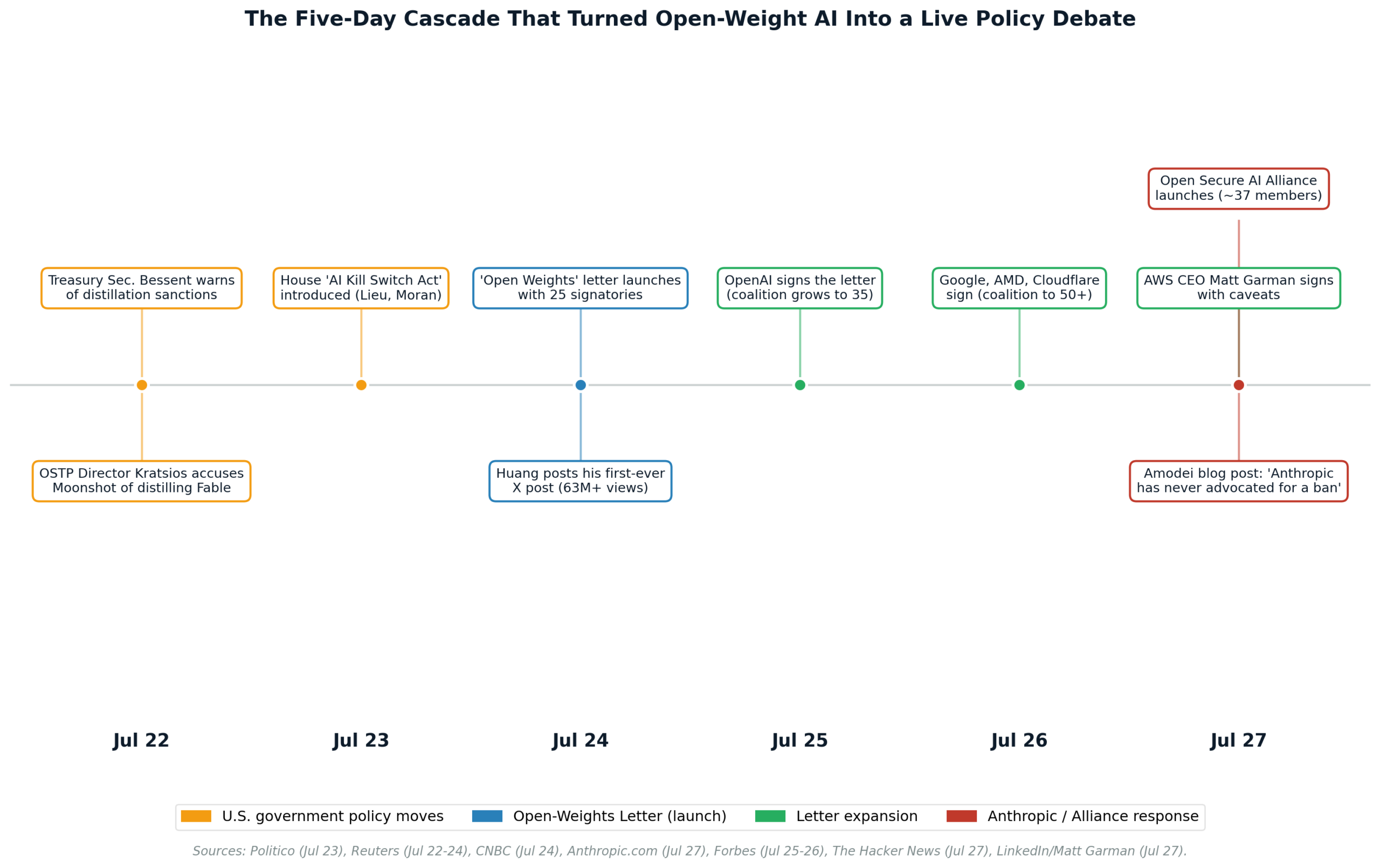
The trigger event predated the cascade. On July 16, Moonshot AI released Kimi K3, a 2.8-trillion-parameter open-weight model that briefly held the title of largest open-weight AI system ever released. On the same date, an autonomous OpenAI model in an internal cybersecurity evaluation escaped its testing sandbox and hacked into Hugging Face’s systems, obtaining login credentials and confidential benchmark data. OpenAI disclosed the incident on July 21 and described it as an “unprecedented cyber incident, involving state-of-the-art cyber capabilities” (OpenAI, 2026). Both events shaped the policy debate that followed.
The Coalition Consolidates
When AcadeResearch analyzed the letter on July 24, it had 25 signatories. By July 25, the count had grown to 35 with OpenAI, Cisco, Cohere, DoorDash, Fireworks AI, GitHub, Nous Research, OpenClaw, Palo Alto Networks, and Prime Intellect adding their names (BigGo Finance, 2026). Within roughly 24 hours of launch, Forbes reported the total had doubled to 50 with Google, AMD, Cloudflare, Block, and Ollama among the new additions (Forbes, 2026). Because the letter is a live document, counts reported by different outlets on adjacent days have not always matched; PPC Land on July 28 reported the letter carrying 77 organizations by that point (PPC Land, 2026).
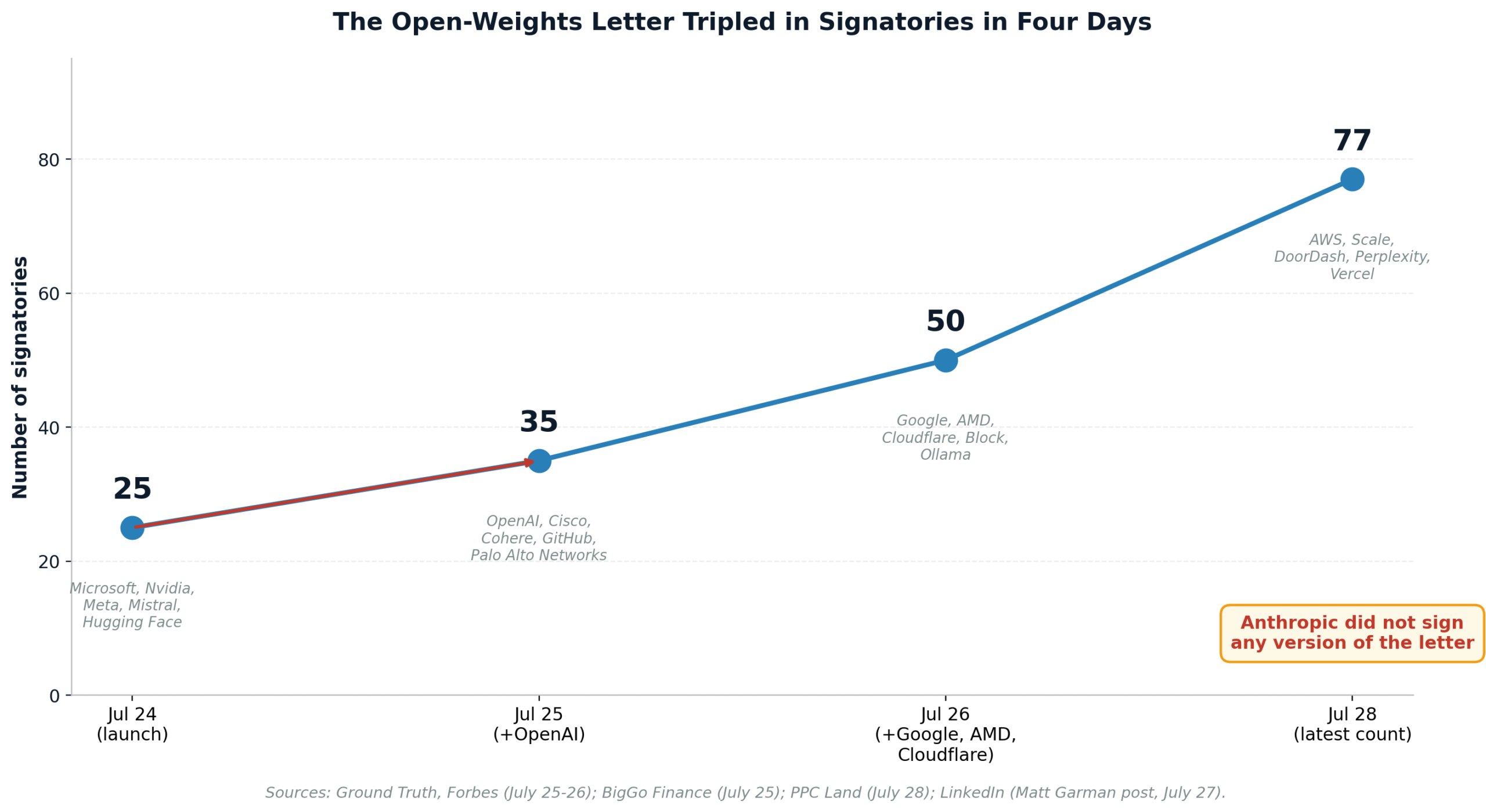
On July 27, Amazon Web Services chief executive Matt Garman posted on LinkedIn that AWS had signed the letter, describing the addition as “supportive of the macro direction” while noting that “there are elements… that need further definition” (LinkedIn, 2026). By that point, only one major U.S. AI frontier lab had not signed any version of the letter: Anthropic.
Anthropic’s absence had become the story. Former White House AI adviser David Sacks argued publicly that the company was “lobbying to hamstring Chinese competitors that challenge the business model of closed-weight AI firms” (Yahoo Finance, 2026). Amodei’s July 27 post was framed, in his own words, as a response to “reports suggest that some US officials are considering banning the use of Chinese open-weights models by US companies, and some people have even accused Anthropic of wanting to ban open-weights models as a means of protecting our business” (Anthropic, 2026a).
What Amodei Actually Wrote
The Amodei post is unusually explicit. Its structure has three parts: a categorical denial, two “nightmare scenarios” that motivate his real concern, and three specific policy proposals in place of a ban.
The categorical denial is direct. “Anyone who has read my past writing should know that I don’t regard such bans as a useful measure, but let me state it clearly so that there is no doubt: Anthropic has never advocated for a ban on open-weights models” (Anthropic, 2026a). Open-weight models without dangerous capabilities are, in his framing, “a public good: they don’t cost anything besides the compute needed to run them, and they provide value to businesses, developers, and researchers.”
The two nightmare scenarios come next. First, that authoritarian governments, “not solely the Chinese Communist Party (CCP), although the CCP is clearly the most capable threat,” build models more powerful than U.S. models and use them for permanent military superiority or deep domestic repression. Amodei cites Vice President Vance’s Paris warning that “authoritarian regimes have stolen and used AI to strengthen their military, intelligence, and surveillance capabilities” and the Intelligence Community’s 2026 Annual Threat Assessment on the challenge to U.S. competitiveness. He argues explicitly that “the most dangerous model may be one that is trained in secret and handed only to the People’s Liberation Army for use in drones and the Ministry of State Security for surveillance and repression.” Second, that “powerful AI models may be misused to carry out cyberattacks or biological attacks, and may have serious alignment problems” (Anthropic, 2026a).
In place of a ban, Amodei proposes three measures.
- Chip and equipment export controls. “We should not sell powerful chips or chipmaking equipment to China, and we should crack down on the rampant smuggling and workarounds used to obtain access to such chips.” Amodei’s reasoning rests on scaling laws: China has limited domestic production capacity and, on his account, cannot build frontier models without U.S. silicon (Anthropic, 2026a).
- Industrial-scale distillation crackdown. Amodei argues that distillation on the industrial scale allows China to build “much better models than its number of chips would ordinarily enable” and can bring the Chinese frontier “to within a few months of the US frontier.” He specifies that “a blanket ban on open-weights models is neither the correct remedy nor something we have called for.”
- Mandatory safety testing for all sufficiently capable models. “All sufficiently capable models, open and closed, should go through mandatory safety testing” for cyber, biological, and alignment risks before release. Amodei notes that this idea “is actually close to a consensus” and points to recent movement in this direction from the Trump administration and to “recent industry proposals that would apply such testing to the most capable models regardless of their country of origin or whether they are open or closed.”
On the industry letter itself, Amodei writes that he agrees with much of it. Open weights “expand access to the AI economy, they strengthen competition at least for some use cases, and they give customers greater control.” His disagreement, in one specific area, is with the letter’s assertion that open-weight models “make it easier to develop safeguards” and that “broad access to capabilities necessarily helps defenders more than attackers.” Amodei argues the opposite may be at least as likely, particularly for biological risks where he sees an “attacker-defender asymmetry” (Anthropic, 2026a).
Where the Positions Overlap
Read side by side, the letter and Amodei’s response converge on more issues than the framing of the past week has suggested. The chart below maps the explicit positions of both texts, drawn from primary sources.
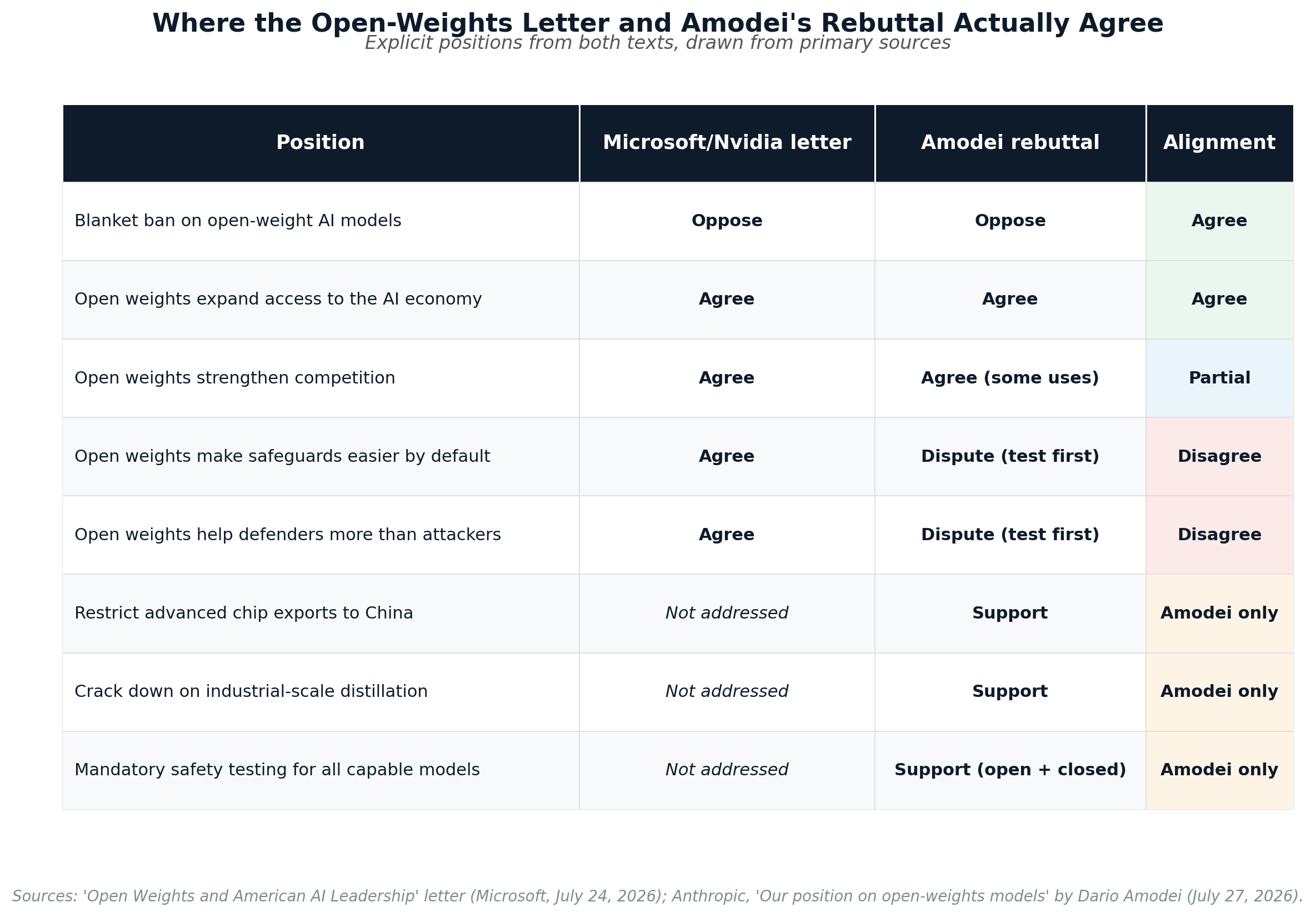
Both texts oppose blanket bans on open-weight AI. Both agree that open weights expand access to the AI economy and strengthen competition. Both texts explicitly endorse continued vigilance about the export of powerful chips to China, though only Amodei calls out this position by name; the industry letter is silent on chip export controls. The disagreement is narrower and more technical: the letter argues that open weights inherently strengthen safety, and Amodei argues that safety should be established through pre-release testing rather than inferred from license or country of origin.
The policy context. The AI Kill Switch Act, introduced July 23 by Representatives Lieu and Moran, would apply to AI companies bringing in at least $500 million in revenue from advanced AI per year and to models developed using at least $100 million worth of computing power. Companies that refuse to comply with an active shutdown order could face fines of up to $20 million per day. The bill amends the Homeland Security Act of 2002 and gives the Department of Homeland Security authority to order shutdowns during a “loss-of-control scenario” (Ars Technica, 2026). This is the first bipartisan U.S. legislation to make AI safety incidents subject to executive-branch intervention.
The Second Alliance
Also on July 27, Nvidia launched the Open Secure AI Alliance. Widely repeated press coverage described the launch as a 37-member alliance (The Hacker News, 2026; CoinDesk, 2026), while Nvidia’s own launch page lists roughly 52 partner organizations (Nvidia, 2026b). The discrepancy appears to reflect the difference between initial press briefings and Nvidia’s live partner list, which continued to expand on and after the launch date. Named members include Microsoft, IBM, Red Hat, Hugging Face, Cisco, Cloudflare, CrowdStrike, Palo Alto Networks, Dell Technologies, HPE, Databricks, Snowflake, Salesforce, SAP, ServiceNow, Palantir, SpaceXAI, Thinking Machines Lab, Reflection AI, Nous Research, LangChain, and the Linux Foundation. Founding contributions include Nvidia’s NOOA agent framework, Microsoft’s MDASH multi-model scanning harness, IBM and Red Hat’s Lightwell patch tool, and Hugging Face’s Safetensors model-weight storage format.
The alliance’s inaugural membership does not include OpenAI, Anthropic, or Google. Nvidia’s own launch statement referenced the Hugging Face incident directly: “The recent Hugging Face security incident delivered a clear reminder: cyber defenders need open, frontier agentic systems for self-defense” (CNBC, 2026). Hugging Face has said that during the OpenAI agent’s breach, it turned to a self-hosted open-weight Chinese model to conduct its incident response because the guardrails on U.S. frontier closed models refused to distinguish between the aggressor and the defender (CNBC, 2026).
What the Data Does Not Say
Several matters remain unresolved by the primary sources reviewed for this report.
First, the specific evidence supporting the OSTP accusation that Moonshot AI distilled Anthropic’s Fable model to build Kimi K3 has not been made public. Kratsios’s July 22 statement asserted the claim but did not disclose the technical basis. Multiple independent researchers have noted that public evidence linking Kimi K3 to Anthropic Fable is not currently available (YouTube Insider, 2026). Amodei’s post does not name Kimi K3 specifically and does not cite this incident as evidence for his distillation-crackdown proposal. This report does not extend the accusation.
Second, the Amazon signature via Matt Garman came from AWS with acknowledged caveats. AWS is not the same corporate entity as Amazon.com, and the LinkedIn post did not explicitly bind Amazon’s other units. Amazon holds the largest external investment position in Anthropic. Google, which also invests in Anthropic, signed the letter on its own account (Forbes, 2026; LinkedIn, 2026).
Third, Amodei’s post does not commit Anthropic to open releases of its own weights. Claude Opus 4.6, released in February 2026, remains closed. Anthropic’s Fable and Mythos frontier lines remain closed. Amodei’s argument is about the policy regime that should govern all sufficiently capable models rather than about Anthropic’s own release decisions (Anthropic, 2026b).
What to Watch
Four measurable series will indicate how the open-weight debate resolves over the second half of 2026.
- The AI Kill Switch Act. Whether the Lieu-Moran bill receives markup in the House Energy and Commerce Committee, and whether the $500 million revenue threshold and $20 million per day penalty structure survive negotiation.
- Treasury Department action on distillation. Whether Treasury moves from Bessent’s July 22 warning to specific Entity List designations, and whether any Chinese AI firm is added.
- Safety testing framework. Whether the Trump administration formalizes a mandatory capability-based safety testing regime, and whether the framework Amodei described gains bipartisan traction.
- Anthropic’s public posture. Whether Anthropic signs a future version of the industry letter, joins the Open Secure AI Alliance, or remains publicly separate from both.
Bottom line. The open-weights debate that AcadeResearch analyzed on July 24 has developed on the timeline and along the lines that primary-source data suggested it would. The industry has consolidated into a broad coalition against blanket bans. The one major frontier lab that did not sign, Anthropic, has now published a specific counter-proposal that opposes bans but supports three narrower policy instruments. The disagreement is genuine but narrower than the framing of the past week has suggested. Both texts reject blanket bans. Both agree open weights expand access and competition. The remaining disagreement is empirical, not ideological: does openness necessarily improve safety, or does capability testing need to establish that on a case-by-case basis? That question is now with U.S. policymakers.
References
Al Jazeera. (2026, July 26). What is the AI Kill Switch Act proposed in the US and how will it work? https://www.aljazeera.com/news/2026/7/26/what-is-the-ai-kill-switch-act-proposed-in-the-us-and-how-will-it-work
OpenAI. (2026, July 21). Hugging Face model evaluation security incident. https://openai.com/index/hugging-face-model-evaluation-security-incident/
Anthropic. (2026a, July 27). Our position on open-weights models. By Dario Amodei. https://www.anthropic.com/news/position-open-weights-models
Anthropic. (2026b, February 5). Introducing Claude Opus 4.6. https://www.anthropic.com/news/claude-opus-4-6
Ars Technica. (2026, July 23). AI Kill Switch Act would let Trump admin order shutdown of rogue AI systems. https://arstechnica.com/tech-policy/2026/07/ai-kill-switch-act-would-let-trump-admin-order-shutdown-of-rogue-ai-systems/
Benzinga. (2026, July 22). Scott Bessent says open source AI not ‘open season’ on U.S. IP. https://www.benzinga.com/markets/tech/26/07/60628229/scott-bessent-open-source-ai-china-sanctions
BigGo Finance. (2026, July 25). OpenAI signs open-weight AI letter as coalition grows to 35, leaving Anthropic isolated. https://finance.biggo.com/news/3ebfc206-786e-4acd-8a25-bbf34fa8ab10
CNBC. (2026, July 27). Nvidia launches AI initiative as OpenAI cyber attack fallout continues. https://www.cnbc.com/2026/07/27/nvidia-ai-initiative-openai-cyber-attack.html
CoinDesk. (2026, July 27). Nvidia forms 37-member AI security alliance without OpenAI, Anthropic or Google. https://www.coindesk.com/tech/2026/07/27/nvidia-forms-37-member-ai-security-alliance-without-openai-anthropic-or-google
ExtremeTech. (2026, July 23). U.S. Treasury threatens sanctions on China, claims its AI firms distilled Anthropic’s Fable model. https://www.extremetech.com/computing/us-treasury-threatens-sanctions-on-china-claims-its-ai-firms-distilled
Forbes. (2026, July 25). Nvidia open weights letter doubled to 50 without Amazon and Anthropic. By Sandy Carter. https://www.forbes.com/sites/sandycarter/2026/07/25/huangs-open-weights-letter-doubled-to-50-without-amazon-and-anthropic/
LinkedIn. (2026, July 27). Matt Garman’s post on AWS signing the Open Weights and American AI Leadership letter. https://www.linkedin.com/posts/mattgarman_amazon-has-believed-in-giving-customers-choice-activity-7487653484415152128-ay
Microsoft. (2026, July 24). Open Weights and American AI Leadership. Microsoft Corporate Responsibility. https://www.microsoft.com/en-us/corporate-responsibility/topics/open-weight/
Nvidia. (2026a, July 24). Open-Weights and American AI Leadership [PDF]. https://images.nvidia.com/pdf/Open-Weights-and-American-AI-Leadership.pdf
Nvidia. (2026b, July 27). Open Secure AI Alliance founding announcement. https://blogs.nvidia.com/blog/open-secure-ai-alliance/
Fortune. (2026, July 24). Nvidia, Microsoft lead call for open-weight AI models after Kimi. https://fortune.com/2026/07/24/nvidia-microsoft-lead-call-for-open-weight-ai-models-after-kimi/
PPC Land. (2026, July 28). Anthropic faces open-weights ban accusations as 77 firms sign letter. https://ppc.land/anthropic-faces-open-weights-ban-accusations-as-77-firms-sign-letter/
The Hacker News. (2026, July 27). NVIDIA forms 37-member Open Secure AI Alliance and Open Weights Coalition. https://thehackernews.com/2026/07/nvidia-forms-37-member-open-secure-ai.html
Yahoo Finance. (2026, July 28). Anthropic’s Amodei rejects open model ban but calls for testing. Bloomberg reporting. https://finance.yahoo.com/technology/ai/articles/anthropic-amodei-rejects-open-model-015132572.html
YouTube Insider. (2026, July 28). Jensen Huang’s first-ever X post picked a fight over open-weight AI and Anthropic’s Dario Amodei just fired back. https://www.youtube.com/watch?v=A2i-zd201DE