
Executive Summary
The Portsmouth Gaseous Diffusion Plant in Piketon, Ohio, enriched uranium for the U.S. nuclear weapons program beginning in 1954 and ceased enrichment operations in 2001. The Department of Energy has been decontaminating and demolishing its roughly 415 facilities since 2011 under a cleanup program now valued at up to $5.87 billion. In March 2026, DOE and the Department of Commerce announced a public-private partnership with SoftBank’s SB Energy and AEP Ohio to build a 10-gigawatt artificial intelligence data center campus on the same federal ground (U.S. Department of Energy, 2026a, 2026b; American Nuclear Society, 2023).
The campus plan includes up to 10 gigawatts of new power generation, of which 9.2 gigawatts is natural gas built on site. That design decision is the analytically significant one. It is a deliberate route around the interconnection queue and grid-capacity constraint documented in this publication’s earlier report on the AI buildout’s physical limits (U.S. Department of Energy, 2026a; AcadeResearch, 2026).
Key finding. Piketon is not a historical curiosity. It is the visible edge of a deliberate federal policy of siting AI compute on the nuclear weapons complex’s old footprint, because those sites carry the transmission corridors, water rights, rail, acreage, and permitting posture that new greenfield sites cannot assemble on the timeline the industry requires. The uranium-to-compute arc is real, but it is an effect of infrastructure inheritance, not a coincidence. This report separates confirmed federal actions from reported and unconfirmed private financing.
A Cold War enrichment site with five contaminated groundwater plumes and one of three original process buildings still standing is being redeveloped as one of the largest computing campuses ever proposed. Federal cleanup records, DOE siting announcements, and press reports of a $250 billion private guarantee describe the same square miles of southern Ohio — and they do not all describe the same level of certainty.
The Site
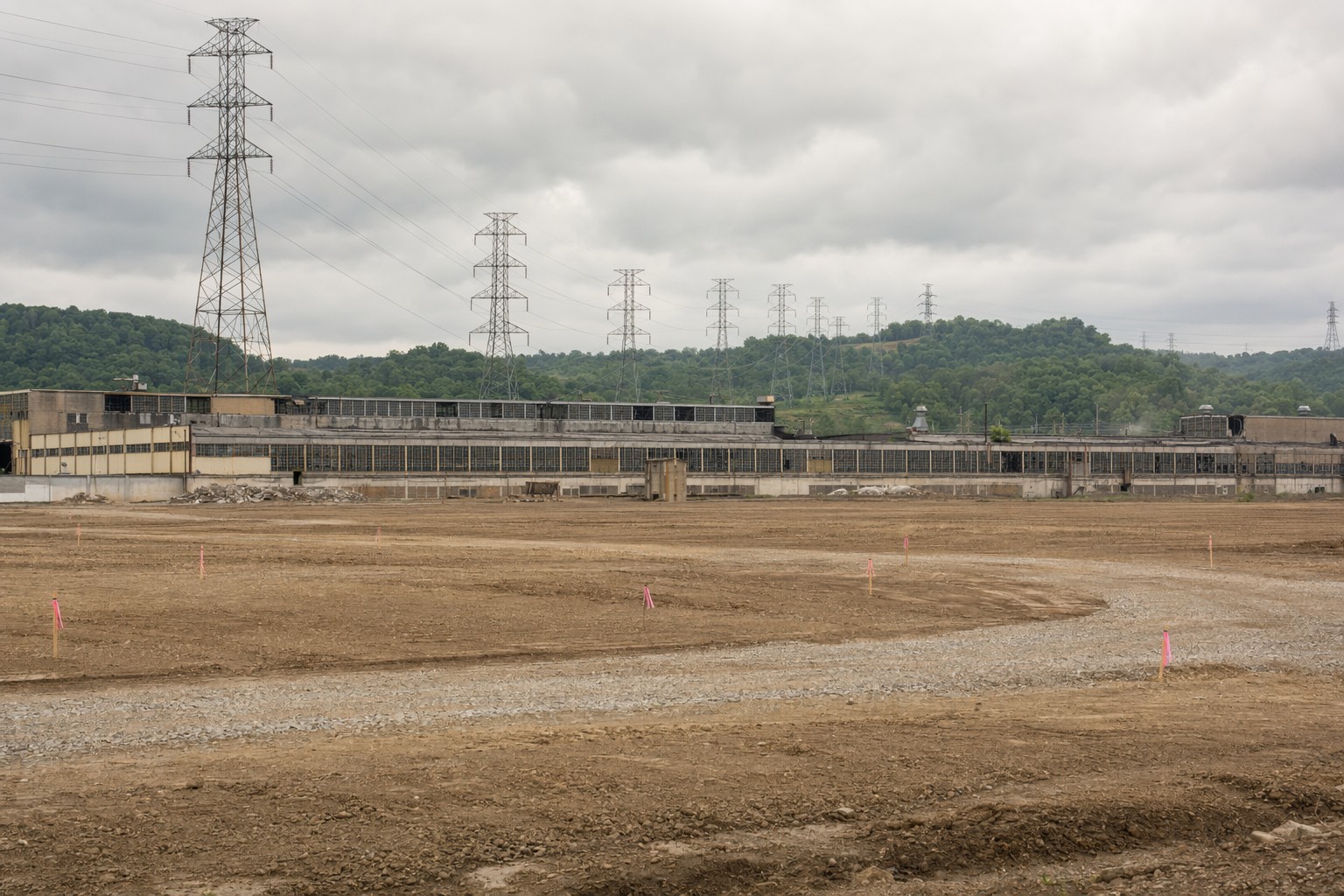
The federal government built the Portsmouth Gaseous Diffusion Plant in Pike County, Ohio, in the early 1950s as part of the nuclear weapons complex. The facility encompasses 3,777 acres. Uranium enrichment operations ran from 1954 until 2001, after which the site transitioned to decontamination and decommissioning under DOE’s Office of Environmental Management (U.S. Department of Energy, 2026c, 2026d).
The scale of what was built there is difficult to convey in the abstract. The three gaseous diffusion process buildings together span the footprint of roughly 158 football fields. The X-326 building alone measured 2,280 feet long, 552 feet wide, and 62 feet tall; its demolition produced more than 163,000 cubic yards of debris, with final disposal completed in August 2023 after a ten-year deactivation phase (U.S. Department of Energy, 2023, 2026d).
That industrial mass is precisely what makes the site attractive now. Enriching uranium by gaseous diffusion was extraordinarily energy-intensive, and the plant was provisioned accordingly: heavy transmission infrastructure, substantial water supply, rail access, and thousands of contiguous acres under single federal ownership. Those provisions did not disappear when enrichment stopped.
The Federal Siting Pattern
Piketon is not an isolated case, and treating it as one obscures what is actually happening. In 2025, DOE issued a request for information covering 16 federal locations as candidates for AI data center and energy infrastructure development, then announced four selected sites: Idaho National Laboratory, the Oak Ridge Reservation, the Savannah River Site, and the Paducah Gaseous Diffusion Plant (U.S. Department of Energy, 2025; Utility Dive, 2025).
Every one of those four is a nuclear weapons complex or national laboratory property. Energy Secretary Chris Wright framed the initiative as accelerating what he called the next Manhattan Project — a comparison that is more literal than rhetorical, given that two of the four sites were built for the original one.
The published rationale for the selections is infrastructural rather than symbolic. DOE’s description of the Paducah site — Portsmouth’s sister enrichment plant, built to the same purpose in the same era — is instructive: approximately 3,500 acres, 19 miles of roads, nine miles of railroad track, positioned to deliver up to 3 gigawatts of power and 30 million gallons of water per day. Oak Ridge offers 500-kilovolt transmission lines connected to TVA hydro, nuclear, and fossil generation. Idaho National Laboratory holds roughly 62,000 DOE-owned acres within an 890-square-mile site with existing reactor infrastructure (U.S. Department of Energy, 2025).
Bottom line. The weapons complex is being reused for AI compute because mid-century nuclear infrastructure and hyperscale data centers have nearly identical site requirements: enormous contiguous acreage, heavy power delivery, industrial water volumes, rail, and a community with a long history of hosting federal industrial risk. The historical resonance is genuine but secondary. The binding reason is that these attributes cannot be assembled quickly anywhere else.
One correction to the popular framing is warranted: Portsmouth was among the 16 sites in the DOE request for information but was not one of the four announced selections. Its development is proceeding through a separate public-private partnership structure rather than under that specific site-selection program (U.S. Department of Energy, 2025, 2026a).
The Power Answer to the Wire Bottleneck
This publication’s earlier report on the AI buildout documented a physical constraint the capital markets could not resolve: ERCOT alone held 233 gigawatts of large-load interconnection requests against an all-time system peak of 85.5 gigawatts, and the skilled trades required to build that capacity were in structural shortage (AcadeResearch, 2026).
The Piketon design is the industry’s answer to the first half of that constraint. DOE’s announcement describes a 10-gigawatt data center accompanied by a commitment to build up to 10 gigawatts of new generation, of which 9.2 gigawatts is natural gas generated on site rather than drawn from existing grid capacity. Reporting on the project indicates the new gas generation is funded in part through the U.S.-Japan strategic trade and investment framework (U.S. Department of Energy, 2026a; Spectrum News, 2026).
The strategic logic is straightforward. If the interconnection queue is the constraint, do not join the queue. Build generation behind the meter, on federal land already provisioned for industrial power, and the multi-year wait for grid capacity ceases to govern the schedule.
The second half of the constraint does not yield so easily. On-site generation does not reduce the labor requirement — it increases it. A campus that builds 9.2 gigawatts of gas generation alongside 10 gigawatts of data center load needs the electricians, pipefitters, welders, and instrumentation technicians for both, in the same labor market, on the same schedule. Project developers have publicly estimated roughly 35,000 construction jobs and 2,500 long-term operating positions; DOE’s own announcement cited approximately 10,000 construction jobs and more than 2,000 permanent positions. Under either figure, the trades constraint identified in the earlier report applies here with more force, not less (U.S. Department of Energy, 2026a; Construction Review Online, 2026).
The Financing Stack, and What Is Actually Confirmed
The confirmed layer is the federal partnership itself. DOE and Commerce announced the public-private arrangement with SB Energy and AEP Ohio; a ceremonial groundbreaking took place on March 20, 2026; and initial site preparation for a first phase spanning 189 acres is under way. SoftBank’s announced data center campus investment exceeds $30 billion, and the overall project has been reported at $67.2 billion with federal permitting coordination under FAST-41 (U.S. Department of Energy, 2026a; Construction Review Online, 2026).
The layer that has drawn the most attention is considerably less settled. Press reports in late July 2026 indicated that OpenAI was in advanced talks to lease the 10-gigawatt campus from SB Energy, and that Nvidia was weighing a guarantee of roughly $250 billion behind that lease, with separate discussions covering as much as $350 billion in accelerator financing (Tom’s Hardware, 2026; DatacenterDynamics, 2026).
Status check. As of this writing, the $250 billion guarantee is reported as under discussion, not executed. The consistent language across outlets is that Nvidia is weighing or in talks regarding a backstop. No definitive agreement has been announced by Nvidia, OpenAI, or SoftBank. Reporting also indicates that Anthropic, Microsoft, and Google have separately discussed the site with the Commerce Secretary, meaning OpenAI is the leading reported candidate rather than a confirmed tenant.
If the reported structure is accurate, its shape is worth noting on its own terms. A chip manufacturer would be guaranteeing its largest customer’s lease obligations on a campus owned by a third party, in order to place its own accelerators there. That is a circular arrangement in which the vendor underwrites the demand for its product. At least one analysis has read the need for such a guarantee as evidence that conventional debt markets declined to finance the lease on the tenant’s own credit. That interpretation is plausible but unverified, and the alternative reading — that a guarantee simply accelerates a transaction the markets would eventually have priced — is equally available on the public record.
The Cleanup Ledger
The redevelopment is proceeding on a site where environmental remediation remains actively under way. DOE’s own published progress figures document the following status:
| Measure | Reported status |
|---|---|
| Total site acreage | 3,777 acres |
| Facilities in the D&D program | Approximately 415 |
| Facilities demolished to date | 38 facilities, 706,000 square feet |
| Process buildings | X-326 demolished; X-333 in deactivation; X-330 remaining |
| Groundwater plumes | Five identified, all under active treatment |
| Groundwater treated | More than 955 million gallons |
| Trichloroethylene removed | 37,788 pounds |
| Landfills closed | Five, covering 60 acres |
| D&D contract value | Up to $5.87 billion over ten years |
Remediation methods in use include pump-and-treat systems, slurry walls, and phytoremediation — the latter involving 3,300 hybrid poplar trees planted under an Ohio EPA-approved remedy (U.S. Department of Energy, 2026d; American Nuclear Society, 2023).
DOE’s position is that the Environmental Management program is making land safely available for reuse as cleanup progresses, and the initial 189-acre development phase is consistent with a staged-release approach rather than wholesale conversion of the site (U.S. Department of Energy, 2026a). The material point for readers is that redevelopment and remediation are running concurrently on the same property, which is a different risk posture from building on a site certified complete.
What the Data Does Not Say
Several figures circulating in coverage of this project require qualification.
The employment estimates diverge substantially by source. DOE’s announcement cited approximately 10,000 construction jobs and more than 2,000 permanent positions. Developer-side and regional reporting has cited roughly 35,000 construction jobs and 2,500 operating positions. That is a factor of three-and-a-half on the construction figure. Neither number is a payroll count; both are projections, and construction employment on a phased multi-year build is typically a peak-workforce estimate rather than a headcount sustained across the project.
The capacity figures describe an end state, not present capability. The campus is announced at 10 gigawatts; reporting indicates a first phase of roughly 800 megawatts targeted for completion around 2028. Announced ultimate capacity for data center projects of this scale is a planning envelope contingent on tenancy, financing, equipment delivery, and permitting, and should not be read as committed construction.
The $250 billion Nvidia guarantee and the associated $350 billion accelerator financing are press reports of discussions. They have not been confirmed by the named parties. Any analysis treating them as executed transactions is running ahead of the public record.
Finally, the project faces organized local opposition, and community concerns regarding water use, air emissions from 9.2 gigawatts of gas generation, property values, and the interaction of heavy construction with an incompletely remediated site are documented in regional reporting and by organized community groups. This report takes no position on those disputes but notes that the public record on the project’s local reception is not one-sided.
What to Watch
Whether the guarantee is executed and disclosed. If Nvidia formalizes a backstop of the reported magnitude, it will appear in securities filings with terms attached. Those terms — duration, triggers, collateral — will reveal considerably more about the risk allocation than the headline number does.
Whether the behind-the-meter model spreads. Piketon’s 9.2 gigawatts of on-site gas is a template. If subsequent campuses at Paducah, Oak Ridge, Savannah River, or Idaho adopt the same structure, the practical effect is a large volume of new generation built outside the conventional interconnection and utility planning process, with consequences for grid planning and emissions accounting that current regulatory frameworks address poorly.
The labor market in southern Ohio. Pike County and its neighbors are not a deep skilled-trades market. If the construction workforce for a project of this size must be imported, the wage and housing effects will be observable in county-level federal data, and they will constitute a direct test of the trades-shortage thesis in a specific geography rather than in national aggregate.
Remediation and construction sequencing. The X-333 deactivation and the five groundwater plumes remain in progress. How DOE sequences parcel releases against construction phases will determine whether the two programs proceed cleanly in parallel or begin to constrain each other.
Conclusion. The arc from enriched uranium to AI compute is a genuine historical fact, but it is not the explanation. Piketon is being redeveloped because the United States built, at mid-century, a small number of places with the acreage, power, water, and rail that hyperscale computing now requires, and because those places remain in federal hands. The AI industry did not choose the weapons complex for its symbolism. It chose it because the infrastructure was already there and the alternative was waiting in a queue.
References
AcadeResearch. (2026, July 15). The wire bottleneck: Why the AI buildout runs on electricians the U.S. has not trained. https://acaderesearch.com/wire-bottleneck-electricians-ai-data-center-shortage-2026/
American Nuclear Society. (2023). DOE-EM awards $5.87 billion Portsmouth D&D contract. Nuclear Newswire. https://www.ans.org/news/article-5176/doeem-awards-587-billion-portsmouth-dd-contract/
Construction Review Online. (2026). $67.2B PORTS Technology Campus gains FAST-41 status, advancing Ohio AI megaproject. https://constructionreviewonline.com/
DatacenterDynamics. (2026). OpenAI in talks to lease 10GW data center from SB Energy in Ohio. https://www.datacenterdynamics.com/en/news/openai-in-talks-to-lease-10gw-data-center-from-sb-energy-in-ohio/
Spectrum News. (2026, March 21). Trump officials announce data center, gas plants for former Ohio uranium site. https://spectrumnews1.com/oh/columbus/news/2026/03/21/data-center-ohio-uranium-site
Tom’s Hardware. (2026). Nvidia weighs $250 billion guarantee so OpenAI can lease SoftBank’s 10-gigawatt Ohio campus, report claims. https://www.tomshardware.com/tech-industry/data-centers/
U.S. Department of Energy. (2023). Portsmouth site reaches X-326 process building demolition debris milestone. Office of Environmental Management. https://www.energy.gov/em/articles/portsmouth-site-reaches-x-326-process-building-demolition-debris-milestone
U.S. Department of Energy. (2025). DOE announces site selection for AI data center and energy infrastructure development on federal lands. https://www.energy.gov/articles/doe-announces-site-selection-ai-data-center-and-energy-infrastructure-development-federal
U.S. Department of Energy. (2026a). Partnership ensures affordable energy, powers AI future at Portsmouth site. Office of Environmental Management. https://www.energy.gov/em/articles/partnership-ensures-affordable-energy-powers-ai-future-portsmouth-site
U.S. Department of Energy. (2026b). Portsmouth D&D program. Portsmouth/Paducah Project Office. https://www.energy.gov/pppo/portsmouth-dd-program
U.S. Department of Energy. (2026c). Portsmouth cleanup strategy. Portsmouth/Paducah Project Office. https://www.energy.gov/pppo/portsmouth-cleanup-strategy
U.S. Department of Energy. (2026d). Portsmouth cleanup progress. Portsmouth/Paducah Project Office. https://www.energy.gov/pppo/portsmouth-cleanup-progress
Utility Dive. (2025). DOE offers 16 locations for possible data center, energy infrastructure development. https://www.utilitydive.com/news/doe-data-center-rfi-ai-colocation/744451/