Physical AI and the commercial kitchen: how robotic fry stations, automated makelines, and AI-powered prep systems are reshaping restaurant labor without yet replacing it.
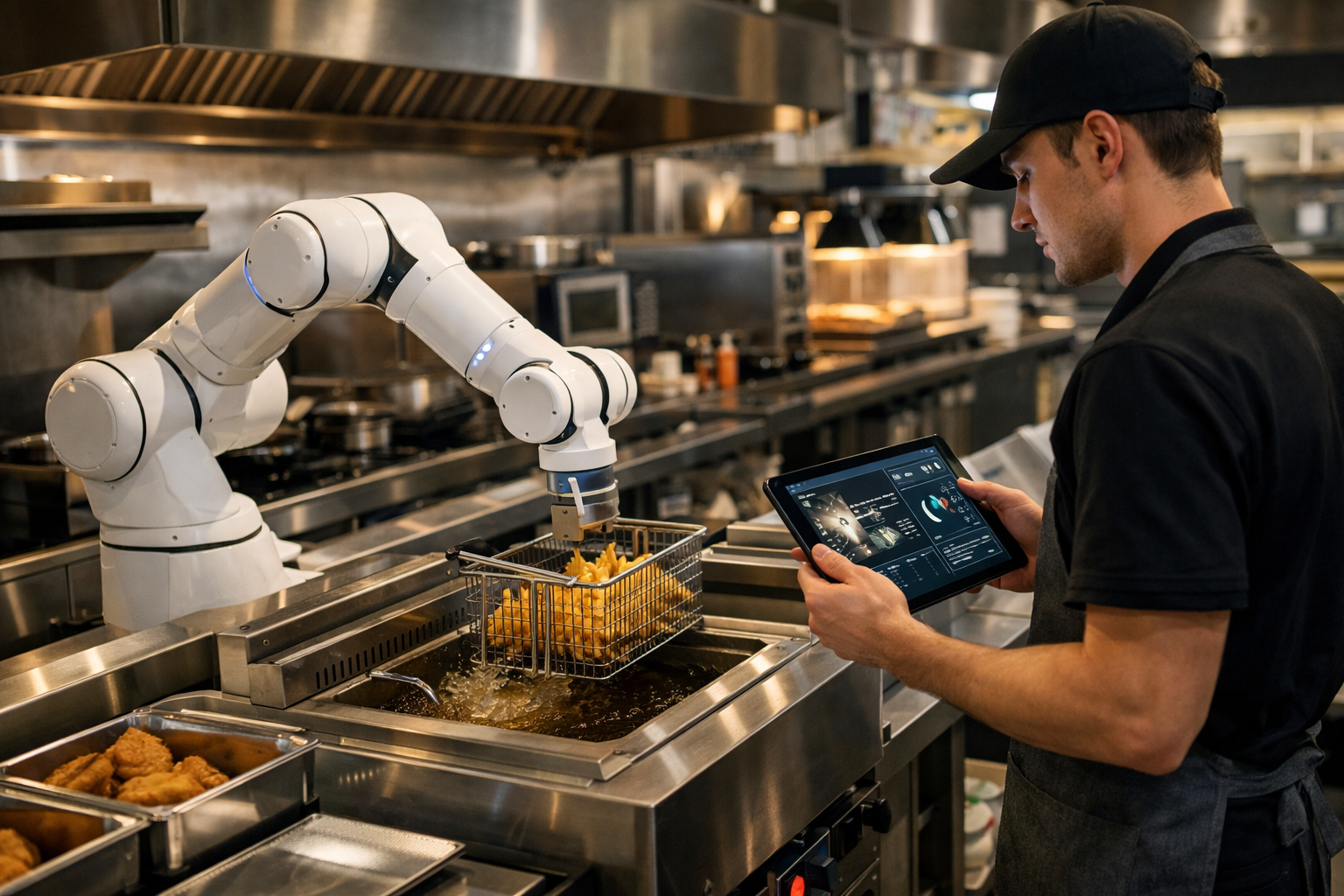
During a packed Friday night rush at a White Castle location, a robotic arm called Flippy methodically lowers fry baskets, monitors oil temperature, and plates chicken tenders without complaint, without fatigue, and without a single sick day. It is not a glimpse of some distant future. It is already operating in select locations today, courtesy of Miso Robotics, and it represents the leading edge of a genuine transformation in how commercial kitchens function. Yet Flippy is also, in important ways, a cautionary tale about the gap between technological promise and real-world adoption.
This article examines physical AI robots in commercial kitchens, specifically robotic arms and automated systems used for frying, assembly, and prep work in quick-service and fast-food settings. The context matters: 70% of restaurant operators report job openings that are tough to fill, and 45% say they do not have enough employees to support existing customer demand, according to the National Restaurant Association (NetSuite, 2024). Rising wages and persistent labor shortages have made automation more appealing than ever. Yet the evidence suggests a nuanced outcome: although physical AI robots like Flippy offer real efficiency and safety gains in restaurant kitchens, their current limited adoption and capabilities suggest they will primarily transform rather than eliminate kitchen jobs, displacing some repetitive prep and frying tasks while shifting human workers toward oversight, quality control, and creative roles, supported by BLS projections of modest growth for cooks overall.
This article proceeds through four sections: the current state of kitchen robotics and real-world examples; the benefits these systems offer workers and operators; the challenges and limits that slow adoption; and the market economics and outlook for the industry.
Kitchen Robots in the Wild
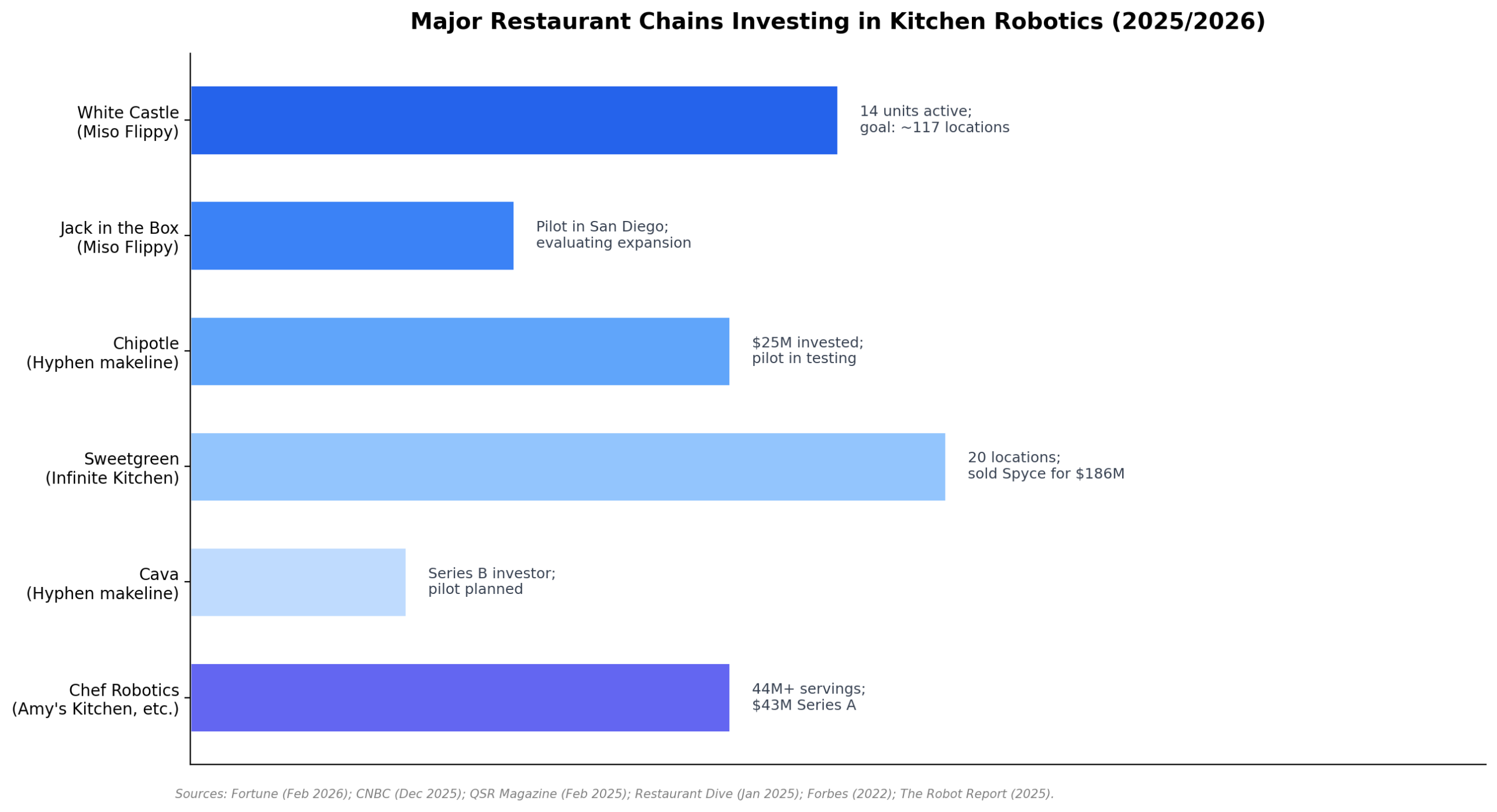
The most visible example of physical AI in a commercial kitchen is Miso Robotics’ Flippy, an AI-powered robotic fry station designed to handle repetitive frying tasks: fries, chicken nuggets, chicken tenders, and similar items. The third-generation Flippy can fry and portion more than 40 menu items, reduces staff interactions with hot equipment by 90%, and can double the output of a short-order cook (Fortune, 2026). At roughly $5,000 per month, Miso positions Flippy as costing less than an equivalent human employee.
The adoption reality, however, is sobering. As of the end of 2025, Miso has only 14 active Flippy units across White Castle and Insert Coin locations, down from 17 units two years earlier when the company also had partnerships with CaliBurger and Panera. White Castle aims to deploy Flippy across roughly one-third of its 350 locations, but revenue tells a more cautious story: Miso recorded just $385,000 in net revenue in 2024, down from $493,000 in 2023 (Fortune, 2026; Restaurant Dive, 2025).
Other players are moving faster in adjacent segments. Chef Robotics raised a $43 million Series A and has produced more than 44 million servings through its food assembly robots, handling almost 2,000 distinct ingredients across meal prep deployments (The Robot Report, 2025). Hyphen, which builds automated makelines for bowl-format restaurants, attracted a $25 million investment from Chipotle and additional capital from Cava. Its systems produce a bowl every 10 to 15 seconds and carry a price tag of $50,000 to $100,000 per unit, with operators typically recovering that investment in under a year (CNBC, 2025). Sweetgreen’s Infinite Kitchen, deployed at 20 locations, demonstrated 7 or more percentage points of labor savings compared to stores of similar age and volume (QSR Magazine, 2025), though Sweetgreen ultimately sold the underlying Spyce technology to Wonder for $186.4 million in late 2025 (Nation’s Restaurant News, 2025).
The common thread across these examples is that kitchen robots are trend-setting, not dominant. Specific labor shortages, repetitive task profiles, and high-volume quick-service environments create the conditions where automation gains a foothold. Outside those conditions, human labor remains the default.
Impacts on Kitchen Workers: Benefits
Proponents of kitchen robotics often invoke the phrase “dull, dirty, and dangerous” to describe the tasks robots handle best, and in commercial kitchens the phrase is apt. Frying involves sustained exposure to hot oil, scalding steam, and repetitive arm movements that cause burns and repetitive strain injuries. Robots like Flippy absorb those risks entirely, allowing human workers to step back from the fryer and focus on tasks that require judgment, flexibility, and customer interaction.
Bank of America analyst Sara Senatore summarized the prevailing view among industry observers: kitchen robots “will not largely replace human workers but will instead improve their working conditions and increase their likelihood of remaining in their jobs longer” (Fortune, 2026). Miso Robotics CEO Rich Hull framed it similarly: “You enhance the human experience significantly. You generate more revenue for the restaurant operator and enable people to remain in these positions longer, develop careers, get promotions, and earn higher wages” (Fortune, 2026).
The job evolution argument holds that as robots absorb repetitive frying and basic prep, human kitchen workers shift toward robot monitoring, final quality checks, menu customization, creative assembly, and cross-training across stations. Rather than narrowing a worker’s role to a single repetitive task, automation could broaden it toward higher-skill, higher-value work.
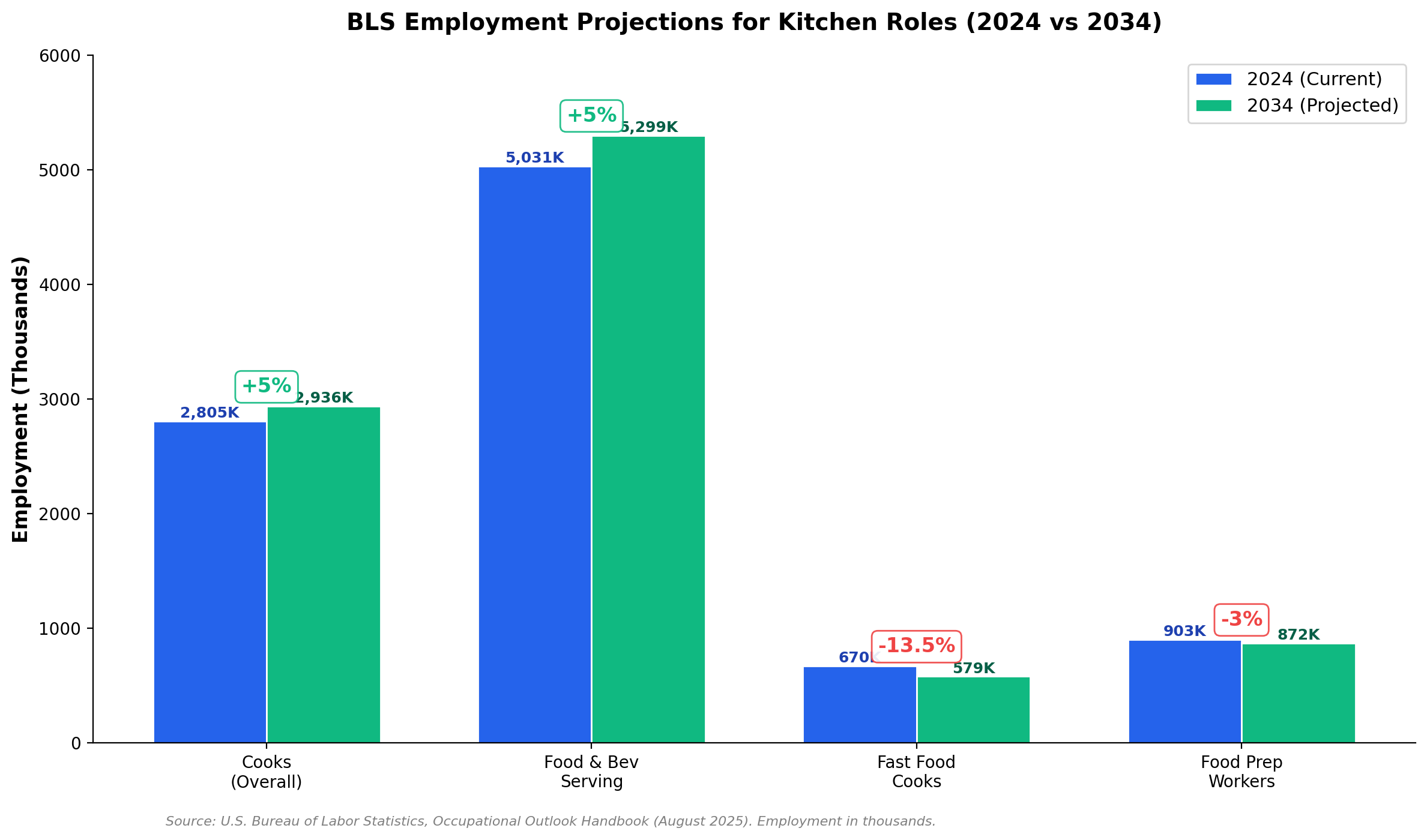
Labor market data from the Bureau of Labor Statistics offers partial support. Overall cook employment is projected to grow 5% from 2024 to 2034, faster than the average for all occupations, with approximately 432,200 job openings projected annually. The median hourly wage for cooks stands at $17.19 (BLS, 2025). Food and beverage serving workers face a similar 5% growth outlook. These figures do not suggest an industry in collapse; they suggest ongoing demand for skilled kitchen labor even as specific roles evolve.
Impacts on Kitchen Workers: Challenges and Limits
The optimistic picture has real limits. BLS projections disaggregate the “cooks” category in ways that reveal significant unevenness. Fast food cooks, the workers whose roles overlap most directly with what robots currently do, are projected to see employment decline 13.5%, from 669,500 to 579,200 jobs between 2024 and 2034 (BLS, 2025). Food preparation workers face a projected 3% decline, losing approximately 30,900 positions over the same period (BLS, 2025). Entry-level and repetitive roles carry the highest exposure to displacement, and workers who do not upskill toward robot oversight and maintenance may face reduced hours or wage stagnation rather than career advancement.
Technology itself imposes hard limits on how far automation can reach. Robots still struggle with complex or highly variable dishes, improvisation, taste judgment, and the kind of contextual flexibility that experienced cooks exercise constantly. A robot can fry a chicken tender to a precise temperature every time; it cannot adjust seasoning after tasting, respond to a customer allergy mid-order, or substitute an ingredient when a delivery falls short. Human chefs remain essential for nuance, customer interaction, and quality decisions that go beyond binary pass-fail checks.
Adoption barriers compound the technology limits. Miso Robotics carried a net loss of $8.6 million in its most recent fiscal year, with cash of $3.94 million against liabilities of $3.56 million, according to SEC filings (Restaurant Dive, 2025). The projected $28 billion global restaurant automation market (Fortune, 2026) contrasts starkly with a company that has only 14 active units and declining revenue. Restaurants operate on thin margins of 3 to 9%, meaning even a $5,000 monthly lease demands clear and demonstrable ROI. Hyphen’s $50,000 to $100,000 upfront cost creates a similar hurdle for smaller operators.
Sweetgreen’s trajectory illustrates the pattern. The company promised full automation across all its stores after acquiring Spyce in 2021, then scaled back to half its locations, and ultimately sold the technology entirely to Wonder for $186.4 million (Nation’s Restaurant News, 2025). The Infinite Kitchen demonstrated genuine labor savings, but the complexity and cost of large-scale deployment proved more than the company wanted to manage. No mass displacement has occurred; what exists is augmentation in targeted, high-volume, repetitive contexts.
Market Economics
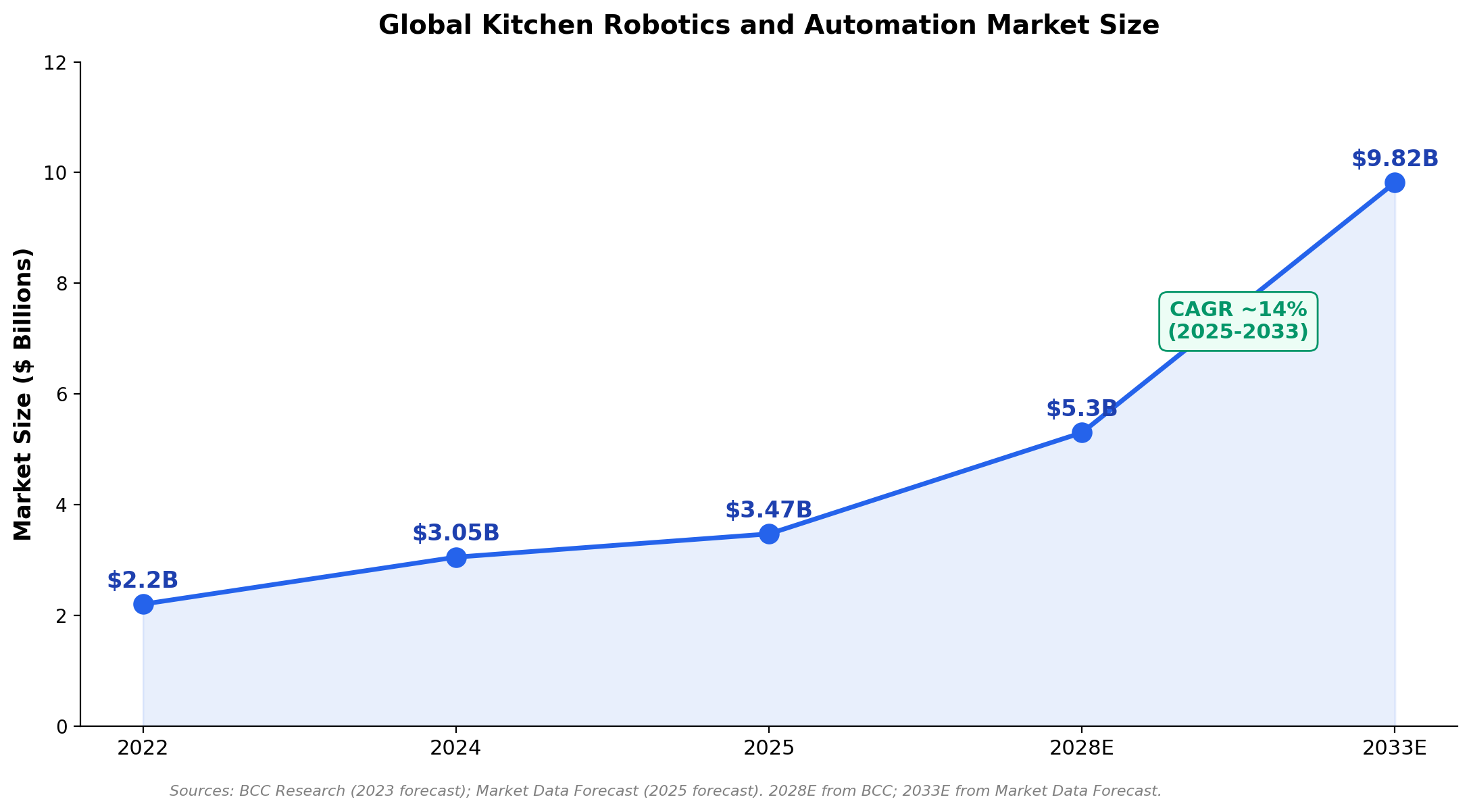
The commercial opportunity for kitchen robotics is real, even if current deployments are modest. The global kitchen robotics market reached $3.05 billion in 2024 and is projected to grow to $9.82 billion by 2033, a compound annual growth rate of 13.88% (Market Data Forecast, 2025). Broader restaurant automation is expected to reach roughly $28 billion this year (Fortune, 2026).
| Metric | Value | Source |
|---|---|---|
| Global kitchen robotics market (2024) | $3.05 billion | Market Data Forecast |
| Projected market size (2033) | $9.82 billion | Market Data Forecast |
| CAGR (2025-2033) | 13.88% | Market Data Forecast |
| Global restaurant automation market (2026) | ~$28 billion | Fortune/industry estimates |
| Flippy monthly cost | ~$5,000 | Fortune (2026) |
| Hyphen makeline cost | $50,000-$100,000 | CNBC (2025) |
| Average restaurant profit margin | 3-9% | Industry standard |
| Flippy potential ROI per location | $50,000-$250,000/year | Miso SEC filing (2025) |
The economic logic for adoption improves as hardware costs fall. Miso notes that the cost to manufacture a Flippy arm has dropped by 80% over five years (Fortune, 2026). If that trajectory continues, the monthly lease model becomes more attractive for mid-size operators who currently cannot justify the expense. Meanwhile, institutional capital continues to flow: Chipotle’s $25 million commitment to Hyphen and Chef Robotics’ $43 million Series A signal that investors see long-term viability even if near-term deployments are limited.
Conclusion and Outlook
The evidence assembled here supports a clear conclusion: kitchen robots augment commercial kitchens rather than replace them wholesale. Flippy handles frying so workers avoid hot oil. Hyphen makelines assemble bowls at speeds no human crew can match. Chef Robotics’ systems process ingredients at scale across meal prep facilities. Each represents genuine value in specific, high-volume, repetitive contexts. None of them signals the end of the kitchen workforce.
Looking forward, if hardware costs continue to decline and reliability improves, hybrid models could become standard in quick-service settings over the next decade. The scenario where a human worker monitors two or three robotic stations, troubleshoots errors, handles exceptions, and manages final quality is plausible and, for many workers, preferable to spending a full shift next to a deep fryer. For that transition to benefit workers rather than simply cut costs for operators, investment in reskilling is essential: robot monitoring certifications, basic maintenance training, and cross-functional kitchen skills that make workers valuable in an automated environment.
BLS projections show fast food cook roles declining while overall cook employment grows modestly. The gap between those two trends is where the policy and employer opportunity lies. Kitchen jobs are evolving toward more skilled, less hazardous work, but that evolution requires deliberate training and support. Restaurants that treat automation as a workforce development opportunity, rather than a pure headcount reduction, are better positioned to retain experienced staff, maintain quality, and build the kind of human-robot collaboration that current technology actually demands. The robots are here, but they still need people to make the kitchen work.
References
- Bureau of Labor Statistics. (2025, August). Cooks: Occupational Outlook Handbook. U.S. Department of Labor. https://www.bls.gov/ooh/food-preparation-and-serving/cooks.htm
- Bureau of Labor Statistics. (2025, August). Food Preparation Workers: Occupational Outlook Handbook. U.S. Department of Labor. https://www.bls.gov/ooh/food-preparation-and-serving/food-preparation-workers.htm
- Bureau of Labor Statistics. (2025, August). Occupations with the largest job declines, 2024-2034. U.S. Department of Labor. https://www.bls.gov/emp/tables/occupations-largest-job-declines.htm
- Rogelberg, S. (2026, February 26). Meet your new robot fry cooks: Inside the $28 billion race to automate the restaurant kitchen. Fortune. https://fortune.com/2026/02/26/robot-disruption-fast-food-short-order-cook-flippy-labor-shortage/
- Rogers, K. (2025, December 30). Tech startup Hyphen is bringing AI to the lunch line with help from Cava and Chipotle. CNBC. https://www.cnbc.com/2025/12/30/hyphen-automated-makelines-investments-cava-chipotle.html
- Klein, D. (2025, April 8). Sweetgreen’s automated Infinite Kitchen readies for a step up in 2025. QSR Magazine. https://www.qsrmagazine.com/growth/finance/sweetgreens-automated-infinite-kitchen-readies-for-a-step-up-in-2025/
- Fantozzi, J. (2025, November 7). Sweetgreen to sell Spyce to Wonder for $186.4 million. Nation’s Restaurant News. https://www.nrn.com/fast-casual/sweetgreen-is-selling-its-automated-kitchen-technology-to-wonder-for-186-4-million
- Restaurant Dive. (2025). Miso Robotics develops smaller, faster Flippy for White Castle, Jack in the Box. Restaurant Dive. https://www.restaurantdive.com/news/miso-robotics-develops-smaller-faster-flippy-white-castle-jack-in-the-box/738567/
- Schwarz, L. (2024, December 17). The shortage of restaurant workers in 2025. NetSuite. https://www.netsuite.com/portal/resource/articles/human-resources/restaurant-labor-shortage.shtml
- Nation’s Restaurant News. (2025). Full-service restaurants led industry’s job growth in 2025. Nation’s Restaurant News. https://www.nrn.com/restaurant-labor/full-service-restaurants-led-industry-s-job-growth-in-2025
- The Robot Report Staff. (2025, March 31). Chef Robotics brings in $43M to deploy more food assembly robots. The Robot Report. https://www.therobotreport.com/chef-robotics-brings-in-43m-to-deploy-more-food-assembly-robots/
- Market Data Forecast. (2025). Kitchen robotics and automation market. https://www.marketdataforecast.com/market-reports/kitchen-robotics-automation-market
- BCC Research. (2023). Kitchen robotics and automation market. https://www.bccresearch.com/market-research/instrumentation-and-sensors/kitchen-robotics-and-automation-market.html
- Kelso, A. (2022, April 26). Jack in the Box is the latest restaurant chain to test Miso Robotics’ kitchen automation. Forbes. https://www.forbes.com/sites/aliciakelso/2022/04/26/jack-in-the-box-is-the-latest-restaurant-chain-to-test-miso-robotics-kitchen-automation/
