Executive Summary
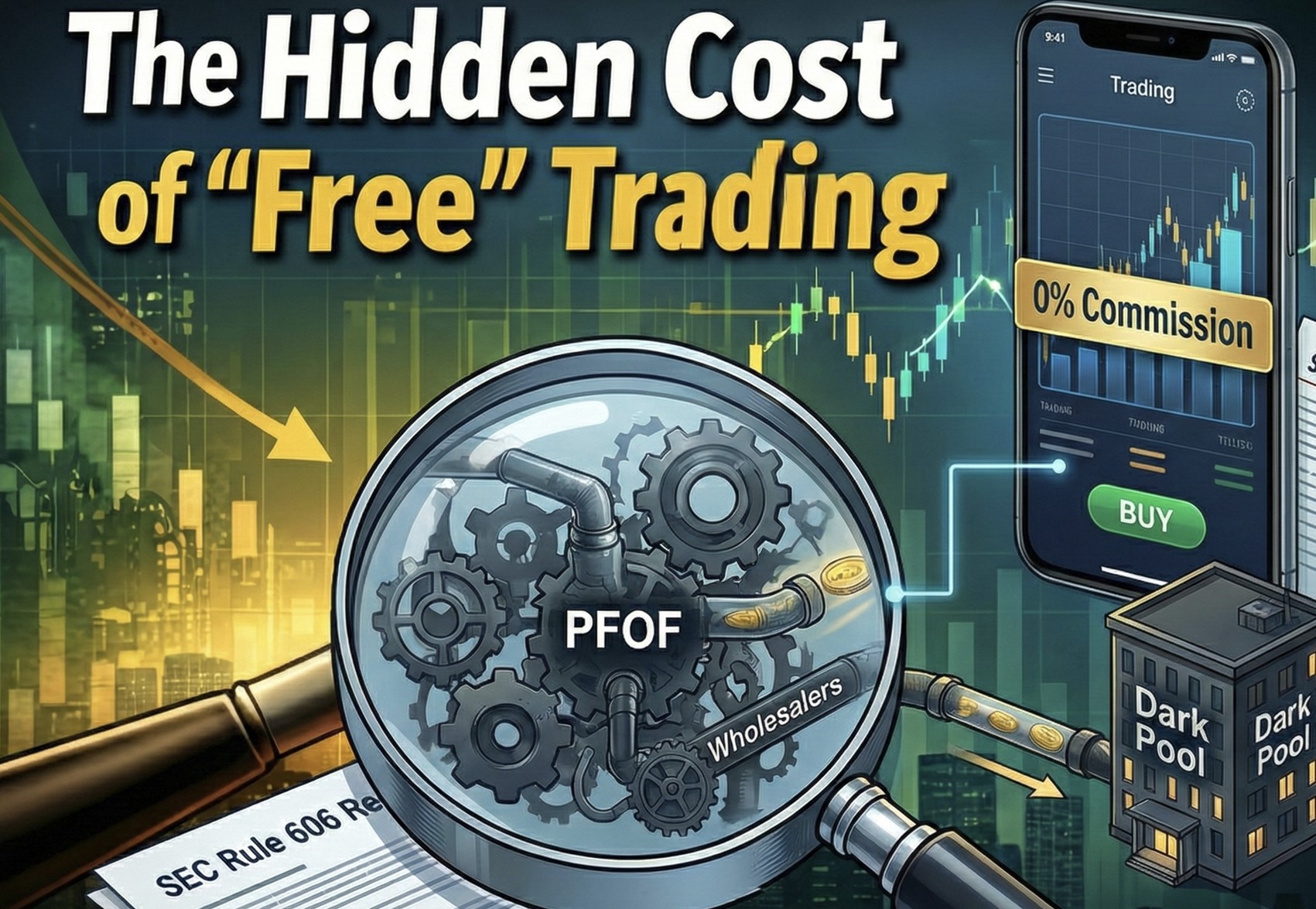
Commission-free trading has democratized access to U.S. equity markets, but this shift has been funded primarily through payment for order flow (PFOF)—a practice in which broker-dealers are compensated by wholesale market makers for routing customer orders. While platforms such as Robinhood market trades as “free,” regulatory disclosures under SEC Rule 606 reveal that most retail orders are executed off-exchange by a small group of wholesalers that pay for this order flow.
Using Rule 606 regulatory requirements, FINRA guidance, and broker-published reports, this paper demonstrates that commission-free trading often substitutes visible commissions with hidden execution costs and incentive conflicts. While proponents argue that PFOF provides price improvement over the National Best Bid and Offer (NBBO), this analysis suggests that such benchmarks often obscure the true cost of execution by ignoring superior liquidity available at the midpoint of the spread.
Key Findings:
- PFOF generated $3.8 billion in revenue for the 12 largest U.S. brokerages in 2021, with Robinhood alone collecting $974 million (about half its revenue at the time) and $270.5 million from options PFOF in Q2 2025 (congress.gov, 2025).
- Over 90% of retail marketable orders are routed to just six wholesalers, with options trading accounting for 65% of PFOF revenue (congress.gov, 2025).
- Brokers like Fidelity and Interactive Brokers (Pro accounts) avoid PFOF, proving it is not a necessity for commission-free trading. (Investopedia, 2025)
- The SEC has proposed—but not yet implemented—reforms to increase transparency and competition, including order-by-order auctions and stricter best execution rules (Global Trading, 2025).
Abstract
Commission-free trading has transformed U.S. equity markets by lowering visible transaction costs and increasing retail participation. This transformation, however, relies heavily on payment for order flow (PFOF), a market structure mechanism that monetizes retail trades indirectly. Building on critiques by Charlie Munger, this paper evaluates whether commission-free trading improves investor welfare or obscures costs through conflicted incentives. Drawing on SEC Rule 606 disclosure requirements, FINRA guidance, actual broker Rule 606 reports, and quantitative analysis, this paper finds that PFOF concentrates execution away from public exchanges, limits price competition, and raises material concerns regarding transparency, execution quality, and long-term retail investor outcomes. The analysis also examines counterarguments from industry defenders and academic research suggesting price improvement benefits, providing a balanced assessment of this controversial practice.
1. Introduction: The Illusion of “Free” and the Reality of Transparency
The elimination of trading commissions by major U.S. retail brokerages represents one of the most significant structural shifts in modern equity markets. By 2020, nearly all major platforms had adopted commission-free trading, a move widely framed as a democratizing innovation that lowered barriers for retail investors. However, this visible cost reduction coincided with the rapid expansion of a less visible monetization mechanism: payment for order flow (PFOF). Under this model, brokers route customer orders to wholesale market makers like Citadel Securities and Virtu Financial in exchange for compensation, effectively internalizing trades rather than exposing them to open exchange competition.

As legendary investor Charlie Munger publicly criticized, labeling such trades as “free” risks misleading investors by obscuring how brokers generate revenue and how trades are executed. This paper investigates the economic and structural consequences of commission-free trading by analyzing PFOF through the transparency lens provided by SEC Rule 606. The central thesis is that while Rule 606 effectively reveals the hidden costs and conflicts inherent in PFOF-dependent models, its disclosure-based framework is fundamentally inadequate to resolve the investor protection and market quality concerns it exposes. The analysis proceeds by examining the regulatory design of Rule 606, evaluating empirical data from broker disclosures, assessing alternative market structures, and considering recent regulatory proposals that acknowledge the limitations of transparency alone.
2. Payment for Order Flow and Broker Incentives
Payment for order flow creates a fundamental principal-agent conflict in equity markets. In this arrangement, brokers are compensated by third-party wholesale market makers, the entities executing customer trades, rather than by the investors whose orders are being routed. While brokers maintain a legal obligation to seek “best execution” for their clients, this fiduciary duty exists in tension with the economic incentive to maximize PFOF revenue. Market makers profit by capturing the bid-ask spread, the difference between buying and selling prices, often providing price improvement relative to the National Best Bid and Offer (NBBO) but frequently executing orders without the competitive price discovery that occurs on public exchanges.
This structure has transformed broker revenue models. Traditional commission-based platforms charged investors explicit fees for trade execution, creating transparent, aligned incentives. PFOF-dependent platforms replace this visible revenue with routing payments, creating an opaque subsidy system where transaction costs are embedded in execution quality rather than disclosed on investor statements. The conflict is structural: when a broker’s compensation depends on where an order is sent rather than solely on the execution quality obtained for the client, the potential for incentive misalignment is inherent.
3. SEC Rule 606: A Transparency Tool with Inherent Limitations
3.1 Regulatory Design and Intent
Implemented by the U.S. Securities and Exchange Commission, Rule 606 operates within a disclosure-based regulatory philosophy. Under Rule 606(a), broker-dealers must publish quarterly reports detailing their order routing practices for non-directed equity and option orders. As FINRA explains, these disclosures must include: the venues to which orders are routed; the percentage of orders routed to each venue; and whether the broker receives payment for that routing. The SEC states the rule’s purpose is to provide investors with information to “assess the quality of order handling services” and evaluate potential conflicts.
This framework represents a transparency-for-accountability approach, assuming that informed investors can make better choices and that public scrutiny will encourage better broker practices. The rule empowers regulators, researchers, and sophisticated investors to analyze routing patterns but places the burden of interpretation and action on disclosure recipients rather than establishing substantive conduct standards.
3.2 The Disclosure Limitation
Despite its value, Rule 606 has critical limitations that undermine its effectiveness as an investor protection mechanism:
- Reactive Rather Than Preventive: The rule requires disclosure of conflicts but does not prohibit or structurally mitigate them. Brokers can fully comply while maintaining arrangements that prioritize PFOF revenue over execution quality.
- Information Asymmetry: The aggregated, quarterly nature of the reports makes it difficult for individual investors to assess the cost impact on their specific trades. As Cornell Law School’s legal analysis of 17 CFR § 242.606 notes, the disclosures provide “general routing information” rather than trade-by-trade accountability.
- Execution Quality Opaqueness: While Rule 606 reveals where orders go, Rule 605 (requiring execution quality statistics) operates separately. This disconnect allows brokers to highlight routing transparency while obscuring whether those routing choices actually deliver best execution.
This regulatory design reflects a fundamental tension: Rule 606 successfully makes hidden conflicts visible but provides no mechanism to resolve them, effectively documenting a problem it cannot solve.
4. What Rule 606 Data Reveal
Rule 606 disclosures do not merely describe broker practices in theory; they provide verifiable, broker-published evidence of how retail orders are executed.
4.1 Off-Exchange Dominance
Actual Rule 606(a) reports published by retail brokerages, including Robinhood, Charles Schwab, and E*Trade, show that the vast majority of non-directed retail market orders are routed to wholesale market makers, not to public exchanges. FINRA explicitly states that Rule 606 reports are intended to reveal how brokers handle customer orders, including routing to venues that may pay for order flow, enabling assessment of execution quality and conflicts of interest.
4.2 Quantitative Evidence
For example, Robinhood’s publicly available Rule 606 disclosures list specific wholesale market centers that execute its retail orders, explicit acknowledgment that these venues pay for order flow, and aggregated routing percentages by order type. In 2021, Robinhood collected $974 million in PFOF revenue, representing approximately 54% of its total revenue. By 2024, Robinhood generated $2.95 billion in total revenue, with transaction-based revenue (primarily PFOF) comprising approximately 70% of income.
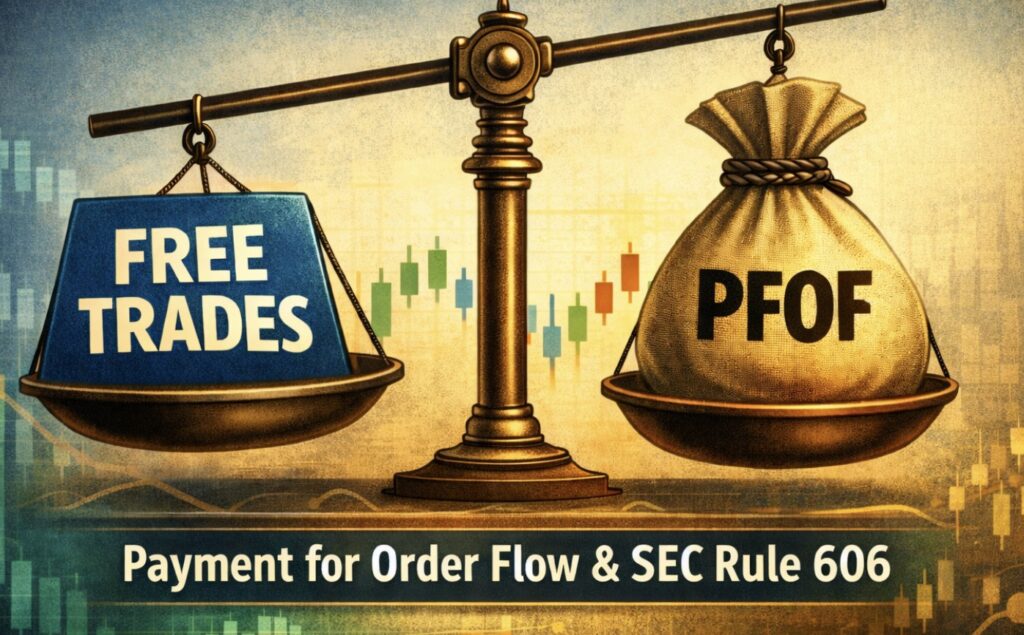
Analysis of 2024 Rule 606 filings reveals that Robinhood received approximately $0.40 per 100 shares for equity order flow and $0.48 per options contract, rates approximately double those received by competitors like E*Trade ($0.14 per 100 shares for equities). This differential has regulatory significance: in December 2020, the SEC charged Robinhood with failing to satisfy its duty of best execution, noting that “due in large part to its unusually high payment for order flow rates, Robinhood customers’ orders were executed at prices that were inferior to other brokers’ prices.” Robinhood agreed to pay a $65 million civil penalty without admitting or denying the findings.
4.3 Implications for Market Structure
Because Rule 606 reports show that a high percentage of retail orders are executed internally by wholesalers, they demonstrate that most retail trades never interact with public exchange order books, competitive price discovery is limited, and execution quality comparisons based solely on NBBO may be incomplete since the counterfactual auction price is never observed. These conclusions are directly grounded in regulatory disclosure, not inference.
5. Broker Reliance on Payment for Order Flow
Rule 606 reports confirm that PFOF is widespread across the industry, though reliance varies:
- Robinhood relies heavily on PFOF as a primary revenue source.
- Charles Schwab and TD Ameritrade disclose routing payments from wholesalers.
- E*TRADE and Webull publish Rule 606 reports confirming similar practices.
6. Brokers That Avoid or Limit PFOF
Some firms demonstrate that commission-free or low-cost trading does not require PFOF:
- Fidelity Investments: Does not accept PFOF for equity trades and claims to have saved investors $1.94 billion in 2024 through price improvement, an average of $24.30 per 1,000-share equity order compared to an industry average of $4.34.
- Interactive Brokers (IBKR Pro): Uses proprietary Smart Routing algorithm and charges explicit commissions rather than accepting PFOF.
- Public.com: Eliminated PFOF for equity trades in February 2021, introducing optional tipping instead. However, Public does accept PFOF for options trades through a rebate-sharing program with customers.
- Vanguard and Merrill Edge: Do not accept PFOF for equity orders.
These models prioritize explicit pricing or alternative revenue streams such as securities lending and margin interest, reinforcing that PFOF is a business choice, not a structural necessity.
7. Execution Quality and The “Price Improvement” Debate
A critical distinction must be made between Rule 606 (which discloses routing and payments) and Rule 605 (which measures execution quality statistics). While Rule 606 reveals the conflict of interest, it does not inherently prove poor execution.
7.1 The Price Improvement Defense
Wholesalers and brokers defend PFOF by citing “price improvement.” They argue that by routing to wholesalers, retail investors often receive a fill price slightly better than the National Best Bid and Offer (NBBO) available on public exchanges.
7.2 The Counter-Argument: Benchmarking Limitations
However, this “improvement” is often measured against a flawed benchmark. The NBBO displays the best public bid and offer, but it does not reflect:
- Midpoint Liquidity: Prices available between the spread.
- Odd-Lot Liquidity: Better prices available for small order sizes that are not displayed on the NBBO.
When orders are internalized by wholesalers, they may offer a fraction of a penny of improvement over the NBBO while capturing the majority of the spread for themselves. Consequently, while the trade appears “free,” the investor may explicitly lose more in inferior execution (relative to the midpoint) than they saved in commissions.
8. Behavioral Effects on Retail Investors
Behavioral finance research consistently shows that higher trading frequency correlates with lower long-term returns due to overconfidence and timing errors. The seminal study by Brad Barber and Terrance Odean (2000), “Trading Is Hazardous to Your Wealth,” analyzed 66,465 households with accounts at a large discount broker from 1991 to 1996. They found that households that traded most frequently earned an average annual return of 11.4%, substantially below the market return of 17.9%. The average household turned over 75% of its portfolio annually, with overconfidence identified as the primary explanation for excessive trading.
Commission-free platforms reduce friction and encourage short-term trading. While Rule 606 does not measure behavior directly, it reveals the economic structure that subsidizes these platforms, linking execution incentives with behavioral risk. The gamification features common on platforms like Robinhood, including confetti animations for trades and simplified mobile interfaces, may exacerbate these tendencies. As Munger observed, “It’s really stupid to have a culture which encourages as much gambling in stocks by people who have the mindset of racetrack bettors.”
9. Charlie Munger’s Critique Revisited
At the 2021 Daily Journal annual meeting, Charlie Munger stated:
“Robinhood trades are not free. When you pay for order flow, you’re probably charging your customers more and pretending to be free.”
Munger elaborated: “The frenzy is fed by people who are getting commissions and other revenues out of this new bunch of gamblers… It’s a dirty way of making money.” At the 2022 Berkshire Hathaway annual meeting, he described Robinhood’s short-term gambling model, hidden kickbacks, and commission structure as “disgusting,” adding: “Now it’s unraveling. God is getting just.”
Rule 606 disclosures empirically support this critique by showing that brokers are compensated primarily by market makers rather than customers, validating concerns about incentive misalignment and transparency. The quantitative evidence confirms that PFOF creates structural conflicts of interest, even if the net impact on retail investor welfare remains debated.
10. Conclusion: Beyond Transparency to Structural Solutions
SEC Rule 606 has successfully performed its intended function: it has made visible the hidden economic arrangements behind “free” trading, empirically validating critiques like Charlie Munger’s that investors “are probably paying more and pretending it’s free.” The disclosures unequivocally show that commission-free trading substitutes visible commissions with less transparent execution costs and structural conflicts of interest.
However, the persistence and scale of PFOF despite years of transparent disclosure reveals the fundamental limitation of the Rule 606 approach. Transparency alone cannot resolve the principal-agent conflict when economic incentives strongly favor one outcome (maximizing PFOF revenue) over another (optimizing execution quality). The rule documents a market structure that fragments price discovery, concentrates execution risk, and creates behavioral nudges toward excessive trading, yet provides no mechanism to alter that structure.
The path forward requires moving beyond disclosure to substantive regulation. This could involve implementing competitive mechanisms like the proposed order-by-order auctions, establishing clearer best execution standards that account for PFOF conflicts, or reconsidering whether certain order types should be permitted at all. As alternative brokerage models demonstrate, different structures are possible, ones that align broker compensation with investor outcomes rather than creating inherent tensions between them.
In the final analysis, Rule 606 serves as both a crucial transparency tool and a testament to the insufficiency of transparency alone. It reveals the architecture of modern retail trading but leaves unaddressed the structural reforms needed to ensure markets serve long-term investor welfare rather than short-term intermediary profit. True market democratization requires not just the elimination of visible commissions, but the alignment of hidden incentives with investor success.
References
Barber, B. M., & Odean, T. (2000). Trading is hazardous to your wealth: The common stock investment performance of individual investors. Journal of Finance, 55(2), 773–806. https://doi.org/10.1111/0022-1082.00226
Better Markets. (2023, April 3). SEC market structure reforms: Order competition rule. https://bettermarkets.org/impact/sec-market-structure-reforms-order-competition-rule/
BrokerChooser. (2025, September 9). Payment for order flow: A brief guide for traders and investors. https://brokerchooser.com/education/investing/payment-for-order-flow
Congressional Research Service. (2023). Payment for order flow (PFOF) and broker-dealer regulation (CRS Report IF12594). Congress.gov. https://www.congress.gov/crs-product/IF12594
Congressional Research Service. (n.d.). Payment for order flow: The SEC proposes reforms (CRS Report IF12332). Congress.gov. https://www.congress.gov/crs-product/IF12332
Council of the European Union. (2024, February 20). MiFIR and MiFID II: Council adopts new rules to strengthen market data transparency [Press release]. https://www.consilium.europa.eu/en/press/press-releases/2024/02/20/mifir-and-mifid-ii-council-adopts-new-rules-to-strengthen-market-data-transparency/
Curvo. (2025, November 16). Payment for order flow (PFOF): What it is and why it’s controversial. https://curvo.eu/article/payment-for-order-flow-pfof
Ernst, T., & Spatt, C. S. (2025, January 24). How does payment for order flow influence markets? Evidence from Robinhood crypto token introductions [Working paper]. U.S. Securities and Exchange Commission Division of Economic and Risk Analysis. https://www.sec.gov/files/dera_wp_payment-order-flow-2501.pdf
Fidelity Investments. (2025). Commitment to execution quality. https://www.fidelity.com/trading/execution-quality/overview
Fidelity Investments. (2025). SEC Rule 606: Disclosure of order routing information. https://clearingcustody.fidelity.com/trade-execution-quality/sec-rule-606
Financial Industry Regulatory Authority. (n.d.). About 606—SEC Rule 606 order routing disclosures. https://www.finra.org/finra-data/about-606
Financial Industry Regulatory Authority. (n.d.). FINRA Rule 6151 – Centralization of SEC Rule 606(a) reports. https://www.finra.org/filing-reporting/rule-6151-reporting-compliance
Fitzgerald, M. (2022, April 30). Charlie Munger says the Robinhood trading app is justly ‘unraveling’ for ‘disgusting’ practices. CNBC. https://www.cnbc.com/2022/04/30/charlie-munger-says-the-robinhood-trading-app-is-justly-unraveling-for-disgusting-practices.html
Fortune. (2022, May 2). Charlie Munger calls Robinhood’s business “disgusting.” https://fortune.com/2022/05/02/charlie-munger-robinhood-earnings-disgusting-earnings-berkshire-hathaway-annual-shareholder-meeting/
Fox Business. (2021, February 25). Charlie Munger blasts Robinhood platform for touting “free” investing. https://www.foxbusiness.com/markets/charlie-munger-blasts-robinhood-platform-for-touting-free-investing
Global Trading. (2025, June 10). Citadel Securities paid US$943m for retail US equity, options order flow in nine months. https://www.globaltrading.net/citadel-securities-paid-us943m-for-retail-us-equity-options-order-flow-in-nine-months/
Global Trading. (2025, June 19). SEC takes hatchet to payment for order flow, best execution proposals and 12 more rules. https://www.sec.gov/files/reg-nms-rule-606-disclosures-risk-alert.pdf
Global Trading. (2025, August 8). Robinhood, Schwab led US$340m retail order flow payment bonanza in May. https://www.globaltrading.net/robinhood-schwab-led-us461m-retail-order-flow-payment-bonanza-in-may/
Goldman Sachs. (2025). SEC Rule 606(a) report: Q3 2025. https://www.goldmansachs.com/compliance-rule606
IBTimes. (2021, June 30). Robinhood fined record $70 million; Charlie Munger calls it “sleazy,” a “gaming parlor”. https://www.ibtimes.com/robinhood-fined-record-70-million-charlie-munger-calls-it-sleazy-gaming-parlor-3239614
Investopedia. (2025, October 4). Payment for order flow (PFOF): Definition and how it works. https://www.investopedia.com/terms/p/paymentoforderflow.asp
Legal Information Institute. (n.d.). 17 CFR § 242.606—Disclosure of order routing information. Cornell Law School. https://www.law.cornell.edu/cfr/text/17/242.606
Li, Y. (2021, February 24). Charlie Munger says novice investors are getting lured into a bubble in ‘dirty way’ by Robinhood. CNBC. https://www.cnbc.com/2021/02/24/charlie-munger-says-novice-investors-are-getting-lured-into-a-bubble-in-dirty-way-by-robinhood.html
Nasdaq. (2021, October 21). Exploring the SEC’s bid to ban payment for order flow: What could replace PFOF? https://www.nasdaq.com/articles/exploring-the-secs-bid-to-ban-payment-for-order-flow:-what-could-replace-pfof-2021-10-21
Popper, N. (2020, July 8). Robinhood has lured young traders, sometimes with devastating results. The New York Times. https://www.nytimes.com/2020/07/08/technology/robinhood-risky-trading.html
Robinhood Markets, Inc. (2021). SEC Rule 606 and 607 disclosure (Q2 2021). https://cdn.robinhood.com/assets/robinhood/legal/RHS%20SEC%20Rule%20606%20and%20607%20Disclosure%20Q2%202021.pdf
Robinhood Markets, Inc. (2025, February 12). Robinhood reports fourth quarter and full year 2024 results [Press release]. https://investors.robinhood.com/news-releases/news-release-details/robinhood-reports-fourth-quarter-and-full-year-2024-results
Schwarz, C., Barber, B. M., & Odean, T. (2022). The “actual retail price” of equity trades [Working paper]. SSRN. https://ssrn.com/abstract=4189239
Spatt, C. S. (2023). Payment for order flow and the retail trading experience [Working paper]. Wharton Financial Institutions Center. https://wifpr.wharton.upenn.edu/wp-content/uploads/2023/10/Payment-for-Order-Flow.pdf
StockBrokers.com. (2025, November 4). Best brokers for order execution of 2025. https://www.stockbrokers.com/guides/order-execution
U.S. Securities and Exchange Commission. (2020, December 17). SEC charges Robinhood Financial with misleading customers about revenue sources and failing to satisfy duty of best execution [Press release]. https://www.sec.gov/newsroom/press-releases/2020-321
U.S. Securities and Exchange Commission. (2022, December 14). SEC proposes rule to enhance competition for individual investor order execution [Press release]. https://www.sec.gov/newsroom/press-releases/2022-225
