

Executive Summary
Most of the reporting on enterprise AI in 2026 has been about the bill. Uber exhausted its annual AI coding budget in four months. Microsoft pulled a coding assistant from divisions over cost. Salesforce’s chief executive put its annual spending with a single model provider at roughly $300 million. The FinOps Foundation put the enterprise AI budget overrun rate at 73 percent.
Far less has been written about what happened next. We pulled quarterly SEC filings for nine large companies that are deploying AI — Palantir, Disney, Amazon, Uber, Salesforce, Paramount Skydance, Microsoft, Accenture and Meta — and compared the most recent quarter with the same quarter a year earlier.
Eight of the nine expanded operating margin. Several posted their strongest profitability in years, in the same period they were reportedly losing control of their AI spending. This report sets out the numbers, the competing explanations, and the specific reasons the question cannot be closed from public filings — and leaves the judgment to the reader.
A note on approach: this report poses a question rather than answering it. The figures are verifiable; the interpretation is contested. Both readings are set out below with the evidence for each.
The Question
Through the first half of 2026, “tokenmaxxing” described a management fashion in which token consumption was treated as a proxy for productivity. Nvidia’s chief executive gave it its most repeated line, saying he would be alarmed if a $500,000 engineer had not spent $200,000 on tokens. Meta and Uber ran internal usage leaderboards. Then the bills arrived, and the coverage turned.
What went largely unexamined is the other side of the ledger. If a company spends unexpectedly large sums on inference and its profitability improves in the same period, is that a return on the spending, or is it unrelated?
The honest answer is that the filings do not settle it. But they do narrow it, and the shape of the data is worth seeing directly.
What the Filings Show
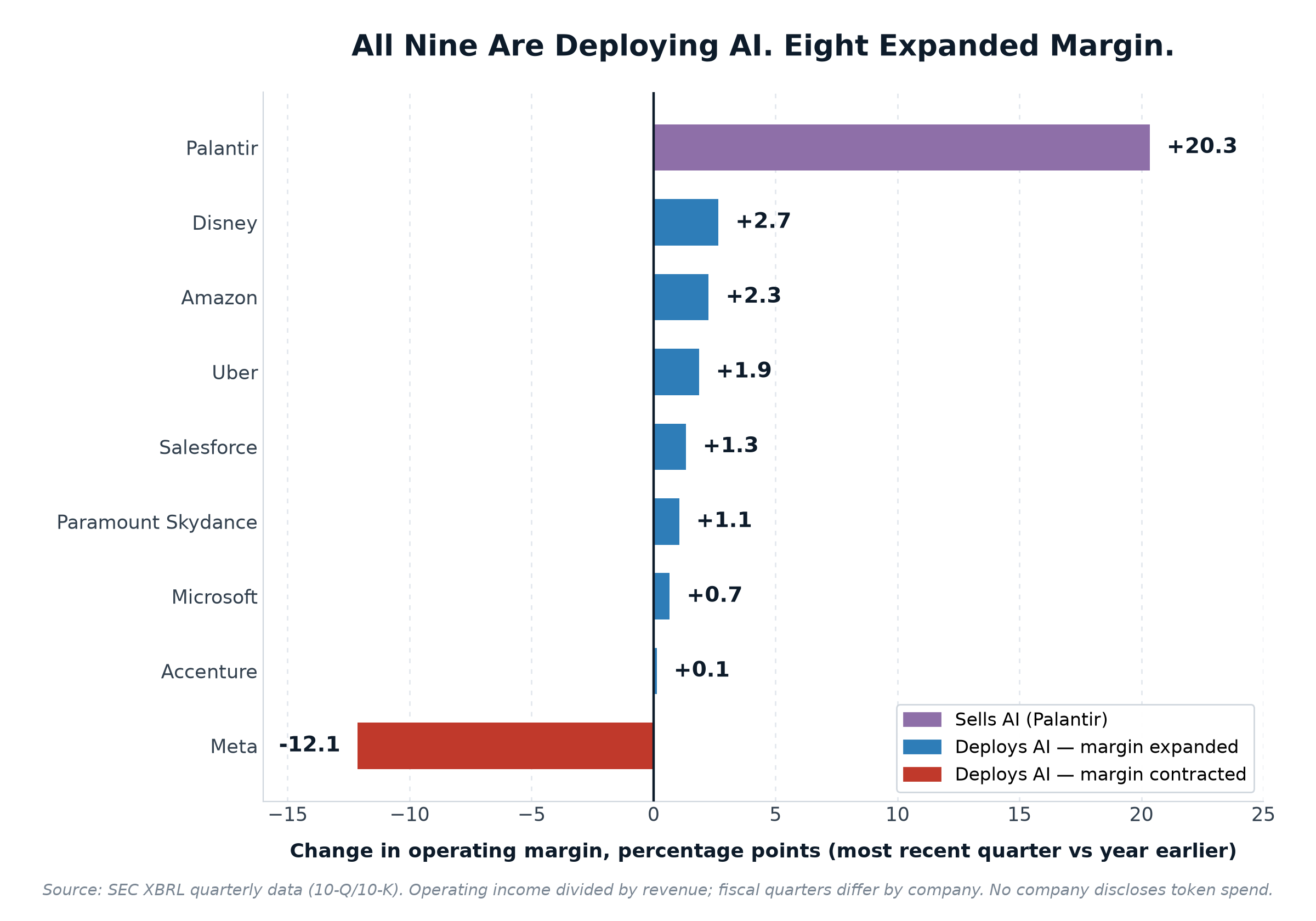
| Company | Revenue | Operating income | Margin | Change |
|---|---|---|---|---|
| Palantir | +92.8% | +238.6% | 26.8% → 47.1% | +20.3 |
| Disney | +6.8% | +21.4% | 19.3% → 22.0% | +2.7 |
| Amazon | +19.6% | +43.2% | 11.4% → 13.7% | +2.3 |
| Uber | +12.2% | +30.3% | 11.5% → 13.3% | +1.9 |
| Salesforce | +13.3% | +20.9% | 19.8% → 21.1% | +1.3 |
| Paramount Skydance | +0.9% | +19.0% | 5.8% → 6.9% | +1.1 |
| Microsoft | +18.3% | +20.0% | 45.7% → 46.3% | +0.7 |
| Accenture | +5.6% | +6.5% | 16.8% → 17.0% | +0.1 |
| Meta | +28.0% | −8.2% | 43.0% → 30.9% | −12.1 |
All figures are computed from values companies tag in their own filings via the SEC’s XBRL service. Operating income is used rather than net income throughout, for a reason worth stating: Uber’s first-quarter net income fell from $1.78 billion to $263 million year over year, a collapse driven by revaluation of equity stakes rather than trading. Its operating income rose 57 percent over the same span. Any read of operating efficiency that uses the net line will mislead.
There Is No Control Group Left
The obvious way to test whether AI drove these gains would be to compare adopters with non-adopters. Among large public companies in 2026, that comparison is no longer available.
Disney and Paramount Skydance were initially included in this analysis as media businesses without an AI spending story. On examination, that description does not hold. Disney’s leadership describes AI programmes across five areas of the business — content production, monetisation, workforce productivity, guest experience and enterprise operations — including labour-forecasting systems in the parks that model attendance, weather and guest flow to set staffing, and an internal AI tool used by more than 2,000 Imagineers. In December 2025 Disney went as far as announcing a $1 billion equity investment in OpenAI alongside a licence covering more than 200 characters. That deal collapsed in March 2026 when OpenAI shut down its Sora video platform, and talks about a successor arrangement have been reported since — but the willingness to commit a billion dollars is itself evidence of how far from an AI bystander Disney is.
Paramount Skydance is arguably further along. David Ellison’s post-merger plan is explicitly technology-led: consolidation onto a single platform, AI-assisted localisation for dubbing and subtitling, proprietary advertising technology, expanded virtual production, and a six-year, $300 million cloud commitment signed with Oracle in February 2026. The company projects savings well above its original $3 billion target, with $2.5 billion anticipated by the end of 2026.
Why this matters for the question. Every company in this sample is deploying AI, in several cases aggressively and by their own account for the express purpose of reducing cost. That removes the possibility of a clean comparison — but it also removes a common objection. The pattern here is not “companies that adopted AI did well while others did not.” It is “nine companies adopting AI, eight of which improved profitability.” Whether that is cause or coincidence is precisely the open question.
Question One: Is the Timing a Coincidence?
The case that it is not. Eight of nine companies improved margin in the same twelve months that AI deployment moved from pilot to production across the enterprise. Several are documented as targeting cost reduction explicitly: Paramount’s AI-assisted localisation streamlines dubbing and subtitling; Disney’s labour forecasting matches park staffing to predicted demand; Uber shipped roughly 70 percent of its committed code with AI assistance. These are not vague ambitions but named programmes with stated cost objectives. Their results improved.
The case that it is. Margins across large American companies improved through this period for reasons that predate AI adoption — cost discipline following the 2022–23 correction, operating leverage on recovering demand, and company-specific stories that are well documented independently. Disney’s improvement is closely tied to streaming reaching profitability. Paramount’s is a merger-integration story with a stated $2.5 billion synergy target. Uber’s margin gain came almost entirely from cost of revenue, a line driven by delivery mix and its growing advertising business. Each has a sufficient explanation without invoking AI at all.
Both readings fit the data. Neither can be excluded by it.
Question Two: Why Is Meta the Exception?
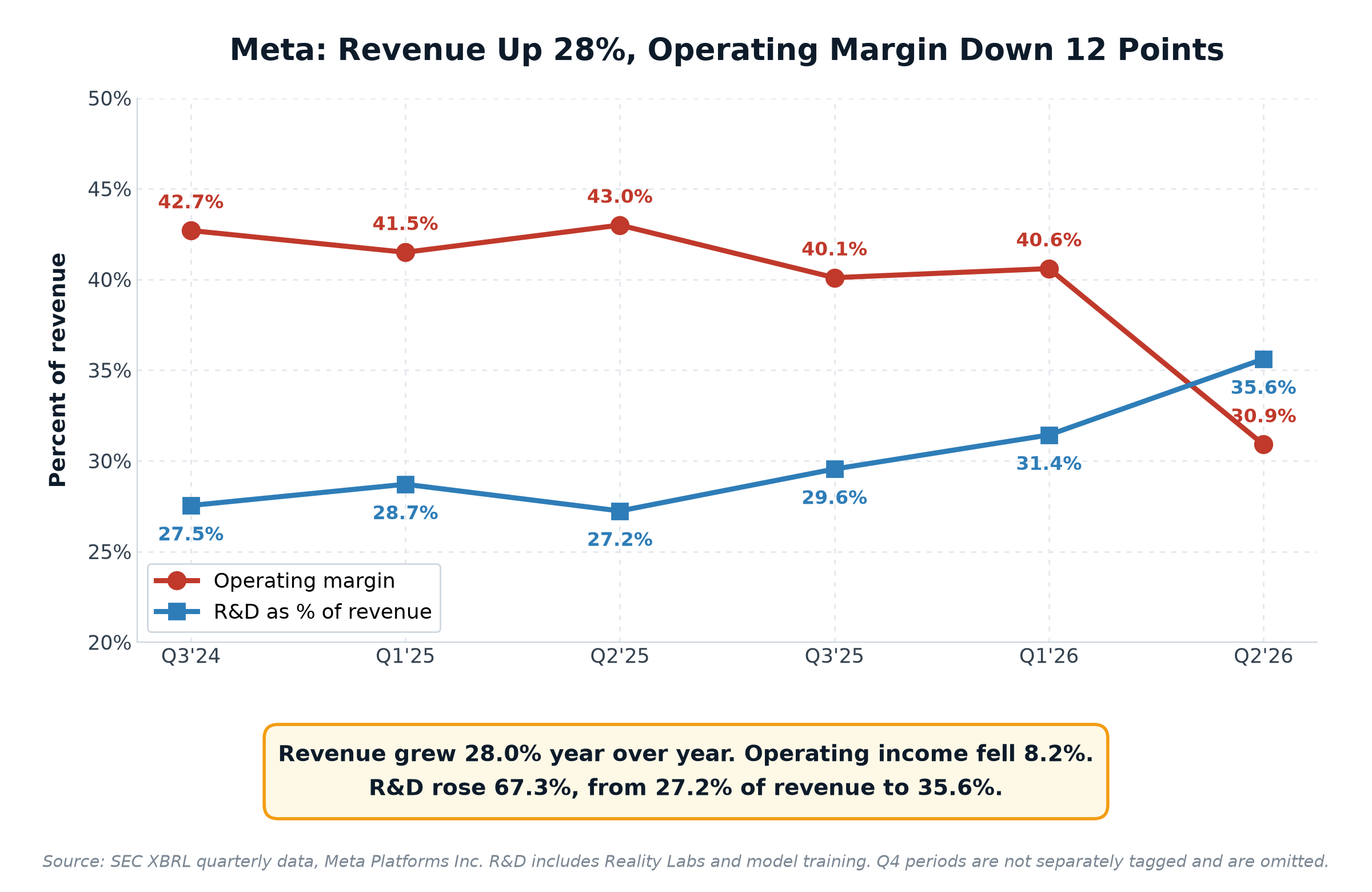
Meta grew revenue 28 percent — faster than every company here except Palantir — while operating income fell 8.2 percent. Margin dropped from 43.0 to 30.9 percent in four quarters. Research and development rose 67.3 percent, from 27.2 to 35.6 percent of revenue. General and administrative expense more than doubled in dollar terms, rising from 5.6 percent of revenue to 9.2 percent.
Meta is the only company in the sample where AI spending is large enough to be legible in the income statement without any proxy or inference. And it is the only one whose margin fell.
There is an important distinction available to readers here. Meta is not primarily buying AI; it is building it — training frontier models, staffing a superintelligence effort, and running Reality Labs, all inside the same R&D line. That is a categorically different expense from Uber purchasing access to a coding assistant. One reading is that Meta shows what happens when a company crosses from consuming AI to producing it. Another is that Meta is simply the honest case, and that the difference between it and the others is disclosure rather than economics.
Question Three: Why Did Uber’s Overheads Rise?
Uber is the best-documented overrun in the sample and therefore the most useful test. It exhausted its annual AI coding budget in four months, with 84 percent of engineers using an AI coding tool by March.
Revenue grew 12.2 percent and operating income 30.3 percent. But the overhead ratios moved the wrong way for the productivity thesis. General and administrative expense rose from 5.29 to 6.59 percent of revenue. Sales and marketing rose from 9.56 to 10.68 percent. Research and development rose from 6.64 to 7.35 percent, growing at roughly twice the rate of revenue — a step-up of about $181 million per quarter against the prior run rate.
Readers can take this two ways. If AI were compressing administrative work, G&A should be falling as a share of revenue, and it is not. Alternatively, the R&D acceleration is exactly what heavy tool adoption looks like in its investment phase, and the payoff has not yet arrived — the productivity J-curve that economists describe, in which gains follow rather than accompany the spending.
Uber’s own chief operating officer said the company struggles to draw a direct line from its AI spending to shipped functionality. Notably, R&D at Uber also contains engineering headcount and its autonomous vehicle programme, so even the step-up cannot be attributed to tooling with confidence.
The Company That Looks Most Like the Thesis
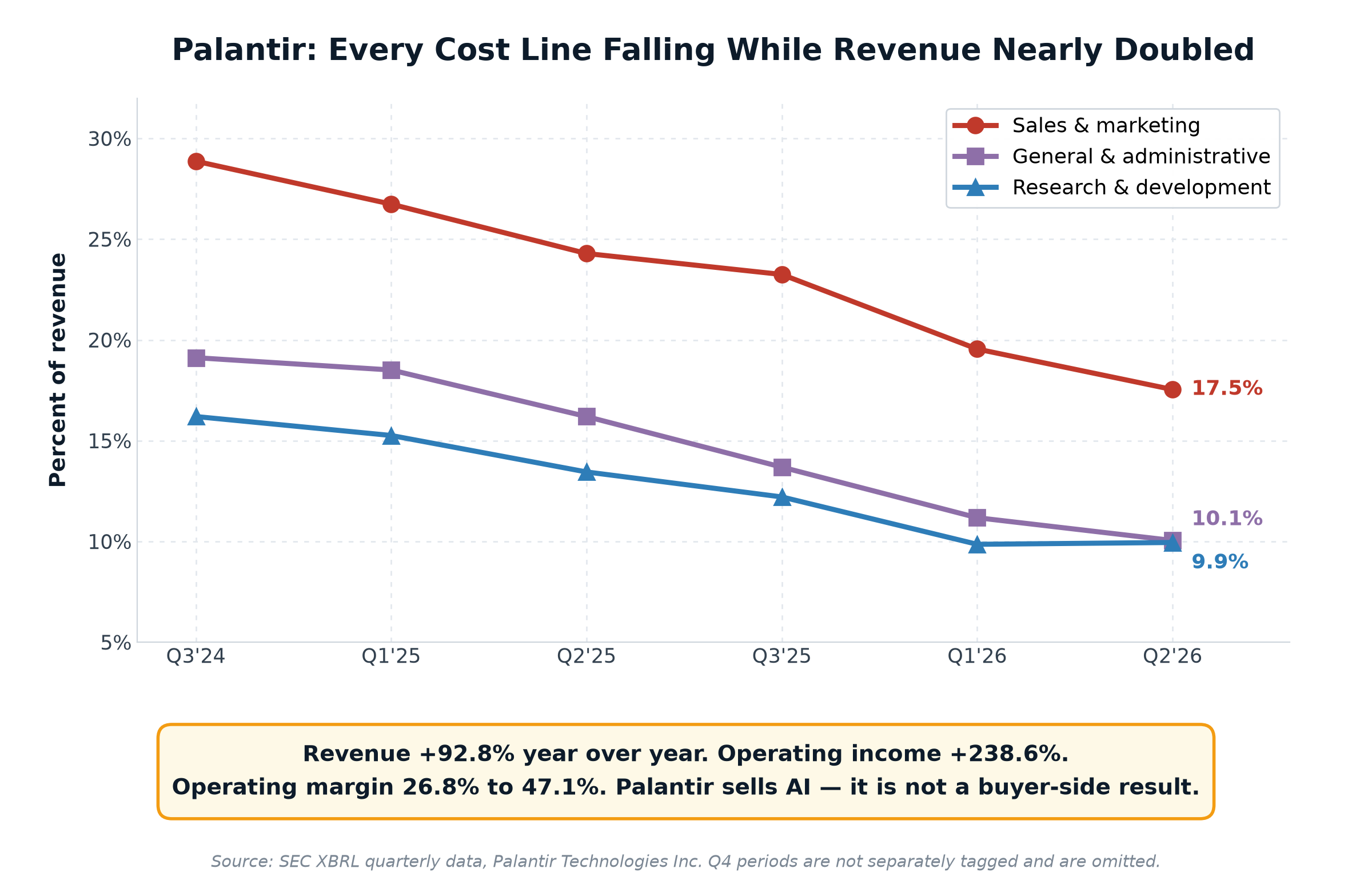
Palantir is what the optimistic case predicts, executed almost perfectly. Revenue rose 92.8 percent and operating income 238.6 percent. Every major cost category fell as a share of revenue at once — research and development from 13.5 to 10.0 percent, sales and marketing from 24.3 to 17.5, general and administrative from 16.2 to 10.1. Operating margin went from 26.8 to 47.1 percent in a year.
The qualification readers should weigh: Palantir sells AI. Its results prove that supplying AI capability is extraordinarily profitable at present. Whether they say anything about the economics of buying it is a separate question — and it points at a structural feature of this whole debate. Uber’s exhausted budget is a model provider’s revenue. Salesforce’s $300 million is an entry on someone else’s income statement. The same dollar is frequently cited twice as evidence that AI works, once as vendor growth and once as customer adoption.
What Would Actually Settle It
A disclosed inference line. No company in this sample reports what it spends on tokens. There is no income statement line for it, no XBRL tag, and no requirement to provide one. A single large buyer reporting inference cost against any consistent output measure would tell readers more than every executive statement made this year combined.
Falling overhead ratios. This test needs no new disclosure. If AI compresses administrative work, general and administrative expense should decline as a share of revenue at heavy adopters. Across several more quarters, that single ratio will say more than any earnings call.
Meta’s recovery, or lack of it. If the twelve-point compression reverses as models reach production, that is the J-curve behaving as its proponents describe. If it persists, it is the standing cost of competing at the frontier.
Limits of This Analysis
Nine companies, selected because they appeared in coverage of AI spending or offered contrast to it, is not a random sample. Fiscal calendars differ — Salesforce closes in January, Microsoft in June, Accenture in August, Disney in September — so “the past year” is not one synchronised period. Microsoft and Amazon both sell and buy AI, so the two effects net out in their accounts and cannot be separated. Paramount Skydance’s year-earlier comparative reflects predecessor Paramount Global, before the August 2025 merger closed, so its year-over-year change spans a change in the reporting entity. Booking Holdings was examined but excluded: its recent quarterly figures are not tagged in the fields queried, and no current data could be retrieved, so it is omitted rather than estimated.
Most importantly, no figure in this report measures AI spending. Every number is a proxy, because the underlying data is not disclosed by anyone.
The reader’s call. Nine companies deploying AI, several of them explicitly to cut cost. Eight improved operating margin over the past year, some substantially. The one that spends most visibly on AI lost twelve points of margin, and it is also the one building models rather than buying them. Every overhead ratio at the best-documented buyer moved the wrong way, while its operating profit grew 30 percent. Is the timing a coincidence, or is this what a return looks like before the accounting catches up to it? The filings are laid out above. Reasonable analysts are reaching opposite conclusions from the same numbers, and until someone discloses an inference line, that disagreement cannot be resolved by evidence.
Sources
All revenue, operating income and expense figures: U.S. Securities and Exchange Commission, XBRL company facts API, quarterly data as filed on Forms 10-Q and 10-K. https://www.sec.gov/search-filings/edgar-application-programming-interfaces
Paramount Skydance Corp. Form 10-Q, quarter ended 30 June 2026. https://www.sec.gov/Archives/edgar/data/0002041610/000204161026000054/psky-20260630.htm
Fortune. Tokenmaxxing is over. It was a flawed way to measure a company’s ROI from AI, 28 May 2026. https://fortune.com/2026/05/28/tokenmaxxing-is-dead-companies-didnt-get-the-roi-from-ai-they-wanted-to-see/
Forbes. After ‘Tokenmaxxing’, Token Spend Has Become The New Metric To Watch, 10 July 2026. https://www.forbes.com/sites/timkeary/2026/07/10/after-tokenmaxxing-token-spend-has-become-the-new-metric-to-watch/
Deadline. David Ellison on cost savings, growth, the tech stack and AI, March 2026. https://deadline.com/2026/03/david-ellison-warner-bros-discovery-cost-savings-growth-1236769564/
Fox Business. Disney CEO Josh D’Amaro outlines AI and content strategy in growth plan, 2026. https://www.foxbusiness.com/markets/disney-ceo-unveils-entertainment-giants-new-3-pillar-growth-plan
CNBC. Disney making $1 billion investment in OpenAI, will allow characters on Sora AI video generator, 11 December 2025. https://www.cnbc.com/2025/12/11/disney-openai-sora-characters-video.html
Variety. OpenAI Will Shut Down Sora Video App; Disney Drops Plans for $1 Billion Investment, March 2026. https://variety.com/2026/digital/news/openai-shutting-down-sora-video-disney-1236698277/
The Hollywood Reporter. OpenAI Still Talking to Disney About a Deal After Sora Shutdown, 2026. https://www.hollywoodreporter.com/business/digital/openai-still-talking-disney-sora-shutdown-1236554471/
FinOps Foundation, cited for the 73 percent enterprise AI budget overrun rate; Uber, Microsoft and Salesforce spending disclosures as reported by Fortune, the Financial Times and Forbes, 2026.