
Executive Summary
Within seven months, two competing international structures were built around artificial intelligence. The United States launched Pax Silica in Washington on December 12, 2025. China signed the World Artificial Intelligence Cooperation Organization into existence in Shanghai on July 16, 2026. They are routinely described as rivals.
They are not, in the strict sense, the same kind of thing. WAICO is a treaty-based intergovernmental organization with a Council, a Secretariat, and a mandate to shape AI governance. Pax Silica is a non-binding political declaration coordinating supply chains across semiconductors, critical minerals, and energy. One writes rules. The other allocates materials. Most comparisons between them fail at this first step.
Where they genuinely compete is for the assent of the roughly 140 countries that build no frontier models and manufacture no advanced chips. On that contest, WAICO currently holds more members — approximately 37 to Pax Silica’s 24 — while Pax Silica holds the physical chokepoints. This report sets out what each is, how they differ, and where each is weak. It closes with a clearly labelled editorial assessment, which leans toward the American framework on the specific and limited ground of verifiability.
A note on this report’s stance: the descriptive sections are written to be neutral, and readers should be able to check every factual claim against the sources listed at the end. The judgment in the final section is editorial, and is labelled as such rather than smuggled into the analysis.
What Pax Silica Is
Pax Silica was announced on December 11, 2025, and launched the following day at a summit convened by the U.S. Department of State in Washington. It is led by Jacob Helberg, Under Secretary of State for Economic Growth, Energy, and the Environment, and operates under the working motto “Securing the Silicon Supply Chain.”
Seven countries signed the founding declaration: the United States, Japan, South Korea, Singapore, Israel, Australia, and the United Kingdom. The Netherlands, Qatar, the United Arab Emirates, India, Sweden, Finland, the Philippines, and Norway followed over the next five months. At the second summit on June 25–26, 2026, membership expanded from 14 to 24 signatories, adding Argentina, Chile, Costa Rica, El Salvador, Germany, Greece, Kazakhstan, Panama, and the European Union as a bloc. Canada, Taiwan, Estonia, and the OECD have participated in guest or observer capacities.
Critically, the Pax Silica Declaration is not a treaty and creates no binding obligations. The European Commission stated plainly that it is “not legally binding; it is a political statement that will not interfere with EU internal decision-making.” What it does instead is signal coordinated commitment to mechanisms that already exist independently: export controls, cross-investment bans, industrial subsidies, mining agreements, and rules steering capital flows.
The second summit produced specific deliverables. Thirty-five nations signed a Joint Statement on AI Opportunity favoring pro-growth regulation. The State Department opened a competitive funding call for a pilot system to verify the provenance of semiconductors and critical minerals transiting Panama. Stanford University and the State Department developed a “Foundry School” advanced-manufacturing curriculum for adoption across member economies. The administration sought $250 million for a Pax Silica Fund supporting minerals extraction and manufacturing, and announced an economic security zone in Kazakhstan.
The “moving gap” doctrine. Underlying the coalition is an explicit U.S. objective of maintaining a six-to-eighteen-month technological lead over China rather than attempting total denial. In December 2025 Washington authorized export of the H200 AI chip to approved Chinese customers — previous-generation hardware released while frontier capability is withheld. This is a deliberate strategy, and also, as discussed below, the coalition’s most-criticized feature.
What WAICO Is
The World Artificial Intelligence Cooperation Organization was first proposed by Chinese Premier Li Qiang at the World AI Conference in Shanghai in July 2025, and reiterated by Xi Jinping at the APEC meeting in October 2025. The founding agreement was signed in Shanghai on July 16, 2026, by 29 countries, with Foreign Minister Wang Yi signing for China. UN Secretary-General António Guterres attended the ceremony.
Signatories include Russia, Brazil, Indonesia, Pakistan, Malaysia, South Africa, Senegal, Kazakhstan, and Laos. Iran acceded on July 31, 2026. By August 2026 membership had reached roughly 37 states — approximately 16 in Asia, 13 in Africa, five in Latin America, and three in Europe. The United States, the European Union, the United Kingdom, Japan, and South Korea — the jurisdictions where frontier models are actually built — are all absent.
WAICO is headquartered in Shanghai and constituted as an independent intergovernmental organization. Its governance consists of a Council, the decision-making body, and a Secretariat that implements Council decisions. The Council may grant observer status to non-member states and intergovernmental organizations, and may establish subsidiary bodies and working groups. A thirteen-point Global AI Governance Action Plan was released alongside the founding agreement and functions as its intellectual charter.
Membership is open to any sovereign state with no values-based or regime-type entry test. The stated principles are benefit to the people, respect for sovereignty, development orientation, safety and controllability, fairness and inclusiveness, and open cooperation. China has committed to 5,000 exchange-programme places over five years and to establishing cooperation centres with ASEAN, the Arab League, the African Union, CELAC, BRICS, and the Shanghai Cooperation Organisation. WAICO sits alongside the Beijing-based World Data Organization in what Chinese officials describe as a dual-hub framework.
Side by Side
| Pax Silica | WAICO | |
|---|---|---|
| Type | Non-binding political declaration | Treaty-based intergovernmental organization |
| Founded | December 12, 2025, Washington DC | July 16, 2026, Shanghai |
| Members | 24 signatories (June 2026), plus guests | ~37 states (August 2026) |
| Entry test | Alignment and capability; effectively invitation-based | Open to any sovereign state; no values test |
| Core function | Supply-chain security: chips, minerals, energy, manufacturing | AI governance, standards, and development cooperation |
| Permanent bodies | None; summit-based, State Department coordinated | Council and Secretariat |
| Published rules | Declaration text and summit outcomes public | Charter, budget, and enforcement not yet public |
| Money on the table | $250M proposed fund; EU commitment to buy $40B in US AI chips | 5,000 exchange places; regional cooperation centres; sums undisclosed |
| Frontier AI developers | US, UK, South Korea, Japan, EU inside | China inside; all others outside |
| Posture on open models | Not a stated organizing principle | Open-source AI is a central plank |
The Four Differences That Matter
1. One is a forum, the other is a supply chain. This is the difference most coverage misses. WAICO can convene, deliberate, and eventually issue standards on model safety, data governance, and AI development. Pax Silica does none of that. It has no standards-setting mandate and no view on how models should be regulated. It coordinates who can buy which machines and where minerals are refined. A country can, in principle, belong to both without contradiction — and Kazakhstan does.
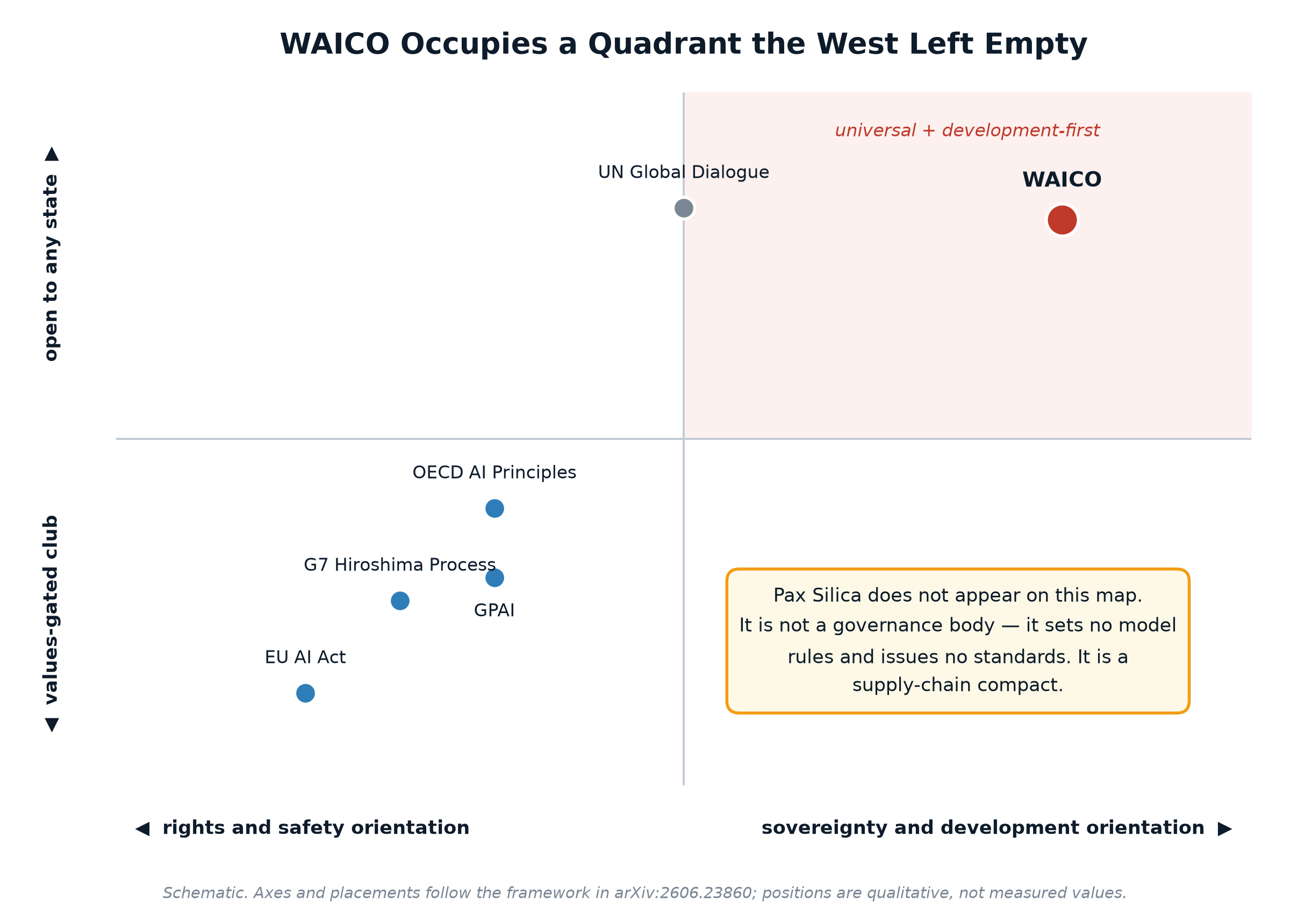
2. Open membership versus gated membership. An academic mapping of fifteen AI governance institutions found that WAICO occupies a quadrant no formal organization previously held: universally open to any state, with a development-first rather than rights-first agenda. Western bodies — the G7 Hiroshima Process, GPAI, the OECD principles, the EU AI Act — cluster in the values-gated, rights-oriented corner. That structural gap is the clearest explanation for WAICO’s rapid membership growth. It is not principally that states endorse Beijing’s model; it is that no comparable open door existed.
3. Published architecture versus undisclosed architecture. Pax Silica’s declaration text, summit outcomes, membership list, and funding requests are public and dated. WAICO’s Council-and-Secretariat structure has been described, but as of this writing the charter text, budget, funding mechanism, and any enforcement provision have not been released. Whether membership carries binding obligations is therefore unknown. This is a meaningful asymmetry between an organization claiming a rule-making mandate and a coalition that explicitly disclaims one.
4. Different chokepoints, held by different sides. The material balance is genuinely mixed, and neither side holds a winning hand alone.
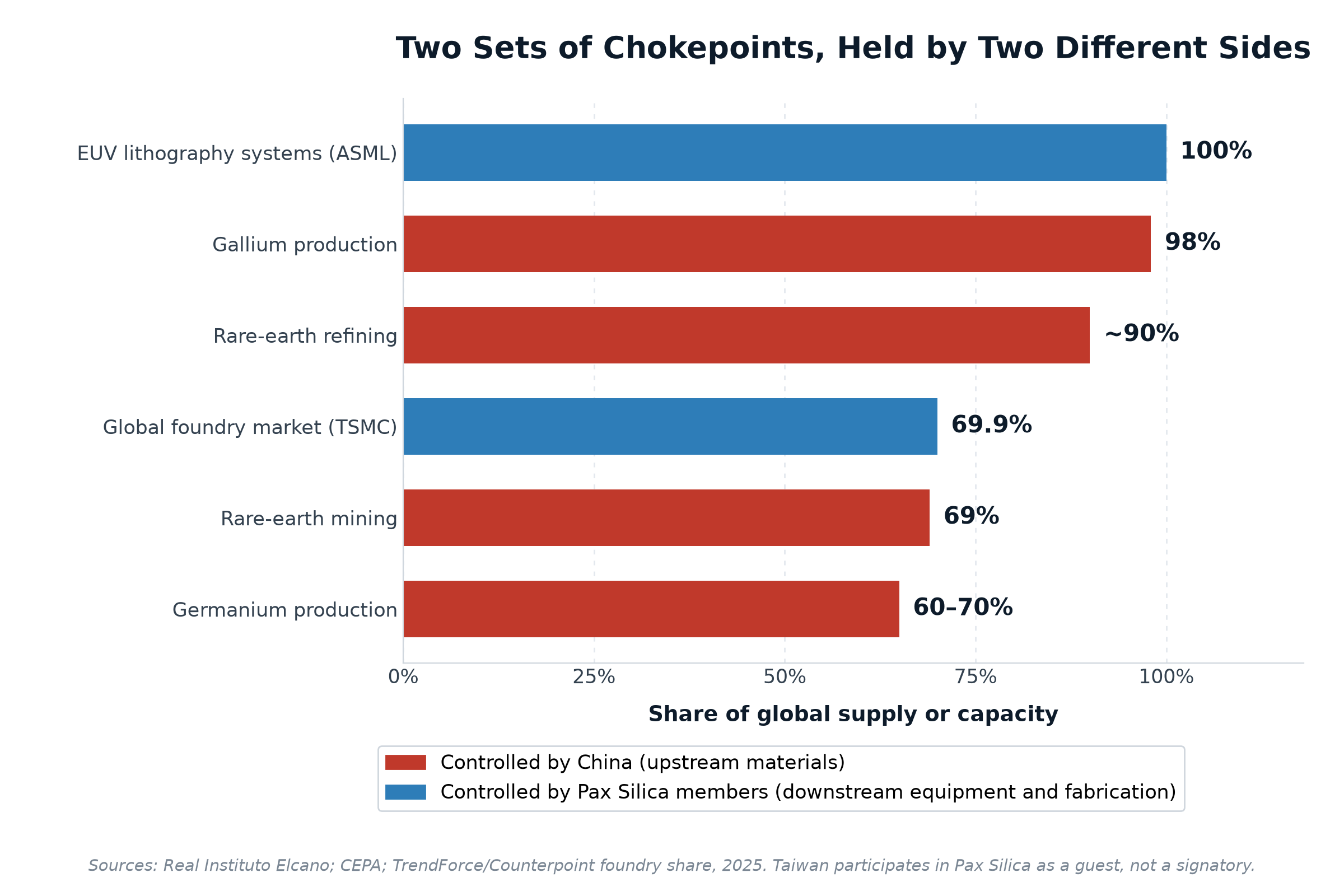
China holds the upstream: roughly 69% of rare-earth mining, close to 90% of refining, 98% of gallium production, and 60–70% of germanium. Pax Silica members hold the downstream: ASML in the Netherlands is the sole producer of EUV lithography systems, and TSMC held 69.9% of the global foundry market in 2025 — though Taiwan participates only as a guest, not a signatory. Beijing has already used its side of this ledger, imposing export controls on gallium, germanium, antimony, and graphite, and expanding its Unreliable Entity List to cover companies in the coalition’s supply chain.
The Case Against Pax Silica
The criticisms are substantive and mostly come from inside the coalition.
Tiering. Analysts describe the structure as sorting participants into allies, who are integrated into the technology stack, and clients, who receive transactional access under rules set in Washington. For a coalition premised on removing coercive dependencies, replacing dependence on Beijing with dependence on Washington is a real objection, and it is the one most often raised by prospective members.
Selective discipline. The H200 authorization is the sharpest charge. Washington demanded tighter alignment from partners on equipment exports while permitting its own frontier vendor to sell into the Chinese market. One critic characterized the effect as discipline for the coalition and carve-outs for Washington. This is not a fringe complaint; it goes directly to whether commitments are reciprocal.
Sovereignty friction. France opposed EU accession on the grounds that it threatens European technological sovereignty, and several capitals demanded clarification on governance, the relationship to the G7, and effects on EU regulatory autonomy. In the Philippines, agricultural and environmental groups objected to a planned 4,000-acre AI hub in New Clark City; a dispute arose over a reported U.S. request that the zone operate under U.S. law, which Manila rejected and Helberg later said had been mischaracterized.
Unresolved legislation. The proposed MATCH Act would require allies including Japan and the Netherlands to match U.S. restrictions on advanced semiconductor equipment, potentially extending to DUV immersion systems that remain unrestricted. Pax Silica has not settled this dispute; it has given the parties a room in which to argue about it.
The Case Against WAICO
Undefined substance. A month after signing, the questions of who pays, who decides, and what members are actually bound to remain unanswered publicly. An academic assessment scored WAICO lowest of fifteen institutions on institutional formalization — a charter, secretariat, budget, voting rules, and defined membership — though that assessment was published shortly before the signing and the picture may change as documents are released.
Structural dependence on one member. An organization headquartered in Shanghai, proposed by China’s premier, signed by China’s foreign minister, and funded through Chinese capacity-building programmes will find it difficult to demonstrate that its rule-making is not effectively Chinese rule-making. Openness of membership does not by itself produce distribution of influence.
The compute problem. WAICO’s central promise is to close the global intelligence gap. But model development, GPUs, data-centre capacity, and cloud infrastructure remain concentrated in a small number of firms, almost none of them in member states. Access to open model weights is genuinely valuable, and Chinese open models have gained real traction — one analysis reports their share of tokens processed by U.S. companies rising from below 10% in mid-2025 to around 40% by mid-2026. But weights are not compute. A country that can download a model but cannot afford to serve it has received a smaller gift than the framing suggests.
Governance concerns from democracies. French officials have argued that WAICO could normalize authoritarian approaches to AI governance and undercut the G7 Hiroshima Process. Indian analysts have urged vigilance. These are contested claims rather than established facts, and WAICO has issued no binding standards to test them against — but the absence of a values-based entry test is a design decision with foreseeable consequences.
What follows is this publication’s judgment rather than a finding of the research above. Readers who accept the facts may reasonably reach a different conclusion.
On the evidence currently available, the American framework is the more accountable of the two — and accountability, not membership size, is the right test for institutions this young.
Three things support that reading. First, Pax Silica can be checked. Its text, membership, summit outcomes, and dollar requests are published and dated, and it claims no authority it has not disclosed. WAICO asserts a rule-making mandate while withholding the charter that would define it. An organization asking states to accept its standards carries the burden of publishing its rules first.
Second, visible dissent is a feature. France publicly opposed accession. The Netherlands is in open conflict with Washington over the MATCH Act. Manila refused a U.S. jurisdictional request and Washington retreated. These episodes are embarrassing, and they are also evidence that members can say no at cost to the leader. WAICO has produced no comparable public disagreement, which may reflect its youth — or its design.
Third, the coalition has demonstrated it corrects. Early criticism held that Pax Silica excluded the countries that mattered most industrially: the Netherlands, Germany, and the wider EU. Within six months all three were signatories. That is a coalition responding to its own critics, which is different from a coalition that cannot hear them.
Two qualifications keep this from being an endorsement. The H200 carve-out is a genuine credibility problem: a coalition cannot ask partners to forgo revenue while its own champion is licensed to collect it, and that inconsistency will cost Washington more over time than any Chinese initiative will. And the American absence from universal forums is a strategic error. WAICO grew quickly because it occupied an empty quadrant — open to all, focused on development. That space was available because the West declined to fill it.
The stronger position is therefore contingent rather than secure. Pax Silica leads on transparency and on control of the chokepoints that gate frontier capability. It trails badly on breadth, and the gap is self-inflicted.
What This Analysis Does Not Claim
That WAICO will fail. Undisclosed institutional details one month after a founding signature are normal, not disqualifying. Many organizations publish their operating documents well after signature. If WAICO releases a charter, a budget, and voting rules, the transparency argument above weakens considerably.
That membership counts measure influence. WAICO has more members; Pax Silica has more of the world’s chip-making capacity. Neither figure settles anything on its own, and this report has deliberately avoided treating the 37-to-24 comparison as a score.
That the two are mutually exclusive. Kazakhstan belongs to both. Nothing in either instrument forbids dual membership, and for states that need development assistance from one and market access from the other, joining both may be the rational course.
That the roster figures are exact. Sources differ on accession dates — the Netherlands is variously reported as signing in December 2025 and at the June 2026 summit — and on whether the European Union counts as one signatory or several. Membership totals here should be read as accurate to within a small margin.
What to Watch
Whether WAICO publishes its charter. This is the single most informative event available in the next year. A published charter with defined voting rules and a funded secretariat would make WAICO a genuine institution. Continued silence would suggest it functions primarily as a caucus.
Whether the MATCH Act passes. It is the test of whether Pax Silica is a coalition or a hierarchy. Legislation compelling allies to match U.S. controls, enacted over Dutch and Japanese objections, would validate the harshest reading of the arrangement.
Whether any state joins both openly. Kazakhstan’s dual membership has attracted little comment. If others follow without penalty, the bloc framing weakens and the two structures start to look complementary rather than rival.
Whether Washington builds an open forum of its own. The empty quadrant is the American vulnerability. A U.S.-backed body open to any state, focused on AI capacity in developing economies, would compete with WAICO where WAICO is strongest. Nothing of the kind currently exists.
Conclusion. Pax Silica and WAICO are not mirror images, and treating them as a straightforward rivalry obscures more than it explains. One is a non-binding compact over physical inputs; the other is a treaty organization over rules. The United States currently leads on disclosure, on internal accountability, and on control of the manufacturing chokepoints that determine who can build frontier systems. China leads on reach, and it earned that lead by opening a door the West left closed. Both advantages are reversible, and the next twelve months of published documents — a WAICO charter, a MATCH Act vote — will indicate which way each is moving.
Sources
U.S. Department of State. Pax Silica Initiative and Outcomes of the Second Pax Silica Summit, December 2025 and June 2026. https://www.state.gov/releases/office-of-the-spokesperson/2025/12/pax-silica-initiative
Brownstein Hyatt Farber Schreck. State Department Expands Pax Silica Initiative at 2026 Summit. https://www.bhfs.com/insight/state-department-expands-pax-silica-initiative-at-2026-summit/
Real Instituto Elcano. Pax Silica: alliances, frontier and markets in the geopolitics of the chip. https://www.realinstitutoelcano.org/en/analyses/pax-silica-alliances-frontier-and-markets-in-the-geopolitics-of-the-chip/
Center for European Policy Analysis. Pax Silica — Can it Stop China? https://cepa.org/article/pax-silica-can-it-stop-china/
Euronews. The EU is set to join US-led chip alliance ‘Pax Silica’ to counter China’s AI race, June 1, 2026. https://www.euronews.com/my-europe/2026/06/01/the-eu-is-set-to-join-us-led-chip-alliance-pax-silica-to-counter-chinas-ai-race
Xinhua. 29 countries sign agreement on establishing World AI Cooperation Organization, July 16, 2026. https://english.news.cn/20260716/b0449aa2133542868e310fdc45ef2969/c.html
Permanent Mission of the People’s Republic of China to the UN. Signing Ceremony of the Agreement on the Establishment of the World Artificial Intelligence Cooperation Organization. https://un.china-mission.gov.cn/eng/zgyw/202607/t20260717_11984747.htm
SESEC. After the World Data Organization, China Unveils WAICO for Global AI Cooperation, August 7, 2026. https://sesec.eu/2026/08/07/after-the-world-data-organization-china-unveils-waico-for-global-ai-cooperation/
World Artificial Intelligence Cooperation Organization: Mapping an Emerging Institution in the Global AI Governance Regime Complex. arXiv:2606.23860. https://arxiv.org/abs/2606.23860
Forbes. China Launches WAICO In Shanghai As West Sits Out AI Governance, July 28, 2026. https://www.forbes.com/sites/timbajarin/2026/07/28/china-launches-waico-in-shanghai-as-west-sits-out-ai-governance/
Tech Wire Asia. MATCH Act passes first hurdle — targeting semiconductor tools, not just chips, April 2026. https://techwireasia.com/2026/04/match-act-semiconductor-export-controls-congress-advances/