
Executive Summary
When the FCC added foreign-produced advanced robotic devices to its Covered List on July 28, 2026, the announcement described humanoids and quadrupeds. This publication noted at the time that the operative definition was considerably broader and that consumer service robots appeared to fall inside it, while flagging the question as unresolved (AcadeResearch, 2026). It is now resolved: the Commission has confirmed that the definition explicitly includes robot vacuums.
The practical effect is that new models from Roborock, Ecovacs, Dreame, Xiaomi, Narwal — and iRobot, whose Roomba business passed to Shenzhen-based Picea Robotics through a 2025 bankruptcy — cannot obtain the authorisation required to enter the U.S. market. Previously authorised models continue to be sold, and devices already in homes are unaffected.
Key finding. Read as a vacuum-cleaner policy, this looks disproportionate. Read as a physical-AI policy, it is coherent and arguably overdue. The binding constraint in embodied AI is not compute or algorithms but real-world interaction data, which is expensive and slow to gather. A robot vacuum is the cheapest continuously deployed data-collection platform ever placed inside American homes at scale — mapping floor plans, tracking occupancy patterns, and in camera-equipped models, photographing interiors. The economic cost of the restriction is real and falls on consumers. The strategic asset being withheld is larger.
The obvious objection is that a vacuum cleaner is not a national security threat. The obvious objection is looking at the wrong product. What these devices manufacture is not clean floors; it is a continuous, labelled, spatially precise record of how humans actually live — the exact input the next phase of artificial intelligence is short of.
Why the Definition Reached Them
The National Security Determination defines an advanced robotic device as a mechanical mobile device — expressly including autonomous mobile robots — capable of locomotion, obstacle avoidance, and navigation; operating at a distance from a human operator based on sensor data; weighing more than 4.4 pounds combined with any docking station; and containing an environmental sensor, network connectivity of at least 200 kbps, and software controlling navigation, perception, or data collection (AcadeResearch, 2026).
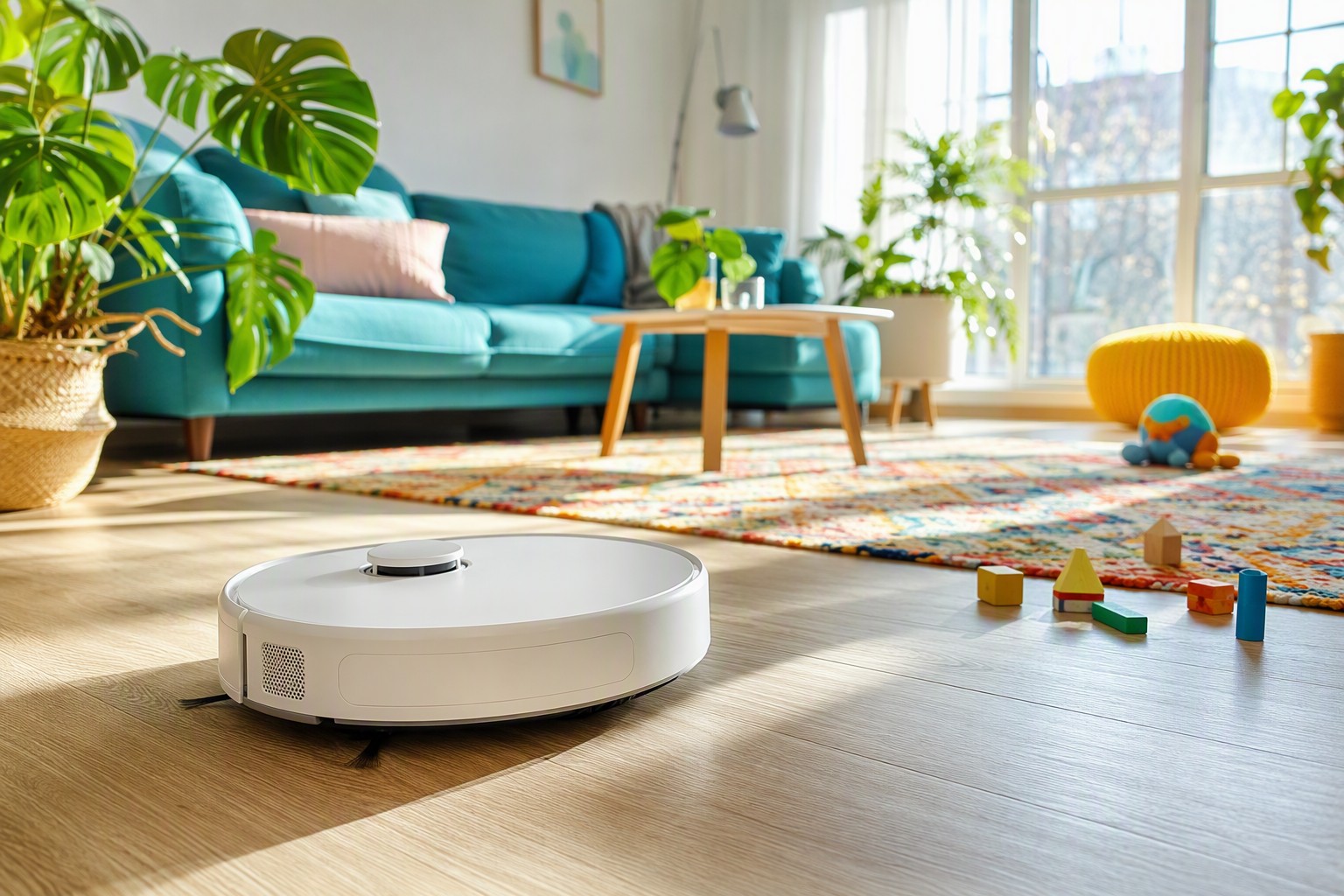
A modern robot vacuum satisfies every element without strain. It navigates autonomously, avoids obstacles, carries LiDAR and frequently cameras, connects to a cloud service, and — with its self-emptying base — comfortably exceeds the weight threshold. The exclusions cover connected vehicles, rail vehicles, uncrewed aircraft, underwater vehicles, FDA-regulated medical devices, and fixed industrial arms. Consumer service robots are not among them.
In other words, this was not regulatory overreach discovered after the fact. The definition was written to capture the category, and the Commission’s confirmation simply made explicit what its own text already said.
The Data Bottleneck in Physical AI
Understanding why this matters requires understanding what constrains embodied AI. Language models were trained on a corpus that already existed — the internet. Physical AI has no equivalent. A system that must manipulate objects, navigate cluttered rooms, and operate safely around people needs data about physical interaction, and that data has to be generated by something physically present in the world.
This is the field’s acknowledged bottleneck. Research on world models is explicit that collecting diverse, extensive real-world data is the hard part, which is why so much effort goes into synthesising training data from simulation. Simulation helps, but it carries a persistent gap: simulated homes are tidier, better lit, and more geometrically regular than real ones. The messiness of an actual house — cables, pet bowls, a chair moved six inches since yesterday — is precisely what is hardest to synthesise and most valuable to capture.
What a robot vacuum actually produces. A persistent, updated floor plan of a dwelling with room segmentation and furniture placement. A record of which rooms are occupied and when, inferred from where it can and cannot clean. Obstacle taxonomies built from millions of real encounters with real household objects. Surface and material transitions. And in camera-equipped models, images of domestic interiors. Considered as a sensor platform rather than an appliance, it is a distributed mapping fleet that consumers pay several hundred dollars each to install and power in their own homes.
This Risk Is Documented, Not Hypothetical
The strongest argument for the restriction is not a scenario. It already happened, and it happened through the AI training pipeline specifically.
In 2020, development units of iRobot’s Roomba J7 series captured images inside test participants’ homes. Those images were sent to Scale AI for annotation, and gig workers in Venezuela performing the labelling shared at least fifteen of them in private social media groups — including an image of a minor and one of a woman seated on a toilet. The images reached MIT Technology Review, which published the account in December 2022. iRobot terminated its contract with Scale AI. Participants later said they felt misled about what they had consented to (MIT Technology Review, 2022, 2023).
Every element of that chain was American and nominally accountable: a U.S. manufacturer, a U.S. annotation vendor, consenting test participants, and a legal system with recourse. The images escaped anyway, through the ordinary operation of a machine-learning data pipeline. The relevant question for policy is not whether a hostile actor would exfiltrate such data, but what happens by default when this data class exists and is routed abroad for processing — and the answer, on the documented record, is that it leaks.
The Strategic Context: China Has Made This an Industrial Policy
The restriction reads differently against what the other side is doing. China’s 15th Five-Year Plan places robotics at the centre of its modern industrial system, positioning embodied AI as a primary engine of economic growth (International Federation of Robotics, 2026).
The implementation is specifically about data. State direction has produced national-scale training grounds for embodied AI — warehouse and city-scale testbeds where robots learn through combined simulation and real-world deployment, feeding proprietary data loops back into national models. MERICS has counted more than forty state-funded robot training centres already operating, generating what it estimates as millions of real-world training entries. Chinese embodied-AI companies raised $3.3 billion in the first quarter of 2026 alone, and ByteDance has declared world models its top priority (AI in China, 2026).
Set beside a deliberate national programme to accumulate physical-world training data, tens of millions of networked mapping devices inside American homes stop looking like consumer electronics and start looking like infrastructure. The devices need not be instruments of espionage for this to matter. Ordinary, contractually permitted data flows to a parent company operating in a jurisdiction with compulsory data-access laws are sufficient to make the point.
The Economic Cost, Stated Honestly
A case for the restriction is not credible unless it accounts for what the restriction costs, and the costs here are real and concentrated on consumers.
The affected firms hold the market. The global robot vacuum market is roughly $4.2 billion in 2026, with North America accounting for about 43.8 percent of it. Roborock alone reported around $1.8 billion in revenue in 2025. Between the Chinese manufacturers and a Chinese-owned iRobot, the restriction reaches essentially the entire category.
Prices will rise and innovation will slow domestically. Chinese manufacturers have driven the aggressive price-performance improvement in this category. Removing new-model competition means U.S. consumers pay more for older technology, while buyers elsewhere continue receiving annual upgrades. This is a straightforward consumer welfare loss, and it should not be minimised.
There is no ready domestic substitute. Unlike drones, where a Blue UAS ecosystem existed before restrictions tightened, there is no meaningful American robot vacuum industry waiting to absorb demand. And because the Covered List defines foreign-produced against the Buy American Act’s domestic-content test — U.S. manufacture plus domestic components exceeding 65 percent of component cost — a would-be domestic entrant faces a supply chain in which motors, sensors, batteries, and LiDAR modules are overwhelmingly Asian. Qualifying is genuinely difficult (AcadeResearch, 2026).
Two features soften the near-term impact. Previously authorised models remain saleable, so shelves do not empty and existing owners are untouched. And the Conditional Approval pathway through the Department of War means a manufacturer able to satisfy security review can return to the market.
Why the Trade Is Defensible
The case rests on asymmetry between what is lost and what is protected, and on timing.
The loss is bounded and reversible; the data exposure is neither. Slightly more expensive vacuum cleaners is a recoverable cost — resolved by domestic entry, allied manufacturing, or conditional approvals. A floor plan of a home, once collected, cannot be recalled. Neither can a decade of aggregated behavioural mapping across tens of millions of households, and neither can its contribution to a model already trained on it.
Prospective restriction is the only kind that works. Because the rule applies to new authorisations, it does not attempt to recover data already gathered — which would be impossible. It prevents the installed base from expanding under the current arrangement. Acting after the category reaches saturation would be acting after the asset has been accumulated.
The precedent point is larger than vacuums. If the principle is that networked autonomous devices which map private spaces and stream data to foreign-controlled infrastructure require security review before market entry, then applying it to a $500 appliance and not to a $50,000 humanoid would be incoherent. The consumer device is where the volume is, and volume is what makes a training corpus.
The Strongest Objections
An argued case should state what would weaken it.
No public evidence establishes actual exfiltration. The determinations describe categories of risk — supply chain vulnerability, remote access, data collection leveraged by malign actors — rather than documented incidents involving these manufacturers. The Roomba case is real but involved an American company and an American vendor. The argument here is structural and precautionary, and readers should weigh it as such.
Country-neutral drafting produces odd results. Because the rule turns on production location rather than nationality, a Swiss or Japanese manufacturer with no relationship to the concern is captured identically. That is a defensible way to avoid discriminatory targeting, but it means the instrument is blunter than the rationale.
A data rule might have been the better instrument. Requiring on-device processing, prohibiting offshore transfer of home mapping data, or mandating local storage would address the harm directly rather than through market exclusion. The counter is that such rules are difficult to verify in firmware that updates remotely, whereas authorisation is enforceable at the border. Reasonable people can disagree about which failure mode is worse.
Domestic firms collect similar data. American manufacturers also map homes and route data to cloud services, and this restriction does nothing about that. A consumer concerned about domestic surveillance gains nothing. The rule addresses foreign-state access specifically, not privacy generally — a real limitation, and an argument for federal privacy legislation rather than against this measure.
What to Watch
Whether Conditional Approvals are granted, and on what terms. If manufacturers can qualify by committing to on-device processing and domestic data residency, the measure functions as a data-governance regime enforced through market access — the better outcome. If no approvals issue, it is simply an exclusion.
Prices and model refresh rates. The consumer cost will be observable within two to three product cycles as the authorised catalogue ages. That is the number that will determine whether this remains politically sustainable.
Whether domestic or allied production materialises. The restriction only converts into industrial policy if someone builds. Watch for entrants structured to clear the 65 percent domestic content threshold — which rises to 75 percent in 2029.
Scope expansion. Robotic lawn mowers, delivery robots, and warehouse AMRs meet the same definitional elements. The vacuum confirmation suggests the Commission intends the definition to be read as written.
Conclusion. The instinct that a robot vacuum ban is regulatory overreach depends on classifying the device by its function rather than its capability. By function it cleans floors. By capability it is an autonomous, sensor-equipped, networked mapping platform operating unsupervised inside the most private space most people have — and physical AI’s scarcest input is exactly the data such a platform produces. The consumer cost is genuine and should be acknowledged plainly: higher prices, slower innovation, no domestic alternative in the near term. But it is bounded, reversible, and small against an exposure that is none of those things. Restricting the category before the installed base compounds is the version of this decision that was still available. Next year it may not be.
References
AcadeResearch. (2026, July 29). The FCC did not ban robots. It made U.S. market access conditional on American parts. https://acaderesearch.com/fcc-covered-list-robots-power-inverters-market-analysis/
AI in China. (2026). China’s embodied AI revolution: The $3.3 billion quarterly funding frenzy, world models, and the physical AI economy. https://www.ainchina.com/blog/china-embodied-ai-revolution-funding-world-models-2026/
Family Handyman. (2026). FCC robot vacuum ban: What U.S. buyers need to know. https://www.familyhandyman.com/article/fcc-ban-robot-vacuums-mowers/
Federal Communications Commission. (2026, July 28). FAQs on recent updates to FCC Covered List regarding foreign-produced advanced robotic devices and power inverters. https://www.fcc.gov/covered-list-faqs-robots-inverters
International Federation of Robotics. (2026). China makes AI-powered robots core of national strategy. https://ifr.org/ifr-press-releases/news/china-makes-ai-powered-robots-core-of-national-strategy
MIT Technology Review. (2022, December 19). A Roomba recorded a woman on the toilet. How did screenshots end up on Facebook? https://www.technologyreview.com/2022/12/19/1065306/
MIT Technology Review. (2023, January 10). Roomba testers feel misled after intimate images ended up on Facebook. https://www.technologyreview.com/2023/01/10/1066500/
NVIDIA. (2026). What is embodied AI? https://www.nvidia.com/en-us/glossary/embodied-ai/
The Robot Report. (2025, December). iRobot to enter Chapter 11, acquired by Chinese creditor. https://www.therobotreport.com/irobot-to-enter-chapter-11-acquired-chinese-creditor/
Vacuum Wars. (2026). FCC restricts future foreign-made robot vacuums; existing models unaffected. https://vacuumwars.com/fcc-restricts-future-foreign-made-robot-vacuums-existing-models-unaffected/
WeLiveSecurity (ESET). (2026). Gathering dust and data: How robotic vacuums can spy on you. https://www.welivesecurity.com/en/privacy/gathering-dust-and-data-how-robotic-vacuums-can-spy-on-you/