

The European Union delayed the hardest parts of its AI Act by up to 16 months while U.S. states continued to enact new AI statutes at a pace unmatched by any other regulator in the world. An economic look at what any company operating in both markets now has to comply with, and when.
On or around June 29, 2026, the Council of the European Union formally adopted the Digital Omnibus on AI, a package of amendments to the AI Act that extends compliance deadlines for the most burdensome high-risk obligations by 12 to 16 months. Publication in the Official Journal is expected within days (DLA Piper, 2026; Humpington via Substack, 2026). Across the Atlantic, Plural Policy, whose legislative tracker is used by lawmakers and industry compliance teams, documented 19 AI statutes passed into law across 7 U.S. states in a two-week window earlier in 2026 (Plural Policy, 2026). Additional state-level enactments have followed through May and June, with California, New York, and Colorado all advancing significant AI legislation in the weeks preceding this analysis.
The temptation is to describe these as opposite trajectories. Read carefully, they are not. The EU did not repeal or weaken its AI Act; it deferred the enforcement of one specific class of obligations while leaving three separate classes on their original timelines. The United States did not enact a federal AI framework; the state-level surge reinforced the patchwork model that has been in place since Illinois HB 3773 took effect on January 1, 2026. For any AI-active business with operations, users, or customers on both sides of the Atlantic, the practical result is a compliance landscape with more moving parts on July 5, 2026 than it had on June 15, and a much shorter runway for at least three specific deadlines than most compliance teams have prepared for.
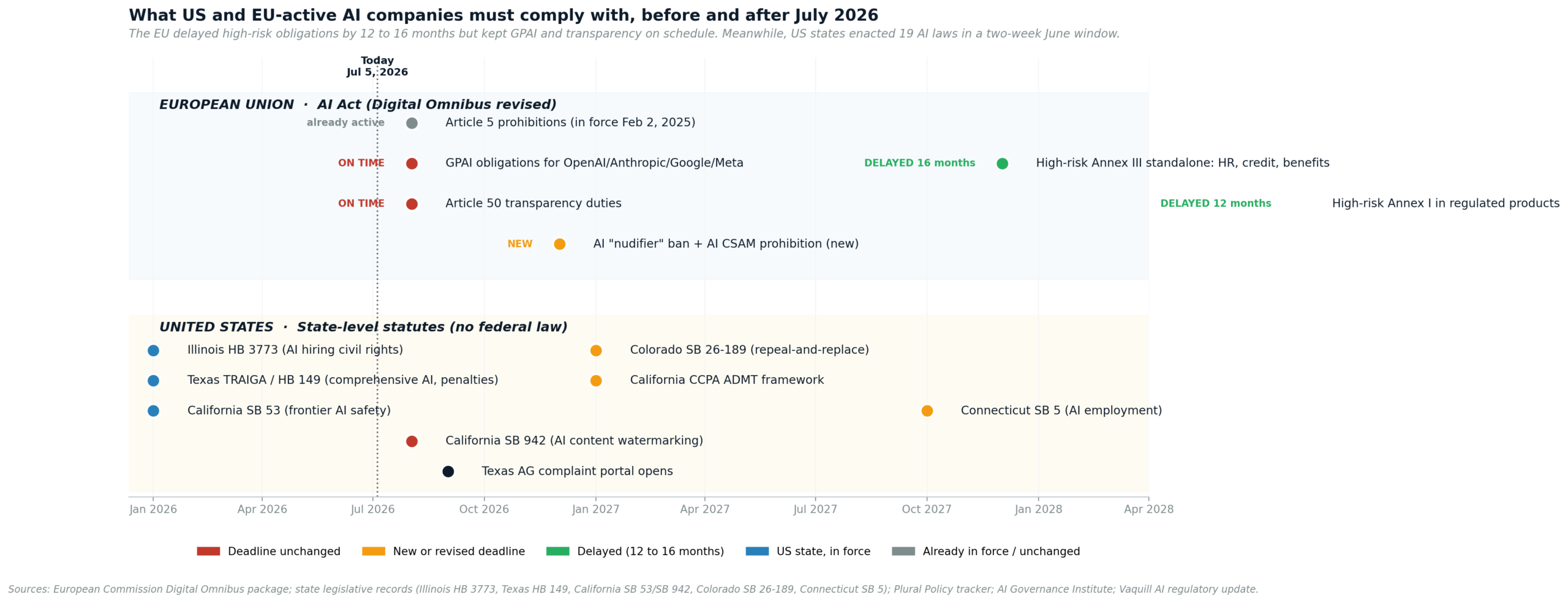
What the EU actually delayed, and what it did not
The European Commission first proposed the Digital Omnibus on AI in November 2025, citing the fact that the technical standards required for AI Act compliance were not going to be ready in time. A provisional agreement between the European Parliament and Council was reached in late May 2026 following a difficult trilogue negotiation, with law-firm tracking placing the agreement on or around May 27. Parliament cast its final approval vote on June 16, 2026, and Council adopted the package on or around June 29 (DLA Piper, 2026; Humpington via Substack, 2026).
The package moves two categories of high-risk obligation. Annex III standalone high-risk systems, which include AI used for recruitment and hiring, credit scoring, benefits eligibility, and other consumer-facing decisions, shift from August 2, 2026 to December 2, 2027. Annex I high-risk systems embedded in already-regulated products, including medical devices, machinery, elevators, toys, and radio equipment, shift from August 2, 2027 to August 2, 2028. National regulatory sandbox deadlines also move to August 2, 2027.
Three separate classes of obligation were untouched by the Omnibus and are consequential. First, the Article 5 prohibitions have applied since February 2, 2025 and remain unchanged. These are the outright bans on social scoring, untargeted facial-image scraping, and manipulative or exploitative AI systems. Any organization operating a system that falls within Article 5 gains nothing from the delay. Second, the Article 50 transparency obligations, which require operators to disclose when a user is interacting with an AI system, when content is AI-generated, and when biometric categorization or emotion recognition is being applied, become applicable on August 2, 2026 as originally scheduled (Humpington via Substack, 2026). Third, the general-purpose AI, or GPAI, obligations that apply to frontier model providers likewise take effect August 2, 2026, unchanged.
The Omnibus also created two new obligations that did not exist previously. A new Article 5 prohibition targets AI systems designed to generate non-consensual intimate images, sometimes called “nudifier” applications, and AI-generated child sexual abuse material. That prohibition takes effect December 2, 2026. Mandatory watermarking of AI-generated content, previously scheduled for August 2, 2026, was granted a three-month grace period and now takes effect December 2, 2026 (Humpington via Substack, 2026).
The practical implication for compliance teams is a bifurcation. Frontier AI model providers, including OpenAI, Anthropic, Google, and Meta, remain on the August 2, 2026 clock for GPAI documentation. They must publish training-data summaries, copyright-compliance documentation, and model cards on the original schedule. Regulated-product integrators, meaning any company embedding AI into medical devices, industrial equipment, vehicles, or other Annex I products, benefit from the additional 12 months but should not treat the delay as a substantive change in requirements (DLA Piper, 2026). Consumer-decision-system operators, meaning any company using AI in hiring, credit, or benefits determinations affecting EU residents, gain the largest window at 16 months, but the underlying risk-management, human-oversight, and documentation obligations remain identical to what was originally required.
The economic context. The delay is best understood as a triage decision, not a policy retreat. The technical standards required for Annex III compliance, particularly around risk management, testing methodology, and cross-border data governance, were behind schedule. The EU chose to preserve enforcement credibility on the more mature obligations (Article 5, Article 50, GPAI) while giving standards bodies more time on the less mature ones. Companies with mature EU compliance programs face lower work in the near term; companies that were counting on further delay for the entire Act now have three separate August 2, 2026 clocks running.
The United States: no federal law, four active state statutes, and 19 additions in June
The United States has no comprehensive federal AI statute. What exists is a patchwork of state laws, sectoral regulations, and non-binding executive guidance, with the White House’s March 2026 National Policy Framework operating as a preemption push rather than binding law (Vaquill AI, 2026). The state regime is where enforcement lives.
Four state statutes and one municipal rule were already in force before the June 2026 surge. Illinois HB 3773 took effect on January 1, 2026, extending Illinois’s civil rights law to explicitly cover AI-driven discrimination in employment decisions and requiring pre-decision notice to job applicants when AI is used (AI Law Tracker, 2026; The Leveraged Years, 2026). Texas’s Responsible Artificial Intelligence Governance Act, HB 149, signed by Governor Greg Abbott on June 22, 2025, also took effect January 1, 2026. It bans AI systems used with intent to discriminate or to produce child sexual abuse material, imposes healthcare AI disclosure obligations on providers, and establishes penalty tiers of $10,000 to $12,000 per curable violation, $80,000 to $200,000 per uncurable violation, and $2,000 to $40,000 per day for continuing violations (Promise Legal, 2026). The Texas Attorney General’s public complaint portal is required to be live by September 1, 2026 (CTTS, 2026). California’s SB 53, the first U.S. state frontier AI safety law, also took effect January 1, 2026 (ChatForest, 2026). And New York City’s Local Law 144, the AI hiring bias-audit rule, has been enforced since 2023.
Layered on top of those four is the state-level acceleration Plural Policy has been tracking since early 2026. In a two-week window during the spring session, 19 new AI statutes were enacted across 7 states (Plural Policy, 2026). Named examples include Washington HB 1170, which imposes affirmative disclosure obligations on large AI providers when content has been modified or synthetically generated. Multiple statutes in the wave introduce chatbot transparency requirements targeting minors, requiring platforms to disclose when users under 18 are interacting with AI. Additional enactments have accumulated through May and June (AI Governance Institute, 2026).
Other specific spring and summer 2026 actions have been confirmed by state records. New York’s Senate passed S 1169, the New York AI Act, a Colorado-style algorithmic-discrimination framework, and it is now pending Assembly action (Eye on AI, 2026). California has multiple AI-related bills in various stages, including AB 2713, an AI transparency bill still pending in the state Senate as of early June 2026 with support from the Center for AI and Digital Policy (CAIDP via LinkedIn, 2026). California SB 942, the AI Transparency Act, is scheduled to take effect August 2, 2026, requiring AI content watermarking on the same day the EU’s Article 50 transparency duties activate (FAQ, 2026).
Two additional statutes are already on the near horizon and matter for planning. Colorado repealed its original AI Act (SB 24-205) and replaced it with SB 26-189 on May 14, 2026, weeks before the original law would have taken effect. The replacement uses a lighter disclosure framework rather than the original risk-based regime and becomes effective January 1, 2027 (Vaquill AI, 2026). Connecticut SB 5 begins phasing in on October 1, 2026, with the automated employment provisions operative October 1, 2027 (The Leveraged Years, 2026).
Where the two frameworks collide
The most immediate compliance collision is on August 2, 2026. The EU’s Article 50 transparency duties activate that day. California SB 942’s watermarking requirements activate the same day. A U.S. company with California customers and any EU exposure has both clocks running simultaneously.
The requirements are not identical. California SB 942 requires “covered providers,” meaning generative AI systems with at least 1,000,000 monthly users, to embed latent disclosures in AI-generated image, video, and audio content. The EU’s Article 50 casts a broader net, requiring disclosure whenever a user is interacting with an AI system and requiring watermarking of AI-generated content produced by any GPAI system regardless of user threshold. A single technical solution can satisfy both if it embeds machine-readable provenance metadata compliant with C2PA-style standards and provides user-visible disclosures. A solution that satisfies only one may fail the other.
The second collision is on the hiring-and-credit side. Illinois HB 3773 requires AI-in-hiring disclosure and equal-employment analysis. Texas TRAIGA imposes healthcare-AI patient disclosure and government-agency notice duties. Connecticut SB 5’s automated employment provisions come online in October 2027. The EU’s Annex III high-risk category covers the same domains at scale, and while its deadline moves to December 2027, the underlying documentation and risk-management infrastructure required for compliance is not materially different from what Illinois and Texas already require in a narrower form. An organization building EU-Annex-III compliance is largely building the same infrastructure a multi-state U.S. HR AI system needs, just with more comprehensive scope.
Where the frameworks genuinely diverge is in enforcement architecture. TRAIGA is enforced exclusively by the Texas Attorney General, with no private right of action and a mandatory 60-day cure period before penalties (Promise Legal, 2026). Illinois HB 3773 creates civil-rights-style liability enforceable through Illinois Department of Human Rights or private action. Colorado SB 26-189 relies on the state attorney general. The EU’s AI Act relies on the European AI Office plus national market surveillance authorities, with penalties up to 7 percent of worldwide annual turnover for prohibited practices and up to 3 percent for other violations. The financial exposure profile is fundamentally different: a U.S. multi-state exposure is a series of moderate per-violation penalties enforced by AGs, while a single EU exposure can produce a top-line financial event.
What businesses now have to do
The compliance actions fall into three timeframes.
Before August 2, 2026. Any organization deploying generative AI to EU users must have Article 50 transparency mechanisms and, if operating a GPAI model, a training-data summary, model card, and copyright-compliance documentation prepared. Any organization with a California user base of one million or more monthly users must have SB 942 watermarking and provenance metadata in place. Any organization deploying AI in hiring for Illinois, Texas, or NYC candidates must have already implemented the applicable disclosure workflows; those deadlines have passed. The Texas AG complaint portal opens September 1, 2026, and enforcement can begin then.
Before January 1, 2027. Colorado SB 26-189 takes effect on this date, replacing the earlier Colorado AI Act with a lighter disclosure model. California’s CCPA-adopted automated decision-making technology framework takes effect the same day. Companies operating in California with automated-decision workflows on consumer data need to have completed their CCPA-ADMT gap analysis before this date. Companies operating in Colorado in employment, credit, insurance, education, healthcare, and legal services need to have their SB 26-189 disclosure programs live (Vaquill AI, 2026).
Before December 2, 2027 and August 2, 2028. The EU high-risk deadlines. Companies deploying Annex III systems, meaning HR, credit, benefits, biometrics, critical infrastructure, education, migration, law enforcement, and justice, have 16 months from today to build the risk management systems, technical documentation, human oversight processes, and post-market monitoring the AI Act requires. Companies embedding AI in Annex I regulated products have 12 additional months on top of that. Neither timeline should be treated as slack. The AI Office’s guidance and technical standards will continue to develop through 2027, and organizations that wait for final guidance are likely to find they have 3 to 6 months of actual implementation time rather than 16.
What to watch next
Four data points and one institutional decision will shape the next 90 days.
First, the Official Journal publication of the Digital Omnibus, expected within days of Council adoption. This confirms the revised deadlines and locks in the legal text.
Second, the European Commission’s General-Purpose AI Code of Practice, in effect since August 2, 2025 for voluntary adopters and required from August 2, 2026 for all GPAI providers. Adherence to the Code is the primary demonstration of compliance with GPAI obligations. Firms that have not yet joined the Code should complete adherence documentation before August.
Third, the Texas Attorney General’s complaint portal launch scheduled for September 1, 2026. The volume and type of complaints filed in the first 30 days will indicate how aggressively Texas plans to enforce TRAIGA in its first full year.
Fourth, the New York Assembly’s action on S 1169. If enacted, New York becomes the fifth state with a comprehensive AI framework, and given the state’s role as headquarters for major financial and media firms, its rule set will shape default compliance across the industry.
The institutional decision to watch is whether the U.S. Congress moves any of the federal AI proposals under discussion. The White House National Policy Framework of March 2026 signaled a preemption push, meaning federal law that would override the state patchwork. If Congress enacts preemption legislation, the compliance calculus resets entirely. If Congress does not, the patchwork continues to compound, and the state count will exceed 30 with active AI statutes within two years by most legislative-tracker projections.
The bottom line. The EU delayed the AI Act’s high-risk obligations by 12 to 16 months but kept the GPAI, transparency, and Article 5 prohibition tracks on their original schedules. In the United States, Plural Policy documented 19 new AI statutes passed into law across 7 states in a two-week window earlier in 2026, with additional enactments through May and June layered on top of four state statutes already in force. Any AI-active business operating in both markets faces three separate August 2, 2026 clocks (EU Article 50, EU GPAI, California SB 942), a Texas enforcement portal opening September 1, and January 1, 2027 deadlines in Colorado and California. The delay was not a reprieve; it was a triage. The business-impact question is not whether the requirements will land but whether the compliance program has been built to accommodate them simultaneously in both jurisdictions.
References
AI Governance Institute. (2026, June 29). Nineteen AI laws in two weeks: State-level surge creates layered disclosure and child-protection wave. https://aigovernance.com/news/nineteen-ai-laws-in-two-weeks-state-level-surge-creates-layered-disclosure-and-child
AI Law Tracker. (2026, June 19). AI laws in Illinois: Compliance guide 2026. https://ai-law-tracker.com/laws/illinois
Center for AI and Digital Policy via LinkedIn. (2026, June 7). CAIDP supports California AI Transparency Act AB 2713. https://www.linkedin.com/posts/center-for-ai-and-digital-policy_caidp-cal-ab2713-june-8-2026-activity-7469367104371138560-kDvF
ChatForest. (2026, June 11). California SB 53: The first U.S. frontier AI safety law. https://chatforest.com/reviews/california-sb53-tfaia-transparency-frontier-ai-act-2025-2026/
CTTS. (2026, June 23). Managed IT services Texas: Making TRAIGA compliance workable in 2026. https://www.cttsonline.com/2026/06/23/managed-it-services-texas-making-traiga-compliance-workable-for-your-business-in-2026/
Eye on AI. (2026, June 27). U.S. state AI patchwork: New companion chatbot laws and Connecticut frontier-model sandbox. https://eyeon.ai/f/956
FAQ. (2026, June 25). California’s AI watermarking law takes effect August 2. https://faq.com.tw/en/policy/2026-06-25-california-sb942-ai-transparency-act-august-enforcement-en/
Humpington, L. via Substack. (2026, July 1). EU AI Act: The revised dates and the deadlines already passed. https://louisehumpington.substack.com/p/eu-ai-act-the-revised-dates-and-the
Promise Legal. (2026, June 15). TRAIGA is in force: What Texas’s AI law requires now. https://blog.promise.legal/traiga-texas-ai-law-what-it-requires/
The Leveraged Years. (2026, June 25). Illinois HB 3773: The four AI disclosures template. https://www.theleveragedyears.com/ai-regulation-news/illinois-hb3773-ai-disclosure-template
The Leveraged Years. (2026, June 28). Four states now regulate AI hiring: One workflow to comply. https://www.theleveragedyears.com/ai-regulation-news/ai-hiring-four-state-rulebooks-one-workflow-2026
Vaquill AI. (2026, June 10). AI legal regulation in 2026: A state and federal update for in-house counsel. https://www.vaquill.ai/blog/ai-legal-regulation-update-state-federal