

Apple’s CEO transition arrives at precisely the moment when its AI strategy is most exposed. Tim Cook hands the keys to John Ternus in September, but the company he inherits is running Siri on Google’s models, spending less than 10% of what rivals spend on AI, and betting that hardware can still win without a competitive intelligence layer underneath. The strategy has a name in tech circles: “rent intelligence.” The problem is that renting does not build moats.
Source: Apple Newsroom
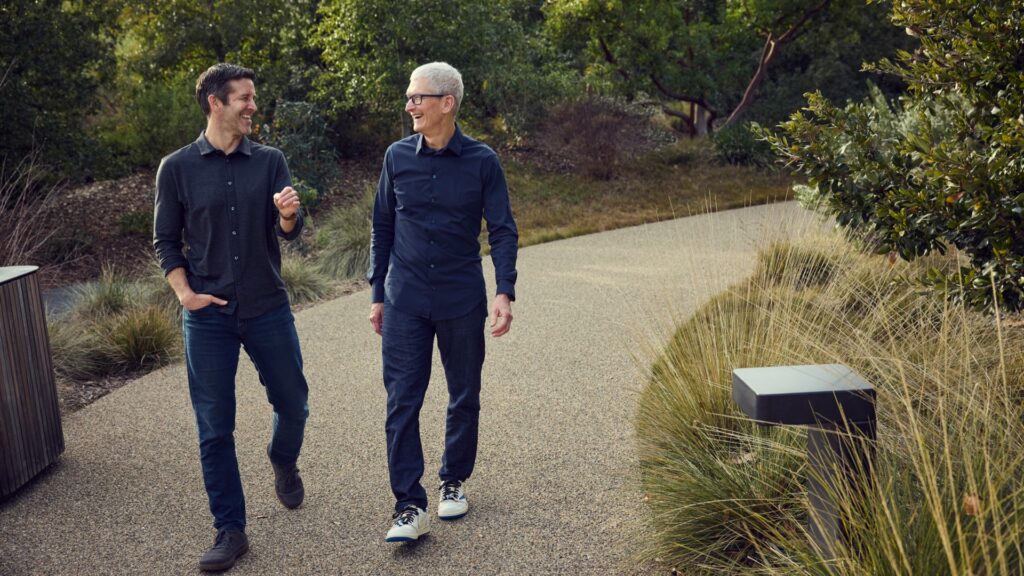
On April 20, 2026, Apple announced that Tim Cook will step down as chief executive officer on September 1, 2026, transitioning to executive chairman. John Ternus, the 50-year-old senior vice president of hardware engineering who has spent 25 years at Apple, will take over as CEO (Evertiq, 2026). The announcement was long anticipated. Cook is 65, and Apple’s board had been planning the succession for years. What is unusual is the timing. Apple chose to announce the transition in the middle of its most visible competitive weakness in over a decade: artificial intelligence.
Why Now: The Pressure Cook Leaves Behind
The most revealing context for the CEO announcement is what came before it. Apple unveiled Apple Intelligence at WWDC 2024 with the promise of a personal, contextual, on-device Siri that would understand users, act across apps, and maintain privacy. What actually shipped was a series of cosmetic features and delays. The “personal Siri” overhaul was delayed in March 2025, delayed again at WWDC 2025, delayed again in February 2026 when the iOS 26.4 window slipped, and has still not arrived in any meaningful form (CNET, 2026; AppleInsider, 2026).
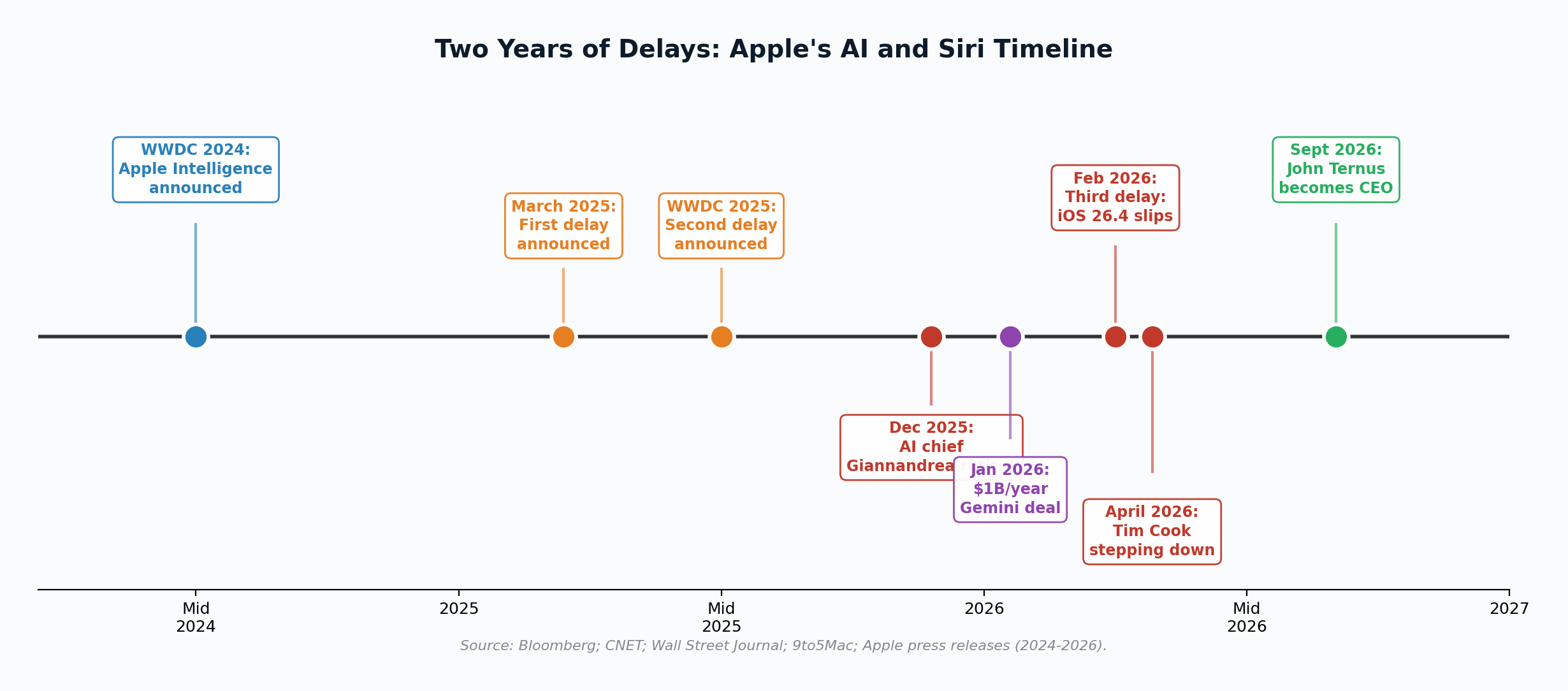
In December 2025, Apple’s AI chief John Giannandrea retired. He was replaced by Amar Subramanya, a former Google and Microsoft executive (New York Times, 2026). One month later, Apple signed a multi-year deal with Google worth a reported $1 billion per year to license Gemini models and cloud capacity to power the next generation of Siri (CNBC, 2026). Three months after that, Cook announced his departure. This sequence, one year of failed AI execution, a leadership reshuffle, a humiliating licensing deal with a direct competitor, and then a CEO handoff, is not coincidental. It is a company acknowledging, through its actions, that the strategy that built the iPhone will not win the next platform shift.
The “Rent Intelligence” Strategy
Apple’s current AI strategy has been described in industry commentary as “rent intelligence.” The company has chosen not to compete in foundation model development. Instead, it licenses frontier models from partners, pays them annual fees, runs the output on Apple silicon, wraps the experience in Apple’s interface standards, and markets the combination under the Apple Intelligence brand. The January 2026 Google Gemini deal is the flagship example. Apple also maintains an OpenAI integration for ChatGPT, and iOS 27 is expected to add an “Extensions” system allowing Siri to route queries to Claude, Gemini, Grok, and other third-party agents (LinkedIn News, 2026).
In defense of this approach, Apple executives and some analysts argue that large language models are becoming commoditized, that Apple’s strength is the interface and ecosystem rather than the model itself, and that the company is saving capital while letting rivals burn cash on infrastructure. MacRumors summarized the bull case as Apple’s “restrained approach” potentially paying off if the AI bubble cools (MacRumors, 2025). The Yahoo Finance framing was even more generous: a “lazy AI strategy” that could crush the competition by avoiding massive capital expenditure (Yahoo Finance, 2026).
Why Rent Intelligence Will Not Work
The rent intelligence thesis rests on three assumptions: that AI will commoditize, that the interface layer is where value accrues, and that Apple’s hardware and ecosystem advantages are durable enough to retain pricing power regardless of what happens underneath. Each assumption is weaker than it appears.
1. AI Is Not Commoditizing at the Frontier
The commoditization argument holds for yesterday’s models, not tomorrow’s. GPT-3 class models are indeed commodity. GPT-5, Claude Opus 4.1, and Gemini 2.5 Pro are not. The frontier keeps moving, and the gap between the best model and the average model remains meaningful in user-perceived quality. Goldman Sachs and others have documented that enterprise adoption disproportionately flows to the top two or three models in any given capability (CNBC, 2026). If Apple’s strategy is to rent whoever is best at the moment, it will always be one generation behind, because the model it is renting is yesterday’s frontier. Google is not licensing the same Gemini model it uses internally for its own most advanced Google products. Apple gets what Google is willing to license, not what Google keeps for itself.
2. The Interface Is Becoming the Model
Apple’s traditional moat is the interface: how the user experiences the product. In the AI era, the interface and the model are fusing. Samsung’s “AI OS” initiative with Google envisions an operating system where the assistant proactively acts on the user’s behalf before being asked (TechRadar, 2026). OpenAI’s acquisition of Jony Ive’s io startup for $6.4 billion signaled that a competitor is trying to build the next device category around an AI-native interface. Meta is investing over $125 billion in AI in 2026 with a similar goal. The assistant is not something the user opens on top of the OS. The assistant is the OS. If the model powering that assistant is rented, Apple does not control the experience. Google does, through its position as the upstream model provider.
3. Supplier Leverage Is Dangerous in Category-Defining Platforms
Apple’s own history is the clearest warning. In the 2000s, Apple depended on Intel for Mac processors, watched Intel fail to deliver competitive mobile chips, and spent nearly a decade and tens of billions of dollars transitioning to Apple silicon. The result was the M1 through M5 chip families, now a durable competitive advantage. Apple knows, from painful experience, that depending on an outside supplier for a category-defining component creates strategic risk. Yet that is exactly what the Gemini deal does for intelligence, the most important category-defining component of the next decade. The fact that the deal is non-exclusive and multi-year does not solve this. It delays it.
The Structural Problem
Apple is paying Google approximately $1 billion per year to improve Gemini on 2+ billion Apple devices. That data, engagement, and revenue flywheel accrues to Google, not Apple. Apple is effectively training its primary competitor’s AI at massive scale while paying for the privilege. The iPhone installed base, historically Apple’s strongest asset, becomes Google’s distribution channel for Gemini. Every quarter this continues, Google gets better at AI faster than Apple can catch up. This is not a neutral partnership. It is a structural wealth transfer.
What Ternus Inherits and What He Must Change
John Ternus is a hardware engineer. His career at Apple has been spent on iPad, AirPods, Mac, Apple Watch, and iPhone. The Wall Street Journal notes that he is “not known for taking big, risky swings” (MacDailyNews, 2026). This is both a concern and potentially an asset. The concern: Apple’s AI problem is not a hardware problem. Apple silicon is already the best consumer AI inference hardware in the world, which makes the lack of competitive models running on that hardware all the more painful. The asset: Ternus understands that Apple’s differentiation has always been vertical integration, and the natural extension of that philosophy into the AI era is to own the intelligence layer, not rent it.
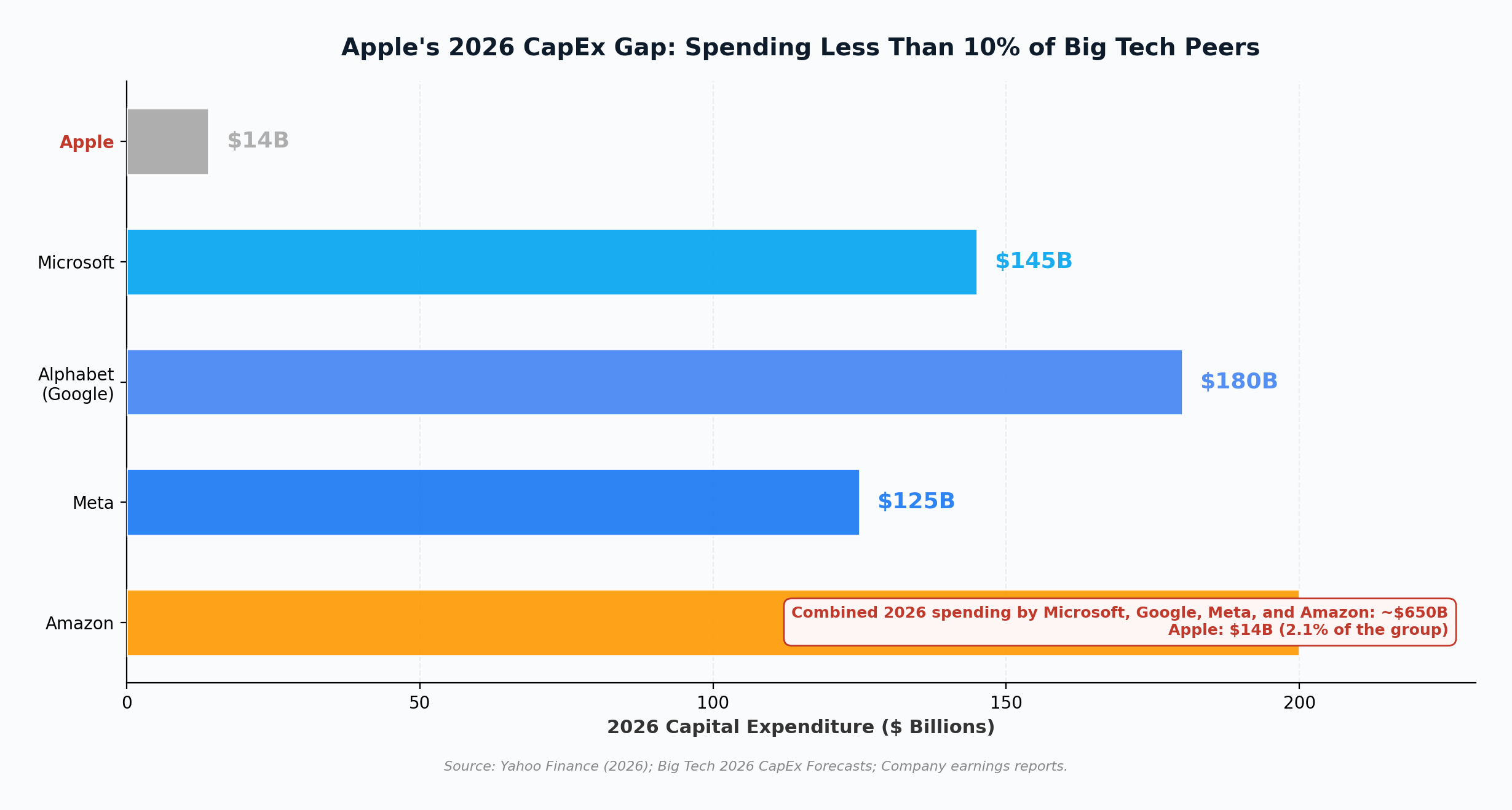
The decision Ternus faces in his first 18 months is whether to continue the rent intelligence strategy or commit Apple to a capital spending profile more comparable to its peers. The gap is staggering: $14 billion in Apple’s 2026 capex against roughly $650 billion combined across Microsoft, Google, Meta, and Amazon (Yahoo Finance, 2026). Even a 3x increase in Apple’s AI-specific investment, to $40-$50 billion annually, would still leave the company behind but would signal a strategic reorientation. A meaningful acquisition, of Anthropic for example, would be an even clearer signal. Anything less than a visible, sustained commitment to owning the intelligence layer means Apple is accepting a role as the most premium distribution surface for someone else’s AI.
Conclusion: A Transition at the Wrong Moment or the Right One
Apple’s CEO transitions happen rarely and tend to define eras. Steve Jobs to Tim Cook in 2011 marked the shift from product visionary to operational excellence, and the result was a decade of iPhone-driven profitability that turned Apple into the most valuable public company in history. Cook to Ternus arrives at a moment when operational excellence alone is insufficient. The question is not whether Apple can still build the best hardware. It can. The question is whether hardware advantage still matters when intelligence is the interface, and whether a company that rents its intelligence can credibly claim to control the product.
Our view is that the timing of the CEO announcement, arriving immediately after the Gemini deal, the Giannandrea retirement, and the third Siri delay, is Apple’s board acknowledging that the current strategy has a ceiling. The Ternus era will either be defined by a decisive break from rent intelligence, through aggressive internal investment or a transformative acquisition, or by the slow erosion of Apple’s pricing power as consumers increasingly experience their most important AI moments through Gemini rather than through Apple. WWDC 2026 in June, still under Cook, will be the first test. Ternus’s first product cycle as CEO, likely the fall 2027 iPhone and iOS 28, will be the real one. The hardware will be excellent. The open question is whether the intelligence behind it will finally be Apple’s own.
References
AppleInsider. (2026, February 13). Siri & Apple Intelligence upgrades still coming in 2026. https://appleinsider.com/articles/26/02/13/siri-apple-intelligence-upgrades-still-coming-in-2026
CNBC. (2026, January 12). Apple picks Google’s Gemini to run AI-powered Siri coming this year. https://www.cnbc.com/2026/01/12/apple-google-ai-siri-gemini.html
CNET. (2026, February 12). Stay patient, Apple fans: Siri AI delayed again to late 2026. https://www.cnet.com/tech/services-and-software/stay-patient-apple-fans-siri-ai-delayed-again-to-late-2026-or-beyond/
Evertiq. (2026, April 21). Tim Cook to step down as Apple CEO, John Ternus to take over. https://evertiq.com/news/2026-04-21-tim-cook-to-step-down-as-apple-ceo-john-ternus-to-take-over
LinkedIn News. (2026, April 19). Apple teases Siri’s AI redesign in WWDC 2026 trailer. https://www.linkedin.com/news/story/apple-teases-siris-ai-redesign-in-wwdc-event-trailer-7958009/
MacDailyNews. (2026, April 21). Incoming Apple CEO John Ternus isn’t known for taking big, risky swings. https://macdailynews.com/2026/04/21/incoming-apple-ceo-john-ternus-isnt-known-for-taking-big-risky-swings/
MacRumors. (2025, December 30). Report: Apple’s AI strategy could finally pay off in 2026. https://www.macrumors.com/2025/12/30/apple-ai-strategy-could-pay-off-in-2026/
New York Times. (2026, January 12). Apple teams up with Google for A.I. in its products. https://www.nytimes.com/2026/01/12/technology/apple-google-ai-partnership.html
TechRadar. (2026, February 26). Samsung says it’s going to beat Apple with its bold new Google-powered AI OS. https://www.techradar.com/phones/samsung-galaxy-phones/we-want-to-create-a-new-android-os
Yahoo Finance. (2026, February 22). How Apple’s lazy AI strategy could crush the competition. https://finance.yahoo.com/news/apple-lazy-ai-strategy-could-145233131.html