

Job openings held near a two-year high in May while the new Fed chair used his first international appearance to formally abandon forward guidance. An economic look at what the labor data actually shows and how markets are pricing the July 29 rate decision.
The Bureau of Labor Statistics reported on June 30, 2026 that the number of job openings in the United States was unchanged at 7.6 million in May, with the openings rate holding at 4.6 percent. Hires were unchanged at 5.2 million and 3.3 percent. Quits changed little at 3.1 million and 1.9 percent, and layoffs and discharges were unchanged at 1.7 million and 1.1 percent (U.S. Bureau of Labor Statistics, 2026).
Read literally, none of that is news. Read against expectations, all of it is. Consensus from economists surveyed by Reuters and Bloomberg had penciled in about 7.30 million openings for May, reflecting an expected mean-reversion from April’s 7.62 million print. The actual May reading, 7.594 million on the unrounded seasonally adjusted series, arrived roughly 294,000 above consensus, a four-percent surprise (Sethi, 2026; U.S. News & World Report, 2026). Combined with the four-decade low the yen touched on June 30 and Federal Reserve Chair Kevin Warsh’s Sintra appearance on July 1, the print reshaped what markets are pricing for the July 28 to 29 FOMC meeting.
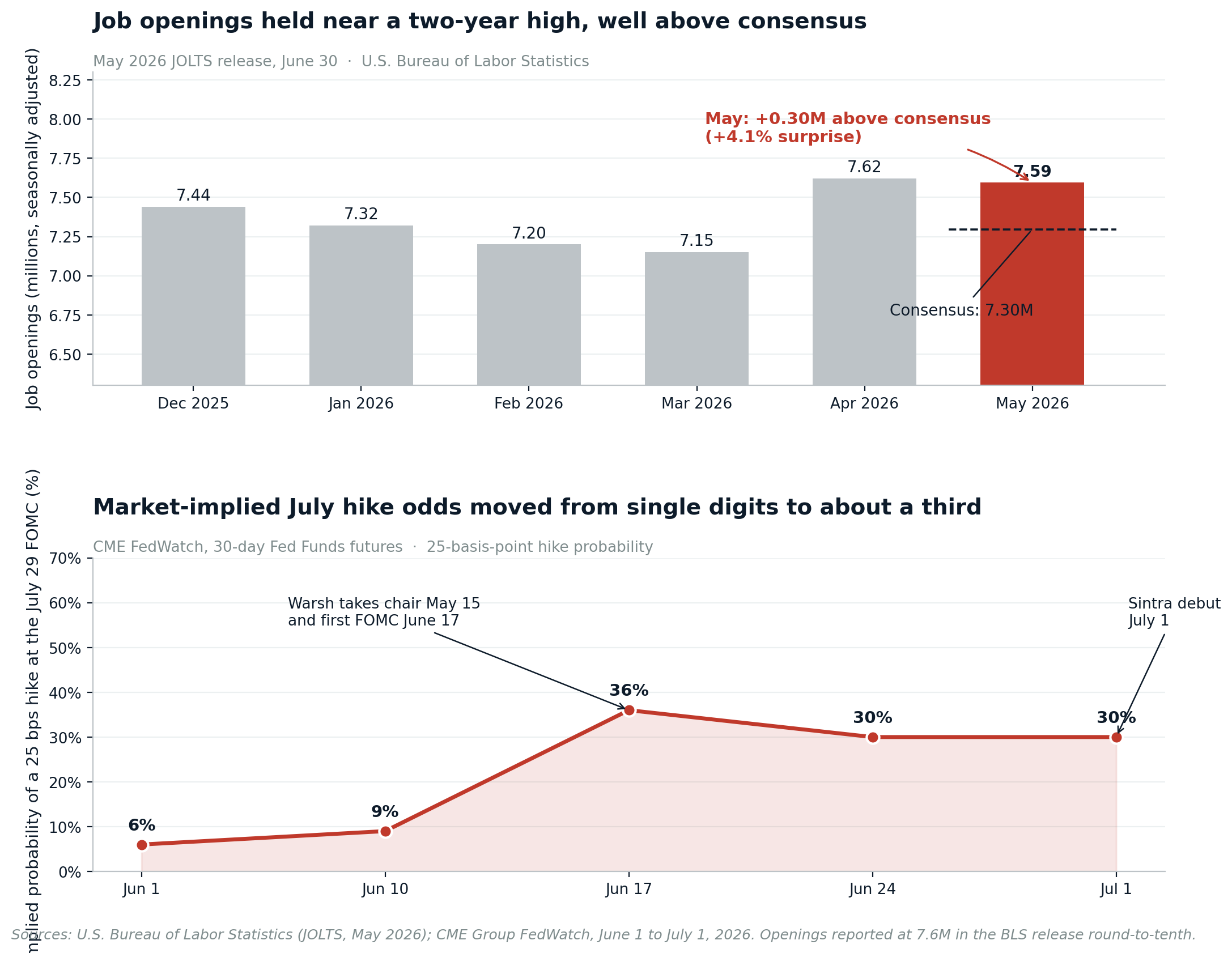
What the JOLTS release actually said
The BLS release is spare. Every headline measure was described as either “unchanged” or “changed little” versus April. Job openings were stable at 7.6 million and at a 4.6 percent rate. The number of hires was 5.2 million with a 3.3 percent rate. Total separations were 5.1 million at a 3.2 percent rate. Quits sat at 3.1 million at 1.9 percent, and layoffs and discharges at 1.7 million at 1.1 percent. Other separations were unchanged at 328,000 (U.S. Bureau of Labor Statistics, 2026).
Industry-level movement was limited to a small number of pockets. Job openings increased in wholesale trade by 71,000. Hires increased in the federal government by 11,000 and quits in the federal government by 4,000. Layoffs and discharges decreased in arts, entertainment, and recreation by 42,000 (U.S. Bureau of Labor Statistics, 2026). April figures were also revised: openings down 33,000 to 7.585 million, hires up 99,000 to 5.2 million, and layoffs and discharges down 25,000.
The single most important number in the release is not in the headline. It is the ratio of job openings to unemployed workers. Independent analysis from Substack economist Lorosha, using the same BLS release and the May Employment Situation report, put the ratio at 1.039, the second consecutive monthly reading above 1.0 (Lorosha, 2026). Reuters, citing the same underlying BLS data, described it as “1.04 jobs for every unemployed person.” A ratio above 1.0 indicates that available positions exceed available job seekers. It has historically preceded and accompanied episodes of wage pressure, and it is the metric the Federal Reserve tracks closely for its bearing on labor cost inflation.
The economic context. The consensus miss is important, but the durability of the miss is more important. Openings have now printed near 7.6 million in each of the last two months, following a stretch of prints below 7.5 million earlier in the year. If May’s number turns out to be a one-off, a September rate move remains the base case. If June and July confirm the trend, the labor market is running hotter than either the Fed’s June projections or private economists were prepared for, and the timing debate collapses toward July 29.
Warsh at Sintra: no forward guidance, and no apologies for it
Roughly 24 hours after the JOLTS release, Kevin Warsh took the stage at the European Central Bank’s Forum on Central Banking in Sintra, Portugal, joining Christine Lagarde of the ECB, Andrew Bailey of the Bank of England, and Tiff Macklem of the Bank of Canada. It was his second public appearance since taking over as Fed chair in May and his first outside the United States (Reuters, 2026).
The message was, functionally, an extension of the framework Warsh introduced at his first FOMC press conference on June 17. He would decline to offer forward guidance about the July 29 rate decision. He would decline to offer forward guidance about the economic outlook. He would decline to characterize how the Fed is weighing artificial intelligence’s effects on the price level. He would restate the 2 percent inflation objective and the Fed’s independence, and he would answer no further questions on where policy might go.
“We are playing Mad Libs now?” Warsh asked CNBC moderator Sara Eisen after she pressed him on the growth outlook. “You’re back to forward guidance. I’m going to disabuse you of trying to extract that” (Reuters, 2026). When Eisen followed up on the July rate decision, Warsh’s response was procedural: “We get into that room and shut the door, we’re going to have a good debate, but I don’t have much more for you than that” (CNBC, 2026).
Two substantive statements did land. On inflation, Warsh reiterated that “if there were people in household or the business sector, in the financial markets, who thought that this central bank was going to be comfortable with an inflation objective above 2 percent, well, I guess they’d be disappointed. We’re going to deliver price stability in the U.S.” (CNBC, 2026). On Fed independence, in response to a question about President Donald Trump’s public campaign for rate cuts, Warsh said, “We’ve been an independent central bank for a very long time. We’re going to be an independent central bank at this moment, and you’re going to see no changes on that” (Reuters, 2026).
The context for the panel matters. Lagarde used her opening speech to argue that the ECB has entered a “new normal” in which forward guidance is no longer central and monetary policy is decided meeting by meeting. She went further in the panel discussion itself, telling the room, “If I have one regret, it’s to have felt bound and compelled by forward guidance” (Axios, 2026). Warsh responded, “So we have found common cause.” The panel did not signal a policy path. It signaled a coordinated view among four of the largest advanced-economy central banks that publishing one is no longer the practice (Axios, 2026).
What markets are pricing
The CME FedWatch tool tracks the 30-day federal funds futures market to derive implied probabilities of FOMC decisions. Its readings for the July 29, 2026 meeting have moved sharply over the past month, and the move began well before the JOLTS release.
One month before the meeting, on approximately June 1, the implied probability of a 25 basis point hike at July 29 was 6 percent. By June 10, roughly a week before Warsh’s first FOMC, it was 9 percent. Immediately after the June 17 FOMC and the hawkish Summary of Economic Projections that accompanied it, the odds jumped to 36 percent. They eased slightly to about 30 percent following the softer late-June inflation and PCE prints, and stood at 30 to 34 percent through July 1, depending on the moment of measurement (New York Post, 2026; Blocknow, 2026; CME FedWatch data via Chepote, 2026).
The September 15 to 16 meeting shows a different picture. Odds of at least one 25 basis point hike by September rose from roughly 42 percent a month ago to about 65 percent as of July 1, with some readings above 70 percent (Blocknow, 2026; MacroVisor, 2026). The interpretation on the trading desks appears to be consistent: markets see July as too soon for the Fed to move but September as the more probable window, and are placing the tightening horizon within Warsh’s first three meetings rather than delaying it.
Bond markets have moved in step. U.S. Treasury yields rose across the curve in the two days surrounding the Warsh Sintra appearance, and the dollar pared earlier gains after Warsh acknowledged that inflation expectations and risks had eased in recent weeks (CNBC, 2026). Gold posted its worst quarterly loss in 13 years as traders repriced the terminal rate higher (Reuters, 2026).
Underlying inflation is the reason the debate exists
The inflation data that make a July hike thinkable at all were released in the final week of June. The Bureau of Economic Analysis reported that headline personal consumption expenditures inflation reached 4.1 percent year-over-year in May, with the core PCE measure at 3.4 percent, the highest since October 2023 (Reuters, 2026; Khan Capital citing BEA, 2026). Both readings run well above the Federal Reserve’s 2 percent target. In the June FOMC Summary of Economic Projections, the median official’s end-2026 rate projection moved from 3.4 percent to 3.8 percent, with 9 of 18 officials now expecting at least one hike by year end (Khan Capital citing FOMC SEP, 2026).
The JOLTS release does not directly settle whether the Fed will move in July, but it removes one of the arguments against moving. A labor market with 7.6 million openings, an openings-to-unemployed ratio above 1.0, a stable 3.3 percent hiring rate, and layoffs holding at a 1.1 percent rate is not a labor market cooling in the way that would let the Fed argue for patience on inflation grounds. It is a labor market that supports continued nominal wage growth, which flows into services inflation, which is precisely the component of the PCE index that has been running hot.
The offset, and the reason the July decision is genuinely in question rather than a foregone conclusion, is the composition of what has driven the recent inflation prints. The headline number has been elevated by energy, which fell sharply once the U.S.-Iran de-escalation reopened the Strait of Hormuz. West Texas Intermediate crude was $68.77 and Brent was $72.20 on July 1, well below the levels that had been pushing headline into the fours (TheStreet, 2026). If energy prices continue to fade and the labor market shows any softening in the June JOLTS or the June Employment Situation report scheduled for release on Thursday, the case for holding rates steady in July while promising a hike in September strengthens.
The fiscal side
One factor rarely discussed in FOMC coverage complicates the labor market read further. In the Yahoo Finance segment following the Warsh remarks, Manulife John Hancock co-chief investment strategist Emily Roland described the current U.S. economy as being on a “fiscal sugar rush” driven by close to a trillion dollars in fiscal stimulus flowing through the economy, including capital-expenditure incentives from what she referred to as the “one big beautiful bill” (Yahoo Finance, 2026). To the extent labor demand is being propped up by fiscal policy rather than by underlying private-sector expansion, the Fed faces a policy calibration problem that monetary tools alone cannot solve. The Fed can only tighten financial conditions further; it cannot offset fiscal stimulus without inflicting substantially more damage on the parts of the economy not directly benefiting from the stimulus.
Warsh acknowledged the point indirectly at Sintra when asked about AI. He said the United States is likely to be “one of the biggest beneficiaries of the AI revolution” and described its current stage as “the first or second inning,” while stressing that it is the central bank’s responsibility to determine whether AI ultimately proves inflationary rather than to untangle in advance how supply-side improvements might interact with demand-side pressures (Mitrade citing Warsh Sintra remarks, 2026). Translated, the Fed reserves the right to lean against nominal demand even when the productivity story is intact.
What to watch through July 29
Four data points and one process moment will determine the July decision.
First, the June Employment Situation report, scheduled for release on Thursday, July 2 at 8:30 a.m. Eastern by the Bureau of Labor Statistics. Nonfarm payrolls, the unemployment rate, and average hourly earnings will provide the last major labor read before the Fed’s July 28 to 29 meeting.
Second, the June Consumer Price Index release scheduled for July 14 and the June PCE release scheduled for July 30. The July 14 CPI print is the last inflation number the FOMC will see before its meeting.
Third, the ADP private-sector employment estimate for June, the ISM Manufacturing PMI, and the S&P Global U.S. Manufacturing PMI released across the week of July 1 (TheStreet, 2026). These will refine the picture between the JOLTS number and the payrolls print.
Fourth, the July JOLTS release for June, scheduled for August 4. This will confirm or reject the recent two-month elevation above 7.6 million openings and will land before the September FOMC.
The process moment is the Fed’s own review of communications. Warsh has indicated that the five task forces he announced last month will begin naming leadership as early as next week, and that at least one task force will formally revisit the dot plot (New York Post, 2026). Whether the dot plot survives past the September meeting in its current form is now an institutional question, not only a policy one.
The bottom line. May JOLTS held job openings at 7.6 million, roughly 294,000 above consensus, with the openings-to-unemployed ratio above 1.0 for a second consecutive month. At Sintra one day later, Fed Chair Kevin Warsh reaffirmed the 2 percent inflation target, declined all requests for forward guidance, and situated his approach alongside the ECB, BOE, and Bank of Canada, all of whom communicated less about the future than previous panels of the same forum. Fed funds futures now imply about a 30 percent chance of a rate hike on July 29 and roughly 65 percent by September 16, with the tightening bias still intact but the specific meeting still contested. Two data releases and one FOMC family debate stand between the current market read and a decision. Neither the labor data nor the central bank chair is currently doing anything to argue rates should be lower.
References
Axios. (2026, July 1). Top central bankers are eager to rewrite the playbook. https://www.axios.com/2026/07/01/warsh-central-banks-ecb-policy
Blocknow. (2026, June 26). When is the Fed’s next meeting: A key July date for Bitcoin and stocks. https://blocknow.com/fed-meeting-july-bitcoin-stocks/
Chepote, F. via LinkedIn. (2026, June 30). CME FedWatch data for July 29, 2026 FOMC meeting. https://www.linkedin.com/posts/fernando-chepote-21089b41_according-to-the-latest-cme-fedwatch-data-activity-7477942747505770496-zJ1D
CNBC. (2026, July 1). Fed chief Kevin Warsh declines to hint at July rate decision, but says inflation “too high.” https://www.cnbc.com/2026/07/01/kevin-warsh-ecb-forum-live-updates.html
CNBC. (2026, July 1). Yen sinks to four-decade low as dollar gets yields boost. https://www.cnbc.com/2026/07/01/yen-sinks-to-four-decade-low-as-dollar-gets-yields-boost.html
Khan Capital. (2026, June 26). Core PCE at 3.4 percent: The inflation data behind the Fed’s hawkish turn. https://khancapitals.com/core-pce-inflation-fed-hawkish-turn/
Lorosha via Substack. (2026, July 1). JOLTS as hinge: How labor data splits equity and bond channels. https://lorosha.substack.com/p/jolts-as-hinge-how-labor-data-splits
MacroVisor via Substack. (2026, July 1). Breakfast Bites: Warsh’s Sintra debut. https://macrovisor.substack.com/p/breakfast-bites-warshs-sintra-debut
Mitrade. (2026, July 1). Kevin Warsh offers no policy clues: Why markets still got their answer. https://www.mitrade.com/au/insights/news/live-news/article-6-1863569-20260702
New York Post. (2026, July 1). Fed chief Kevin Warsh says inflation risks have dipped, but keeps quiet on rate hikes. https://nypost.com/2026/07/01/business/kevin-warsh-says-inflation-risks-have-dipped-but-keeps-quiet-on-rate-hikes/
Reuters. (2026, June 25). May US PCE inflation tops 4 percent, leaves Fed hike on the table. https://www.reuters.com/markets/us/us-pce-inflation-measure-tops-40-may-consumer-spending-strong-2026-06-25/
Reuters. (2026, June 30). Gold set for worst quarterly loss in 13 years on hawkish Fed stance. https://www.reuters.com/business/gold-set-fourth-monthly-fall-bets-fed-rate-hikes-2026-06-30/
Reuters. (2026, July 1). Fed’s Warsh vows to “disappoint” anyone who thinks he will accept inflation above 2 percent. https://www.reuters.com/world/europe/warsh-hits-international-stage-with-peers-sharing-an-inflation-problem-2026-07-01/
Sethi, N. via Substack. (2026, June 30). Job Openings and Labor Turnover Survey, May 2026. https://neilsethi.substack.com/p/job-openings-and-labor-turnover-survey-433?action=share
TheStreet. (2026, July 1). Stock market today, July 1, 2026: Nasdaq futures slip after strongest quarter since 2020. https://www.thestreet.com/stock-market-today/stock-market-today-july-1-2026-nasdaq-futures-slip-after-strongest-quarter-since-2020
U.S. Bureau of Labor Statistics. (2026, June 30). Job Openings and Labor Turnover Summary, May 2026 (USDL-26-1123). https://www.bls.gov/news.release/jolts.nr0.htm
U.S. News & World Report. (2026, July 1). Wall Street futures slip as second half of year begins with Mideast worries. https://money.usnews.com/investing/news/articles/2026-07-01/wall-st-futures-slip-as-second-half-of-year-begins-with-mideast-worries
Yahoo Finance. (2026, July 1). What investors should take away from Warsh’s Sintra speech. https://finance.yahoo.com/video/what-investors-should-take-away-from-warshs-sintra-speech-152031818.html