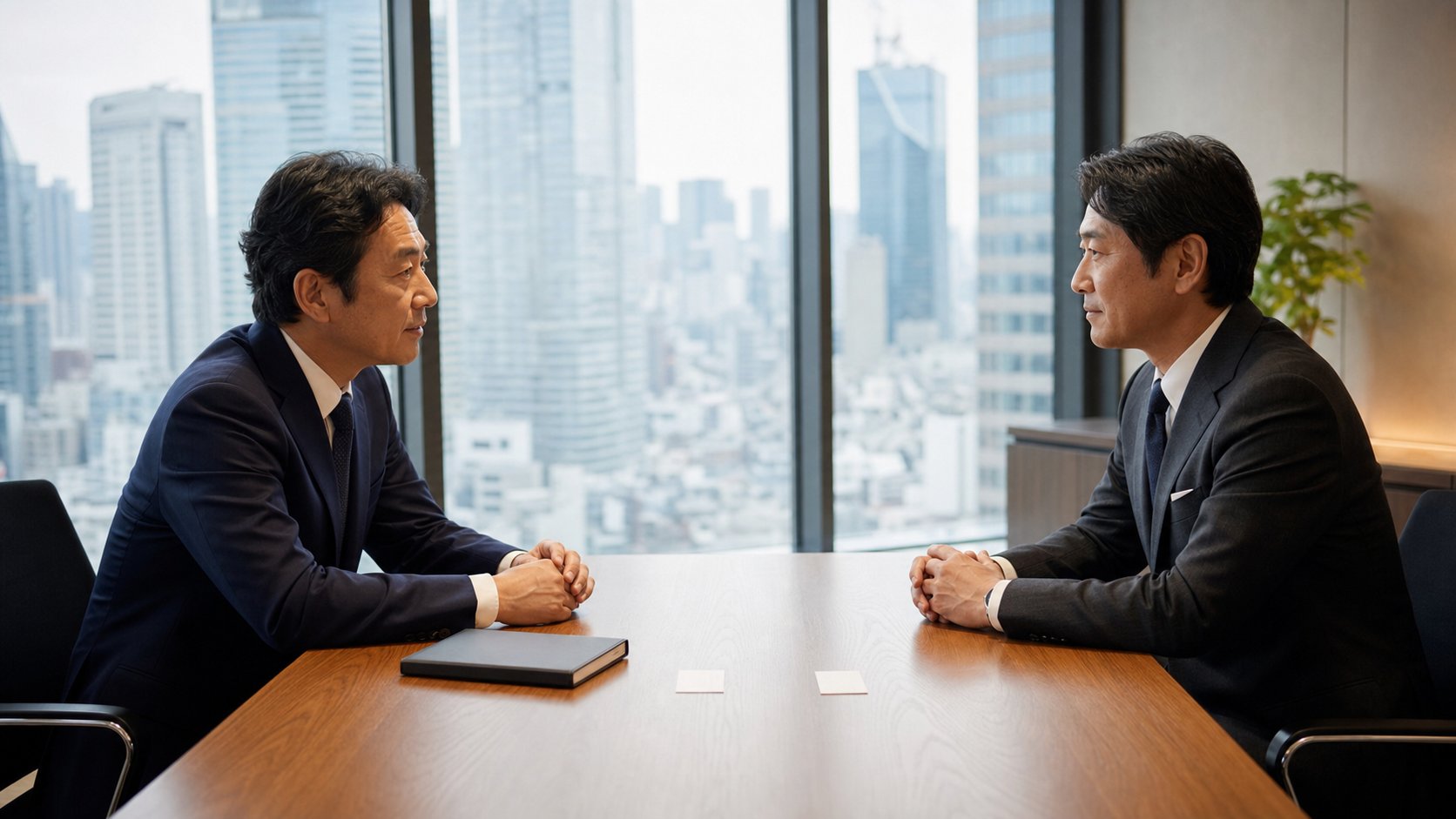
This is Part 3 of Beyond the Boardroom, a six-part series on negotiating with Japanese businesses published by AcadeResearch.com. In this installment, we examine the two dimensions that govern how you are perceived in every Japanese business interaction: how you present yourself, and how you communicate.
Part 2 established that Japanese negotiation is, at its core, a relationship-building exercise oriented toward mutual benefit and long-term partnership. That framing answers the why. The next challenge is answering the how: how do you actually conduct yourself in a Japanese business environment in a way that signals competence, respect, and cultural intelligence?
The answer unfolds across two dimensions that are inseparable in Japan: personal presentation and communication style. Neither is superficial. Both carry significant weight in the judgment your counterparts are quietly forming throughout every interaction.
1. Personal Style: The Discipline of Not Standing Out
Japanese business culture places a strong premium on formality, restraint, and professional presentation. But it is important to understand what this means in the Japanese context, because it differs meaningfully from Western interpretations of “professional dress.”
The ideal in a Japanese business setting is not to make a strong visual impression; it is to make no disruptive impression at all. The Japanese concept of professional appearance is closely tied to the value of blending in, of signaling that you are a reliable, predictable, group-oriented professional rather than an individual seeking to distinguish yourself (Yasui, 2019). Standing out visually, whether through bold colors, dramatic accessories, or strong fragrances, registers not as confidence but as social carelessness.
Bijinesu Fomaru: The Standard of Business Formal
The dominant dress code is bijinesu fomaru (ビジネスフォーマル): dark suits in navy, charcoal, or black for both men and women, paired with conservative accessories and minimal ornamentation (GuidableJobs, 2024; Plaza Homes, 2022). The color choices are not arbitrary. In Japanese aesthetics, kuro (黒, black) carries connotations of authority and formality, while ai (藍, dark indigo/navy) is associated with calmness and stability (Lisina, 2020; MUSUBI KILN, 2024). Wearing these colors in a business context is a subtle signal that you understand the register you are operating in.
The grooming standard is equally restrained. Heavy makeup, strong perfume, and bold nail colors are considered meiwaku (迷惑), a nuisance to others, because they impose sensory experience on people who have no choice but to share a space with you (EMPOWER, n.d.). Even calm, reserved demeanor is considered part of one’s professional presentation. Composure is not merely a personality trait; it is a form of respect for the group (Coslett, 2025).
One practical note that Western visitors often miss: clean socks matter. In some traditional settings, you may be asked to remove your shoes before entering a room. Arriving in worn or mismatched socks is noticed (Plaza Homes, 2022).
The Bow: A Practiced Grammar of Respect
The bow (ojigi, お辞儀) is not a single gesture but a structured language, and understanding its gradations matters in a formal business context. The eshaku (会釈), a 15-degree inclination, is appropriate for casual acknowledgments and passing encounters. The keirei (敬礼), a 30-degree bow, conveys genuine respect and is the standard in formal business meetings (Yani, 2022). Attempting a bow without understanding these distinctions can appear either dismissive or awkwardly excessive. When in doubt, match the angle of your counterpart and hold it slightly longer than feels natural.
The phrase most essential to your early interactions is Yoroshiku onegaishimasu (よろしくお願いします): a multi-purpose expression of goodwill that roughly means “I look forward to working with you” and is used at the beginning of every significant interaction (Plaza Homes, 2025). Learning to say it correctly, and at the right moments, signals more cultural awareness than almost any other single gesture.
2. Strategic Takeaways for Personal Style
- Default to conservative formality: When uncertain about dress code, err toward bijinesu fomaru. Dark suits, minimal accessories, neutral shoes. It is far easier to adjust toward casual if your counterpart dresses down than to recover from appearing underdressed (GuidableJobs, 2024).
- Eliminate strong fragrances: This is not a minor point. In densely occupied meeting rooms and elevators, strong cologne or perfume is a tangible imposition. Omitting it is an easy, concrete signal of cultural consideration (EMPOWER, n.d.).
- Practice the bow intentionally: A brief, clean 30-degree keirei bow at the start of a meeting is simple, memorable, and appreciated. You do not need to execute it perfectly; making the effort at all communicates respect and cultural awareness (Yani, 2022).
- Maintain physical composure: In Japan, restless body language, leaning back in chairs, checking phones, or speaking at high volume can read as disrespectful or immature. Composed posture and attentive stillness are nonverbal signals of seriousness (Coslett, 2025).
3. Communication Style: The Art of What Goes Unsaid
If personal style is about how you appear, communication style is about how you convey, interpret, and respond to meaning, and in Japan, the most significant communications are often not spoken directly at all.
Japan is a quintessential high-context culture: one in which much of the meaning in any interaction is embedded in context, tone, relationship, and non-verbal cues rather than in the explicit content of words (DaiJob, 2024; Villar, 2023). This is the direct opposite of the low-context communication style dominant in American business culture, where directness, clarity, and stating your bottom line upfront are considered virtues. In Japan, leading with your bottom line can feel aggressive, even rude. Context is built first; the main point arrives at the end.
The entire system is calibrated around the preservation of wa, harmony. Direct refusals, open disagreements, and blunt criticism threaten that harmony. So they are avoided, systematically and skillfully, through indirection (Scroope, 2021).
The Language of Indirect Refusal
One of the most important practical skills for negotiating in Japan is learning to decode polite refusals. Japanese counterparts rarely say “no” directly. Instead, they use phrases that function as soft rejections while preserving the surface harmony of the conversation.
Chotto muzukashii (ちょっと難しい), meaning “that may be a little difficult,” is one of the most common. When you hear it, do not treat it as an invitation to push harder or reframe the proposal. It is a polite no. Similarly, Kento shimasu (検討します), meaning “we will consider it,” frequently signals that the proposal has not landed well, even if it sounds encouraging in translation (Scroope, 2021; Koda, 2024).
Misreading these signals is one of the costliest mistakes a Western negotiator can make in Japan. Pressing forward after a soft refusal does not demonstrate confidence; it signals that you cannot read the room, which is a fundamental failure in a culture that prizes exactly that ability.
Haragei, Isshin Denshin, and Reading the Air
Several Japanese concepts illuminate the deeper philosophy behind this communication style. Haragei (腹芸), often translated as “communicating from the belly,” refers to the ability to convey one’s true intentions through non-verbal cues, atmosphere, and implication rather than explicit language (Oyama, 1998). Isshin denshin (以心伝心) describes the ideal of unspoken mutual understanding: a kind of wordless communication between people who know each other well enough that words are almost unnecessary.
The most practically important of these concepts for a foreign negotiator is kuuki wo yomu (空気を読む): literally, “reading the air.” It refers to the ability to pick up on the mood, unspoken concerns, and emotional undercurrents in a room, and to adjust your behavior accordingly (Japan Living Guide, 2023). In Japan, this is not a soft skill; it is a core professional competency. A person who cannot read the air is considered socially unreliable. For a foreign partner, demonstrating some capacity for this, through attentiveness, patience, and careful observation, goes a long way.
Silence, “Hai,” and the Red Ink Taboo
Two common misreadings of Japanese communication deserve particular attention.
First, silence. In Western negotiation contexts, prolonged silence after a proposal can feel like pressure or disagreement. In Japan, silence typically signals careful, respectful consideration (Jain, 2024; Interac, 2019). Filling every pause reflexively, or interpreting silence as rejection, can interrupt a deliberative process that is actually going well. Sit with it.
Second, hai (はい). The word translates literally as “yes,” but in Japanese business conversation it means “I am listening” or “I understand what you are saying.” It does not mean “I agree.” Treating a series of hai responses as enthusiastic endorsement of your proposal is a very common and very costly error for Western negotiators (Jain, 2024; Interac, 2019).
One additional taboo worth knowing: never write someone’s name in red ink. In Japanese culture, red ink on a name is associated with death and the severing of relationships, a deeply inauspicious act in a context where the relationship is everything (Asano, 2016; Digi-Joho Japan, n.d.). Use black or blue ink for all handwritten notes and name cards.
4. Strategic Takeaways for Communication
- Build context before stating your position: Open with background, your company’s history, the broader market context, your counterpart’s situation. Arrive at your main proposal only after this groundwork is laid. This mirrors the high-context communication structure your Japanese counterparts expect (DaiJob, 2024).
- Learn the vocabulary of polite refusal: Print a short reference card if necessary. When you hear chotto muzukashii or kento shimasu, register it as a soft no and respond by exploring alternatives rather than pressing the same proposal (Scroope, 2021).
- Do not fill every silence: When your Japanese counterpart goes quiet after a proposal, resist the instinct to elaborate or clarify. Let the silence work. Give them the space to process. Patience here is not passivity; it is competence (Jain, 2024).
- Do not confuse “hai” with agreement: Confirm understanding explicitly at key moments. Instead of relying on hai responses as a signal of buy-in, follow up important discussions with written summaries that allow your counterpart to flag any misalignment in a face-saving way (Interac, 2019).
- Watch the room, not just the speaker: Develop a habit of scanning the full group during meetings. Non-verbal reactions from mid-level managers, slight shifts in posture, brief glances between colleagues, these can carry more information about how a proposal is landing than anything said aloud (Japan Living Guide, 2023).
- Use only black or blue ink when writing names: A simple rule, but an important one. If you are annotating a business card, signing a document in someone’s presence, or writing on a shared whiteboard, keep red markers away from any names or titles (Asano, 2016).
Together, these two dimensions, composed personal presentation and high-context, indirect communication, form the behavioral layer of Japanese business culture. They are not stylistic preferences; they are the medium through which trustworthiness is communicated and evaluated.
In Part 4, we will examine three forces that operate very differently in a Japanese negotiation than in Western contexts: time, emotion, and risk. Once you understand how your Japanese counterparts relate to each of these, you will be equipped to navigate the full arc of a complex cross-cultural deal.
References
- Asano, J. (2016, August 8). 10 scary superstitions & taboos in Japan. All About Japan. https://allabout-japan.com/en/article/3814/
- Coslett, M. (2025, June 23). 10 unspoken rules in Japan. GaijinPot Blog. https://blog.gaijinpot.com/10-unspoken-rules-in-japan-that-youll-probably-break/
- DaiJob. (2024, November 26). Mastering effective communication in Japan. https://www.daijob.com/en/guide/skill-up/effective-communication-in-japan/
- Digi-Joho Japan. (n.d.). Writing a name in red ink is a rude manner in Japan. https://www.digi-joho.com/living-japan/name-in-red-is-rude.html
- EMPOWER. (n.d.). Workplace dress codes and attire in Japan. https://www.empower.co.jp/en/workplace-dress-codes-and-attire-in-japan/
- GuidableJobs. (2024, January 12). Dressed for success: Discovering Japan’s workplace dress codes. https://jobs.guidable.co/en/articles/dressed-for-success-discovering-japans-workplace-dress-codes
- Interac. (2019, January 7). Japan cultural nuances: Communication styles & eye contact. https://interacnetwork.com/reading-between-the-lines-insight-into-japanese-cultural-nuances/
- Jain, H. (2024, September 23). Japanese communication style. EJable. https://www.ejable.com/japan-corner/japanese-language-and-communication/japanese-communication-style/
- Japan Living Guide. (2023, December 28). Japanese verbal & nonverbal communication for business. https://www.japanlivingguide.com/career/business-etiquette/japanese-verbal-nonverbal-communication/
- Koda, Y. (2024, September 18). Communication style in Japan. Nihonium. https://nihonium.io/communication-style-in-japan/
- Lisina, E. (2020, January 5). Symbolic colors in Japan. JapanTravel. https://en.japantravel.com/blog/symbolic-colors-in-japan/61005
- MUSUBI KILN. (2024, October 25). Aesthetics of Japanese traditional colors. https://musubikiln.com/blogs/journal/aesthetics-of-japanese-traditional-colors
- Oyama, Y. (1998, August 1). Major factors affecting communication styles of American children and Japanese children. NYU. https://pages.nyu.edu/keefer/waoe/oyama.html
- Plaza Homes. (2022, March 29). Dress code in Japan: A guide to appropriate Japanese attire. https://www.realestate-tokyo.com/living-in-tokyo/japanese-culture/japans-dress-code/
- Plaza Homes. (2025, April 8). Polite and useful Japanese business phrases. https://www.realestate-tokyo.com/living-in-tokyo/japanese-culture/business-phrases/
- Scroope, C. (2021). Japanese communication. Cultural Atlas. https://culturalatlas.sbs.com.au/japanese-culture/japanese-culture-communication
- Villar, G. A. (2023, January 12). How Japan’s high context culture influences Japanese. Glossika. https://ai.glossika.com/blog/japanese-language-the-influence-of-a-high-context-culture
- Yani, A. L. (2022, July 30). Three types of bowing in Japanese culture. Tokhimo. https://www.tokhimo.com/post/different-type-of-bows-in-japan-1
- Yasui, H. (2019, May 2). Japan is too concerned with physical appearance. The Johns Hopkins News-Letter. https://www.jhunewsletter.com/article/2019/05/japan-is-too-concerned-with-physical-appearance
