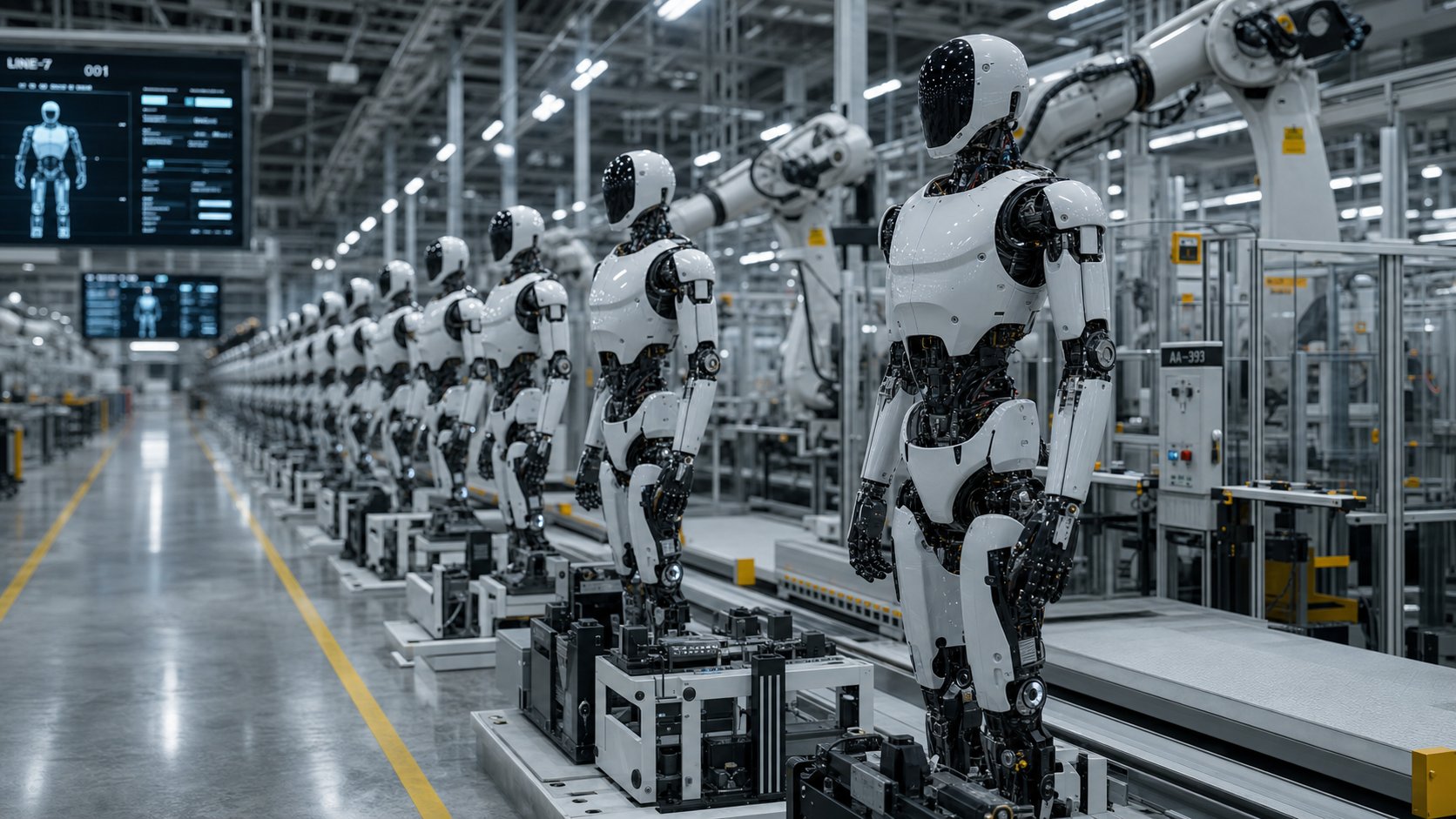
A Chinese factory in Shenzhen began shipping a full-size humanoid robot every 15 minutes on May 29. The story is not who built the most impressive robot. It is who built a real assembly line first, and what that means for an industry that has spent a decade competing on demo videos.
On May 29, 2026, the Chinese company EngineAI Robotics opened its EngineAI Intelligent Manufacturing base in Shenzhen and began mass delivery of its T800 full-size humanoid robot. The facility produces one unit every 15 minutes, has annual capacity of 10,000 units, and pushes each robot through 79 quality checkpoints and 46 simulated operating-condition tests before it leaves the line (AI Weekly, 2026; HumanoidHub, 2026).
That sentence contains the most important development in the humanoid robotics industry in 2026, and it has very little to do with what the robot can do.
For a decade, the global humanoid race has been measured in capability demonstrations. Tesla unveiled Optimus prototypes at AI Day events in 2021 and 2022. Figure AI’s robots have folded laundry, walked through warehouses, and tidied living rooms in viral promotional clips. Boston Dynamics’ Atlas has done parkour. Unitree’s H1 has danced on stage. What none of these companies had done, until last week, was produce humanoid robots at a manufacturing rhythm that resembles the automotive industry. The question for the rest of 2026 is no longer who can build the smartest humanoid. It is who can build them by the thousand, who can build them by the million, and what happens to the industry’s economics when the answer to those questions turns out to be answered first in China.
The Numbers That Frame the Race
The chart below shows two views of the humanoid manufacturing question. The left panel compares stated 2026 production capacity for the leading platforms, drawn from each company’s own most recent disclosures. The right panel shows Morgan Stanley’s 2050 adoption forecast for the United States and China, the longest-horizon industry projection from a major investment bank.
Three patterns are visible in the left panel.
EngineAI’s 10,000-unit annual capability is the most concrete near-term commitment in the industry. The 15-minute cycle time implies a theoretical maximum of 35,040 units per year if the line ran continuously, but the company’s stated commercial target is the more conservative 10,000 figure (HumanoidHub, 2026).
Figure AI’s BotQ facility in California reached one robot per hour on April 29, 2026, a 24-fold throughput increase in under 120 days, after delivering more than 350 of its Figure 03 third-generation humanoid robots (Figure AI, 2026). At a one-per-hour cycle running continuously, that implies roughly 8,760 units per year, similar to EngineAI’s near-term scale but reached on a different operational profile.
Tesla, despite holding the most ambitious long-term humanoid production targets in the industry, declined to provide a 2026 production figure on its April 22 Q1 earnings call. Elon Musk told analysts that initial Optimus V3 output beginning at Fremont in late July or August would be “quite slow,” calling the production rate “literally impossible to predict” given the Optimus contains roughly 10,000 unique parts across an entirely new line (Bellan, 2026). Musk’s January 2025 prediction of 10,000 Optimus units that year was missed entirely. By January 2026, Musk acknowledged that zero Optimus robots were doing useful work in Tesla’s factories. Fremont’s target run-rate of 1 million units annually and the new Giga Texas facility’s stated 10-million-unit goal remain real planning numbers, but they are 2027 and beyond.
Hyundai Motor Group, working through its US robotics subsidiary Boston Dynamics, announced on May 20–22, 2026 that it intends to deploy more than 25,000 Atlas humanoid robots across Hyundai and Kia manufacturing plants by 2028, absorbing roughly 83% of a planned 30,000-unit annual production capacity (Tech Times, 2026; ChosunBiz, 2026). First deployment at the Hyundai Metaplant America in Savannah, Georgia is scheduled for 2028, with Kia’s Georgia plant following in 2029.
The right panel of the chart, drawing on Morgan Stanley’s May 2025 humanoid market forecast, projects 302.3 million humanoids in use in China by 2050, compared with 77.7 million in the United States, the latter revised upward from a previous estimate of 63 million (Morgan Stanley, 2025). The bank projects the global humanoid market at roughly $5 trillion by 2050.
Why China Got to Factory Scale First
The disagreement between American optimism on capability and the visible Chinese lead in throughput is not a contradiction. It is a description of how the industry is divided.
The Wall Street Journal documented in April 2026 that even the most advanced US humanoid platforms, including Tesla’s Optimus and Figure AI’s robots, rely on Chinese-manufactured components for critical motion and sensing hardware. Industry estimates cited in the Journal’s reporting suggest that motion-related components, including motors, joints, sensors, planetary roller screws, and precision speed reducers, account for more than half of a humanoid robot’s total build cost (WSJ, 2026). A subsequent supply chain database compiled by industry analyst Terence Bennett found that approximately 63% of humanoid-supply-chain companies are based in China (Bennett, 2026).
Morgan Stanley’s chief Asia economist Chetan Ahya put the implication directly in a May 7 report: China’s early advantage in humanoid robotics could push its share of global manufacturing from 15% today to approximately 16.5% by 2030 (Bloomberg, 2026). The bank’s analysis described the dynamic as analogous to China’s electric vehicle dominance, with humanoids replacing EVs as the next major export driver. TrendForce projected on April 9, 2026 that China’s humanoid robot output would grow approximately 94% in 2026, with Unitree Robotics and AgiBot together expected to capture nearly 80% of domestic market share (TrendForce, 2026).
The structural reasons are unsurprising to anyone who has tracked Chinese industrial policy over the past 15 years. The Chinese government has actively financed humanoid robotics development through state-backed venture funds and direct subsidies. Domestic supply chains for precision actuators, harmonic drives, and rare earth magnets are vertically integrated. Demonstration platforms operate in domestic markets without the regulatory frictions or unionization dynamics that constrain Western deployment. And Chinese firms, including EngineAI, AgiBot, Unitree, and the Beijing-based startups that ran a humanoid endurance race earlier this year, can iterate publicly on their hardware faster than US competitors that must satisfy investor expectations, safety certifications, and a more fragmented industrial base.
None of this means Chinese humanoids are categorically more capable. Demonstrations of dexterity, autonomy, and reasoning have generally favored US platforms, particularly Figure 03 and Boston Dynamics’ Atlas, which combine state-of-the-art AI models from US labs with multi-year hardware refinement. The Tokyo Humanoids Summit earlier this month showcased Chinese-origin platforms performing dexterous tasks such as needle-threading and complex dance routines, but those displays do not yet translate into productive industrial deployment at the scale that BMW, Hyundai, and Amazon have begun discussing with Western suppliers.
The pattern, in short, is that the United States retains a lead in artificial intelligence software and high-end robotics design, while China has moved faster on the physical manufacturing and component supply chains required to actually produce humanoid robots at industrial volume.
The Tariff Problem That Makes It Worse
The supply chain question would be uncomfortable in any geopolitical environment. In 2026, it is operationally critical.
The United States currently imposes tariffs that effective rates reach 145% on certain categories of Chinese imports relevant to humanoid robotics, including actuators, batteries, and sensors (Bennett, 2026). In April 2025, China imposed export restrictions on the rare earth magnets used in Optimus actuators, in retaliation for prior US tariff escalations. As of March 2026, Tesla’s export license applications had not been publicly resolved. American humanoid makers are simultaneously trying to scale production using Chinese components and facing tariff and export-control regimes that make those components dramatically more expensive or, in some cases, unavailable.
The implications are not theoretical. Industry estimates suggest that a US humanoid manufacturer sourcing components at full tariff-adjusted prices may face per-unit costs 30% to 60% higher than a Chinese competitor sourcing domestically. At a target unit price below $20,000, which Musk has stated is the long-term goal for Optimus and which Chinese manufacturers are already approaching with units like the Unitree G1 priced at $16,000 and up, those cost differentials matter more than capability differences in determining which company wins which contract.
A March 2026 supply chain analysis by industry watchers noted that the Defense Production Act Title III authorizes federal funding for domestic production of materials critical to national defense, and that humanoid actuators, precision drive systems, and sensors fit that profile (Bennett, 2026). Taiwanese suppliers including Nengli, Canon, Sungtai, and Aurotek are positioning to absorb component manufacturing diverted from China. None of those alternatives, however, can match China’s combined scale, vertical integration, and price.
What the NIST Benchmark Is Trying to Solve
One related development of the past week is worth flagging. On May 29, the US National Institute of Standards and Technology proposed the first standardized performance benchmark for humanoid robots since the 2015 DARPA Robotics Challenge, with the explicit goal of creating “a common metric for capabilities that have so far been demonstrated only in marketing videos” (HumanoidHub, 2026).
Aaron Prather, director of the Robotics and Autonomous Systems Program at ASTM International, observed of the proposal: “In a decade that has seen Tesla’s Optimus, Figure, Agility, Apptronik, Unitree, and a dozen other humanoid platforms attract billions in investment, there is still no agreed-upon way to measure what any of them can actually do. Marketing videos have filled the gap” (HumanoidHub, 2026).
The benchmark proposal is, in part, an acknowledgment that the absence of comparable metrics has allowed both Chinese and American manufacturers to make claims that cannot be independently verified. Once a standard exists, customers, regulators, and investors will be able to compare a Figure 03 to a Unitree H1 to an EngineAI T800 on objective grounds. Some of the gap between American capability lead and Chinese manufacturing lead will, in that environment, become measurable rather than rhetorical. That measurement may favor the United States. It may also reveal that Chinese platforms have closed more of the capability gap than American observers have been willing to admit.
What This Means for the Industry’s Economics
The shift from prototype to production has three significant implications for how the humanoid industry is valued, regulated, and structured.
First, the economics of humanoid robotics will increasingly resemble the economics of the automotive industry, not the economics of artificial intelligence software. Software businesses scale at near-zero marginal cost. Manufactured goods do not. A humanoid robot factory has fixed costs in the tens of billions of dollars, variable costs dominated by physical components, and quality control requirements that grow nonlinearly with production volume. The companies that win this market over the next decade will be the ones that can lower per-unit production cost the fastest. EngineAI’s claim of one unit every 15 minutes is, in that frame, more strategically meaningful than any single capability demonstration.
Second, the financial mismatch between US humanoid valuations and Chinese production volumes is now visible. Figure AI was reportedly valued at approximately $39 billion in early 2026 after demonstrating Figure 03 capabilities; Tesla’s market capitalization continues to bake in long-term Optimus optionality. By contrast, Chinese humanoid manufacturers have been valued more conservatively, despite reaching factory scale first. If Morgan Stanley’s adoption projections prove approximately correct, the long-term winners may be the manufacturers that controlled the physical supply chain, not the ones that controlled the AI capability narrative.
Third, the policy environment in the United States is now likely to accelerate. The Defense Production Act, CFIUS reviews of Chinese capital flowing into US humanoid startups, tariff schedules, and federal procurement preferences for domestically built robots all have direct, near-term consequences for which companies become viable competitors over the next 36 months. The Hyundai-Boston Dynamics announcement of 25,000 Atlas robots at US plants, including the Savannah Metaplant, is partly a strategic response to that environment: a Korean-American partnership building US-assembled humanoids that depend less on Chinese inputs.
The economic context. The total addressable market for humanoid robotics is projected by Morgan Stanley at $5 trillion globally by 2050, with humanoids replacing or supplementing roughly 90% of repetitive industrial labor. Even if those projections are off by half, the manufacturing question, who can build them, where, and at what cost, will determine the distribution of trillions in industrial value over the next two decades. The capability question, what they can do, is a question that the entire industry has spent ten years answering. The manufacturing question is the one that began to be answered last week.
The Bottom Line
A Chinese factory in Shenzhen began shipping a humanoid robot every 15 minutes on May 29. Figure AI’s California facility reached one robot per hour a month earlier. Tesla declined to provide a 2026 production target. Hyundai pledged 25,000 humanoids at its US plants by 2028. The humanoid robotics industry has, in the span of roughly six weeks, transitioned from a competition about who can build the most capable robot to a competition about who can build them by the thousand. On the manufacturing dimension, the verifiable evidence available today suggests China is moving first. On capability, the United States retains a meaningful lead. Both can be true simultaneously, and the industry’s long-term winners will be determined not by which side of that divide is correct, but by which side learns to absorb the other’s advantage faster. The United States can build the most sophisticated humanoid in the world. China can build the most humanoids in the world. The next two years will reveal whether those two propositions can coexist, or whether one of them will turn out to be definitive.
References
AI Weekly. (2026, May 29). EngineAI factory ships T800 humanoid robots at scale. https://aiweekly.co/alerts/engineai-factory-ships-t800-humanoid-robots-at-scale
Bellan, R. (2026, April 22). Tesla pushes Optimus V3 reveal later this year, again. Electrek. https://electrek.co/2026/04/22/tesla-optimus-production-fremont-model-sx-line/
Bennett, T. (2026, March 31). Humanoid robotics supply chain database and US-China analysis. LinkedIn. https://www.linkedin.com/posts/terencehbennett_two-resources-everyone-in-tech-should-bookmark-activity-7443028469480869888-0P9g
Bloomberg. (2026, May 7). Humanoid robots to drive next leg of China export dominance. https://www.bloomberg.com/news/articles/2026-05-07/humanoid-robots-to-power-next-leg-of-china-s-export-dominance
ChosunBiz. (2026, May 20). Hyundai Motor Group to deploy 25,000 Atlas robots at Hyundai and Kia plants. https://biz.chosun.com/en/en-industry/2026/05/20/HYY7SI4JIZEFTBOX3BUXBAZ7CQ/
Figure AI. (2026, April 29). Ramping Figure 03 production. https://www.figure.ai/news/ramping-figure-03-production
HumanoidHub. (2026, May 30). NIST proposes a baseline performance benchmark for humanoid robots. https://www.humanoidhub.ai/news/nist-proposes-a-baseline-performance-benchmark-for-humanoid-robots-the-robot-report-6e674dbd-3d14-4f63-a98e-322213be9628
Morgan Stanley. (2025, May 14). Humanoid robot market estimated at $5 trillion by 2050. https://www.morganstanley.com/insights/articles/humanoid-robot-market-5-trillion-by-2050
Tech Times. (2026, May 22). Hyundai commits 25,000 Atlas robots to own factories: Union blocks deployment without labor deal. https://www.techtimes.com/articles/317005/20260522/hyundai-commits-25000-atlas-robots-own-factories-union-blocks-deployment-without-labor-deal.htm
TrendForce. (2026, April 9). China’s humanoid robot output to surge 94% in 2026; Unitree and AgiBot to capture nearly 80% market share. https://www.trendforce.com/presscenter/news/20260409-13007.html
The Wall Street Journal. (2026, April 2). Under the skin of America’s humanoid robots: Chinese technology. https://www.wsj.com/tech/under-the-skin-of-americas-humanoid-robots-chinese-technology-27dd4fdf
