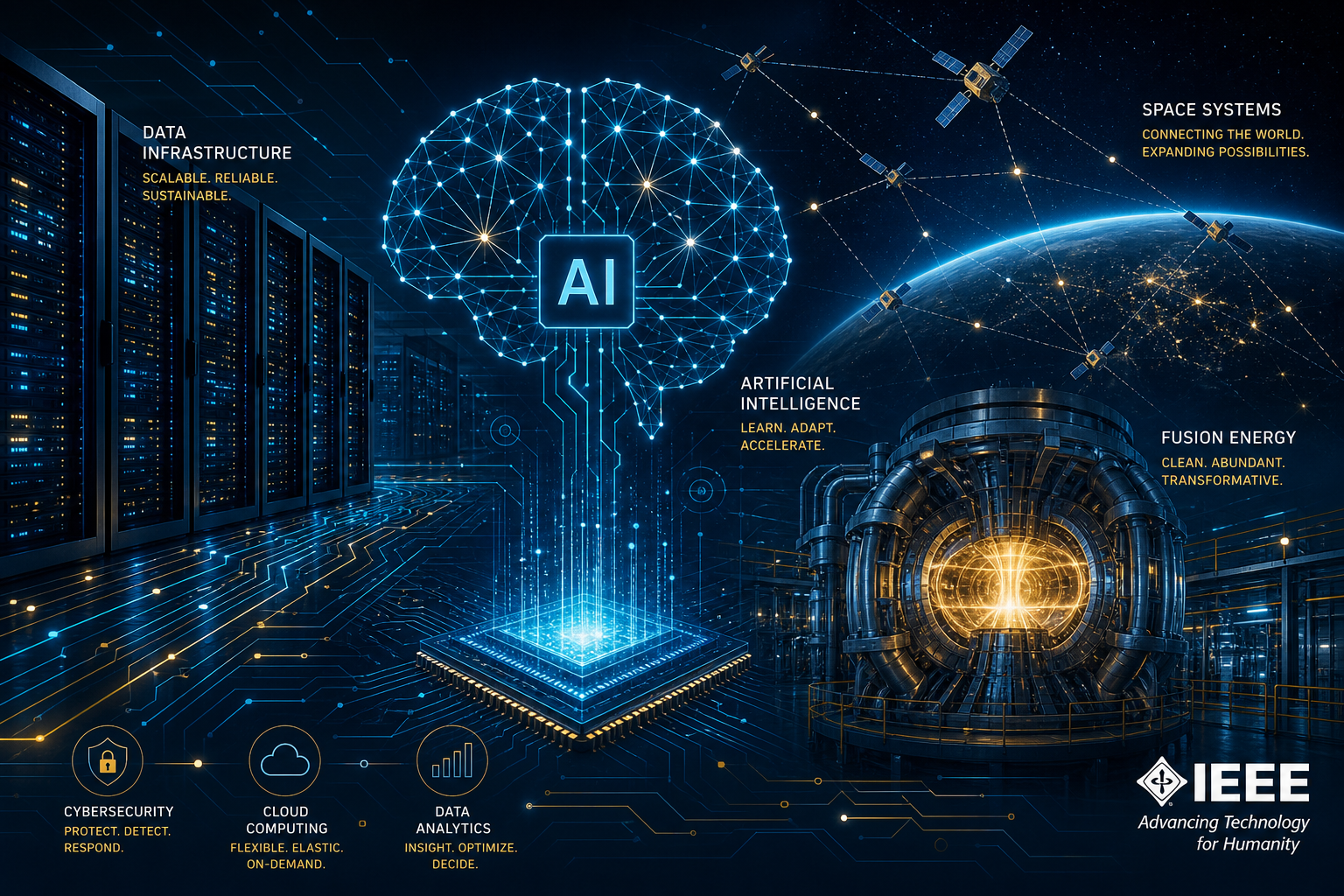
Institutional forecasts from the IEEE Computer Society identify AI-driven automation, datacenter energy innovation, and adaptive healthcare as the three dominant technology trends shaping 2026, with space communications and fusion energy flagged as the highest-risk reward frontier.
The Predictions: What IEEE Expects
On January 29, 2026, the IEEE Computer Society released its annual Technology Predictions Report, mapping the trajectory of computing and technology through the close of the year. The report is compiled by IEEE Life Fellows and technology experts who evaluate emerging developments, infrastructure shifts, and policy implications to project which innovations will have the largest real-world impact (IEEE Computer Society, 2026a).
The 2026 edition centers on three primary megatrends that collectively reshape how societies produce, consume, and manage energy-intensive computing infrastructure, medical services, and industrial automation. The report also identifies critical datacenter energy dynamics and space-based communications as secondary trends that could amplify or constrain AI growth. Finally, it flags high-risk, high-reward areas electric vertical takeoff and landing vehicles, fusion energy, and synthetic biology as developments that could disrupt the status quo within the decade.
AI-Driven Automation and the Future of Work
The report identifies AI as the primary driver of automation across work categories. AI-based technologies are expected to significantly reduce routine manual and cognitive work over 2026, shifting labor from execution-intensive tasks to oversight, coordination, and creative domains. The shift is not merely productivity-enhancing; it restructures entire operational models in manufacturing, logistics, software development, and administrative services (IEEE Computer Society, 2026a).
Dejan Milojicic, IEEE Life Fellow and chair of the IEEE Computer Society Technology Predictions Committee, stated that AI-based megatrends in health, energy, space, robotics, and emerging verticals are molding the future of work, medicine, and software development. The report notes that AI will not replace all human labor but will redirect it toward higher-value functions, requiring substantial workforce retraining and institutional adaptation (IEEE Computer Society, 2026a).
Key Insight
The IEEE report frames AI not as a standalone technology but as a cross-sector megatrend that intersects with healthcare, energy, space, and robotics to shape the broader technological landscape of 2026.
Datacenter Energy Innovation and Carbon Reduction
A critical component of the 2026 predictions addresses the energy demands of AI infrastructure. Datacenter energy management has emerged as a focal point: AI workloads are driving unprecedented electricity consumption, forcing innovation in energy production, thermal management, and power dissipation. The report concludes that AI demand will accelerate investment in next-generation energy infrastructure, which in turn could reduce carbon emissions and operational costs at scale (IEEE Computer Society, 2026a).
This prediction reflects a broader shift in computing economics. Energy efficiency is no longer a secondary optimization target; it is the primary constraint on AI deployment scaling. Organizations that invest in energy-efficient compute architecture today will have significant cost and competitive advantages as regulatory pressure on datacenter emissions increases.
Adaptive Therapeutics and Healthcare
Adaptive therapeutics is one of the three primary megatrends identified by the report. AI-driven personalization of medical treatments will accelerate throughout 2026, enabling dynamic dosing adjustments, real-time patient monitoring, and predictive health interventions. The shift from static treatment protocols toward continuously adaptive systems represents a fundamental reconfiguration of clinical practice, with implications for drug development, pharmaceutical supply chains, and patient outcomes.
High-Risk, High-Reward: Ones to Watch
Beyond the primary predictions, the report identifies several frontier technologies that carry significant uncertainty but also substantial disruption potential:
- Space-based communications. Satellite constellations and orbital infrastructure are advancing toward reliable, low-latency global connectivity. This development could bridge the digital divide but also creates new cybersecurity and space governance challenges (IEEE Computer Society, 2026a).
- Electric VTOL vehicles. Urban air mobility is transitioning from prototype to early commercial deployment. Regulatory approval, battery energy density, and noise reduction remain key barriers to scale.
- Fusion energy. Continued experimental progress in controlled fusion could begin delivering commercially viable power within the decade. The IEEE report frames fusion as a potential breakthrough in energy abundance, contingent on sustained R&D investment and materials science advances.
- Synthetic biology. Engineering of biological systems for manufacturing, medicine, and environmental applications is accelerating. The convergence of AI and synthetic biology is expected to produce new therapeutic agents, biofuels, and engineered organisms for environmental remediation.
What Stakeholders Must Do
The report extends beyond predictions into actionable guidance for three stakeholder groups:
| Stakeholder | Recommended Action |
|---|---|
| Industry | Invest in energy-efficient compute, standardize AI safety protocols, and fund workforce retraining programs |
| Government | Develop interoperable tech standards, fund frontier research, and establish AI governance frameworks |
| Academia | Research energy-dissipation techniques, train interdisciplinary AI ethics specialists, and advance materials science for fusion reactors |
The report emphasizes that no single organization or sector can advance these technologies in isolation. Coordinated effort across industry, government, and academia is essential for building the standards, infrastructure, and regulatory frameworks that govern next-generation computing (IEEE Computer Society, 2026a).
Conclusion: What This Means
The IEEE Computer Society’s 2026 Technology Predictions report provides a comprehensive roadmap of the technological landscape for the year. AI remains the central force, but its impact is mediated through energy infrastructure, healthcare systems, industrial automation, and the emerging frontier of space and fusion technologies.
For organizations evaluating investment priorities, the report makes clear that energy efficiency in compute, AI workforce planning, and adaptive health systems are not optional developments they are structural shifts that will define competitive advantage. The high-risk frontier technologies offer outsized rewards for early adopters but require patient capital, long timelines, and tolerance for technical failure.
The Bottom Line
AI is the dominant force in 2026’s technology landscape, but its trajectory is equally shaped by energy infrastructure, workforce adaptation, healthcare modernization, and frontier R&D in fusion and space communications.
Sources Cited
IEEE Computer Society. (2026, January 29). IEEE reveals 2026 predictions for top technology trends. IEEE Press Room. https://www.computer.org/press-room/2026-tech-predictions
