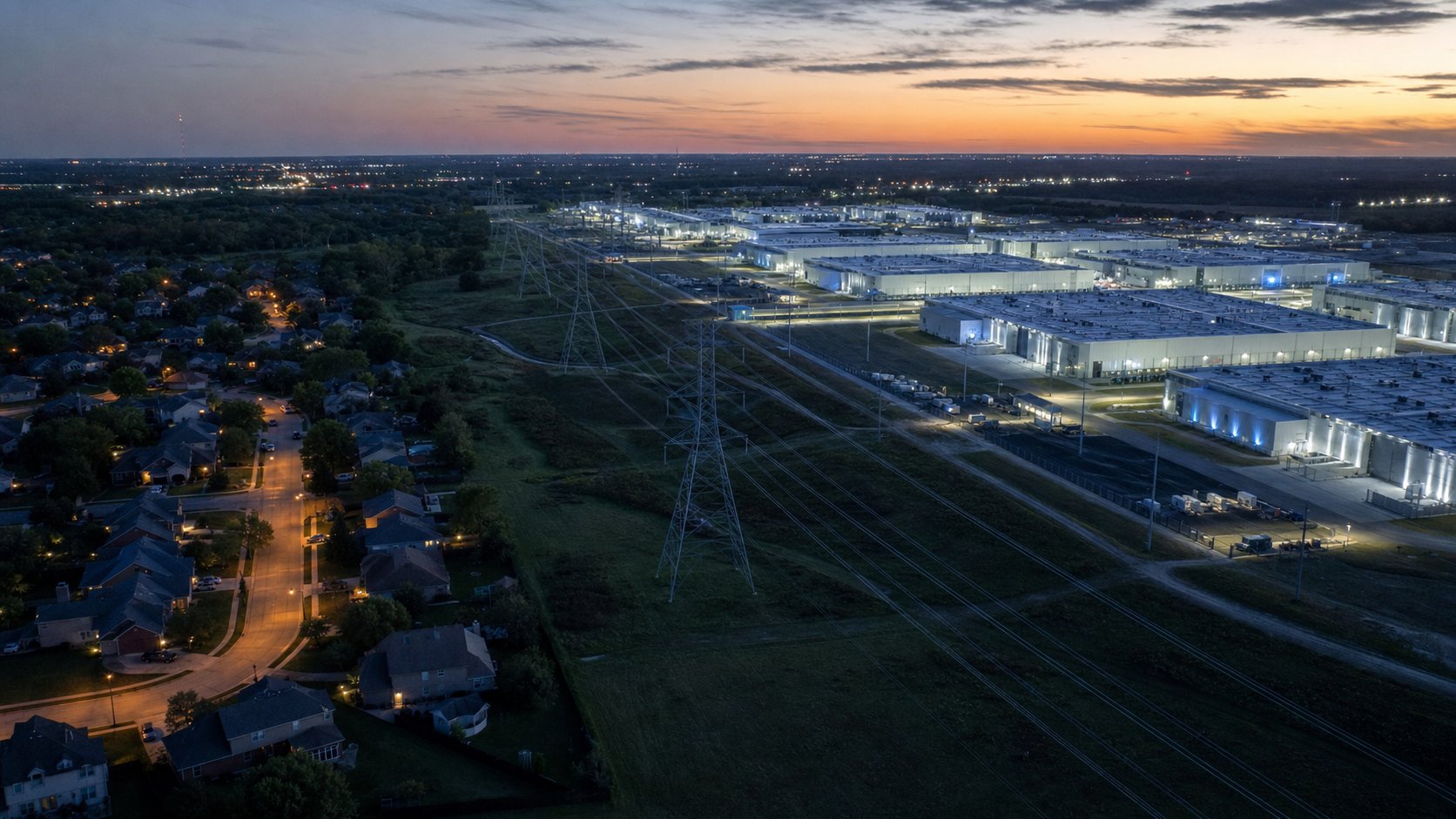
Two new reports released within 24 hours of each other reach opposite conclusions on whether the AI data center boom is raising household electric bills. The disagreement is real, the data behind both is real, and the answer depends on questions that ratepayers, regulators, and Congress are only now beginning to ask out loud.
By Kenny Le
On May 28, 2026, the Data Center Coalition published an independent analysis by Energy + Environmental Economics (E3) titled Data Centers are Not Driving Higher Electricity Costs, finding “no historical evidence that data centers are driving increases in residential electricity costs under existing rate structures” (TED Magazine, 2026). The same day, Earthjustice and Environmental Advocates Mississippi released an analysis by Synapse Energy titled In the Dark: Data Centers Could Be Costing Mississippi Households, concluding that residential customers of Entergy Mississippi are already paying up to $10.60 more per month, in part to fund grid upgrades serving new data centers (Earthjustice, 2026).
The two reports landed at the same moment that Congress, the Trump White House, and at least a dozen state regulators are actively debating who should pay for the largest single load-growth event in modern American electricity history. Both sides are working from real data. Both make defensible arguments. What follows is an attempt to lay out what each side says, what the underlying numbers actually show, and where the disagreement is genuinely substantive rather than rhetorical.
The Numbers Both Sides Cite
The chart below presents two of the data points that appear in nearly every analysis on either side of the debate.
The left panel tracks the annual change in U.S. residential electricity prices alongside headline CPI inflation. Two patterns are noted by both sides. First, electricity prices rose 7.1% in 2025, more than twice the underlying inflation rate of 3.0%, according to data summarized by the University of Pennsylvania’s Kleinman Center for Energy Policy (Draves, 2026). Second, prices have risen at a pace exceeding inflation in four of the past five years, after more than a decade of relative stability prior to 2019. The right panel shows the U.S. Department of Energy’s projection that data centers, which consumed roughly 4.4% of U.S. electricity in 2024, could reach 12% by 2028 (U.S. Department of Energy, 2024).
Both sides accept those figures. The disagreement is over what they mean.
The Industry Case: Data Centers Are Not the Primary Driver
The E3 analysis commissioned by the Data Center Coalition reviewed more than 10 quantitative studies and concluded that residential electricity costs are driven by a range of economic, policy, and market factors that vary by region (TED Magazine, 2026). Its core argument rests on five points.
First, the report argues there is no consistent statistical relationship between load growth and rising electricity rates at the state level. States with significant data center-driven demand growth, such as Texas and Virginia, have seen relatively modest rate increases. States like California and New York have experienced higher prices despite declining load. If data centers were the dominant cause, the geography would line up more cleanly.
Second, the analysis identifies five other forces driving rates higher: general inflation that raises labor, materials, and financing costs for utilities; grid modernization spending to replace aging infrastructure; natural gas price volatility; wildfire mitigation and grid hardening spending; and wholesale market design changes including power plant retirements, reduced accreditation of fossil resources, and interconnection backlogs (TED Magazine, 2026).
Third, the report argues that, under existing rate structures, data centers can generate more revenue for utilities than it costs to serve them, which can offset costs for other customers. This is an important claim and one that depends entirely on how individual state utility commissions structure large-load tariffs.
Fourth, on the often-cited PJM capacity market, the E3 analysis acknowledges that data center load growth accounted for approximately half of the recent increase in capacity prices, but attributes the remainder to market design changes, supply constraints, and power plant retirements (TED Magazine, 2026). PJM, which serves 13 states and Washington, D.C., is the largest wholesale electricity market in the country.
Fifth, Kush Patel, the senior partner at E3 who led the analysis, argues that the policy conversation should be conducted at the state and regional level rather than nationally: “While there’s a lot of national rhetoric on this, the real opportunity to manage costs and maintain affordability is at the state and regional level, where stakeholders can address what’s actually driving costs in their own system and build a framework for responsible load growth that fits their system” (TED Magazine, 2026).
The Data Center Coalition’s president and CEO, Josh Levi, has stated that “the data center industry is committed to paying its own way for the power it uses.” The industry has also pointed to the March 2026 White House Ratepayer Protection Pledge, signed by Google, Microsoft, Meta, Oracle, xAI, OpenAI, and Amazon, in which signatories committed to “build, bring, or buy all of the energy needed for building and operating data centers, paying the full cost of their energy and infrastructure, no matter what” (Draves, 2026).
The Consumer Advocate Case: The Costs Are Already on the Bill
The Synapse Energy analysis released for Earthjustice and Environmental Advocates Mississippi reaches a sharply different conclusion in a specific state. According to the report, Entergy Mississippi residential customers had already paid $38 million in electricity grid enhancements by March 2026, with an additional $80 million expected to be billed by the end of 2026 (Earthjustice, 2026). The total grid enhancement project, called Superpower Mississippi, is expected to cost $300 million over five years. The Synapse analysis concluded that average residential bills are currently up to $10.60 higher per month as a direct result of investments to serve data centers, with potential for the figure to grow.
The consumer advocate case rests on three observations.
First, in some regions where data center concentration is highest, electricity costs have risen faster than the national average. Senator Adam Schiff (D-Calif.) has cited an estimate that “costs of electricity have gone up 267% for residents in areas with data centers” (Schiff, 2026). The Kleinman Center analysis cites Virginia, the largest data center market in the country, as a case where electricity prices have risen “by as much as 267% over the last five years” in specific high-data-center areas (Draves, 2026). These figures refer to localized areas rather than statewide averages.
Second, infrastructure investment to support data center growth is substantial. PJM transmission upgrades totaled $4.4 billion across seven PJM states between 2022 and 2024 (Draves, 2026). Meta’s planned Hyperion campus in Louisiana is projected to require more than three times the electricity of the entire city of New Orleans. When these upgrades are paid for by all ratepayers rather than the new large loads that triggered them, the cost incidence falls on households and small businesses regardless of whether they personally use AI services.
Third, the consumer-side argument focuses on accountability and transparency mechanisms. The Earthjustice report criticizes a 2024 Mississippi law that allows nondisclosure agreements between large data centers and Entergy Mississippi, which the advocates argue prevents the Mississippi Public Service Commission from fully evaluating whether costs are appropriately allocated (Earthjustice, 2026). Yolanda Daniel of Environmental Advocates Mississippi has said: “Entergy Mississippi needs to disclose its secret contracts with data centers so we can know for sure that we’re not footing the bill to bring electricity to these trillion-dollar companies.”
Critics of the Ratepayer Protection Pledge note that the commitments are voluntary. Ari Peskoe, director of Harvard Law School’s Electricity Law Initiative, has argued the pledge “does nothing to help consumers” because states and public utility commissions, not the White House or tech companies, control electricity markets and rate structures (Draves, 2026).
Where the Two Sides Actually Agree
Beneath the headlines, the two camps converge on several points that often get lost in the back-and-forth.
Both sides agree that residential electricity prices have been rising faster than inflation for several years. Both sides agree that data centers are not the only driver. Both sides agree that PJM capacity prices have risen, and that data center demand explains roughly half of that increase. Both sides agree that state and regional utility commissions, not federal policy, ultimately determine how costs are allocated. And both sides agree that the current allocation framework was not designed for loads of the scale now being proposed.
What they disagree on is the relative weight of data centers compared to other cost drivers, whether existing rate structures adequately protect residential customers, whether voluntary industry commitments are sufficient, and whether the lack of national statistical correlation between load growth and rate increases tells us that data centers are not the cause, or simply that the impact is highly local and obscured in national averages.
What Congress Is Doing About It
The debate has produced bipartisan legislative interest, though not yet bipartisan legislation.
In December 2025, Representative Greg Landsman (D-OH-01), joined by Representative Don Beyer (D-VA), introduced H.R. 6529, the Protecting Families from AI Data Center Energy Costs Act. The bill would direct the Federal Energy Regulatory Commission (FERC) to convene a technical conference within 90 days, involving the Department of Energy, public utilities, transmission providers, state regulators, ratepayer advocates, and large-load entities, to explore strategies and rate structures protecting residential and small commercial ratepayers from cost shifts driven by large electricity consumers. FERC would then submit recommendations to Congress within 180 days (Quiver Quantitative, 2025; Congressional Auditor, 2026). The bill, as written, mandates a study rather than directly changing rate structures.
In April 2026, Landsman introduced a second, broader bill, the No Harm Data Centers Act, which would require data centers to pay the full cost of their energy demands and infrastructure, study the environmental impacts of data centers, and prohibit NDAs between public officials and data center developers (Landsman, 2026).
Earlier in May 2026, Senator Adam Schiff (D-Calif.) introduced the Energy Cost Fairness and Reliability Act, which would require data centers over 50 megawatts to bring their own power, direct FERC to require data center developers to pay 100 percent of network upgrade costs, prohibit data centers from relying on existing generation capacity to meet new demand, and require regulators to ensure utilities are not shifting grid upgrade costs onto ratepayers (Schiff, 2026). The Schiff bill currently has no Republican cosponsors, though Schiff himself acknowledged that “the concern of rising utility bills is widespread. It’s not just on the left or the right or on the center. It’s certainly pervasive.”
The Trump administration’s response has been the voluntary Ratepayer Protection Pledge, issued in March 2026 and signed by Google, Microsoft, Meta, Oracle, xAI, OpenAI, and Amazon, asking signatories to fund their own energy and infrastructure (Draves, 2026).
The Question Underneath
What both sides are really arguing about is a foundational question in utility economics: who pays for an infrastructure upgrade triggered by a single new customer.
Traditional utility ratemaking spreads infrastructure costs across the broad customer base on the theory that grid upgrades benefit everyone in the form of improved reliability and capacity. That logic was developed in an era when individual large customers, even substantial industrial facilities, represented a manageable share of any single utility’s load. The hyperscale AI data center is a different animal. Meta’s planned Louisiana campus, projected to draw more than three times the electricity of New Orleans, is not a typical industrial customer. It is a new class of load that arrives faster than utilities can plan, lasts longer than typical commercial agreements, and concentrates in regions with cheap power, friendly tax structures, and available land.
Whether the costs of accommodating this new class of load should be socialized across all ratepayers, charged exclusively to the data center developers, or distributed through some hybrid formula is fundamentally a values question dressed in economic terms. Reasonable people, looking at the same data, can reach different conclusions depending on what they believe rate structures are supposed to do.
One thing both sides actually believe. If the goal is to know who is paying for what, the current rate-setting system, with state-level public utility commissions reviewing utility filings under varying levels of public disclosure, is opaque. The Earthjustice critique of Mississippi’s NDA law and the E3 analysis’s call for “tailored large load tariffs” and stronger planning and forecasting both point at the same underlying gap: existing tools were not built for loads of this size or speed. Reform of the rate-design process, rather than a single legislative fix, may be the actual structural question regardless of which side’s data turns out to be closer to the truth.
The Bottom Line
Two reports released on the same day reach different conclusions about whether data centers are raising household electricity bills. Both draw on real data. The industry-funded E3 analysis is correct that load growth and rate increases do not correlate cleanly at the state level and that several other forces, including inflation, gas volatility, wildfire mitigation, and grid modernization, also push prices higher. The Synapse Energy analysis is correct that in at least one state, Mississippi, residential customers are demonstrably already paying tens of millions of dollars in grid upgrades tied in part to new data center demand. The fact that both can be true at once is not a sign of bias on either side. It is a sign that the issue is local, that national averages obscure as much as they reveal, and that the question of cost incidence depends on rate-design choices that vary by state and utility. The most honest reading of the available evidence is that data centers are a meaningful, growing, but not exclusive driver of higher residential electricity prices, that the impact is concentrated in specific regions, and that the policy debate is no longer about whether something needs to be addressed but about how, and by whom, the costs are assigned. The Congress, the White House, and at least a dozen state regulators are now asking that question in public. Whether they get a coherent answer in the next two years will determine whose electricity bill goes up, and by how much, for the better part of the next decade.
References
Congressional Auditor. (2026, January 7). H.R. 6529: Protecting Families from AI Data Center Energy Costs Act. https://poliscore.us/2026/bill/hr/6529
Draves, A. (2026, May 28). Ratepayer Protection Pledge: The White House’s attempt to shield customers from rising electricity prices caused by data center expansion. Kleinman Center for Energy Policy, University of Pennsylvania. https://kleinmanenergy.upenn.edu/commentary/blog/ratepayer-protection-pledge-the-white-houses-attempt-to-shield-customers-from-rising-electricity-prices-caused-by-data-center-expansion/
Earthjustice. (2026, May 28). New report: Data centers could already be costing utility customers ~$11/mo. in one state. https://earthjustice.org/press/2026/new-report-data-centers-could-already-be-costing-utility-customers-11-mo-in-one-state
Landsman, G. (2026, April 9). Landsman leads new bill requiring Big Tech to pay for data centers and no NDAs. Office of Representative Greg Landsman. https://landsman.house.gov/posts/landsman-leads-new-bill-requiring-big-tech-to-pay-for-data-centers-and-no-ndas
Quiver Quantitative. (2025, December 10). New bill: Representative Greg Landsman introduces H.R. 6529: Protecting Families from AI Data Center Energy Costs Act. https://www.quiverquant.com/news/New+Bill:+Representative+Greg+Landsman+introduces+H.R.+6529:+Protecting+Families+from+AI+Data+Center+Energy+Costs+Act
Schiff, A. (2026, May 28). ICYMI: Sen. Schiff introduces legislation to ensure fair and affordable energy costs for Americans amid data center buildouts. Office of U.S. Senator Adam Schiff. https://www.schiff.senate.gov/news/press-releases/icymi-sen-schiff-introduces-legislation-to-ensure-fair-and-affordable-energy-costs-for-americans-amid-data-center-buildouts/
TED Magazine. (2026, May 28). Report: Data centers are not driving higher electricity costs. https://tedmag.com/study-finds-no-clear-link-between-data-centers-and-power-prices/
U.S. Department of Energy. (2024, December 20). DOE releases new report evaluating increase in electricity demand from data centers. https://www.energy.gov/articles/doe-releases-new-report-evaluating-increase-electricity-demand-data-centers
