

This is Part 2 of our comprehensive 6-part series on “Mastering Negotiation Strategy in Japan.” In this installment, AcadeResearch examines what Japanese negotiators are actually optimizing for: not the contract, but the relationship.
In Part 1, we explored how Japanese companies make decisions: slowly, collectively, and through layers of informal consensus-building before any formal agreement is reached. A natural follow-up question for any Western executive is: why? Why invest months in Nemawashi, why circulate a proposal through every department, why treat a meeting as a ceremony rather than a decision-point?
The answer lies not in bureaucracy, but in a fundamentally different understanding of what a business negotiation is for.
1. Goal Orientation: The Relationship Is the Deal
In the Western business tradition, a negotiation has a clear finish line: the signed contract. The document defines the relationship. If circumstances change, you refer back to the contract. If a dispute arises, you litigate on its terms. The contract is the relationship, codified and bounded.
Japan operates from a different premise entirely. Japanese business culture is fundamentally relationship-based rather than transaction-based, and this distinction reshapes everything about how negotiations unfold (EHLION, n.d.). Before substantive discussions begin, Japanese companies invest significant time and resources in simply getting to know their counterparts: through multiple in-person visits, social engagements outside the office, and months of informal interaction. This is not a preamble to the real work. This is the real work.
The signed contract, when it finally arrives, is viewed not as a destination but as a beginning. As one analysis of Japanese cultural values notes, the traditional Japanese attitude treats a contract as “the mere formalisation of a binding personal commitment to work together rather than a detailed instrument with fixed clauses that have to be complied with exactly” (Garcia, 2015). Put simply: the document confirms the relationship. It does not replace it.
Jijo Henko: Contracts That Breathe
This orientation is reinforced by a culturally embedded concept: jijo henko (事情変更), meaning “changing circumstances.” In Japan, even a recently signed contract is considered open to renegotiation if external conditions shift significantly (Garcia, 2015). Specific clauses can lose validity if they become unfavorable to either party. This is not bad faith; it reflects a deeply held belief that a contract should serve the relationship, not constrain it.
This stands in sharp contrast to the Western legal expectation that contracts are fixed obligations. For U.S. companies entering Japan, this has practical implications: a signed agreement may not resolve all future ambiguity. The trust embedded in the relationship often matters more than the precision of the paperwork.
Nagai Tsukiai: The True Goal
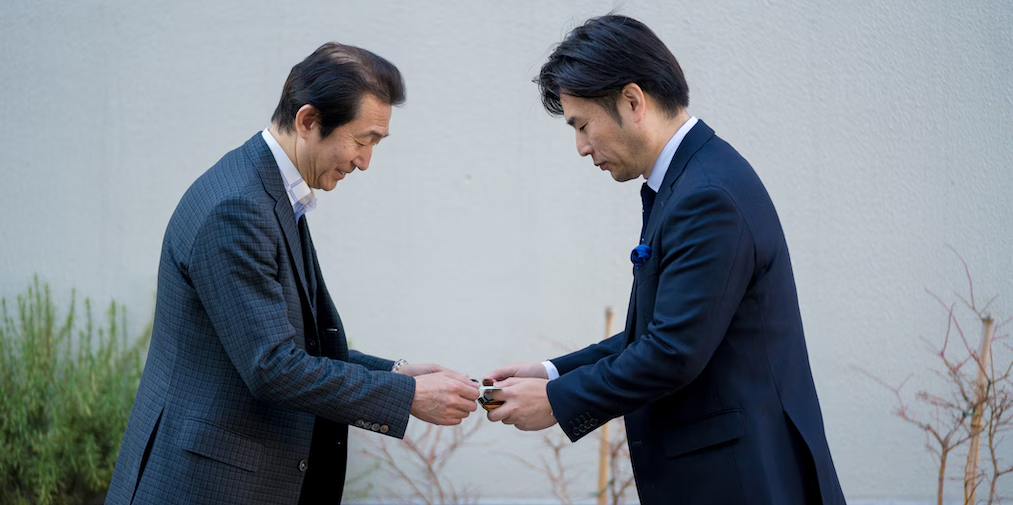
The concept underlying all of this is nagai tsukiai (長い付き合い): the long-term relationship. It is the organizing principle of Japanese business culture, and the ultimate objective of any negotiation (Garcia, 2015). Japanese companies are not negotiating for the best terms on a single transaction; they are evaluating whether you are the kind of partner they want to build something with over years, even decades.
This explains behaviors that often confuse Western executives: the prolonged social courtship before business discussions begin, the reluctance to engage with new counterparts, the insistence on repeated face-to-face visits. These are not inefficiencies. They are the investment required to enter a relationship that the Japanese side intends to maintain for the long term (Koda, 2025).
2. Attitude: In Japan, Everyone Must Win
If the goal is a lasting relationship, then the attitude at the negotiating table must be collaborative by definition. Confrontation, hardball tactics, and zero-sum posturing are not just stylistically unpleasant in Japan; they are strategically counterproductive.
Japanese negotiation culture is overwhelmingly win-win oriented, rooted in the concept of wa (和): harmony. A win-lose outcome would, by definition, damage the harmony of the relationship, making it unsustainable. Negotiation is understood as a form of collaborative problem-solving, not a competition between opposing interests (Salacuse, 2005).
The distinction is articulated sharply in research on cross-cultural negotiation. As Movius et al. (2006) note in their analysis of negotiations with Japanese partners: “Americans tend to approach negotiations as a game which they are determined to win. In Japan everybody must win” (Movius, Matsuura, Yan, & Kim, 2006). This is not a polite aspiration; it is a structural requirement of how business relationships are designed to function.
Compromise as Strength
In American boardrooms, compromise sometimes carries a connotation of weakness: you concede when you lack leverage. In Japan, the ability to compromise is a signal of maturity, good faith, and commitment to the partnership. Cross-cultural studies consistently show that Japanese negotiators are significantly more likely to make concessions than their American counterparts, not because they are pushover, but because flexibility is a virtue in a system built on long-term cooperation (Clavecilla, 2022).
It is also worth noting where competition does exist in Japanese business culture. Japanese companies compete intensely, but that competitive energy is directed outward, against rival firms and alternative solutions, not inward against their negotiating partners (Smethurst, 2014). Once a company is considered a potential partner, the framing shifts: you are no longer an adversary to be defeated but a collaborator to be aligned with.
This collaborative posture extends to the early stages of discussion as well. Japanese negotiations typically begin with exploratory conversations about each company’s broader situation before any terms are discussed. This is not inefficiency; it is a deliberate effort to map out mutual interests, identify potential trades, and lay the groundwork for genuine joint problem-solving (Movius et al., 2006).

3. Strategic Takeaways for Managers
Understanding Japan’s relational and win-win orientation is not merely an academic exercise; it has direct implications for how U.S. executives should structure their approach from the first contact onward.
- Prioritize the relationship before the deal: Do not arrive in Tokyo focused on closing. Arrive focused on building. Allocate time and budget for social engagement, informal meals, and repeated visits. This investment pays dividends in trust, which is the real currency of Japanese business (Koda, 2025).
- Signal long-term commitment explicitly: Japanese partners are evaluating your intentions as much as your offer. Concrete signals, such as a local office presence, Japanese-speaking team members, or a multi-year business plan, communicate that you are building toward nagai tsukiai, not a one-time transaction (Koda, 2025).
- Treat the contract as a living document: Once signed, a contract is the start of the relationship, not a closed chapter. Remain open to revisiting terms if circumstances change significantly. Rigid insistence on original clauses during a major market shift can damage the trust that took years to build (Garcia, 2015).
- Adopt a collaborative posture from day one: Frame proposals in terms of mutual benefit. Lead with questions about your counterpart’s needs and constraints before presenting your own position. This mirrors the exploratory opening style that Japanese negotiators expect and respect (Movius et al., 2006).
- Avoid hardball tactics entirely: Tactics like artificial deadlines, take-it-or-leave-it ultimatums, or aggressive anchoring are not just ineffective in Japan; they are relationship-ending. They signal that you view the negotiation as a competition, which is incompatible with the wa-oriented framework your counterparts are operating within (One Step Beyond, 2025).
- Focus on mutual benefit, and say so explicitly: Japanese negotiators respond well to framing that emphasizes shared outcomes. Use language like “what would work for both of us” rather than “what we need.” This is not merely diplomatic phrasing; it aligns with how your counterpart conceptualizes the purpose of the conversation (Salacuse, 2005).
- Be prepared to compromise, and reframe it as a strength: When you make a concession, do not frame it as a reluctant capitulation. Frame it as a demonstration of your commitment to the partnership. In this context, flexibility is a virtue that builds credibility (Clavecilla, 2022).
Once you internalize that Japanese negotiation is fundamentally a relationship-building exercise, the pace, the formality, the indirection, and the emphasis on harmony all begin to make coherent strategic sense. The slow start is the strategy.
In Part 3, we turn to a closely related challenge: now that you understand what your Japanese counterparts are optimizing for, how do you actually conduct yourself in the room? Because in Japan, how you communicate, and what you deliberately leave unsaid, matters more than you might expect.
References
- Clavecilla, L. (2022). Understanding the Japanese approach to negotiations. SME Japan. https://www.smejapan.com/business-news/understanding-the-japanese-approach-to-negotiations-2/
- EHLION. (n.d.). Developing business relationships in Japan. https://ehlion.com/magazine/business-relationships-japan/
- Garcia, G. (2015, June 12). Japanese cultural values in business relationships. Real Instituto Elcano Royal Institute. https://www.realinstitutoelcano.org/en/analyses/japanese-cultural-values-in-business-relationships/
- Koda, Y. (2025, May 29). How to build trust in Japanese business negotiations. Nihonium. https://nihonium.io/how-to-build-trust-in-japanese-business-negotiations/
- Movius, H., Matsuura, M., Yan, J., & Kim, D.-Y. (2006). Tailoring the mutual gains approach for negotiations with partners in Japan, China, and Korea. Negotiation Journal, 22(4), 389. MIT Press. https://direct.mit.edu/ngtn/article/22/4/389/122171/Tailoring-the-Mutual-Gains-Approach-for
- One Step Beyond株式会社. (2025, September 4). Negotiating with Japanese companies: Strategies for success. https://onestepbeyond.co.jp/blogs/negotiating-with-japanese-companies-strategies-for-success/
- Salacuse, J. W. (2005). The top ten ways that culture can affect international negotiations. Ivey Business Journal. https://iveybusinessjournal.com/publication/the-top-ten-ways-that-culture-can-affect-international-negotiations/
- Smethurst, R. (2014, June 5). Cultural influences on negotiation: Japan vs. Canada. LinkedIn. https://www.linkedin.com/pulse/20140605130624-73232945-cultural-influences-on-negotiation-japan-vs-canada