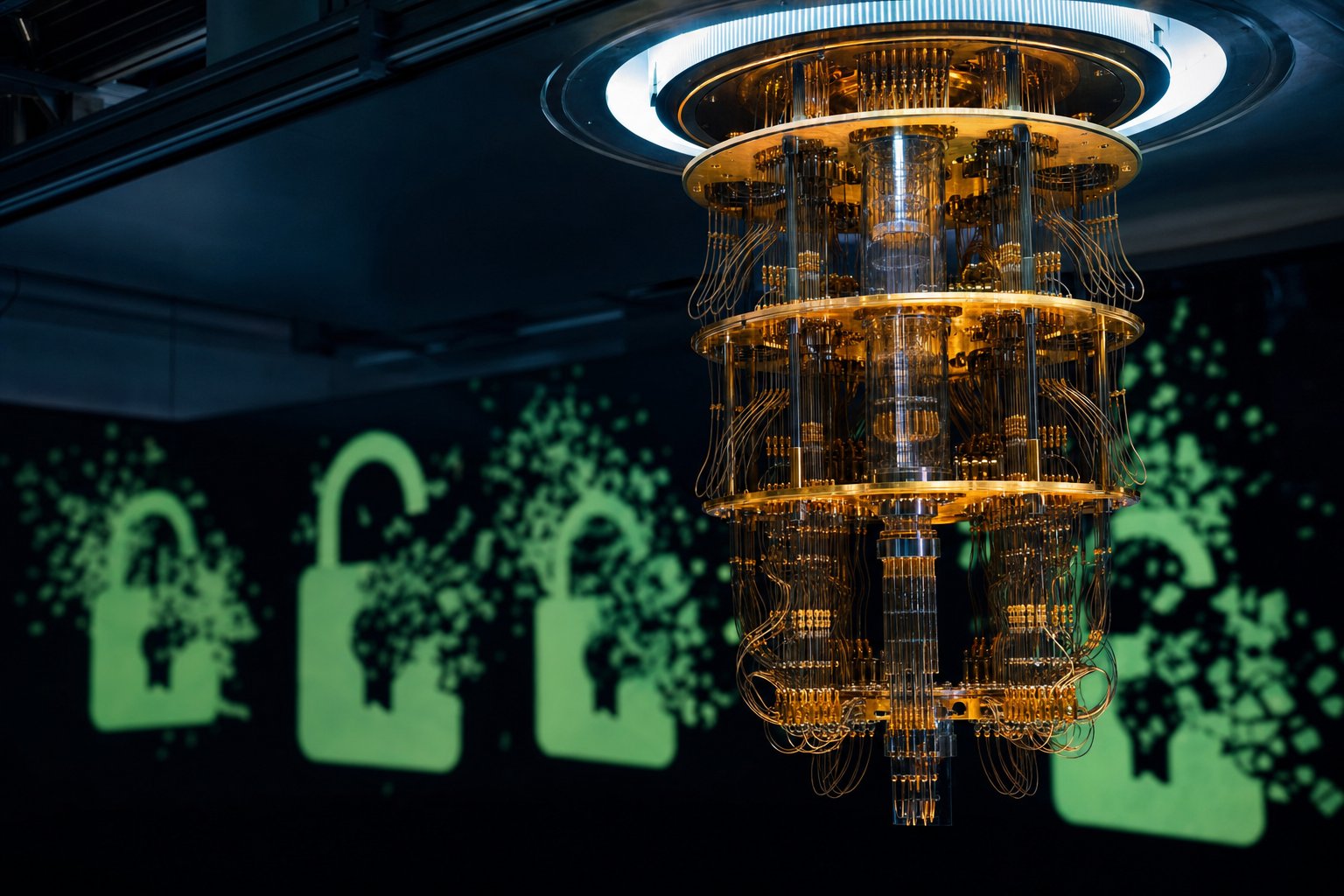

Most experts still place Q Day in the 2030s, but in twelve months, three research papers have reduced the quantum resources needed to break RSA-2048 by a factor of more than 200. Google has set its own internal deadline at 2029. The migration window may be shorter than anyone expected.
“Q Day” is not a date on a calendar. It is a capability milestone, the moment a cryptographically relevant quantum computer (CRQC) becomes powerful enough to break the public-key cryptography that secures most of the digital economy (Palo Alto Networks, 2026). It is the day Shor’s algorithm can be run on real hardware to derive private keys from RSA and elliptic-curve cryptography (ECC), the mathematical foundations that protect bank transactions, government communications, software updates, and most encrypted internet traffic. Until recently, most cryptographers placed the milestone safely in the 2030s or later. A series of 2025 and 2026 research papers has begun to compress that timeline.
The Threat, in Plain Terms
Modern public-key cryptography rests on a single mathematical premise: certain operations are easy to perform but difficult to reverse. RSA security depends on the difficulty of factoring large prime numbers. ECC depends on a related problem involving elliptic curves. Both are “intractable” on classical computers, requiring time scales measured in millennia for keys of practical size (ISC2, 2026).
In 1994, mathematician Peter Shor published an algorithm that, when run on a sufficiently powerful quantum computer, would solve both problems efficiently (ISC2, 2026). The implication was immediate: a future quantum computer of sufficient scale could derive the private keys behind RSA and ECC, forge digital signatures, and decrypt previously protected traffic. According to Palo Alto Networks, the algorithms most directly at risk are RSA and elliptic-curve encryption, along with the digital signatures and key exchanges that rely on them (Palo Alto Networks, 2026). Most symmetric encryption (such as AES with longer keys) and hashing functions (such as SHA-256 and SHA-512) remain considered safe with appropriate rekeying, because the relevant quantum algorithm, Grover’s, provides only a quadratic rather than exponential speedup (ISC2, 2026).
Why Q Day Differs From AI Threats
Q Day is a categorically different kind of cybersecurity risk from the AI-augmented attacks that have dominated 2025 and 2026 headlines. AI accelerates attackers and defenders simultaneously, shifting the balance probabilistically. Q Day is deterministic. Once the qubit threshold is crossed, RSA and ECC provide zero security regardless of who controls the quantum computer. The scope is total rather than targeted: a single cryptographically relevant quantum computer can, in principle, break confidentiality for every archived TLS session, every signed firmware image, and every cryptocurrency wallet that has ever exposed a public key (Palo Alto Networks, 2026).
According to Palo Alto Networks, the “harvest now, decrypt later” attack pattern is also already active, which means Q Day risk does not wait for Q Day to materialize. Data harvested today against an adversary’s expectation of future decryption is already at risk for any information that needs to remain confidential into the 2030s (Palo Alto Networks, 2026; The Quantum Insider, 2026b). Where AI risk is generally manageable with detection controls, governance, and monitoring, Q Day risk requires a cryptographic transition that organizations cannot defer indefinitely.
How Far Away Is Q Day?
The honest answer is that no one knows. Palo Alto Networks, citing the Global Risk Institute’s 2024 Quantum Threat Timeline, reports that most cryptographic specialists expect cryptographically relevant quantum computers sometime in the 2030s or later, and that even in optimistic forecasts the probability of such a machine arriving within ten years remains under 20% (Palo Alto Networks, 2026; Global Risk Institute, 2024). The U.S. federal government has set 2035 as the deadline for federal post-quantum migration under National Security Memorandum-10 (Palo Alto Networks, 2026).
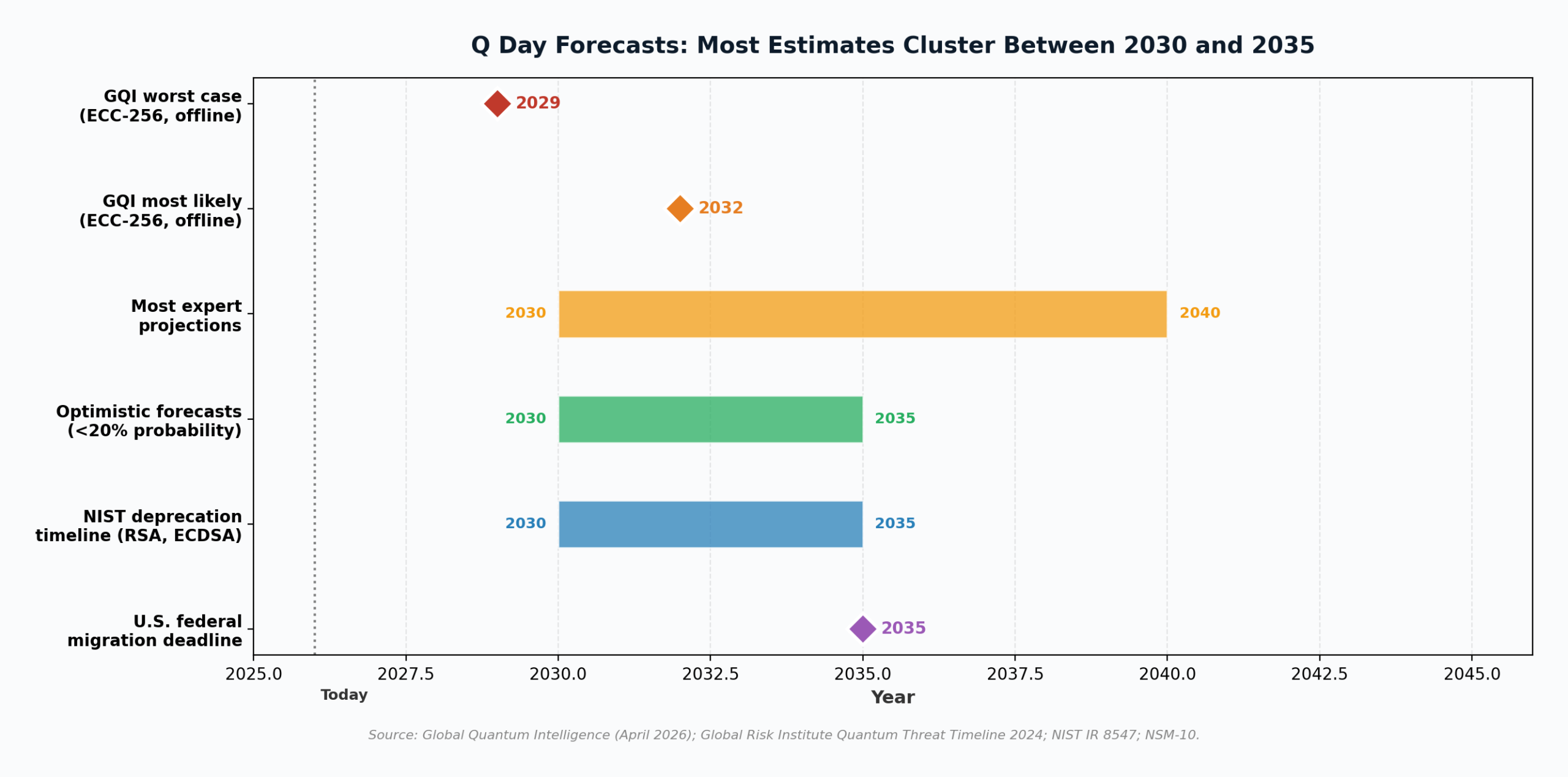
Recent research, however, has compressed the picture significantly. According to a March 2026 analysis from The Quantum Insider, three papers published between May 2025 and March 2026 sharply reduced the estimated quantum resources needed to break the cryptography underpinning the digital economy (The Quantum Insider, 2026a). Craig Gidney of Google Quantum AI showed in May 2025 that a quantum computer with fewer than one million noisy physical qubits could factor a 2048-bit RSA integer in under a week, a 20-fold reduction from his 2019 estimate of 20 million qubits, achieved through approximate residue arithmetic and yoked surface codes (The Quantum Insider, 2026a). In February 2026, Sydney-based startup Iceberg Quantum published its Pinnacle architecture, which uses quantum low-density parity-check (QLDPC) codes to reduce the requirement further, to fewer than 100,000 physical qubits. In March 2026, a Google Quantum AI paper co-authored with Justin Drake of the Ethereum Foundation and Dan Boneh of Stanford showed that the elliptic-curve cryptography protecting most cryptocurrencies could be broken with fewer than 500,000 physical qubits in minutes (The Quantum Insider, 2026a).

Hardware progress has been more modest. According to ISC2, leading quantum systems today operate with hundreds of qubits, against the hundreds of thousands or millions still required (ISC2, 2026; Palo Alto Networks, 2026). The trajectory of algorithmic gains, however, has prompted Global Quantum Intelligence to assess the most likely date for ECC-256 Q Day, in offline retrospective attacks, as 2032, with a reasonable worst case of just three years from today (Quantum Computing Report, 2026).
The Bitcoin Case Study: A Concrete Attack Window
The March 2026 Google Quantum AI whitepaper made the threat concrete. The paper estimates that a cryptographically relevant quantum computer with fewer than 500,000 physical qubits could solve the 256-bit elliptic curve discrete logarithm problem (ECDLP-256) protecting Bitcoin and Ethereum wallets in a few minutes on a superconducting architecture (Google Research, 2026a; Google Quantum AI whitepaper, 2026). Critically, Shor’s algorithm can be “primed,” meaning the first half of the computation, which depends only on fixed curve parameters, can be precomputed in advance. Once a specific public key is revealed, the remaining computation takes approximately nine minutes (Google Quantum AI whitepaper, 2026).
Bitcoin’s average block time is roughly ten minutes. Under the idealized conditions modeled in the paper, Google estimates a primed quantum computer could derive a private key before a Bitcoin transaction is confirmed with approximately 41% probability (Google Quantum AI whitepaper, 2026; The Quantum Insider, 2026a). According to Project Eleven analysis cited in the same whitepaper, approximately 6.9 million BTC, roughly one-third of total supply, sit in addresses where the public key is already visible on-chain, including P2PK outputs from Bitcoin’s first two years, addresses that have spent transactions, and Taproot keypath spends (Phemex, 2026). The Bitcoin developer community has responded with BIP-360 (Pay-to-Merkle-Root, published February 11, 2026) and BIP-361 (introduced April 2026), proposals that would migrate Bitcoin toward quantum-resistant address types using NIST-standardized signature schemes such as ML-DSA (Phemex, 2026; Bitcoin Magazine, 2026).
The Threat That Is Already Happening: Harvest Now, Decrypt Later
The most consequential dimension of Q Day is not what happens on the day itself, but what is already happening in anticipation of it. Adversaries do not need a working quantum computer today to extract future value from encrypted traffic. According to Palo Alto Networks, the “harvest now, decrypt later” (HNDL) attack pattern involves collecting encrypted data today and storing it until quantum computers reach decryption capability (Palo Alto Networks, 2026). The Quantum Insider’s May 2026 analysis describes the same dynamic: adversaries are collecting encrypted data right now, cannot read it yet, and expect to be able to do so within the next 10 to 15 years (The Quantum Insider, 2026b).
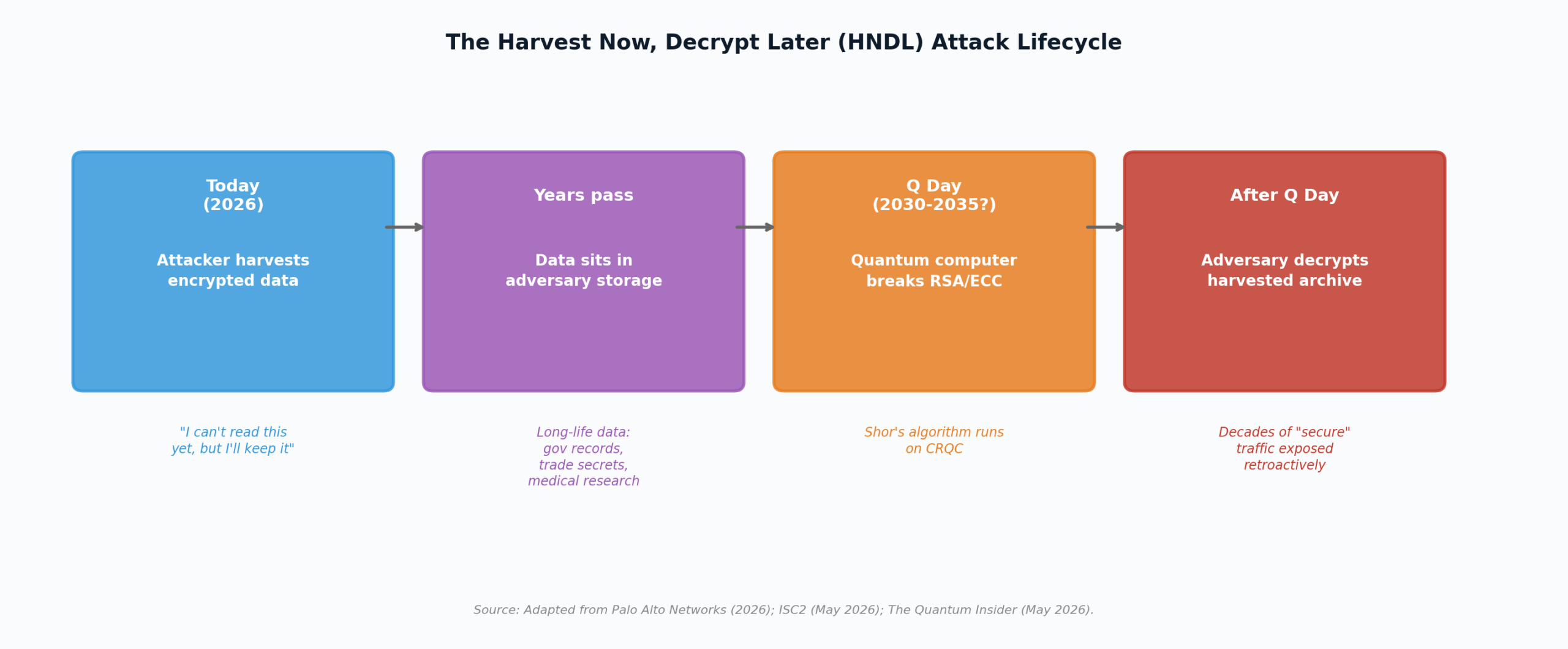
The risk concentrates in data with long confidentiality lifespans. Palo Alto Networks identifies government archives, trade secrets, medical research, financial records, and intellectual property as the categories most exposed (Palo Alto Networks, 2026). Prathibha Rama, a computer engineer at Johns Hopkins University Applied Physics Laboratory, framed the urgency in an April 2026 GovCIO interview: cybersecurity leaders do not need to panic about Q Day, but should recognize that information stolen today could be exposed retroactively (GovCIO Media, 2026). The U.S. federal response is being formalized through the White House’s June 2025 executive order on strengthening the nation’s cybersecurity, which directs agencies to support post-quantum migration “as soon as practicable, but not later than January 2, 2030” (GovCIO Media, 2026).
The Defensive Response: NIST Post-Quantum Standards
On August 13, 2024, the U.S. Department of Commerce’s National Institute of Standards and Technology finalized its first three post-quantum cryptography standards, the result of a public competition that began in 2016 (NIST, 2024). The standards specify mathematically distinct algorithms designed to remain secure against quantum attack. In March 2025, NIST announced HQC as a fifth selected algorithm to serve as a code-based backup option, with a draft standard expected for public comment and a finalized standard planned for 2027 (NIST, 2025).
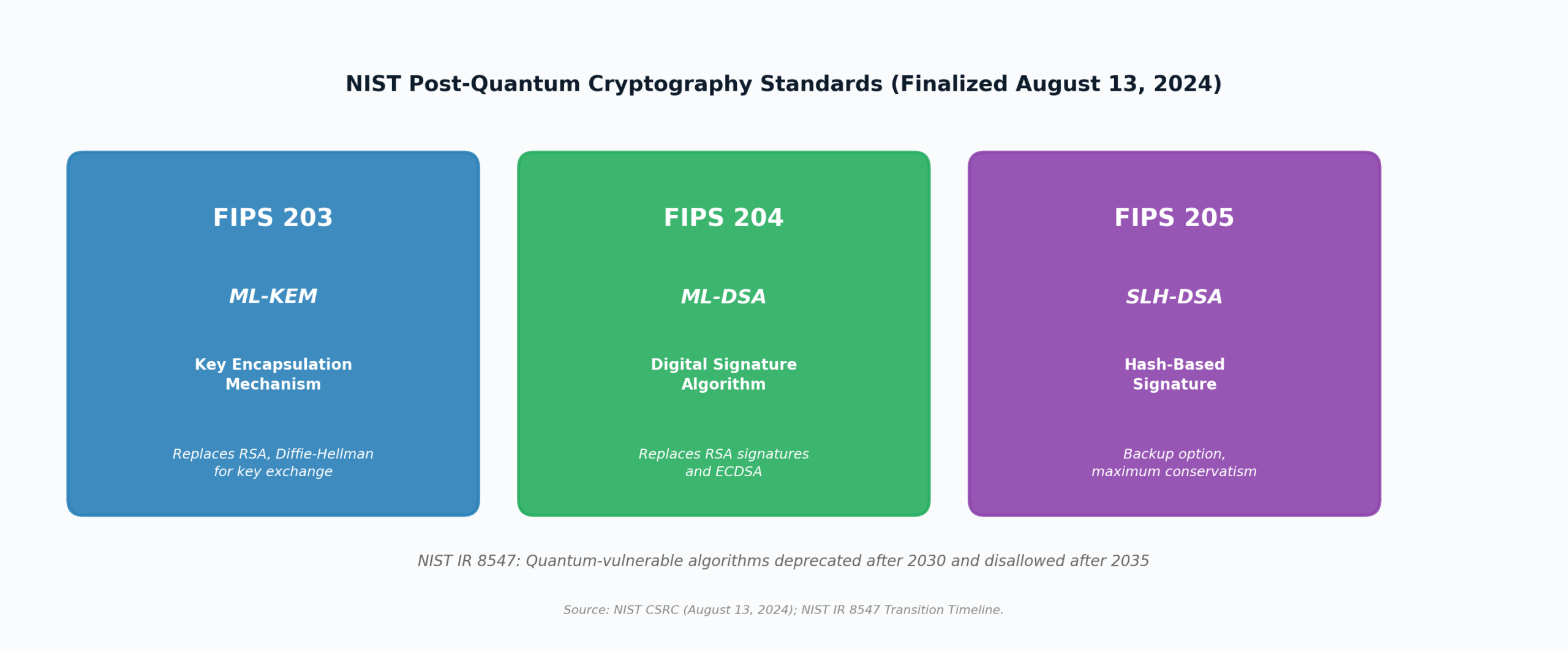
NIST IR 8547, the transition timeline document, calls for quantum-vulnerable algorithms to be deprecated after 2030 and disallowed after 2035, with RSA-2048 and ECDSA with P-256 explicitly in scope (The Quantum Insider, 2026a). The NSA’s Commercial National Security Algorithm Suite 2.0 supports the same goal for defense systems, with the NSA stating it expects new deployments to comply with CNSA 2.0 starting January 1, 2027. Equipment and services unable to support CNSA 2.0 are to be phased out by December 31, 2030, with CNSA 2.0 algorithms mandated by December 31, 2031 (QuSecure, 2026). In Europe, ENISA and ETSI are leading parallel initiatives, and the ISO/IEC 23837 standard defines shared testing criteria for technologies such as quantum key distribution (Palo Alto Networks, 2026).
NIST itself is going beyond the standards-setting role. According to the agency’s official post-quantum cryptography hub, NIST is working with technology companies, standards organizations, integrators, and customer organizations to demonstrate migration approaches, with much of that work coordinated through the National Cybersecurity Center of Excellence (NCCoE) Migration to PQC project (NIST, 2026). The Internet Engineering Task Force is incorporating PQC algorithms into core internet protocols such as Transport Layer Security, the foundation of HTTPS, which means PQC adoption will be increasingly automatic for any service that updates its TLS libraries (NIST, 2026).
Vendor implementation is proceeding. According to ISC2, Microsoft’s November 2025 updates of Windows 11 and Windows Server 2025 added PQC capabilities, and Linux’s Post-Quantum Cryptography Alliance is advancing similar work (ISC2, 2026). In a particularly notable signal, Google announced in March 2026 a formal internal deadline of 2029 to complete its own PQC migration, several years ahead of the federal 2035 target, citing the harvest-now-decrypt-later threat and the trajectory of its own attack-resource estimates (Google Blog, 2026; SecureWorld, 2026).
The Attack Surface Organizations Own Today
According to Palo Alto Networks and Cloud Security Alliance guidance, organizations using any of the following are exposed to Q Day risk: web and API TLS connections (which typically use RSA-2048 or P-256), VPNs and SD-WAN controllers, email encryption protocols including S/MIME and PGP, code signing and software update infrastructure, identity tokens such as SAML and OIDC assertions, cryptocurrency wallets and smart contracts, and long-term archives including health records, intellectual property holdings, and legal records (Palo Alto Networks, 2026; Cloud Security Alliance, 2024). Symmetric cryptography such as AES-256 remains usable with appropriate key management; asymmetric public-key systems do not.
What Organizations Are Being Told to Do
The guidance from primary sources is consistent and specific. Palo Alto Networks recommends six steps: start with executive-level accountability, inventory all uses of cryptography across applications and devices, triage long-life data first, design for crypto-agility, test hybrid models that combine classical and post-quantum algorithms, and define formal governance for cryptographic management (Palo Alto Networks, 2026).
McKinsey’s April 2026 guidance frames the response in three “moves”: assess potential quantum risks and exposures and prioritize the PQC transition accordingly using four factors (how long data needs to remain secure, how sensitive it is, how exposed it is, and how critical the supporting system is); reset the architecture to enable crypto-agility through cryptographic functions isolated into shared services, standard libraries, or managed platforms; and elevate quantum readiness to a leadership priority through a cross-functional group spanning technology, risk, and business leaders (McKinsey, 2026). The Cloud Security Alliance, citing NIST guidance, recommends that all organizations begin preparing now, given the typical 5-to-10-year horizon for cryptographically relevant quantum computers (Cloud Security Alliance, 2024).
For organizations seeking a concrete checklist, the operational priorities are: cryptographic inventory of every instance of RSA, ECC, and Diffie-Hellman, prioritized by data lifespan beyond 2030; pilot deployment of NIST PQC algorithms (ML-KEM for key exchange, ML-DSA for signatures) in test environments, including hybrid TLS 1.3 implementations that combine classical and post-quantum schemes; enforcement of crypto-agility through abstracted cryptographic code, algorithm negotiation, and over-the-air key rotation; key exposure reduction, particularly in cryptocurrency systems through avoiding address reuse and exploring quantum-resistant schemes such as those proposed in BIP-360; procurement updates requiring PQC support in vendor contracts for 2026 and 2027, referencing NIST FIPS 203, 204, and 205; and re-encryption of long-lived sensitive data with post-quantum or symmetric-only schemes, on the assumption that any data captured in the last five years may already sit in an adversary’s archive (Palo Alto Networks, 2026; The Quantum Insider, 2026a; Phemex, 2026).
2026 has been designated the “Year of Quantum Security” by a coalition that includes the FBI, NIST, and CISA, intended to increase awareness and adoption pace (The Quantum Insider, 2026a).
What Q Day Would and Would Not Mean
Palo Alto Networks’ framing is worth quoting directly: Q Day “would not mean the internet would go dark” (Palo Alto Networks, 2026). Symmetric encryption, the layer that protects most data in transit and at rest, would continue to function. The disruption would concentrate in public-key infrastructure, certificate authorities, and identity systems. Communication could continue, but verification of who is on the other end of the line, and assurance that signed software has not been tampered with, would become uncertain until new keys and algorithms were deployed.
The systems first at risk would be those using older or static keys, particularly those securing data meant to remain confidential for decades. The systems most protected would be those that have implemented crypto-agility, the architectural property of being able to swap cryptographic algorithms without rebuilding the surrounding system. Palo Alto Networks describes crypto-agility as “the foundation for adopting post-quantum standards safely” (Palo Alto Networks, 2026).
The Bottom Line
Q Day, as Palo Alto Networks puts it, is “not a surprise waiting to happen. It is the predictable outcome of a process already in motion” (Palo Alto Networks, 2026). The cryptographic standards that will replace RSA and ECC have been finalized. The transition timelines have been published. The categories of data most at risk have been identified. What remains uncertain is whether organizations will complete their migrations before adversaries complete theirs.
The compressed timeline matters most for data already in motion. A document encrypted today with RSA-2048 and intended to remain confidential through 2050 is already exposed to harvest-now-decrypt-later attack if Q Day arrives within the next 20 years. For organizations holding such data, the relevant question is not when quantum computers will break their cryptography, but whether they have already lost the race to migrate before adversaries are ready to decrypt what they have already taken. Google’s decision to set its own internal deadline at 2029, six years ahead of the federal mandate, is the clearest signal yet that the company most likely to build the first cryptographically relevant quantum computer is not waiting for the regulatory clock.
Sources Cited
Bitcoin Magazine. (2026, April 15). Bitcoin developers propose Bitcoin quantum migration plan that could permanently freeze unmigrated coins. https://bitcoinmagazine.com/news/bitcoin-developers-propose-quantum-plan
Cloud Security Alliance. (2024, August 15). NIST FIPS 203, 204, and 205 finalized: An important step towards a quantum-safe future. https://cloudsecurityalliance.org/blog/2024/08/15/nist-fips-203-204-and-205-finalized
Global Risk Institute. (2024). Quantum Threat Timeline Report 2024.
Google Blog. (2026, March 25). Quantum frontiers may be closer than they appear: We’re setting a timeline for post-quantum cryptography migration to 2029. https://blog.google/innovation-and-ai/technology/safety-security/cryptography-migration-timeline/
Google Quantum AI. (2026, March 30). Securing elliptic curve cryptocurrencies against quantum attacks. [Whitepaper]. https://quantumai.google/static/site-assets/downloads/cryptocurrency-whitepaper.pdf
Google Research. (2026a, March 30). Safeguarding cryptocurrency by disclosing quantum vulnerabilities responsibly. https://research.google/blog/safeguarding-cryptocurrency-by-disclosing-quantum-vulnerabilities-responsibly/
GovCIO Media. (2026, April 23). ‘Harvest now, decrypt later’ attacks push federal shift to PQC. https://govciomedia.com/harvest-now-decrypt-later-attacks-push-federal-shift-to-pqc/
ISC2. (2026, May 5). Harvest now, decrypt later. https://www.isc2.org/Insights/2026/05/harvest-now-decrypt-later
McKinsey & Company. (2026, April 24). Quantum is almost here: Are you and your systems ready? https://www.mckinsey.com/capabilities/risk-and-resilience/our-insights/quantum-is-almost-here-are-you-and-your-systems-ready
National Institute of Standards and Technology. (2024, August 13). NIST releases first 3 finalized post-quantum encryption standards. https://www.nist.gov/news-events/news/2024/08/nist-releases-first-3-finalized-post-quantum-encryption-standards
National Institute of Standards and Technology. (2026). Post-quantum cryptography. https://www.nist.gov/pqc
National Institute of Standards and Technology. (2025, March 11). NIST selects HQC as fifth algorithm for post-quantum encryption. https://www.nist.gov/news-events/news/2025/03/nist-selects-hqc-fifth-algorithm-post-quantum-encryption
Palo Alto Networks. (2026). What is Q-Day, and how far away is it really? Cyberpedia. https://www.paloaltonetworks.com/cyberpedia/what-is-q-day
Phemex. (2026, May 3). BIP-360 explained: Bitcoin’s first quantum-resistant address type. https://phemex.com/blogs/bitcoin-quantum-resistant-address-bip-360
QuSecure. (2026, April 7). CNSA 2.0 explained: PQC requirements and timelines. https://www.qusecure.com/cnsa-2-0-pqc-requirements-timelines-federal-impact/
Quantum Computing Report. (2026, April 27). Q-Day: Accelerated timeline across wider attack surface. https://quantumcomputingreport.com/q-day-accelerated-timeline-across-wider-attack-surface-executive-summary/
SecureWorld. (2026, April 2). Google sets 2029 deadline for post-quantum cryptography migration. https://www.secureworld.io/industry-news/google-2029-deadline-post-quantum-cryptography-migration
The Quantum Insider. (2026a, March 31). Q-Day just got closer: Three papers in three months are rewriting the quantum threat timeline. https://thequantuminsider.com/2026/03/31/q-day-just-got-closer-three-papers-in-three-months-are-rewriting-the-quantum-threat-timeline/
The Quantum Insider. (2026b, May 1). What is “harvest now, decrypt later” and why should you care? https://thequantuminsider.com/2026/05/01/harvest-now-decrypt-later-why-should-you-care/