

The May 2026 jobs report blew past expectations with 172,000 jobs added. Beneath the headline, Goldman Sachs has quantified what is happening to the American labor market in the background: a net 16,000 jobs erased per month, every month, by artificial intelligence. The hiring is happening. So is the disappearance.
By Kenny Le
On June 5, 2026, the US Bureau of Labor Statistics reported that nonfarm payroll employment rose by 172,000 in May, more than double the consensus estimate of 80,000, while the unemployment rate held steady at 4.3 percent (Bureau of Labor Statistics, 2026). Average hourly earnings rose 0.3 percent for the month and 3.4 percent year-over-year. The three-month average payroll gain has tripled from roughly 63,000 a year ago to nearly 190,000 this spring (CBS News, 2026).
By every standard headline measure, the US labor market is in a healthy phase. The Federal Reserve is unlikely to cut interest rates in the immediate term, and CNBC reported on the morning of June 5 that “rate cuts are not on the immediate horizon” (CNBC, 2026). The Atlanta Fed currently tracks second-quarter GDP growth at a 3 percent annualized rate. Job gains, wages, and broad economic activity are all moving the right direction.
Underneath those numbers, a separate dataset tells a different story. In April 2026, Goldman Sachs Research published a granular analysis by economist Elsie Peng that quantified, for the first time in dollar-and-payroll terms, the labor-market drag attributable to AI adoption. The finding: AI substitution is eliminating roughly 25,000 US jobs per month, while AI augmentation is creating about 9,000, for a net loss of 16,000 jobs per month over the past year (Goldman Sachs, 2026). The pain is not evenly distributed. Workers in their 20s and 30s in AI-exposed tech occupations have seen unemployment rise by nearly 3 percentage points since the start of 2025, “notably higher than for their same-aged counterparts in other trades and for overall tech workers as well” (Goldman Sachs, 2025).
The healthy headline and the quiet drag coexist. Both are real. The economic question is which trend matters more for the next two years.
Five Numbers That Frame the Goldman Findings
The infographic below collects the five most consequential data points from Goldman Sachs Research, plus the related work from BLS and the Yale Budget Lab.
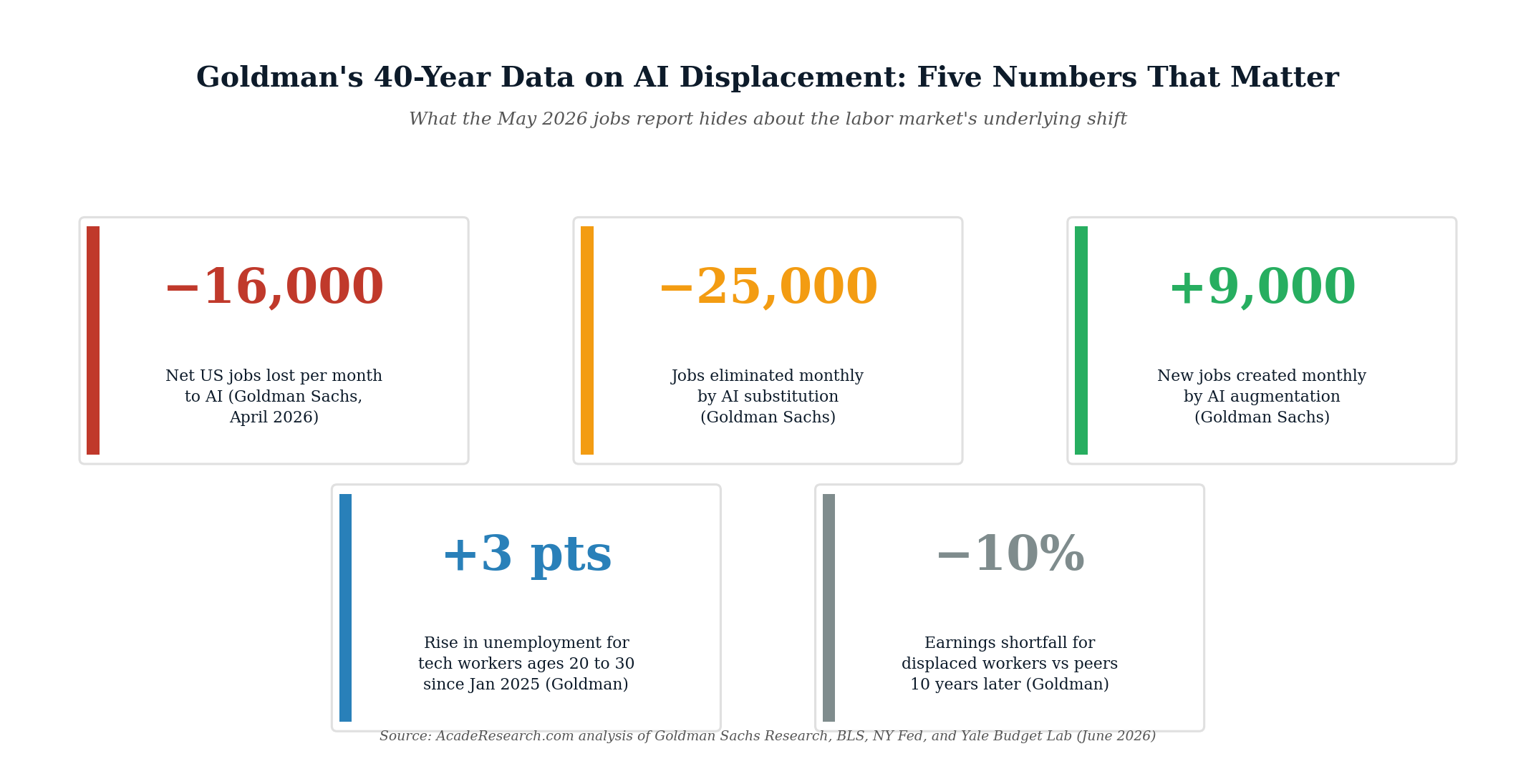
The chart below shows the same numbers in their fuller context.
How Goldman Got to 16,000
The Goldman Sachs methodology is the most rigorous public attempt to date to separate AI’s two competing effects on the labor market.
The substitution side of the calculation begins with the bank’s 40-year longitudinal dataset of individual-level employment outcomes during prior periods of automation. Joseph Briggs, who co-leads Goldman’s Global Economics team, and economist Sarah Dong have written that approximately 25 percent of all US work hours could be automated by current AI capabilities (Goldman Sachs, 2025). The 6 to 7 percent of US workers that Goldman estimates will eventually be displaced corresponds to roughly 25,000 monthly job eliminations under the bank’s base-case adoption timeline of 10 years.
The augmentation side captures the jobs being created by AI rather than destroyed. Goldman identifies three categories: workers in occupations that explicitly require AI knowledge (machine learning engineers, prompt engineers, AI policy specialists), workers in new specializations enabled by AI (a comparable example from past technology shifts is how the spreadsheet created entirely new financial-analyst specializations), and indirect demand growth from the broader economic activity that AI productivity generates. The augmentation figure of approximately 9,000 jobs per month is currently dominated by the first two categories.
The net of 16,000 jobs lost per month is, as Goldman emphasizes, not a one-time event. It is “a persistent, measurable drag on employment that wasn’t visible in the headline numbers” and has held steady “across the past year” (Goldman Sachs via Yahoo Finance, 2026). Over the past year, those losses have accumulated to approximately 200,000 net jobs that, in a counterfactual without AI adoption, would have been part of the payroll figure.
The headline jobs reports cannot detect this drag because they measure the net result. When the BLS reports 172,000 jobs added in May, that figure is already net of any AI displacement effect. The question is what the figure would have been without that effect. Goldman’s analysis suggests the true underlying gross hiring is closer to 188,000 jobs created with 16,000 simultaneously eliminated by AI, producing the 172,000 net result we observe.
Why Gen Z Is Absorbing Most of the Damage
The Goldman analysis is most disturbing in its description of who is being displaced. Goldman wrote in its August 2025 update that “younger tech workers appear to be disproportionately affected. Unemployment among 20- to 30-year-olds in tech-exposed occupations has risen by almost 3 percentage points since the start of 2025, notably higher than for their same-aged counterparts in other trades and for overall tech workers as well” (Goldman Sachs, 2025).
This pattern is corroborated by independent research. The Federal Reserve Bank of New York found in a 2026 study that recent college graduates aged 22 to 27 had an unemployment rate of 5.6 percent at the end of 2025, compared with the overall national rate of 4.2 percent (Economic Policy Innovation Center, 2026). The Economic Policy Innovation Center has connected this dynamic explicitly to AI adoption: “generative AI is replacing coding personnel now, and we are seeing in the tech industry what we likely will observe in other sectors between now and 2030.”
The economic logic is consistent with prior technology transitions. Entry-level workers are most exposed because the tasks they typically perform, basic coding, junior analysis, drafting documents, summarizing materials, are the tasks generative AI can most reliably substitute for today. The senior worker who can review and judge AI output retains their job and becomes more productive. The entry-level worker who would have learned through producing that output finds that the rung of the career ladder has been removed.
The longer-term consequences are quantifiable. A separate Goldman analysis of 40 years of individual-level data found that workers displaced by AI-driven job loss see real earnings roughly 10 percentage points below their never-displaced peers a full decade later (Goldman Sachs via Sohn, 2026). Goldman calls this “occupational downgrading”: displaced workers take longer to find new jobs, earn less when they do, and slide more often into lower-skill roles. Delayed homeownership, delayed household formation, and lasting career scarring follow.
The Counterargument: AI Has Not Yet Disrupted the Aggregate Labor Market
The Yale Budget Lab published a comprehensive analysis in October 2025 that reaches a notably different conclusion. Across multiple measures including AI exposure, automation potential, and augmentation potential, the Yale researchers found “no sign of being related to changes in employment or unemployment” at the aggregate level (Yale Budget Lab, 2025).
Specifically, the Yale researchers measured the dissimilarity of the occupational mix before and after the introduction of ChatGPT and found “no substantial acceleration in the rate of change in the composition of the labor market since the introduction of ChatGPT.” Even when examining unemployed workers specifically, they found that unemployed workers were in occupations where approximately 25 to 35 percent of tasks could be performed by generative AI, regardless of how long they had been unemployed. The data show “no clear upward trend and no clear difference by the duration of unemployment” (Yale Budget Lab, 2025).
The Yale researchers’ summary is direct: “The picture of AI’s impact on the labor market that emerges from our data is one that largely reflects stability, not major disruption at an economy-wide level.”
The Goldman and Yale findings are not contradictory. Goldman is measuring monthly flow at the level of specific occupations and demographic cohorts. Yale is measuring stocks at the level of the entire economy. A 16,000-jobs-per-month drag is real and quantifiable when it shows up concentrated in tech occupations and young workers. The same drag is small relative to a labor market with 160 million participants and may not produce a visible signal in aggregate occupational-mix measures. Both can be true at the same time.
What both teams agree on is that AI’s labor market impact remains in an early phase. Joseph Briggs at Goldman has written that “the big story in 2026 in labor will be AI” and that “if we see some job losses pulled forward, that sets stage for potential underperformance relative to our forecast, and that may lead the Federal Reserve to cut rates” (Goldman Sachs, 2026). The Yale Budget Lab writes that AI “looks likely to join the ranks of transformative, general purpose technologies” but that “it is too soon to tell how disruptive the technology will be to jobs.”
The Center for American Progress Read
The Center for American Progress released its analysis of the May jobs report on June 6 with the headline “May’s headline jobs numbers mask underlying labor market slack.” Three points from that analysis are worth elevating because they corroborate the Goldman picture from a different angle (Center for American Progress, 2026).
First, the number of Americans who want work but have stopped searching has grown materially compared with the pre-pandemic baseline. These workers do not appear in the headline unemployment rate because they are not officially unemployed. They are also not employed.
Second, involuntary part-time work, where workers want full-time hours but cannot find them, has remained elevated. The May broader unemployment measure that includes discouraged workers and involuntary part-timers was 8.1 percent, compared with the 4.3 percent headline rate.
Third, average duration of unemployment for those who do find themselves out of work remains above pre-pandemic levels. This is consistent with the Goldman finding that displaced workers experience “occupational downgrading” that lengthens the time required to find comparable replacement work.
None of these CAP measures definitively prove that AI is the cause. All three are consistent with the Goldman quantification of a persistent monthly drag concentrated on AI-exposed workers and on entry-level talent that has not yet built the experience needed to switch occupations easily.
The macro context. The Federal Reserve has held its benchmark rate at 3.50 to 3.75 percent through a divided FOMC. April PCE inflation read 3.8 percent. Markets are pricing fewer than three cuts by year-end, with some Fed officials openly discussing the possibility of a hike. Into this environment, Goldman’s research suggests the underlying labor market is being weakened by a force that does not yet show up in the headline data. If the Fed eventually cuts rates because the labor market is weaker than it appears, the trigger may be AI displacement rather than the conventional cyclical signals the Fed is accustomed to reading. The single most important question for the second half of 2026 is whether the BLS, the Fed, and the consensus economic data infrastructure can detect a labor market shift that is, by Goldman’s own description, occurring “quietly” and without “dramatic headlines.”
What This Means for Workers and Policy
Four implications follow from the data above.
The first is that the burden of AI adjustment is currently falling on the workers least equipped to absorb it. Workers in their 20s and 30s in technology and knowledge occupations are losing entry-level positions at a pace that is statistically distinguishable from peers in other fields. The career scarring documented in Goldman’s 40-year dataset suggests that earnings shortfalls of approximately 10 percentage points over a decade are the expected outcome for displaced workers, not the worst-case scenario.
The second is that the augmentation story, while real, is not yet absorbing the displacement. Goldman’s 9,000 augmentation jobs per month are concentrated in occupations that require existing technical skills, post-graduate education, or specialized expertise that displaced entry-level workers do not yet have. The “new jobs created by AI” frequently quoted in policy discussions are not the jobs available to the worker whose job was just eliminated by AI.
The third is that monetary policy is unlikely to be the right tool for this transition. Goldman’s Briggs argues that AI displacement may pressure the Fed to cut rates if it accelerates. Rate cuts would lower borrowing costs and could stimulate hiring, but they would do nothing to address the skills mismatch between displaced workers and newly created roles. The structural problem requires structural responses: workforce retraining, education curriculum reform, and labor-market policies that explicitly account for AI exposure.
The fourth, and most uncomfortable, is that the May 2026 jobs report shows that the US economy can simultaneously add jobs at a healthy pace and shed jobs in specific occupations and demographic cohorts at a damaging pace. Both numbers are real. Both are happening at the same time. The political and policy challenge is to recognize that a “good jobs report” can coexist with a real and growing labor market problem, and to design responses that take both seriously.
The Bottom Line
The US added 172,000 jobs in May 2026, more than double the consensus forecast. By every standard headline measure, the labor market is healthy. Goldman Sachs Research, in an April 2026 analysis by economist Elsie Peng, has quantified a different and quieter reality: AI substitution is eliminating approximately 25,000 US jobs per month while AI augmentation is creating about 9,000, for a net loss of 16,000 jobs per month that does not appear in any single headline number. The Federal Reserve Bank of New York’s data confirms that recent graduates aged 22 to 27 face a 5.6 percent unemployment rate, well above the 4.2 percent national figure. Goldman’s 40-year longitudinal data shows that workers displaced by automation earn roughly 10 percentage points less than peers a decade later, with delayed homeownership, delayed household formation, and durable career scarring as the typical outcomes. The Yale Budget Lab argues that no aggregate labor market disruption is yet visible at the economy-wide level, and that disagreement is legitimate. What is not contested is that the cohort hit hardest by AI displacement is the youngest, that the pattern has held for a year, and that the headline jobs report cannot detect it because it measures the net result of hiring and AI displacement together. The economic question for the next twelve months is whether the augmentation curve will rise fast enough to absorb the substitution curve, and whether monetary policy, retraining policy, and education policy will adapt fast enough to match a labor market shift that is happening quietly and without obvious crisis signals. The May jobs report is the loudest possible argument that the conventional measurement infrastructure for understanding the US economy is missing a story that Goldman Sachs has already quantified to the tens of thousands of jobs per month.
References
Bureau of Labor Statistics. (2026, June 5). Employment situation summary: May 2026. US Department of Labor. https://www.bls.gov/news.release/empsit.nr0.htm
CBS News. (2026, June 6). The job market is much stronger than economists expected. Why? https://www.cbsnews.com/news/jobs-labor-market-hiring-rebound-may-2026/
Center for American Progress. (2026, June 6). May’s headline jobs numbers mask underlying labor market slack. https://www.americanprogress.org/article/mays-headline-jobs-numbers-mask-underlying-labor-market-slack/
CNBC. (2026, June 5). Jobs report May 2026. https://www.cnbc.com/2026/06/05/jobs-report-may-2026.html
Economic Policy Innovation Center. (2026, April 17). The EPIC jobs report for March 2026. https://epicforamerica.org/education-workforce-retirement/march-2026-jobs-report-ai-path/
Goldman Sachs. (2025, August 13). How will AI affect the global workforce? Goldman Sachs Research. https://www.goldmansachs.com/insights/articles/how-will-ai-affect-the-global-workforce
Goldman Sachs. (2026, March 18). How will AI affect the US labor market? Goldman Sachs Research. https://www.goldmansachs.com/insights/articles/how-will-ai-affect-the-us-labor-market
Goldman Sachs via Sohn, E. (2026, May 9). AI is cutting 16,000 US jobs a month, and Gen Z is taking the brunt. LinkedIn analysis of Fortune coverage. https://www.linkedin.com/posts/evansohn_ai-is-cutting-16000-us-jobs-a-month-activity-7449826319560921089-k5js
Goldman Sachs via Yahoo Finance. (2026, April 25). Goldman Sachs says AI cost US economy 16,000 jobs per month. https://finance.yahoo.com/economy/articles/goldman-sachs-says-ai-cost-102139322.html
Yale Budget Lab. (2025, October). Evaluating the impact of AI on the labor market: Current state of affairs. https://budgetlab.yale.edu/research/evaluating-impact-ai-labor-market-current-state-affairs