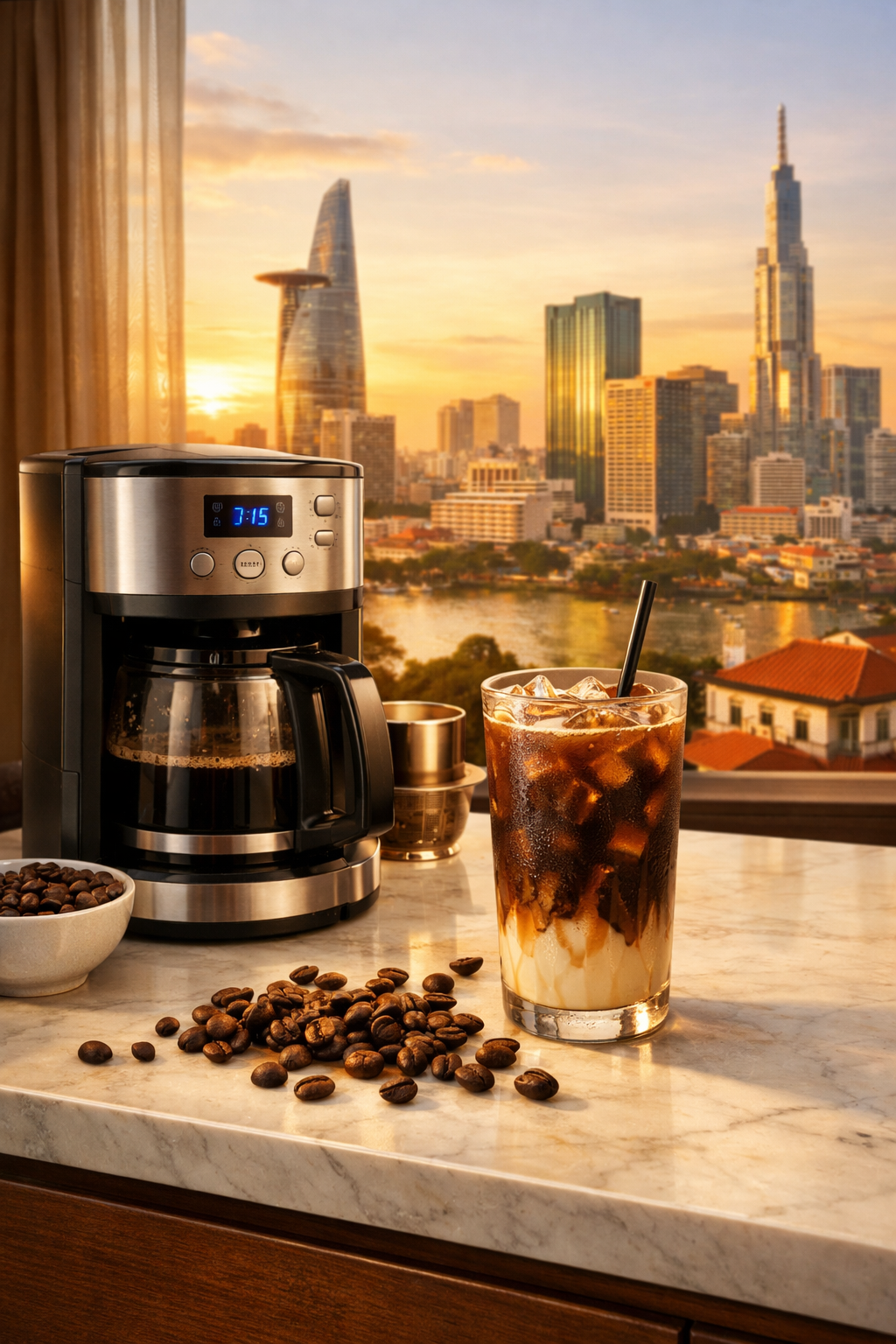

How a 50-year-old American kitchen brand can win Vietnam’s $51 million coffee machine market by respecting the world’s second-largest coffee culture.
Vietnam is the world’s second-largest coffee exporter, home to over 500,000 cafes, and a nation where coffee is not just a drink but a social ritual. Yet a quiet revolution is underway: young, urban Vietnamese are increasingly brewing at home, and the coffee machine market is projected to hit $51.2 million in 2025. Into this opening steps Cuisinart, a brand whose name literally means “the art of cuisine,” with a product that grinds beans fresh and brews a single cup in minutes. The question is not whether the market exists. It is whether an American appliance maker can adapt deeply enough to win it.
The Market Opportunity
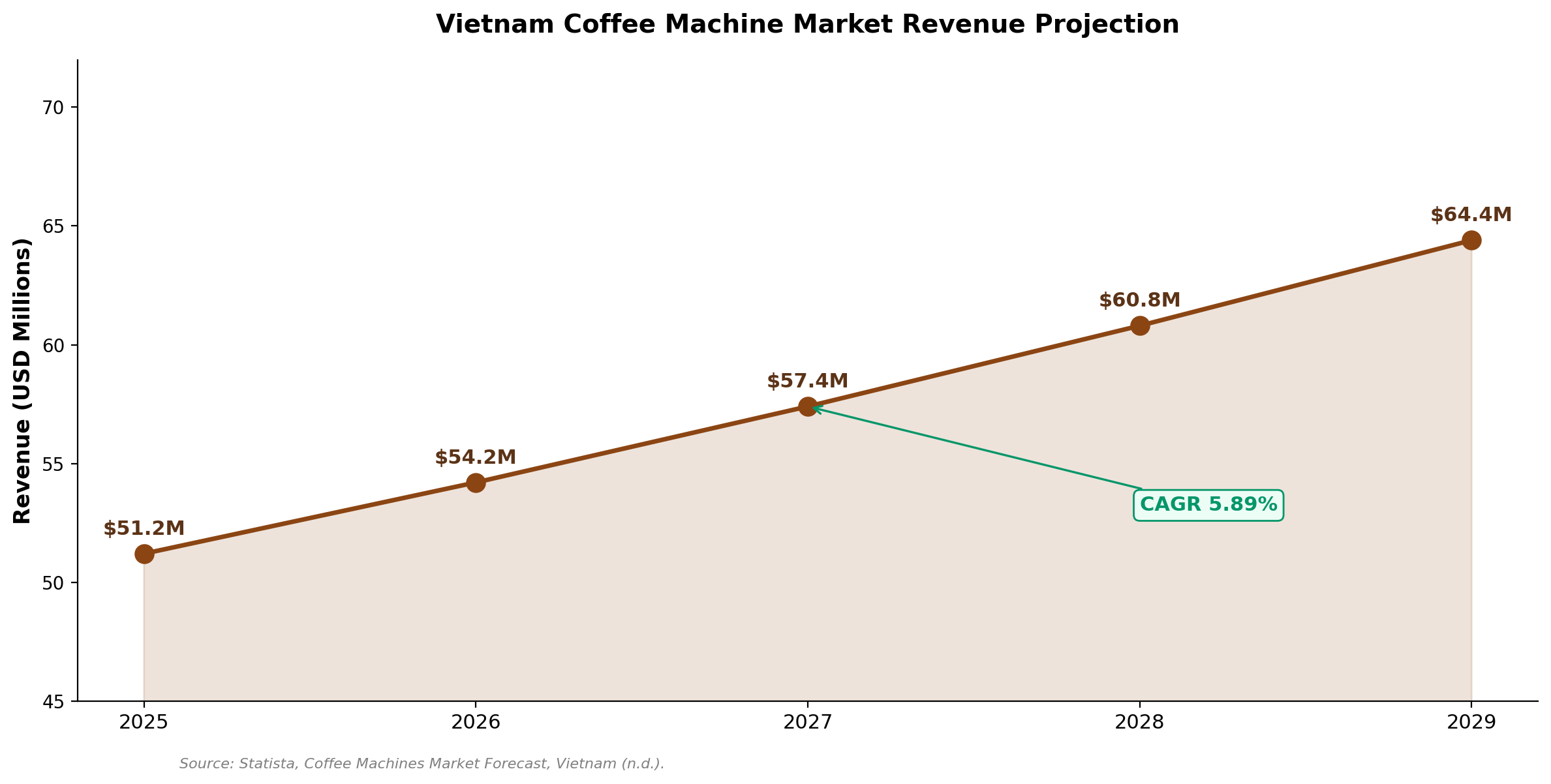
Vietnam occupies a rare economic position: a lower-middle-income economy growing fast enough to generate meaningful consumer spending power (World Bank, 2025). The broader kitchen appliances market reached $971.84 million in 2024 and is projected to hit $1.49 billion by 2033 at a compound annual growth rate of 4.89% (IMARC, n.d.). Within that expanding market, the coffee machine segment stands out, valued at $51.2 million in 2025 and growing at 5.89% CAGR (Statista, n.d.).
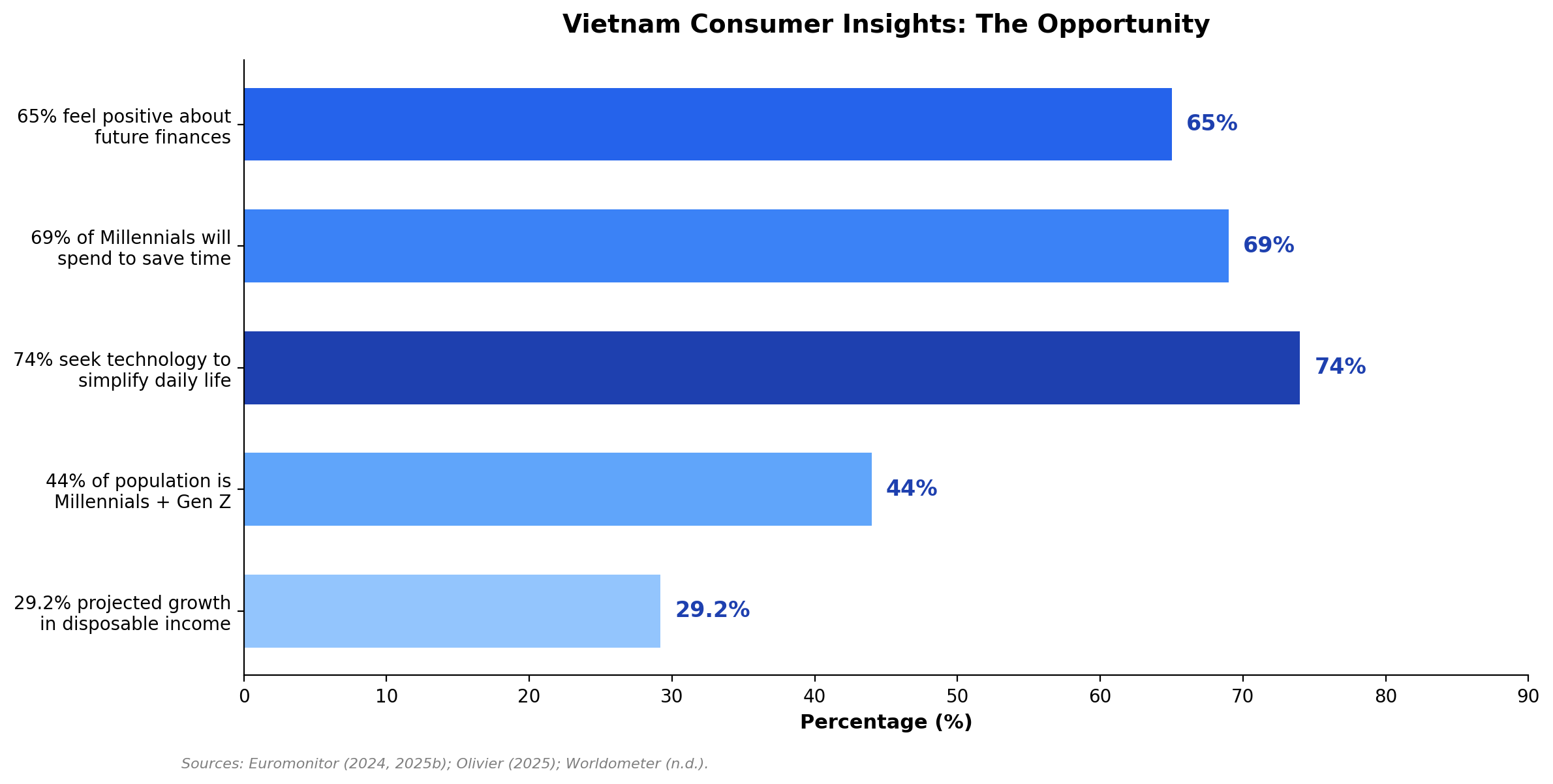
The consumer base is increasingly optimistic. Some 65% of Vietnamese consumers feel positive about their future finances (Euromonitor, 2024), and per capita disposable income is projected to grow 29.2% between 2024 and 2028 (Euromonitor, 2025b). Vietnam’s population of 101 million skews young, with Millennials and Gen Z representing 44% of the total (Euromonitor, 2024; Worldometer, n.d.). These cohorts are driving a behavioral shift: 69% of Vietnamese Millennials are willing to spend to save time, and 74% actively seek technology to simplify their lives (Olivier, 2025).
Coffee is not peripheral to Vietnamese culture. It is central. Vietnam is the world’s second-largest coffee exporter (USDA, n.d.), and the country’s more than 500,000 cafes (Saigoneer, 2024) represent not merely a commercial infrastructure but a deeply embedded social tradition. What is changing is the venue: increased urbanization, longer working hours, and rising home ownership are accelerating a shift toward at-home brewing, particularly among young professionals seeking fresh-ground quality without leaving their apartments (Nugroho, 2024).
Key Market Statistics
| Metric | Value |
|---|---|
| Coffee machine market (2025) | $51.2 million |
| Coffee machine CAGR | 5.89% |
| Kitchen appliances market by 2033 | $1.49 billion |
| Population | 101 million |
| Millennials + Gen Z share | 44% |
| Projected real income growth (2024-2028) | 29.2% |
The Product: Cuisinart DGB-2 Grind & Brew Single-Serve Coffeemaker
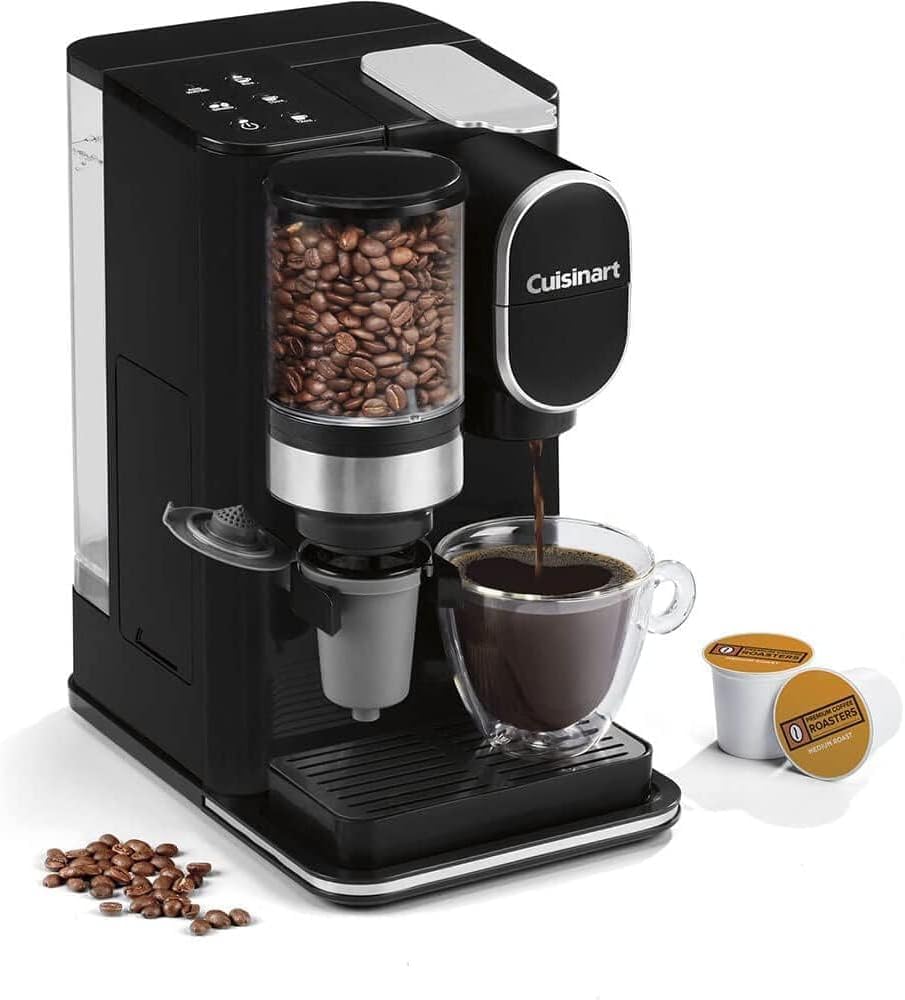
The Cuisinart DGB-2 is a single-serve coffeemaker with an integrated conical burr grinder that automatically grinds whole beans immediately before brewing, delivering maximum freshness in every cup. In the U.S. market, it retails at $189.95 and occupies an “accessible premium” position between mass-market drip machines and high-end espresso systems (Cuisinart, n.d.-b). The brand, founded in 1973 and famously endorsed by Julia Child and James Beard, was named the most trusted brand in three major kitchen appliance categories in 2025 (Snider, 2025). Its tagline, “A Work of Cuisinart,” reflects a positioning built on the intersection of culinary craft and modern convenience (Brand Media Coalition, n.d.).
| Specification | Detail |
|---|---|
| U.S. Retail Price | $189.95 |
| Grinder | Integrated conical burr mill |
| Compatibility | Whole beans + K-Cup pods |
| Brew Sizes | 8 oz, 10 oz, 12 oz |
| Water Reservoir | 48 oz, removable |
| Filtration | Charcoal water filter |
| Brand Founded | 1973 (50+ years of heritage) |
| Brand Recognition | Most trusted in 3 kitchen categories (2025) |
The Adaptation Strategy
A successful market entry requires surgically distinguishing what must change from what must not. Cuisinart’s challenge is to localize deeply enough to earn relevance without diluting the core brand equity that makes it worth choosing in the first place. The framework below maps what stays standardized against what requires genuine adaptation.
| What Stays: Standardization | What Changes: Adaptation |
|---|---|
| Core technology (burr grinder, heating element, brewing mechanism) | K-Cup pod compatibility removed (irrelevant in Vietnam) |
| Brand identity, logo, and design aesthetic | Single optimized 4-oz concentrated shot for ca phe sua da |
| Quality standards and American brand perception | Target price: 3,499,000 VND (~$135) |
| Fundamental value proposition: convenience + fresh-ground quality | Re-engineered for 220V / 50Hz Vietnamese electrical grid |
| Grinder calibrated for darker, oilier Robusta beans | |
| Extraction optimized for bold, phin-style flavor profile | |
| 3-year warranty as trust differentiator | |
| Local service and repair network established at launch |
The Competitive Landscape
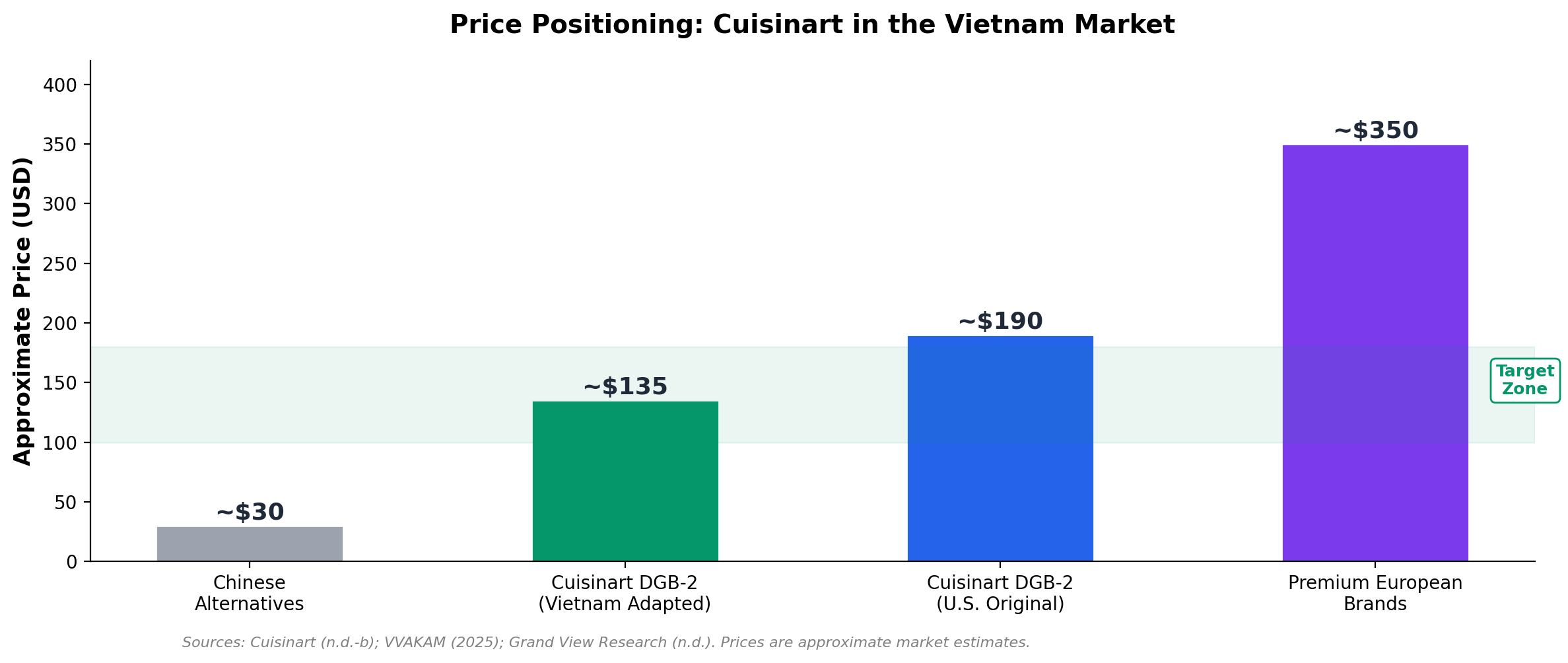
Vietnam’s coffee machine market is characterized by what might be called a “trust and quality deficit.” The lower end of the market is flooded with inexpensive Chinese-manufactured machines, many retailing around $30, that offer limited warranty coverage and no calibration for Vietnamese beans. Vietnamese consumers are aware of quality differences and aspire to better products, but trusted options at accessible price points are scarce. This gap is precisely where Cuisinart’s adapted positioning (roughly $135 with a 3-year warranty)- is designed to operate.
Research on Vietnamese consumer behavior finds a meaningful preference for foreign-origin products, particularly American brands, which are associated with quality, durability, and innovation (Lee & Nguyen, 2017). Local coffee giants such as Highlands Coffee and Trung Nguyen command cultural authority around the cafe experience but do not compete directly in home appliances. European premium brands serve the upper end of the market but remain aspirationally priced and poorly calibrated for Robusta-forward Vietnamese tastes.
Competitive Comparison
| Factor | Chinese Alternatives | Cuisinart (Adapted) | European Premium |
|---|---|---|---|
| Price | ~$30 | ~$135 | ~$350 |
| Bean Optimization | Generic | Robusta-calibrated | Arabica-focused |
| Warranty | Limited or none | 3-year manufacturer | Varies |
| Local Service | Minimal | Planned network | Limited |
| Brand Trust | Low | High (American heritage) | High |
| VN Coffee Fit | Low | High (4-oz shot) | Low |
Go-to-Market and Diffusion Strategy
The adaptation work required before launch means time-to-market will be longer than a standard product introduction. However, once in market, the conditions are favorable for accelerated diffusion. Consumers are not being asked to invent a new behavior; they already drink coffee daily. They are being offered a superior way to do something they already value deeply. This distinction matters: it compresses the adoption curve significantly.
Analyzing the launch through Rogers’ diffusion of innovations framework reveals five structural advantages:
- Relative Advantage: The adapted Cuisinart offers demonstrably better quality and warranty coverage than inexpensive Chinese alternatives, while pricing below European premium competitors by more than $200. The value gap is clear and communicable.
- Compatibility: A grinder calibrated for Robusta beans and a 4-oz brew size tuned for ca phe sua da signal to Vietnamese consumers that this product was built for them, not merely translated for them. Compatibility with existing cultural practices is the single most important factor in adoption speed.
- Reduced Complexity: Removing K-Cup pod compatibility streamlines the product. Vietnamese consumers have no K-Cup infrastructure or familiarity. Eliminating an irrelevant feature reduces decision friction and unit cost simultaneously.
- Trialability: In-store demonstrations in Ho Chi Minh City and Hanoi retail environments allow consumers to smell freshly ground Robusta, taste the output, and compare it against the phin-brewed coffee they know. Sensory trial converts skeptics efficiently.
- Observability: In a culture where premium American consumer goods carry aspirational status, a Cuisinart machine on a kitchen counter is a visible signal. Social proof spreads faster when the product is aesthetically distinctive and brand-legible.
Risks and Limitations
No adaptation strategy is without cost. Cuisinart’s Vietnam entry introduces several risk vectors that must be managed proactively:
- Loss of scale economies: A Vietnam-specific SKU with unique grinder calibration, brew-size settings, and electrical specifications breaks the standardized manufacturing run. Per-unit costs will rise until volume justifies a dedicated production line.
- Increased marketing expenditure: Vietnamese-language packaging, culturally resonant campaigns, in-store demo programs, and local influencer partnerships represent meaningful incremental spend relative to a simple export model.
- Supply chain complexity: Establishing reliable distribution and a local service network across Vietnam’s fragmented retail landscape, spanning modern trade, independent electronics retailers, and e-commerce platforms. This requires operational investment and local partnerships.
- Brand dilution risk: If the Vietnam-specific product underperforms or is perceived as a lesser variant, it could damage the broader Cuisinart premium positioning in regional markets. Strict quality control and brand governance are non-negotiable.
- Cafe competition: Vietnam’s 500,000+ cafes remain powerful competition for at-home brewing adoption. Consumers accustomed to paying 30,000-50,000 VND at a cafe may be slow to perceive a $135 machine as a cost-saving investment without sustained education and marketing.
- Persistent price sensitivity: Despite rising income optimism, Vietnam’s consumer base remains cost-conscious. At 3,499,000 VND, the adapted Cuisinart will require confident, sustained value communication to justify the price premium over cheap alternatives.
Conclusion
Vietnam is not just a market; it is a test of whether a 50-year-old American brand can listen deeply enough to adapt without losing its identity. The data supports the opportunity: a $51.2 million and growing coffee machine segment, a young consumer base with rising income and a documented appetite for time-saving technology, and a structural gap between cheap undifferentiated machines and expensive European imports that few brands have moved decisively to fill.
The adaptation strategy outlined here preserves what matters: quality, convenience, and the trust that five decades of Cuisinart heritage have built, while reshaping what must change: price point, brew-size calibration, electrical specifications, and grinder tuning for the Robusta beans that define Vietnamese coffee culture. These are not cosmetic changes. They are signals that Cuisinart has chosen to earn its place in the Vietnamese kitchen rather than simply export into it.
If executed with discipline, Vietnam becomes more than a revenue stream. It becomes a strategic beachhead: proof of concept for a localization methodology that can be replicated across Southeast Asia’s rapidly urbanizing, coffee-drinking, tech-curious Millennial consumer base.
References
Brand Media Coalition. (n.d.). Cuisinart. https://brandmediacoalition.com/brands/cuisinart/
Cuisinart. (n.d.-a). A Work of Cuisinart. https://www.cuisinart.com/support/about-us.html
Cuisinart. (n.d.-b). DGB-2 Grind & Brew Single-Serve Coffee Maker. https://www.cuisinart.com/grind-brew-single-serve-coffee-maker/DGB-2.html
Euromonitor. (2024, October 8). Vietnam: Consumer profile.
Euromonitor. (2025b, August 20). Income and expenditure: Vietnam.
Euromonitor. (2025c, September 30). PEST analysis: Vietnam.
Grand View Research. (n.d.). Vietnam household appliances market report 2030. https://www.grandviewresearch.com/industry-analysis/vietnam-household-appliances-market-report
IMARC. (n.d.). Vietnam kitchen appliances market size 2033. https://www.imarcgroup.com/vietnam-kitchen-appliances-market
Lee, J., & Nguyen, M. J. (2017, March). Product attributes and preference for foreign brands among Vietnamese consumers. https://doi.org/10.1016/j.jretconser.2016.12.001
Nugroho, A. (2024, November 12). Coffee in Vietnam. Euromonitor.
Olivier, J. (2025, June 2). Consumer lifestyles in Vietnam. Euromonitor.
Saigoneer. (2024, August 20). With thriving coffee culture, Vietnam has half a million cafes. https://saigoneer.com/vietnam-news/27233-with-thriving-coffee-culture,-vietnam-has-half-a-million-cafes,-data-shows
Snider, E. (2025, January 13). Cuisinart named most trusted brand. https://www.news10.com/business/press-releases/ein-presswire/775298104/
Statista. (n.d.). Coffee machines, Vietnam. https://www.statista.com/outlook/cmo/household-appliances/small-appliances/coffee-machines/vietnam
USDA. (n.d.). Production: Coffee. https://www.fas.usda.gov/data/production/commodity/0711100
Vietnam News. (2024, June 26). Survey reveals shifts in Vietnamese shopper habits. https://vietnamnews.vn/economy/1658188/
VVAKAM. (2025, August 15). Vietnam kitchen appliance market exploration. https://ar.vvakam.com/vietnam-kitchen-appliance-market-exploration
World Bank. (2025, May 9). Vietnam overview. https://www.worldbank.org/en/country/vietnam/overview
Worldometer. (n.d.). Vietnam population. https://www.worldometers.info/world-population/vietnam-population/