

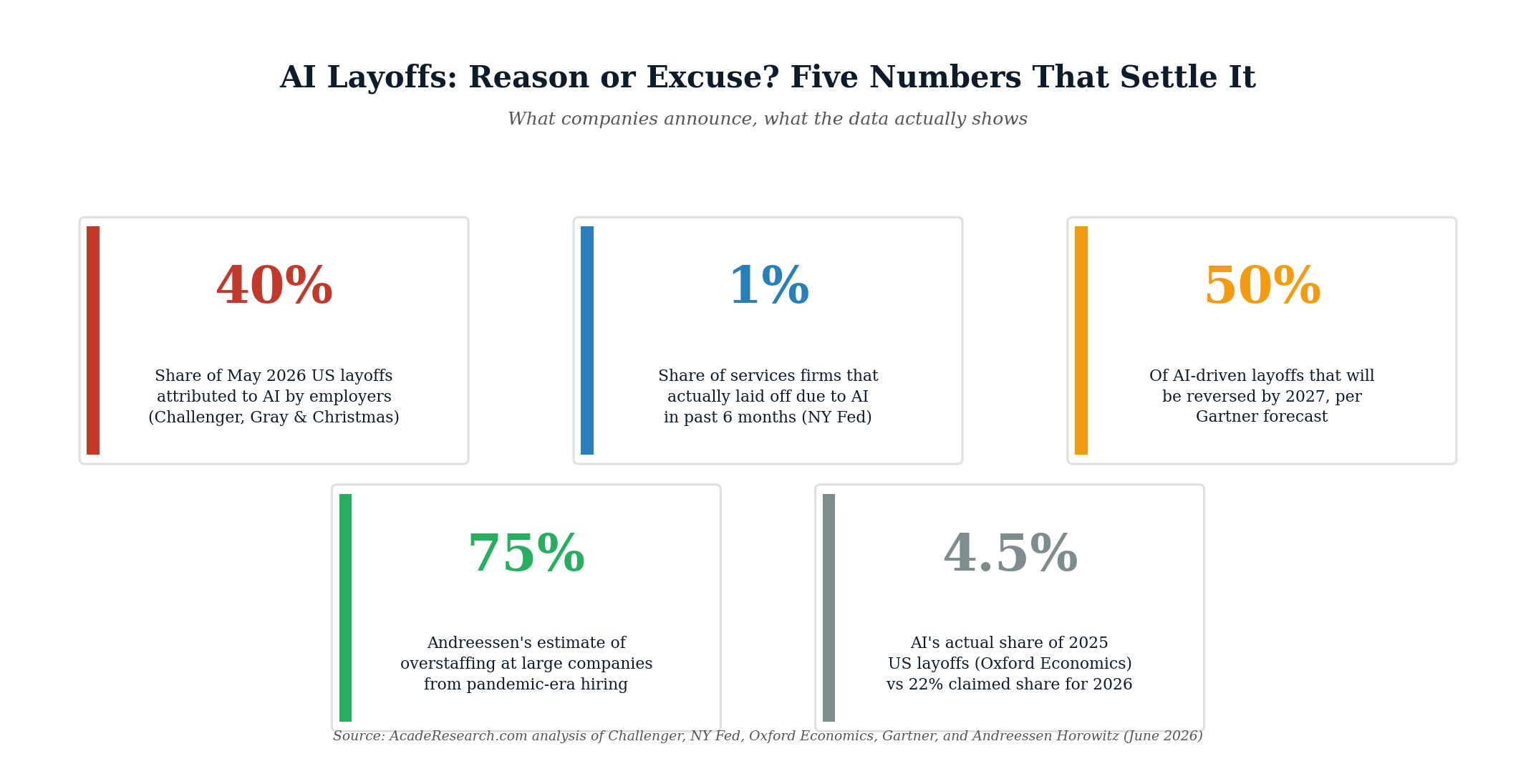
In May 2026, AI was cited as the reason for 40 percent of US layoff announcements, the highest share on record. In the New York Fed’s separate measurement, only 1 percent of services firms reported actually laying anyone off because of AI. Both numbers are real. The gap between them is the entire story.
On June 4, 2026, Challenger, Gray & Christmas released its monthly job-cuts report showing that AI was cited as the reason for 38,579 of the 97,006 layoffs announced by US employers in May, or roughly 40 percent of the monthly total. It was the highest monthly figure for AI-attributed cuts since Challenger began tracking the category in 2023, up from 7 percent in January, 25 percent in March, and 26 percent in April (Challenger, Gray & Christmas, 2026). For the year through May, AI has been blamed for 87,714 of all US layoffs, already surpassing the 54,836 attributed to AI in all of 2025.
The numbers are dramatic. They are also contested. Three separate institutional analyses, the Federal Reserve Bank of New York, Oxford Economics, and Gartner, have all reached the same conclusion in the past 12 months: companies are citing AI for layoffs that are not actually caused by AI. The Federal Reserve’s own regional surveys found that only 1 percent of services firms reported AI-induced layoffs in the prior six months, down from 10 percent the previous year. Oxford Economics estimated AI’s true share of 2025 US layoffs at approximately 4.5 percent of the total. Gartner’s October 2025 survey of 321 customer-service executives found that only 20 percent of respondents who had reduced workforce did so because of AI; the rest cited broader economic conditions (Markman, 2026; OpenTools / Oxford Economics, 2026).
The economic question is which set of numbers more accurately describes what is happening inside the US labor market. Reviewing the named-company evidence, the institutional research, and the expert commentary across the past year produces a clear answer: AI is contributing to layoffs at the margins, but the headline figures are dominated by something else.
The Numbers That Frame the Debate
The chart below shows the five most consequential data points from the institutional research published over the past 12 months.
The horizontal bar chart below tracks AI-cited layoffs at named large companies over the same period, color-coded by the credibility of the attribution.
Three patterns are visible in the chart.
The first is concentration. Amazon alone accounts for 30,000 of the AI-cited layoffs over the past 12 months, more than the next three companies combined. Amazon itself told CNN that AI is not the primary reason for “the vast majority” of those cuts (Markman, 2026). The single largest contributor to the AI-layoff headline is a company that explicitly disclaims the AI explanation.
The second is the difference between direct-AI attribution (red bars in the chart) and AI-as-part-of-restructuring (blue bars). Most large-company AI-cited layoffs fall into the blue category: announcements that mention AI investments alongside broader restructuring that would likely have occurred regardless. The companies that explicitly tied a specific layoff round to a specific AI capability are smaller: Block (40 percent of workforce in February 2026), Salesforce’s September 2025 cut of 4,000 customer support roles tied to Agentforce, Meta’s April 2026 announcement, Wix in March 2026, and Atlassian’s 1,600 cuts in March 2026.
The third is the reversal pattern. Klarna, shown in gray, is the most-cited example of a company that announced AI-driven layoffs and subsequently rehired. CEO Sebastian Siemiatkowski publicly claimed in 2024 that Klarna’s AI assistant was doing the work of 700 customer service agents, and the company cut headcount accordingly. By 2025, with customer satisfaction declining, Klarna reversed course and began rehiring (FounderReports, 2026). IBM made a similar reversal in customer service. Both cases are now cited in academic literature as evidence that AI capability claims were overstated relative to actual operational results.
The Andreessen Argument
The most forceful version of the “AI as excuse” argument has come from Marc Andreessen, the co-founder of Andreessen Horowitz. In a 20VC podcast interview with Harry Stebbings published in late March 2026, Andreessen stated: “Essentially, every large company is overstaffed. It’s at least overstaffed by 25 percent. I think most large companies are overstaffed by 50 percent. I think a lot of them are overstaffed by 75 percent.” He then added the line that has been quoted across nearly every subsequent analysis: “Now they all have the silver bullet excuse: Ah, it’s AI” (Fortune, 2026).
Andreessen’s underlying argument is structural. Between 2020 and 2022, US technology companies and many large enterprises hired aggressively during the zero-interest-rate environment to meet pandemic-era digital demand. As interest rates rose from 0.25 percent to over 5 percent, growth slowed, and the cost of capital climbed, those companies found themselves with workforces calibrated to demand levels that no longer existed. The corrections that should have happened in 2023 and 2024 were delayed by ample cash balances and a tight labor market that made layoffs politically and operationally costly. By 2025 and 2026, the corrections could no longer be deferred. AI provided the narrative wrapper.
Andreessen’s more contentious claim is that AI is not yet capable enough to actually cause the layoffs being attributed to it. “AI literally until December was not actually good enough to do any of the jobs that they’re actually cutting,” he said. “It just can’t have been AI” (The Independent, 2026). OpenAI CEO Sam Altman has used a similar term, “AI washing,” to describe the same pattern.
The Institutional Research
Three sets of institutional findings give the Andreessen argument empirical backbone.
The Federal Reserve Bank of New York’s regional business surveys, conducted in September 2025, found that only 1 percent of services firms reported AI as the reason for laying off workers in the past six months, down from 10 percent that had reduced staff using AI in 2024. Across both services and manufacturing industries in the New York-Northern New Jersey region, AI use among firms “do not point to significant reductions in employment” (Trax Group / NY Fed, 2025).
The Oxford Economics 2026 report concluded that “firms don’t appear to be replacing workers with AI on a significant scale” and characterized the AI attribution as a “convenient excuse” for what is fundamentally an overstaffing correction. The report quantified AI’s actual share of 2025 US layoffs at approximately 4.5 percent of the total, against the over 245,000 layoffs driven primarily by broader economic conditions (OpenTools, 2026). Fabian Stephany, an AI labor expert at the Oxford Internet Institute, has been the most direct in framing the pattern: companies use AI for “rubber stamping and scapegoating,” which lets executives “eliminate positions due to economic trends or poor strategic decisions of the past while appearing agile and forward-thinking” (The Telegraph, 2026).
The Gartner October 2025 survey of 321 customer-service executives, the function most exposed to AI deployment, found that only 20 percent of respondents who had reduced workforce did so directly because of AI. Gartner analyst Kathy Ross summarized the finding: “Most recent reductions were driven by broader conditions rather than automation alone” (Markman, 2026). Gartner separately forecast that approximately 50 percent of companies that had cut staff citing AI by early 2026 would reinstate employees in similar roles by 2027, often under different job titles.
A Duke University and Federal Reserve study of 750 chief financial officers, cited in early 2026 reporting, found that AI’s actual impact on jobs in 2025 was, in the researchers’ own description, “small.” A separate finding from that same study reported that 55 percent of companies that had rushed to replace workers with AI now regretted the decision after discovering hidden costs in customer churn, brand reputation, and operational reliability (Duke / Federal Reserve via 20VC discussion, 2026).
The Academic Voices
Three named economists have published the most pointed academic critiques of AI-attributed layoffs over the past year.
Philippe Aghion, the 2025 Nobel laureate in economics, told The Telegraph that “numerous companies have recently announced substantial layoffs, referencing AI, but the reality is that these decisions were likely planned beforehand, with AI serving as a convenient excuse. Thus, the extent is exaggerated. They present alarming figures of job losses attributed to AI, which is misleading. I believe we are overstating the true impact of AI on job displacement” (The Telegraph, 2026).
MIT professor Wanda Orlikowski (research cited under “Osterman” in Yahoo Finance reporting) characterized AI as part of a long-running corporate pattern. Speaking after Wix’s May 2026 announcement, she said: “AI is a convenient justification for significant layoffs. It creates the impression that the decision is beyond our control. It’s the technology’s doing.” She also noted that firms often eliminate workers they had already planned to dismiss during economic downturns, using AI as an effective cover story. After Cisco announced its 4,000-employee cut earlier in 2026, the company’s stock surged 13 percent, illustrating how AI framing produces market reward (Yahoo Finance, 2026).
Daniel Zhao, chief economist at Glassdoor, has urged direct skepticism: “A company can assert that AI is the reason for layoffs, but that doesn’t necessarily mean it is the actual cause” (CNBC, 2026).
What is striking about the academic consensus is its convergence. Economists across the ideological spectrum, from Andreessen on the venture-capital right to Aghion on the academic mainstream to Stephany at Oxford, all reach the same operational conclusion: the AI explanation, in its current widely-cited form, is largely a narrative rather than a description.
Where AI Is Actually Causing Layoffs
The honest reading of the data is not that AI is causing zero job losses. It is that the population of layoffs genuinely caused by AI is smaller and more concentrated than the headline 40 percent suggests.
The Stanford Digital Economy Lab’s August 2025 study found that early-career workers aged 22 to 25 in the most AI-exposed occupations, including software engineering, marketing, and customer service, have experienced a 16 percent relative decline in employment since late 2022 (Time / Stanford, 2025). Co-author Bharat Chandar told TIME that the researchers were able to rule out alternative explanations including COVID-induced remote work and changes in education, leaving AI as the most consistent hypothesis. Lead researcher Erik Brynjolfsson stopped short of saying AI was definitively causing unemployment but noted that the findings were “consistent with the hypothesis.”
The Goldman Sachs analysis from April 2026, which AcadeResearch covered separately, quantified the net monthly drag at approximately 16,000 US jobs per month: 25,000 substituted by AI minus 9,000 created. Goldman’s data shows that the displacement is concentrated in tech occupations and on workers in their 20s, with unemployment among that cohort rising 3 percentage points since January 2025.
The pattern these two studies describe is consistent: AI is producing real displacement at the margin, concentrated in entry-level coding, customer support, and content moderation roles, primarily affecting workers under 30. That is meaningfully smaller than the 40 percent of US layoffs that companies are attributing to AI. The discrepancy is exactly what the institutional research has documented.
Why Companies Have an Incentive to Blame AI
The economic incentive to attribute layoffs to AI is straightforward and operates at three levels.
At the level of investor communications, “AI layoff” is read by public markets as evidence of forward-looking strategic discipline. Cisco’s 13 percent stock surge after a 4,000-employee AI-cited cut is the cleanest single example of that effect. Salesforce’s September 2025 announcement that AI was replacing 4,000 customer support roles was paired with a $20 billion share buyback, exactly the kind of capital allocation move that markets reward. AI framing converts a defensive cost-cutting decision into an offensive technology investment narrative.
At the level of corporate reputation, AI attribution allows companies to avoid the more uncomfortable acknowledgment that they had previously over-hired. Admitting to a strategic mistake invites investor and board scrutiny. Citing AI invites investor and board approval.
At the level of individual employee morale, AI framing is also less corrosive for the workers who remain. Telling the survivors that the company is being remade around new technology is easier than telling them that the company over-hired by 25 to 75 percent. The remaining workforce has a more coherent narrative about why the cuts happened and what their continued employment depends on.
None of these incentives produce more honest disclosure. They produce uniform incentives to label layoffs with whatever justification produces the best response from each audience. AI, in mid-2026, is that label.
The economic context. Total US layoffs announced in 2025 were approximately 1.1 million according to Challenger data, the highest since the pandemic. The 54,836 attributed to AI represented less than 5 percent of that total. In 2026, the AI-attributed share has risen to 22 percent of 2026 layoffs through May, even though the institutional research suggests the true causal share has not changed materially. The growth is in the attribution, not in the underlying cause. Companies have learned in real time that AI framing produces better market and reputational outcomes than the alternatives. The category “AI layoff” is, increasingly, a financial communications choice rather than an operational fact.
What Workers and Investors Should Take From This
Three practical implications follow from the evidence reviewed above.
The first is that workers, particularly entry-level tech workers in their 20s, should not dismiss the AI displacement story as pure narrative. Stanford and Goldman Sachs have documented real and measurable effects in specific occupations and demographic cohorts. The displacement is real where it is happening. Workers in customer support, junior coding, content moderation, and basic content generation are operating in a labor market that has structurally tightened, and that tightening is consistent with the AI-augmentation hypothesis.
The second is that workers outside those specific cohorts should weigh the layoff explanations they hear with skepticism. If a manager or executive cites AI as the reason for a layoff round at a mature non-tech company in 2026, the more probable explanation is post-pandemic overstaffing correction, with AI providing the framing rather than the cause. The Federal Reserve’s 1 percent finding and Oxford Economics’ 4.5 percent figure are far closer to operational reality than Challenger’s 40 percent attribution rate.
The third is that investors evaluating “AI-driven efficiency” claims in earnings calls and layoff announcements should apply the same three-part test that separates substantive industrial AI pivots from financial engineering: Is there a named AI system actually deployed? Is there a measurable productivity gain documented for that system? And is the post-layoff customer experience holding or degrading? Klarna’s quiet rehiring after declaring 700 customer service jobs replaced by AI is the warning case. Salesforce’s stated 50 percent AI handling of customer interactions, while continuing to redeploy hundreds of workers internally, is closer to the honest case.
The Bottom Line
AI was cited in 40 percent of US layoff announcements in May 2026, the highest share Challenger has ever recorded. Five separate institutional analyses, the Federal Reserve Bank of New York, Oxford Economics, Gartner, Duke University with the Federal Reserve, and the Yale Budget Lab, have independently concluded that the true causal role of AI is far smaller than that figure suggests. The Federal Reserve’s regional surveys put the actual share of services firms cutting staff because of AI at 1 percent. Oxford Economics put AI’s share of 2025 US layoffs at 4.5 percent. Gartner forecasts that 50 percent of AI-driven layoffs will be reversed by 2027. Marc Andreessen has argued that large companies are overstaffed by 25 to 75 percent from pandemic-era hiring binges, and that AI has become the silver bullet excuse for corrections that should have happened two years ago. Nobel laureate Philippe Aghion, MIT and Oxford academics, and Glassdoor’s chief economist have all reached the same operational conclusion through different methodologies. The honest reading of the data is that AI is causing real but concentrated displacement at the margins, particularly for workers aged 22 to 30 in software, customer service, and content production, and that the vast majority of layoffs being labeled as AI-driven in 2026 are pandemic-era overhiring corrections with AI framing applied for investor, board, and reputational benefit. The most consequential effect of the AI narrative is not the jobs it is eliminating. It is the cover it provides for executive decisions that, in a more honest framing, would be harder to defend. The technology is real. The displacement at the margin is real. The headline number is, for now, mostly a story.
References
Challenger, Gray & Christmas. (2026, June). May 2026 Challenger Report. https://www.challengergray.com/wp-content/uploads/2026/06/Challenger-Report-May-2026.pdf
CNBC. (2026, June 5). AI is now the leading reason companies give for cutting jobs, says new report. What that means for workers. https://www.cnbc.com/2026/06/05/ai-is-now-the-leading-reason-companies-give-for-cutting-jobs-says-new-report-what-that-means-for-workers.html
FounderReports. (2026, May 24). AI layoffs by company: A tracker of every major layoff tied to AI. https://founderreports.com/ai-layoffs-tracker/
Fortune. (2026, March 31). Marc Andreessen: Companies are 75% overstaffed and AI is the silver bullet excuse. https://fortune.com/2026/03/31/marc-andreessen-ai-layoffs-silver-bullet-excuse-overhiring/
The Independent. (2026, April 2). Rise of AI contributes to tech jobs being slashed by 25 percent. https://www.independent.co.uk/tech/tech-job-cuts-ai-b2950978.html
Markman, J. (2026, March 4). Why today’s AI-driven layoffs are becoming tomorrow’s rehiring crisis. Forbes. https://www.forbes.com/sites/jonmarkman/2026/03/04/why-todays-ai-driven-layoffs-are-becoming-tomorrows-rehiring-crisis/
OpenTools / Oxford Economics. (2026, January 13). Oxford Economics debunks AI layoff myths in explosive 2026 report. https://opentools.ai/news/oxford-economics-debunks-ai-layoff-myths-in-explosive-2026-report
The Telegraph. (2026, February 17). The AI smokescreen for getting rid of thousands of staff. https://www.telegraph.co.uk/business/2026/02/17/the-ai-smokescreen-for-laying-off-thousands-of-staff/
Time. (2025, August 26). A new Stanford analysis reveals who’s losing jobs to AI. https://time.com/7312205/ai-jobs-stanford/
Trax Group / NY Fed. (2025, October 22). Companies use AI as cover for layoffs despite limited automation evidence. https://www.traxtech.com/ai-in-supply-chain/companies-use-ai-as-cover-for-layoffs-despite-limited-automation-evidence
Yahoo Finance. (2026, May 31). CEOs blame AI for layoffs, but an MIT professor says it fits a long-running pattern to find a cover story. https://finance.yahoo.com/sectors/technology/articles/ceos-blame-ai-layoffs-mit-154604034.html