
Executive Summary
- The manufacturing sector is adopting simulation and digital twin technologies, yet confusion persists about their distinct roles.
- Simulation models scenarios in controlled environments to predict outcomes before physical systems exist.
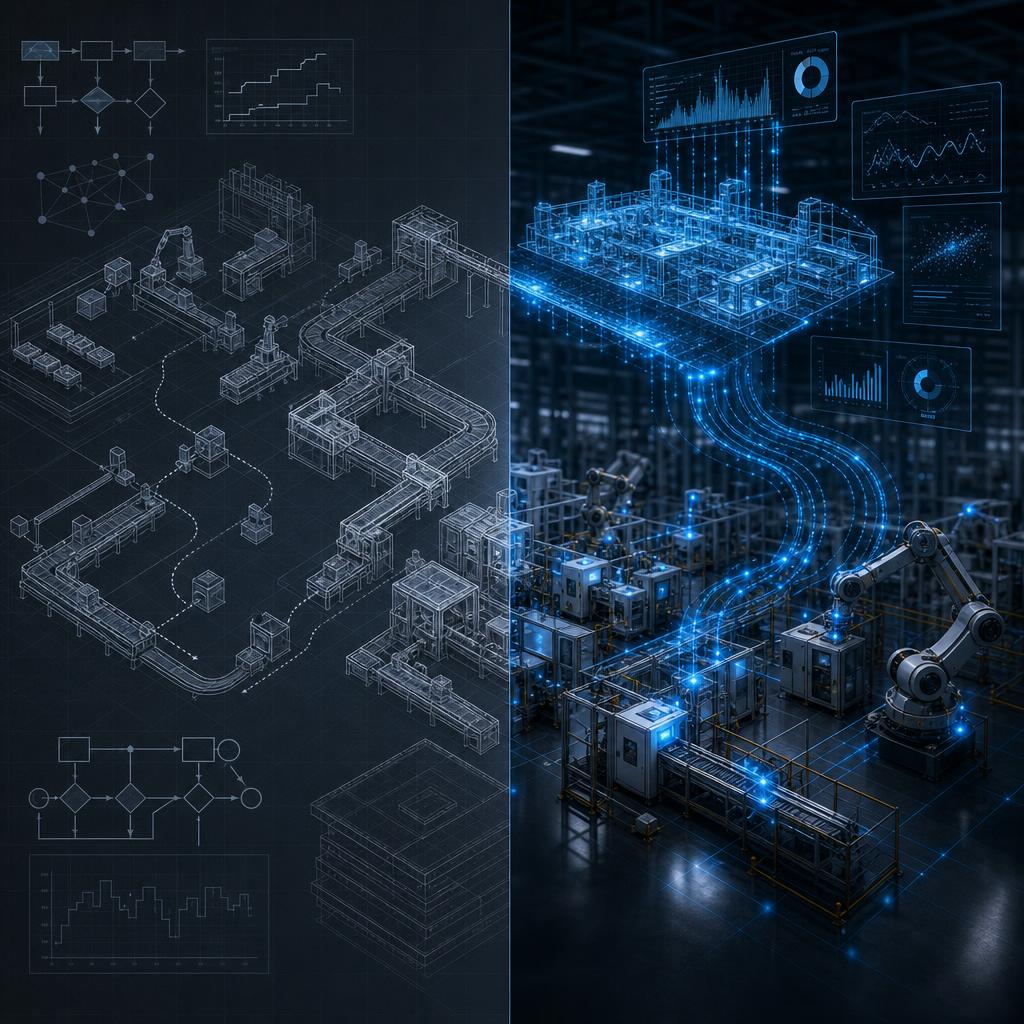
- Digital twins are dynamic, real-time counterparts that continuously exchange data with physical systems.
- The bidirectional data flow of digital twins separates them from traditional digital models and one-directional “digital shadows.”
- Understanding this distinction determines where manufacturers invest their digital transformation budgets.
What Happened
Discrete event simulation and digital twin technology are appearing more frequently in the same conversations about industrial digital transformation. As manufacturers face mounting pressure to optimize production, reduce costs, and respond to supply chain volatility, virtual tools are no longer optional. They have become central to how factories are designed, tested, and operated.
Yet despite growing adoption, the boundary between simulation and digital twin remains poorly understood. This matters because treating them as interchangeable leads to misaligned investment decisions, poorly integrated systems, and missed opportunities for continuous improvement.
The core distinction is not semantic. It is structural. Simulation is a deliberate experiment. Digital twin is a living system.
Over the past decade, the manufacturing industry has experienced rapid convergence between simulation, digital twin, and broader digitalization initiatives. Industry analysts routinely group these technologies together when discussing factory planning and automation.
In May 2026, a detailed analysis published by the Robot Report clarified the relationship between these tools, arguing that their confusion is more than academic. The piece, authored by Graham Wloch of Visual Components, outlined how discrete event simulation and digital twin serve fundamentally different phases of the manufacturing lifecycle.
The analysis draws on established industry frameworks from the Digital Twin Consortium and IEEE Computer architecture guidelines to distinguish between controlled virtual environments and real-time bidirectional counterparts.
Why It Matters
The difference between simulation and digital twin is not purely technical. It is strategic.
Manufacturers that treat simulation and digital twin as equivalent risk building systems that replicate complexity without clarity. As Visual Components noted in its analysis, without a well-understood simulation foundation, digital twins can propagate incorrect assumptions at scale, because they operate in real time.
Digital twins for manufacturing environments can range from individual machine models to complete factory representations. These virtual counterparts evolve with the physical system, reflecting current conditions and helping stakeholders understand not just what is happening, but why it is happening.
The Digital Twin Consortium’s broader definition encompasses not just manufacturing but any domain where real-time physical-to-digital synchronization creates actionable value. IEEE Computer’s architecture framework similarly describes digital twins as a distinct class of virtual systems, separate from both traditional digital models and so-called “digital shadows.”
The Evidence
Simulation, in its manufacturing context, refers to discrete event simulation. Components such as machines, conveyors, and tasks are represented symbolically and interact according to defined logic. The output is a prediction about how a scenario might perform under given constraints.
This approach is valuable during planning, layout design, and automation evaluation. It offers low-risk scenario evaluation and empowers teams to validate assumptions before committing capital. Simulation makes uncertainty visible by modeling alternative scenarios and showing how design choices play out under different conditions.
Digital twins operate differently. A digital twin is a dynamic, real-time counterpart that continuously exchanges data with its physical equivalent. The bidirectional data flow is critical. In a “digital shadow,” data flows from the physical to the virtual system, providing up-to-date information. But without responsive feedback into the physical process, the model remains one-directional and limited in scope.
A true digital twin extends simulation by enabling continuous fine-tuning, detecting throughput fluctuations, and adapting production logic in response to live conditions. This ongoing integration helps companies move beyond periodic reviews toward continuous improvement supported by real data.
Who Is Affected
The implications span multiple stakeholders in the manufacturing ecosystem.
System integrators and automation vendors must understand which tool serves which phase of the client project. Selling a simulation package as a digital twin solution, or vice versa, creates implementation failures that are difficult to rectify after deployment.
Manufacturing operations teams benefit from clarity on deployment timelines and cost structures. Simulation can be deployed quickly during the design phase without requiring physical system data. Digital twins require operational hardware, network infrastructure, and ongoing data pipeline maintenance.
Investors in manufacturing technology are watching this space closely. The market for industrial digital transformation tools has grown substantially, and understanding which products genuinely qualify as digital versus simulated systems has investment implications.
Risks and Uncertainty
Several uncertainties remain about the convergence of these technologies.
First, the line between simulation and digital twin is not always clear in commercial products. Many vendors describe hybrid systems with partial real-time data feeds in ways that blur the technical definitions established by IEEE and the Digital Twin Consortium.
Second, the integration challenge is underestimated by many organizations. A digital twin is only as useful as its data pipeline. Organizations that assume the virtual model itself is the valuable component overlook the infrastructure required to keep models in sync with physical systems.
Third, the economic return on digital twin investment remains difficult to quantify. While simulation offers clear value in the planning phase, quantifying the ROI of continuous real-time optimization is more complex and varies widely across industries.
What to Watch Next
Several indicators deserve monitoring for manufacturing leaders:
The Digital Twin Consortium’s ongoing standardization efforts will likely clarify categorization and reduce vendor confusion.
IEEE Computer architecture guidelines for digital twin implementation, if expanded into formal standards, would provide a clear technical boundary between simulation and twin systems.
Factory layout software vendors such as Visual Components appear to be expanding beyond discrete event simulation toward integrated simulation-to-twin pathways, suggesting the market is moving in that direction.
Conclusion
Simulation and digital twin share a larger purpose: reducing uncertainty, improving efficiency, and driving smarter decisions. They are distinct in their execution, integration, and value.
Simulations prepare systems for integration and ensure that models are robust and meaningful. Digital twins then extend simulation into real time, closing the loop with live operations and enabling ongoing refinement.
Manufacturers that treat this distinction as foundational rather than technical will build digital transformation strategies that begin with understanding and end with continuous improvement.
Sources Cited
1. Wloch, G. (2026, May 25). Simulation versus digital twin: A strategic lens on virtual manufacturing. Robot Report. Available at: https://www.therobotreport.com/simulation-versus-digital-twin-strategic-lens-on-virtual-manufacturing/
2. IEEE Computer. (n.d.). Digital twin. Available at: https://www.computer.org/resources/digital-twin
3. Digital Twin Consortium. (n.d.). What is a digital twin? Available at: https://www.digitaltwinconsortium.org/
4. Zhang, Z., et al. (2021). A comprehensive survey on digital twin technology. arXiv preprint arXiv:2101.08215. Available at: https://arxiv.org/abs/2101.08215
5. IEEE Digital Twin Framework. (2021). arXiv preprint arXiv:2104.08189. Available at: https://arxiv.org/abs/2104.08189