

A Research Analysis on the European Commission’s EU Inc. Proposal and Its Projected Impact on Cross-Border Business Formation
Executive Summary
On March 18, 2026, the European Commission unveiled its proposal for EU Inc. – an optional, digital-by-default corporate framework that would allow entrepreneurs to register a company anywhere in the EU within 48 hours, for under €100, and fully online (European Commission, 2026). The proposal forms the cornerstone of the EU’s “28th regime,” designed to bypass the fragmented landscape of 27 national legal systems and more than 60 company legal forms that currently make cross-border business formation a bureaucratic ordeal.
This analysis examines how the EU’s entrepreneurial landscape compares to the United States, quantifies the registration gap, and projects the potential impact of EU Inc. on new business formation. The conclusion: if implemented effectively, EU Inc. could increase new enterprise creation in the EU by an estimated 10–15% over the next decade, adding approximately 350,000–500,000 additional businesses per year at maturity, a structural shift that begins to close the formation gap with the US.
Section 1: US vs EU by the Numbers
US Business Formation Trends
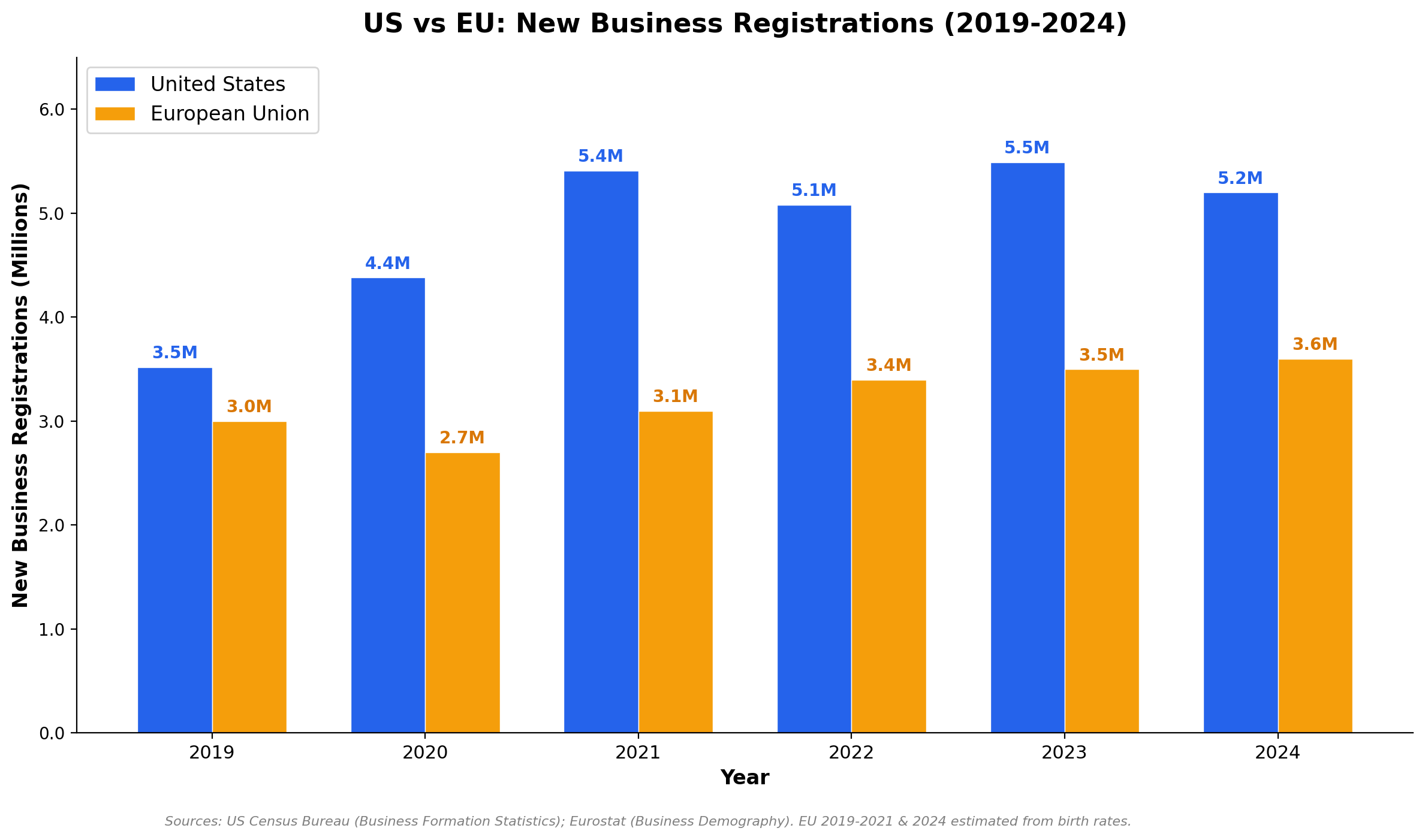
The United States has experienced a post-pandemic entrepreneurial surge that fundamentally reset the baseline for new business creation. According to the U.S. Census Bureau’s Business Formation Statistics, annual business applications have remained above 5 million since 2021 (Census Bureau, 2026):
| Year | US Business Applications | Annual Change |
|---|---|---|
| 2019 | 3.52 million | +0.5% |
| 2020 | 4.38 million | +24.5% |
| 2021 | 5.41 million | +23.5% |
| 2022 | 5.08 million | -6.0% |
| 2023 | 5.49 million | +7.8% |
| 2024 | 5.20 million | -5.1% |
The 2023 figure of 5.49 million represented an all-time record (U.S. Chamber of Commerce, 2024). While 2024 saw a slight pullback to 5.2 million, this still represents a 47.8% increase over pre-pandemic 2019 levels (Commerce Institute, 2026). A key enabler of this dynamism: in the US, a founder can incorporate in Delaware online in a matter of hours and immediately operate across all 50 states under a single set of corporate laws.
EU Enterprise Formation Trends
The EU tells a strikingly different story. According to Eurostat’s business demography data, enterprise births in the EU have been growing but at a notably slower pace and from a lower absolute base (Eurostat, 2025):
| Year | EU Enterprise Births | Birth Rate |
|---|---|---|
| 2020 | ~2.7 million | ~9.0% |
| 2021 | ~3.1 million | ~10.0% |
| 2022 | 3.4 million | 10.5% |
| 2023 | 3.5 million | 10.5% |
| 2024 | ~3.6 million (est.) | ~10.5% |
In 2023, 3.5 million new enterprises were born across the EU from a total of 33.1 million active enterprises, while 2.8 million enterprise deaths were registered (Eurostat, 2025). The highest enterprise birth rates were found in Lithuania (19.6%), Malta (17.1%), and Portugal (16.8%), while Austria (6.2%), Denmark (7.3%), and Italy (7.8%) trailed at the bottom.
The Gap in Context
The raw numbers reveal a persistent and widening gap. In 2024, the US generated roughly 44% more new business registrations than the EU (5.2M vs ~3.6M), despite having a smaller population (335 million vs 450 million). On a per-capita basis, the difference is even more stark:
| Metric | United States | European Union | US Advantage |
|---|---|---|---|
| New businesses (2024) | ~5.2 million | ~3.6 million | +44% |
| Population | 335 million | 450 million | — |
| Per-capita rate | 15.5 per 1,000 | 8.0 per 1,000 | ~1.9x higher |
| Unicorns (early 2025) | 687 | 110 | 6.2x more |
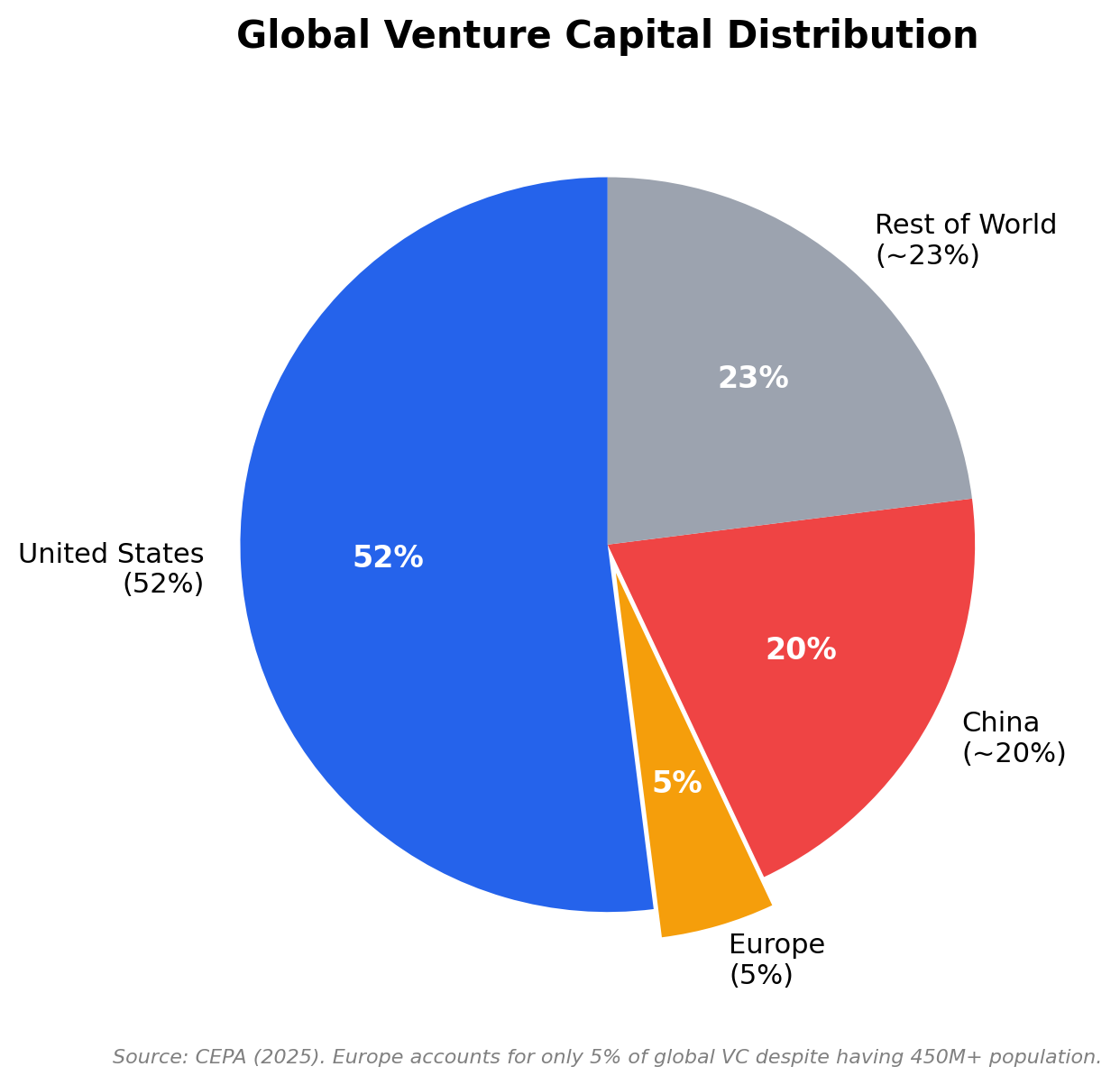
| Share of global VC | 52% | 5% | 10.4x more |
Sources: U.S. Census Bureau; Eurostat; Reuters, 2026; CEPA, 2025.
The unicorn gap is particularly telling. By early 2025, the US had 687 unicorns versus just 110 in the EU, despite the EU generating a comparable raw number of startups (Reuters, 2026). The problem is not a lack of ideas; it is the inability to scale them across borders. Europe accounts for only 5% of global venture capital compared to 52% for the US, and the fragmented regulatory environment is a primary driver of this capital gap (CEPA, 2025).
Section 2: Why Europe Lags
The 27-Regime Problem
The fundamental structural disadvantage facing EU entrepreneurs is that “Europe” is not a single market for company formation; it is 27 separate ones. A German founder who wants to expand to France, Spain, and Italy must navigate three entirely different corporate legal systems, each with its own incorporation procedures, notarial requirements, minimum capital requirements (ranging from €0 to €25,000+), tax registration processes, employment law frameworks, and insolvency regimes.
This fragmentation creates what Morningstar described as a system where “startups in the EU can face a wait of weeks or months just to establish a legal existence, with registration procedures split across a variety of different government offices, without a central guide” (Morningstar/Dow Jones, 2026).
Registration Time: A Concrete Comparison
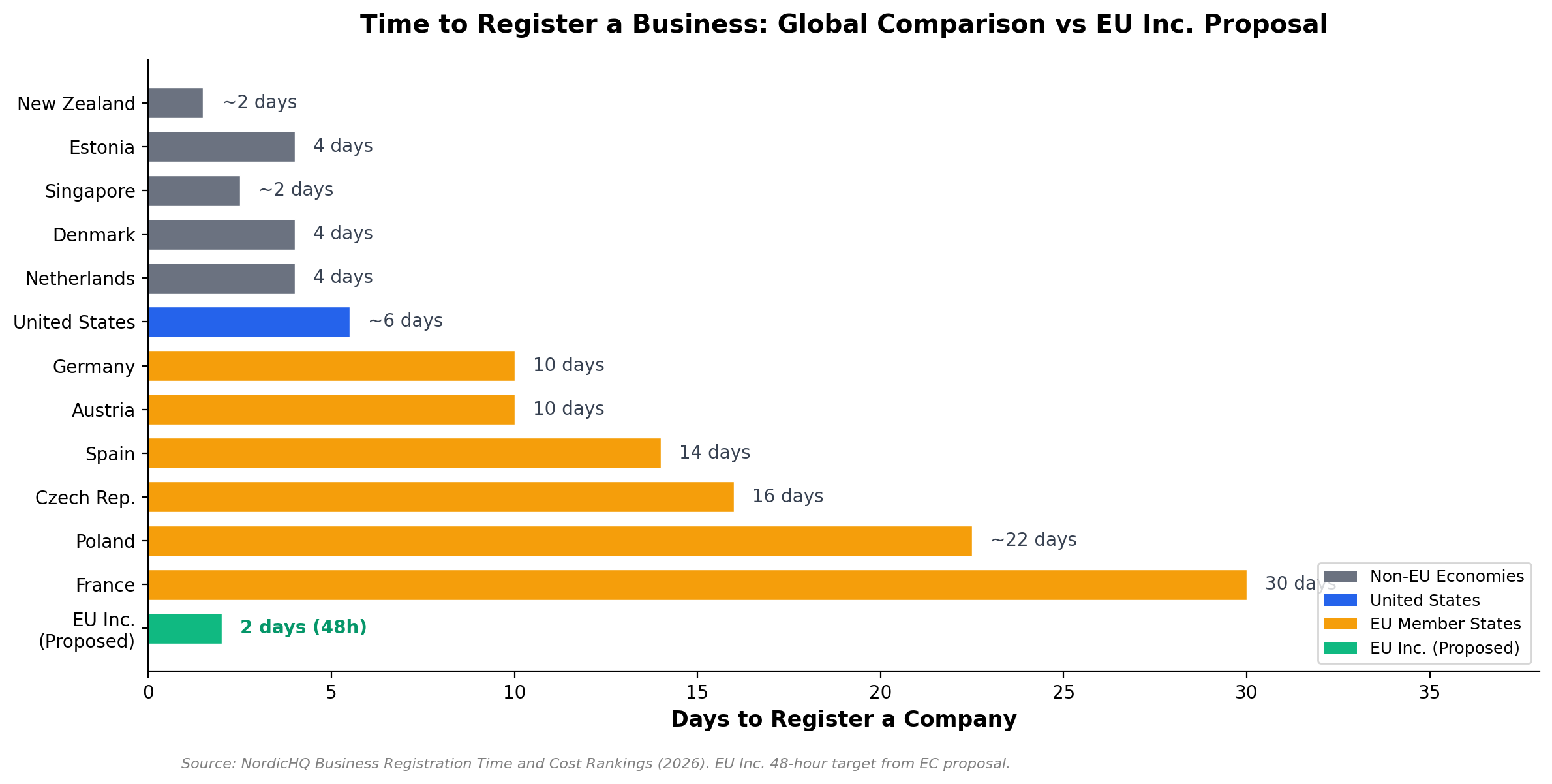
Recent data from NordicHQ’s 2026 rankings reveals the stark reality of company formation timelines across EU member states (NordicHQ, 2026):
| Country | Time (Days) | Cost (€) | Procedures |
|---|---|---|---|
| Estonia | 3–5 | 250–600 | 3 |
| Denmark | 3–5 | 720–1,500 | 3 |
| Netherlands | 3–5 | 1,500–3,000 | 5 |
| United States | 4–7 | 800–2,000 | 5 |
| Germany | 8–12 | 2,000–4,000 | 9 |
| Austria | 8–12 | 2,000–4,500 | 7 |
| Spain | 12–16 | 1,200–3,000 | 8 |
| Czech Republic | 14–18 | 800–1,500 | 7 |
| Poland | 20–25 | 400–900 | 9 |
| France | 25–35 | 2,000–4,000 | 7 |
| EU Inc. (Proposed) | 2 (48h) | <100 | 1 (digital) |
France, the EU’s second-largest economy, takes 25–35 days and costs €2,000–4,000 to register a company. Germany takes 8–12 days with 9 separate procedures and costs up to €4,000. By contrast, a Delaware LLC in the US can be formed in hours for a few hundred dollars with a single filing. The EU Inc. proposal would leapfrog even the US benchmark: 48 hours, under €100, zero minimum capital, fully digital, with a single EU-wide interface.
The Brain Drain Effect
This bureaucratic friction has a compounding economic consequence: Europe’s most promising startups leave. Companies like UiPath and Booking.com “flipped” their incorporation to the United States, while Spotify and many others have moved HQ functions or raised US venture capital to grow abroad (CEPA, 2025). The underlying logic is straightforward, founders choose the jurisdiction that minimizes friction and maximizes access to capital and a large unified market.
Estonia’s e-Residency program offers a small-scale preview of what happens when that friction is reduced. In 2025, e-residents established 5,556 new companies in Estonia, a 15% year-over-year increase, generating €125 million in state revenue, an 87% increase over 2024 (Estonian e-Residency, 2026). Germany (up 49%) and France (up 56%) were among the fastest-growing sources of e-Residency applications, as entrepreneurs from those countries sought to escape their own bureaucratic systems (European Business Magazine, 2026). Estonia’s own analysis found that making its e-Residency fully mobile would boost company formation by at least 20%.
Section 3: What EU Inc. Actually Changes
The proposal, which takes the form of a regulation directly applicable in all member states, introduces several structural shifts (European Commission, 2026):
Formation
- 48-hour registration, fully online, from any EU member state
- Under €100 cost; no minimum share capital
- Single EU-level interface connecting national business registers, with a central EU register to follow
Operations
- Digital-by-default processes throughout the company lifecycle
- Automatic tax ID and VAT number issuance without resubmitting paperwork
- Freedom to incorporate in any member state with full Single Market access
Investment and Talent
- Simplified share transfers with no mandatory intermediary involvement
- EU-wide employee stock option plans, taxed only when gains are realized
- Multiple share classes permitted (varying economic and voting rights)
Exit and Restart
- Fully digital liquidation procedures
- Simplified insolvency for innovative startups to facilitate faster restarts
Safeguards
- National employment and social laws remain fully applicable
- Co-determination rights of the registration state apply in full
- Blacklist of prohibited practices to ensure equal treatment with national companies
As President von der Leyen stated: “Any entrepreneur will be able to create a company within 48 hours, from anywhere in the European Union, and fully online” (European Commission, 2026).
Section 4: How Many More Companies Will the EU Gain?
The Commission’s Own Estimate
The European Commission’s impact assessment projects approximately 308,000 EU Inc. companies over the first decade of the framework’s existence, with cumulative cost savings of €328–440 million for those companies (Reuters, 2026). This represents the direct uptake of the new legal form itself.
However, this figure significantly underestimates the total impact. EU Inc. will also create competitive pressure on national systems to simplify, generate a demonstration effect that encourages entrepreneurship more broadly, and reduce the brain drain of founders who currently relocate to the US or incorporate in Estonia.
Building the Projection Model
This projection estimates the total net impact on EU business formation, combining three effects:
1. Direct EU Inc. Registrations (~30,000/year at maturity)
The Commission projects ~308,000 over 10 years, implying a ramp-up from ~10,000 in year one to ~40,000+ annually at maturity. These represent net new companies that would not have formed under existing national systems.
2. National System Multiplier Effect (~100,000–200,000/year)
When one jurisdiction simplifies, others follow. Estonia’s e-Residency success drove competing simplification efforts across the Baltics and Nordics. EU Inc. will create similar competitive pressure. A conservative 3–5% uplift on the existing 3.6M base yields 108,000–180,000 additional national-system registrations.
3. Reduced Brain Drain / Repatriation Effect (~50,000–80,000/year)
Founders who would have incorporated in Delaware, the UK, or Singapore may choose to stay in the EU. European VC reached €85.3 billion in 2025, up from ~€22 billion a decade earlier, suggesting the capital environment is already improving. EU Inc. addresses the remaining regulatory friction.
Projected Impact Scenarios
| Scenario | Additional New Businesses/Year (at maturity, ~2032) | % Increase over Baseline |
|---|---|---|
| Conservative | +250,000 | +6–7% |
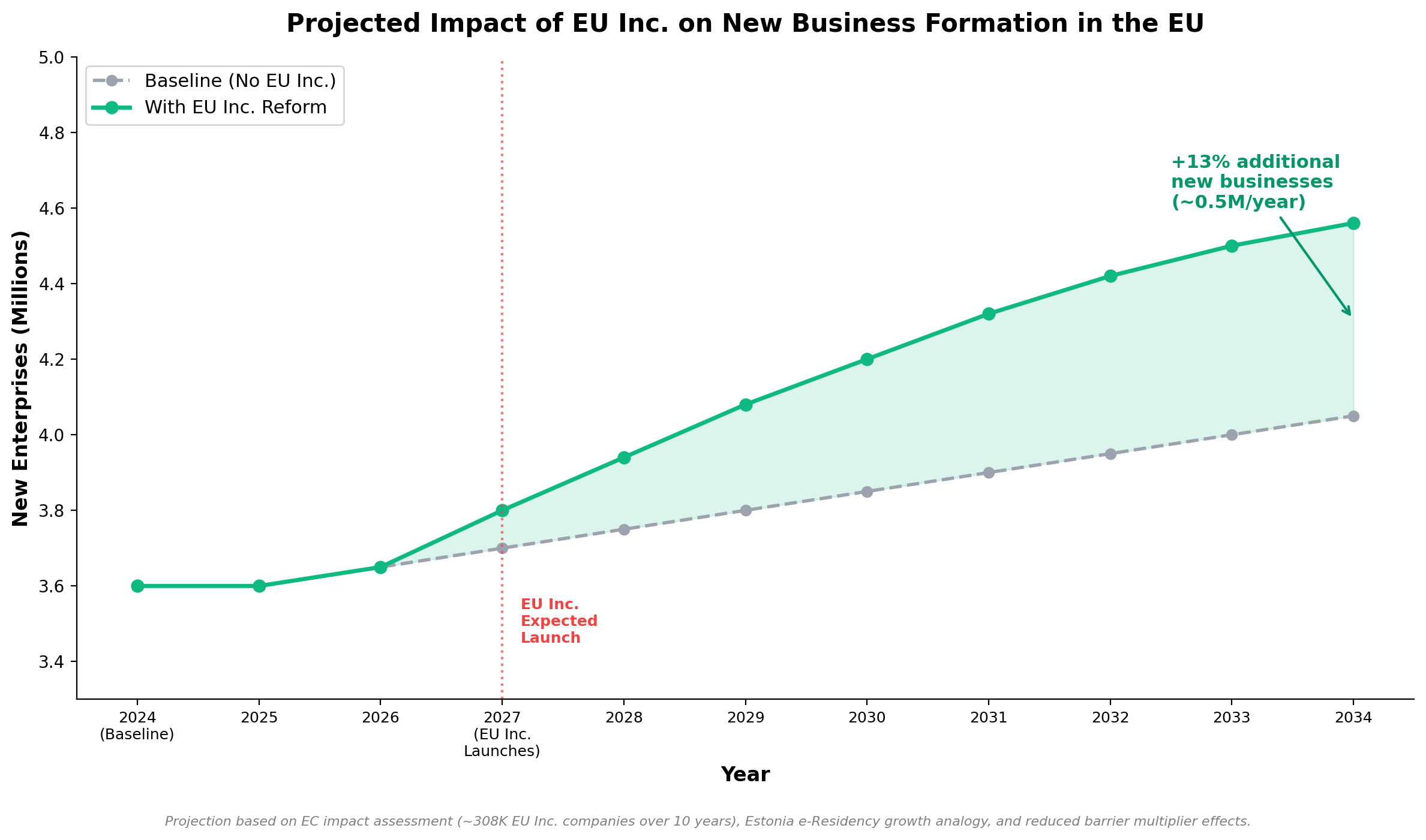
| Base Case | +400,000 | +10–12% |
| Optimistic | +550,000 | +13–15% |
These projections assume EU Inc. is adopted by end of 2026 and operational by 2027, with a 3–5 year ramp-up period, partial national system simplification response, and continued growth in European VC.
The Estonian Analogy
Estonia provides the most relevant real-world analogue. Its e-Residency programme saw a 20% increase in new e-resident applications in 2025 and a 15% increase in company formations (Estonian e-Residency, 2026). E-residents now account for one in five new Estonian company formations. Estonia’s own analysis projects that removing remaining friction would increase formation by another 20%.
EU Inc. goes further than e-Residency by offering full Single Market access rather than access to just Estonia, a dedicated legal form rather than using Estonian national law, and harmonized insolvency, stock option, and corporate governance provisions. If EU Inc. generates even half the proportional impact that e-Residency had on Estonian company formation applied to the EU’s 3.6M baseline, the 10–12% base case projection appears well-supported.
Section 5: Key Risks and Limitations
Implementation Risk. The Commission targets agreement by end of 2026 and rollout by 2027–2028, but previous EU-wide corporate frameworks, the Societas Europaea (SE), introduced 20 years ago, failed to gain traction due to rigid requirements and high capital thresholds (CEPA, 2025). EU Inc. is explicitly designed to avoid these mistakes by targeting startups with minimal capital requirements.
National Resistance. Member states may drag their feet on implementation, particularly around the interoperability of national business registers. As Morningstar noted, “Even if the EU meets the commission’s ambitious timetable for approving the new regime, it will likely take time to have a discernible impact on economic growth” (Morningstar/Dow Jones, 2026).
Employment Law Fragmentation Persists. EU Inc. does not harmonize employment law across the 27 member states. Businesses will still need to comply with 27 separate employment frameworks when hiring across borders. Julian Teicke warned that “slapping a single login screen over 27 fragmented legal systems isn’t the EU Inc. we were promised” (tech.eu, 2026).
Tax Competition Concerns. The freedom to choose any member state for incorporation could intensify tax competition. While the Commission’s Head Office Tax (HOT) system and BEFIT initiative aim to address this, the details remain uncertain.
The “Opt-In” Question. EU Inc. is optional. If adoption is slow, as it was with the Societas Europaea, the impact could fall closer to the conservative scenario or below.
Conclusion
EU Inc. represents the most significant structural reform to European business formation since the creation of the Single Market itself. The numbers tell a clear story: the EU currently creates roughly 3.5–3.6 million new enterprises per year versus 5.2 million in the US, despite having 35% more people. The per-capita startup rate in the US is nearly double that of the EU, driven in part by America’s unified corporate legal framework.
The Commission projects approximately 308,000 EU Inc. companies over the first decade, with €328–440 million in direct cost savings. But the total impact, including competitive pressure on national systems, reduced brain drain, and the broader entrepreneurial confidence effect, could be substantially larger. The base case projection suggests a 10–12% increase in annual EU business formation at maturity, adding roughly 400,000 new businesses per year by the early 2030s.
This would not close the gap with the US, but it would meaningfully narrow it, particularly when combined with the parallel improvement in European venture capital, which reached €85.3 billion in 2025. The 22,000+ founders and investors who signed on to support the EU Inc. movement (tech.eu, 2026) understand the stakes: the question is no longer whether Europe needs this reform, but whether its institutions can execute it fast enough.
As the Draghi Report concluded: Europe has left its Single Market fragmented for decades, driving high-growth companies overseas and reducing the pool of projects to be financed (European Commission, 2024). EU Inc. is the first serious attempt to fix that at the formation layer. Whether it succeeds depends entirely on speed of execution and depth of implementation.
References
- CEPA (2025). “Why Europe’s 28th Regime Could Boost Startups.” Center for European Policy Analysis.
- Commerce Institute (2026). “How Many New Businesses Start Each Year? (2026 Data).”
- Estonian e-Residency (2026). “E-residents generated a record €125 million state revenue in 2025.”
- European Business Magazine (2026). “Estonia’s E-Residency Scheme Generates €125M in 2025.”
- European Commission (2024). “The future of European competitiveness: Report by Mario Draghi.”
- European Commission (2026). “Commission presents proposal for EU Inc.” Press Release IP/26/614.
- Eurostat (2025). “Business demography statistics.” Statistics Explained.
- Eurostat (2025). “More businesses opened than dissolved in the EU in 2023.”
- Morningstar/Dow Jones (2026). “EU Proposes New ‘EU Inc’ Legal Regime to Aid Startups and Innovation.”
- NordicHQ (2026). “Business Registration Time and Cost—Country Ranking.”
- Reuters (2026). “EU Inc proposal seeks to rival US in innovation by easing startup creation.”
- tech.eu (2026). “EU Inc. marks major win for startups as Commission unveils 28th regime proposal.”
- U.S. Census Bureau (2026). “Business Formation Statistics.”
- U.S. Chamber of Commerce (2024). “New business applications are booming. Track them by state.”