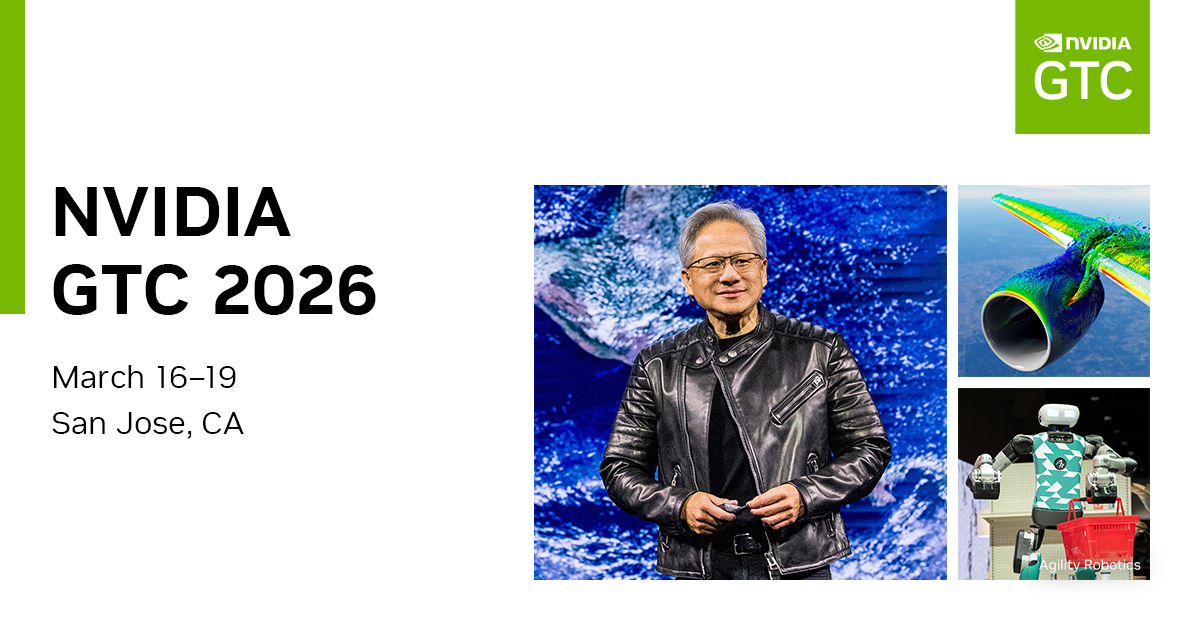

A summary and analysis of NVIDIA’s GPU Technology Conference 2026, held March 16 to 19 in San Jose, California, and its implications for the AI industry.
Executive Summary
NVIDIA’s GTC 2026 was not an incremental product refresh. It was the moment Jensen Huang declared that the age of inference has arrived, and that NVIDIA intends to own every layer of the stack that powers it. Across a four-day conference attended by over 20,000 people in San Jose, NVIDIA unveiled the Vera Rubin full-stack computing platform, confirmed its acquisition of Groq’s team and technology, previewed the Feynman architecture roadmap, launched the Dynamo inference operating system, pushed physical AI and robotics into production, and doubled its AI infrastructure demand projection to $1 trillion through 2027 (NVIDIA GTC Keynote, March 16, 2026).
The central thesis was clear: tokens are the new commodity, and NVIDIA is building the factory that produces them. This article walks through the key announcements, the strategic logic behind them, and what it all means.
Section 1: The Inference Inflection
Huang opened the keynote with a claim that set the tone for everything that followed: computing demand has increased by one million times in the last two years. The driver is no longer just training. AI now has to think, read, plan, and act, and every one of those operations requires inference. “The inflection point of inference has arrived,” Huang declared (NVIDIA Blog, 2026).
This framing matters because it repositions NVIDIA’s entire business. Training was a land grab, dominated by massive clusters doing one thing: making models smarter. Inference is different. It is continuous, it scales with every user interaction, and it touches every industry. Huang estimated the company sees at least $1 trillion in high-confidence demand and purchase orders for its Blackwell, Rubin, and future platforms through 2027, doubling the $500 billion projection he made at GTC 2025 (Techloy, 2026).
He was not shy about the implications. “This is a reinvention. This is a renaissance of the enterprise IT,” he told the audience, noting that every major supply chain partner, including companies that are 50, 70, and 150 years old, hit record revenues in 2025 thanks to AI demand.
Section 2: Vera Rubin, the Full-Stack AI Factory
The headline hardware announcement was Vera Rubin, NVIDIA’s next-generation AI infrastructure platform. Unlike previous launches that centered on a single GPU, Vera Rubin is a vertically integrated system: seven new chips, five rack-scale systems, and one supercomputer designed to operate as a single unified architecture (NVIDIA Newsroom, 2026).
The key components:
- Rubin GPU with NVLink 72 connecting 72 GPUs for massive parallel compute
- Vera CPU, a new ARM-based processor with LPDDR5X memory delivering 1.2 TB/s of bandwidth, double the bandwidth at half the power of general-purpose CPUs
- ConnectX-9 networking and BlueField-4 STX storage processors
- Spectrum-X Ethernet switches with co-packaged optics
- Groq LP30 Language Processing Unit for low-latency token generation
The complete system delivers 3.6 exaflops of compute with 260 terabytes per second of NVLink bandwidth. The Vera Rubin NVL72 configuration offers up to 10x higher inference throughput per watt and can train large models with one-fourth the GPU count of the Blackwell platform (Constellation Research, 2026).
“When we think Vera Rubin, we think the entire system, vertically integrated, complete with software, extended end to end, optimized as one giant system,” Huang said. All seven chips are in full production, with early sampling “going incredibly well” (NVIDIA Blog, 2026).
The Vera CPU Pivot
The Vera CPU deserves special attention. NVIDIA described it as “a brand new CPU designed for super high single-thread AI performance.” Within the Vera Rubin NVL72, the CPU uses NVLink-C2C technology to achieve 1.8 TB/s of coherent bandwidth.
This is NVIDIA’s direct play against Intel and AMD in the CPU market. A standalone rack design integrating 256 liquid-cooled Vera CPUs supports over 22,500 concurrent CPU environments, optimized for reinforcement learning and agentic workflows. CoreWeave expects to be among the first to deploy the Vera CPU rack in production in the second half of 2026 (Futurum Group, 2026).
Section 3: The Groq Acquisition and Workload Disaggregation
The most strategically significant announcement was confirmation that NVIDIA acquired the Groq team and licensed the technology. The Groq LP30 chip, now in volume production at Samsung, contains 500 megabytes of on-chip SRAM and functions as what Huang called “a deterministic data flow processor” with static compilation for ultra-low-latency token generation (Techloy, 2026).
This is where NVIDIA’s vision gets architecturally interesting. Rather than forcing one chip to do everything, NVIDIA is disaggregating inference workloads:
- Vera Rubin GPUs handle the prefill and attention phases (high throughput)
- Groq LPUs handle the decode and token generation phases (low latency)
NVIDIA’s Dynamo software orchestrates the split. Huang offered a blunt deployment recommendation: “If most of your workload is high throughput, I would stick with just 100% Vera Rubin. If a lot of your workload wants to be coding and very high valued engineering token generation, I would add Groq to it. I would add Groq to maybe 25% of my total data center” (Techloy, 2026).
The result: 35x more throughput per megawatt at premium pricing tiers. Huang acknowledged one of his engineers corrected last year’s projections upward: “He says, ‘Jensen sandbagged. It’s actually 50 times.’ He’s not wrong.”
EE Times described this as unifying “two processors of extreme differences, one for high throughput, one for low latency” (EE Times, 2026). It is also a candid admission that GPUs alone may not be the optimal architecture for all inference workloads, which is why NVIDIA chose to absorb Groq rather than compete with it.
Section 4: Dynamo, the Inference Operating System
NVIDIA launched Dynamo 1.0, open-source software it describes as “the first-ever operating system for AI factories.” The adoption list is notable: AWS, Microsoft Azure, Google Cloud, Oracle Cloud, CoreWeave, Nebius, together with AI-native companies like Cursor and Perplexity, inference providers like Baseten, Deep Infra, and Fireworks, and global enterprises including ByteDance, Meituan, PayPal, and Pinterest (NVIDIA Newsroom, 2026).
Dynamo splits inference work across GPUs with intelligent routing, moves data between GPUs and lower-cost storage to reduce waste, and for agentic AI with long prompts, routes requests to GPUs that already have the most relevant context cached from earlier steps. In benchmarks, Dynamo boosted inference performance on Blackwell GPUs by up to 7x, lowering token cost with free, open-source software.
The strategic play is clear: NVIDIA is making its inference software the default orchestration layer for every major cloud provider, creating a lock-in that operates at the software level even as hardware competition intensifies.
Section 5: Agentic AI and the OpenClaw/NemoClaw Stack
NVIDIA framed agentic AI as the primary application layer driving the inference inflection. Two new open-source platforms anchor the strategy:
- OpenClaw: An open-source operating system for agentic computers. NVIDIA calls it the foundation for building AI agents that can see, plan, act, and learn continuously.
- NemoClaw: The application layer that sits on top, providing security guardrails and policy enforcement for deploying autonomous agents in production environments.
NVIDIA partnered with Salesforce to bring Nemotron models into Agentforce and Slack, Dell to enable enterprises to run autonomous agents locally on DGX Station with NemoClaw guardrails, and Microsoft to integrate Nemotron into its Foundry platform with governance features across its 11,000+ model catalog (CRN, 2026).
Live “Build-a-Claw” workshops at GTC let attendees deploy real agents in under an hour. The message: agentic AI is not a research project; it is a deployment story, and NVIDIA wants to own the runtime.
Section 6: Physical AI and Robotics Go Production
NVIDIA moved physical AI out of the lab and into production at GTC 2026. Key announcements:
- Cosmos 3: A unified model that handles world generation, vision reasoning, and action simulation. This is NVIDIA’s answer to the biggest bottleneck in robotics: lack of high-quality training data. By generating synthetic data at scale, it eliminates the need for millions of hours of real-world robot footage.
- Isaac GR00T N models for humanoid robotics (early access plus N2 preview), setting new benchmarks in the field.
- Newton 1.0: A GPU-accelerated, open-source physics engine (a Linux Foundation project co-founded with Google DeepMind and Disney Research) that supports both dexterous manipulation and locomotion simulation.
- IGX Thor: Now generally available for industrial-grade physical AI at the edge, already deployed by Caterpillar, Hitachi Rail, KION, and Medtronic.
Major robotics partners include ABB, Agility Robotics, Figure, FANUC, KUKA, Universal Robots, and YASKAWA. Huang declared that “the ChatGPT moment of self-driving cars has arrived,” announcing new partnerships with autonomous vehicle companies and Uber (TechRadar, 2026).
This is not hype. When Caterpillar and Medtronic are deploying your edge AI hardware in construction sites and operating rooms, the technology has crossed the production threshold.
Section 7: Enterprise, Gaming, and Space
DGX Station and DGX Spark
NVIDIA launched DGX Station, the world’s most powerful deskside supercomputer, powered by the GB300 Grace Blackwell Ultra Desktop Superchip with 748 GB of coherent memory and 20 petaflops of AI compute. It can run open models of up to 1 trillion parameters locally, supports air-gapped configurations for regulated industries, and scales seamlessly to data center deployments. Models supported include OpenAI gpt-oss-120b, Google Gemma 3, Qwen3, DeepSeek V3.2, and NVIDIA Nemotron (NVIDIA Blog, 2026).
DGX Spark enables compact clustering for up to 4 nodes, targeting mid-size companies that need local AI infrastructure without building a data center.
DLSS 5 Neural Rendering
NVIDIA announced DLSS 5, launching in autumn 2026, described as the biggest graphics leap since real-time ray tracing in 2018. It combines 3D-guided neural rendering with generative AI to deliver photorealistic 4K in real time, blending traditional rendering with AI-generated reality (Deeper Insights, 2026).
AI Goes Orbital
In what may be the most audacious announcement, NVIDIA revealed Space-1 Vera Rubin, a module designed to bring AI data centers into orbit, delivering 25x more AI compute than H100 for orbital processing. Jetson Orin and IGX Thor are being adapted for satellites and space stations (NVIDIA Blog, 2026).
Section 8: The Feynman Roadmap
NVIDIA provided its first public look at Feynman, the architecture generation after Vera Rubin. Named after physicist Richard Feynman, it includes:
- Rosa CPU (named after Rosalind Franklin)
- LP40, the next-generation Language Processing Unit
- BlueField-5 and CX10 networking
- Kyber interconnect supporting both copper and co-packaged optics
This gives the ecosystem multi-year roadmap visibility: Blackwell (current) to Vera Rubin (2026 to 2027) to Feynman (2028+). For hyperscalers making billion-dollar infrastructure commitments, that planning certainty is essential.
Section 9: Market Reaction and Ecosystem Signals
Despite the depth of announcements, NVIDIA stock remained essentially flat during GTC week, closing at $181.93 on March 20. Analysts attributed this to broader geopolitical tensions rather than any weakness in the announcements themselves (Longbridge, 2026).
The analyst consensus remains Strong Buy with an average price target of $274.16, representing roughly 50% upside. Dan Ives of Wedbush called it a “bold shift toward AI infrastructure dominance,” while TD Cowen’s Joshua Buchalter and Truist Securities both reiterated Buy ratings highlighting long-term growth drivers (TheStreet, 2026; TipRanks, 2026).
The most striking ecosystem signal came from Nebius Group, which announced a $27 billion infrastructure deal with Meta that includes $12 billion in dedicated Vera Rubin capacity. Micron announced high-volume production of HBM4 36GB memory with a 2.3x bandwidth improvement, allaying concerns about memory supply bottlenecks (Futurum Group, 2026). AWS is deploying over 1 million GPUs plus Groq LPUs, and Microsoft Azure announced it would be the first hyperscale cloud to power Vera Rubin NVL72 systems.
NVIDIA Cloud Partners have now cumulatively deployed more than 1 million GPUs across AI factories globally, representing more than 1.7 gigawatts of AI capacity, with the footprint doubling year over year (NVIDIA Blog, 2026).
Section 10: Analysis and Takeaways
NVIDIA Is No Longer a Chip Company
The overarching message of GTC 2026 is that NVIDIA has completed its transformation from a GPU designer into a full-stack AI infrastructure provider. Every announcement, from Vera Rubin hardware to Dynamo software to OpenClaw agents to Cosmos synthetic data, fits into a single architecture where NVIDIA controls every layer. The company that once sold graphics cards to gamers now builds, in Huang’s words, “AI factories” that produce tokens as their primary economic output.
The Groq Integration Changes the Competitive Landscape
Acquiring Groq was an acknowledgment that the GPU is not the optimal solution for every inference workload. By bringing deterministic, low-latency token generation inside the NVIDIA ecosystem, Huang eliminated what could have been a credible competitor and simultaneously created a heterogeneous architecture that is harder for rivals to replicate. The 25/75 deployment split he recommended (25% Groq LPUs, 75% Vera Rubin GPUs) gives customers a clear blueprint and locks them deeper into the NVIDIA software stack via Dynamo.
Inference Will Dwarf Training in Economic Value
The “inference inflection” framing is not marketing. If Huang’s projections hold, the shift from training-dominant to inference-dominant workloads represents a structural expansion of NVIDIA’s addressable market. Training was a cycle: you build a model, you move on. Inference is continuous and scales with every user, every agent, every API call. The $1 trillion demand estimate through 2027 reflects this shift, and it is why NVIDIA invested so heavily in Dynamo as the orchestration layer.
Physical AI Is Real, Not a Demo
The robotics announcements carried more weight than in prior years because the partner list now includes production deployments. Caterpillar, Medtronic, Hitachi Rail, and KION are not running experiments. They are deploying IGX Thor in construction equipment, operating rooms, rail systems, and warehouses. The Newton physics engine, backed by Google DeepMind, Disney Research, and Toyota Research Institute, provides the simulation infrastructure. Cosmos 3 solves the data bottleneck. The pipeline from simulation to production is closing.
The Stock Did Not Move, and That Is Fine
The flat stock reaction is not a negative signal. NVIDIA trades at a valuation that already prices in dominant AI infrastructure positioning. GTC 2026 did not change the thesis; it reinforced it with execution evidence. The $27 billion Nebius-Meta deal, the million-GPU cloud deployments, and the Vera Rubin production timeline all validate the demand picture. The stock will move when quarterly earnings confirm the revenue trajectory, not when keynotes promise it.
Conclusion
GTC 2026 was the conference where NVIDIA stopped being a semiconductor company and became, in effect, the operating system of the AI economy. From Vera Rubin’s seven-chip architecture to Groq’s deterministic token generation, from Dynamo’s inference orchestration to OpenClaw’s agentic framework, from Cosmos 3 in robotics to DLSS 5 in gaming to Space-1 in orbit, every announcement served the same thesis: the world needs more tokens, and NVIDIA is building the infrastructure to produce them at planetary scale.
Whether the $1 trillion demand projection holds will depend on whether the agentic AI applications that justify these investments materialize at the pace NVIDIA expects. The early signals, measured in production deployments from Fortune 500 industrials and $27 billion infrastructure commitments, suggest NVIDIA’s bet is not speculative. It is already being underwritten by the companies that will use it.
For NVIDIA’s competitors, the message was unmistakable: the race is no longer about who makes the best chip. It is about who owns the factory.
References
- Constellation Research (2026). “Nvidia’s hardware strategy goes beyond GPU in AI inference pivot.” Link
- CRN (2026). “AI Innovation Unveiled: 14 Vendor Partners Helping Shape The Future Of Enterprise AI At Nvidia GTC 2026.” Link
- Deeper Insights (2026). “NVIDIA GTC 2026 Highlights: Recap on Everything You Missed.” Link
- EE Times (2026). “GTC 2026 Keynote: Long Live the Inference King.” Link
- Futurum Group (2026). “NVIDIA Vera Rubin Platform Dominates GTC 2026.” Link
- Longbridge (2026). “Nvidia (NVDA) Stock Flat amid GTC 2026.” Link
- NVIDIA Blog (2026). “NVIDIA GTC 2026: Live Updates on What’s Next in AI.” Link
- NVIDIA Newsroom (2026). “NVIDIA Vera Rubin Opens Agentic AI Frontier.” Link
- NVIDIA Newsroom (2026). “NVIDIA Enters Production With Dynamo.” Link
- Techloy (2026). “Nvidia GTC 2026: Everything Jensen Huang Announced at the Keynote.” Link
- TechRadar (2026). “Nvidia GTC 2026: ‘It all starts here.’” Link
- TheStreet (2026). “Veteran analyst sends blunt message on Nvidia stock after GTC.” Link
- TipRanks (2026). “Top Analysts See Solid Upside in Nvidia Stock after GTC Event.” Link