

The often-quoted “57% rule” claimed that B2B buyers complete more than half of their purchase decision before talking to sales. By 2024, Gartner data put that figure at 80%. The 2026 Gartner survey shows 67% of B2B buyers now prefer a rep-free experience, and 45% used AI in their last purchase. Yet customer indecision causes 40 to 60 percent of all lost deals. This article unpacks what really drives modern buyers and how marketers should respond.
From the 57% Rule to the 80% Reality
In 2015, a CEB (now Gartner) study reported that 57% of a complex B2B purchase decision was completed before any contact with a salesperson (Wizdo, 2015). The number became famous in marketing circles, often cited as a hard rule. Forrester later clarified that the 57% figure was an average and that buyer behavior varies widely by product category and complexity (Wizdo, 2015). The trajectory since then has been one-directional. Forrester’s 2019 update placed self-directed buying at 70%. By 2024, Gartner found buyers were spending only 17% of their total buying time in direct contact with potential vendors, meaning approximately 80% of the journey is self-directed (Brixon Group, 2025). The 2026 Gartner survey of nearly 650 B2B buyers confirms the shift: 67% of buyers state they prefer a rep-free experience, and 45% reported using AI tools during a recent purchase (Demand Gen Report, 2026).
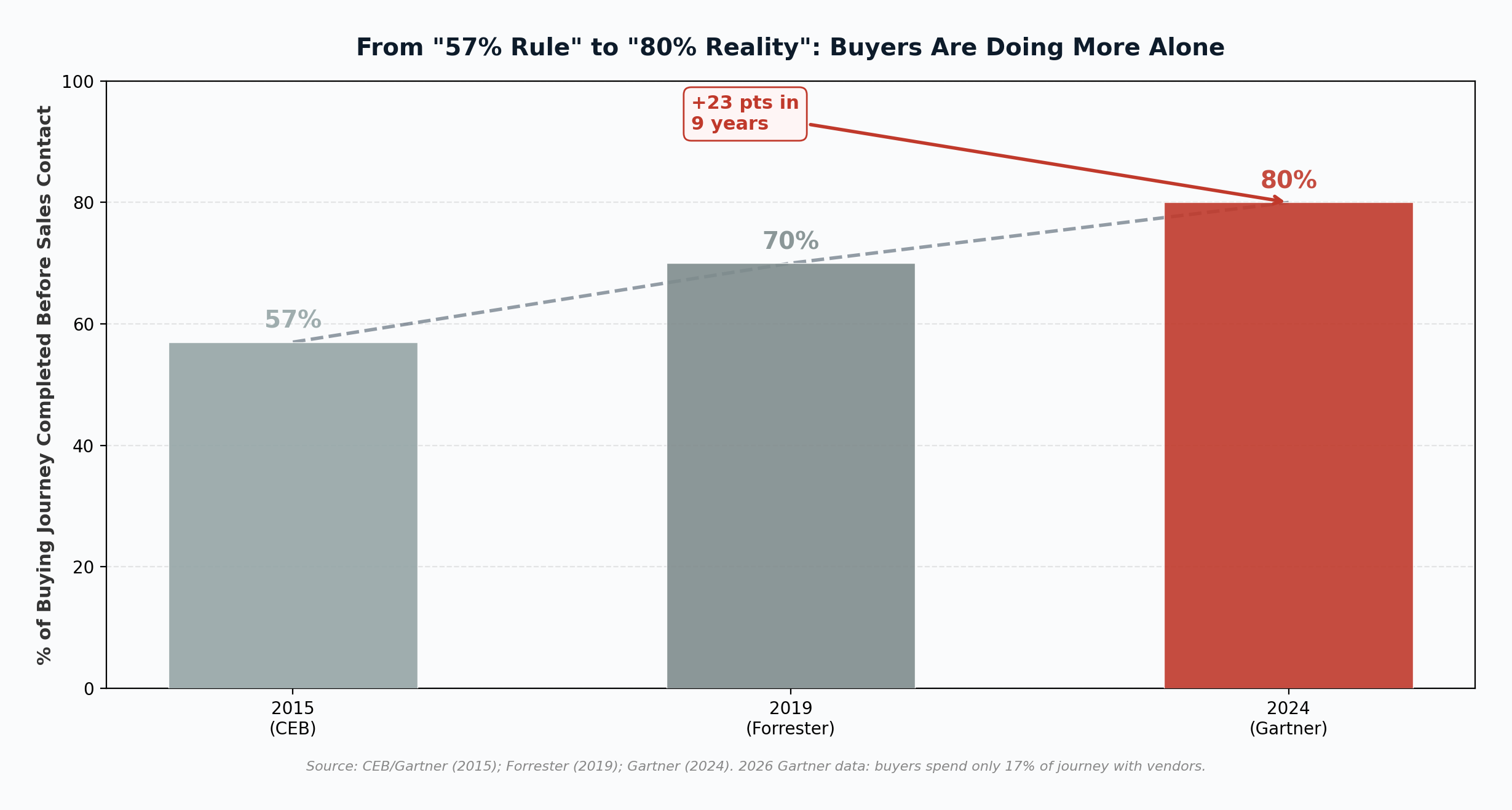
The implication is unambiguous. If a brand is not visible during problem recognition, information search, and evaluation of alternatives, it may never reach the consideration set. The real competition for the modern buyer happens before any sales conversation begins.
The Five-Stage Journey, Reframed for 2026
Solomon and Russell (2024) describe complex purchase decisions as moving through five stages: problem recognition, information search, evaluation of alternatives, purchase, and post-purchase evaluation. The framework has not changed. What has changed is where each stage happens.
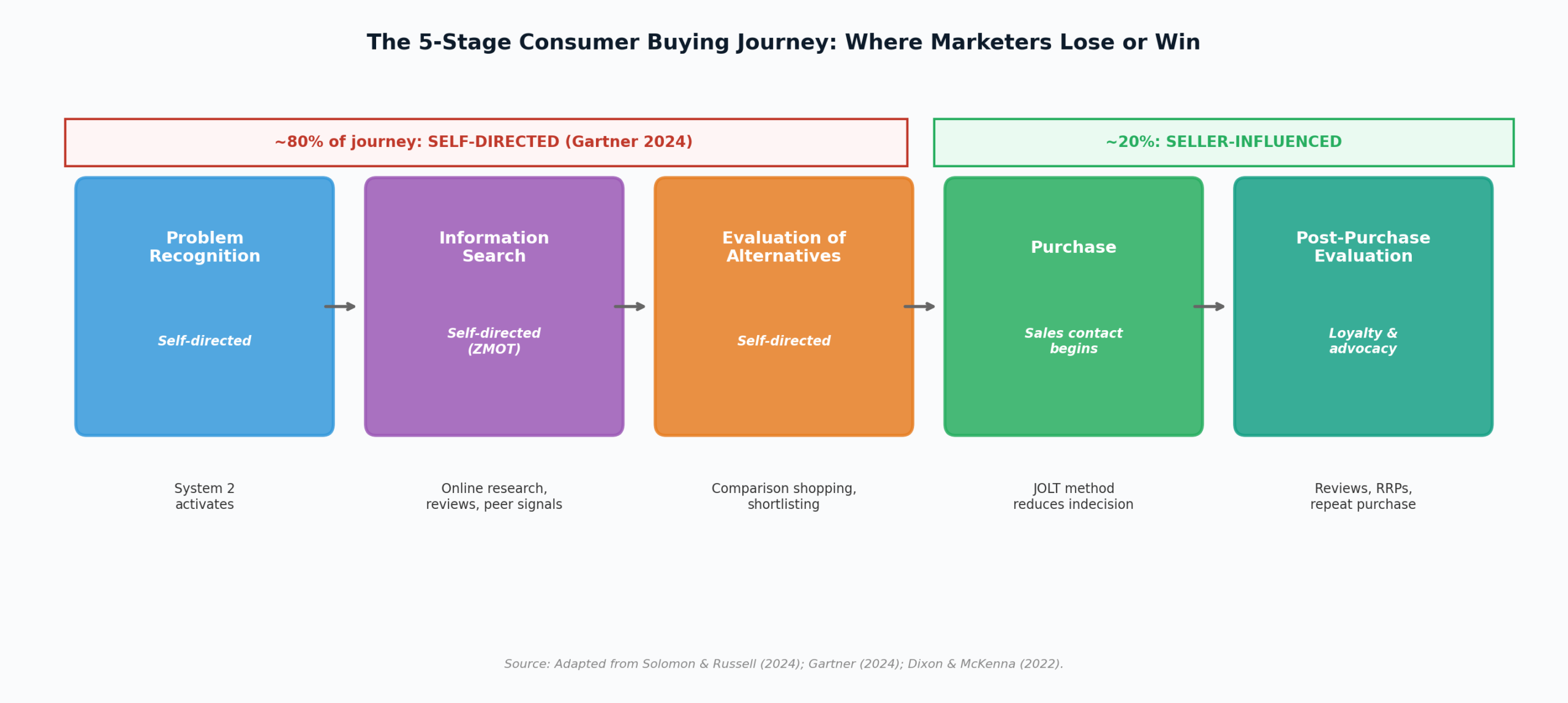
In the information search stage, the Zero Moment of Truth (ZMOT) describes the early online interactions where buyers form their first impressions of a brand (Solomon & Russell, 2024). Buyers now consult an average of 10 digital sources before making a B2B decision, and 71% of all B2B research begins with a generic Google search (Brixon Group, 2025). Because complex purchases carry high perceived risk, they activate System 2 thinking: a slow, conscious, effortful reasoning mode in which the consumer carefully evaluates alternatives (Solomon & Russell, 2024). This is the stage where clear comparison content, FAQs, transparent pricing, and “jobs to be done” framing (Christensen, 2016) reduces cognitive load and increases the likelihood of being shortlisted.
The Indecision Trap: Why Self-Educated Buyers Still Fail to Buy
A counterintuitive finding from recent research is that more buyer information does not equal more closed deals. Dixon and McKenna’s analysis of 2.5 million sales calls found that customer indecision now causes 40% to 60% of all lost deals, and 56% of those losses stem from indecision rooted in fear of failure rather than a preference for the status quo (which accounts for the remaining 44%) (JOLT Effect, 2024; Dixon & McKenna, 2022). In the past five to seven years, win rates have nearly halved while deals ending in “no decision” have more than doubled (Shift90, 2024). According to Challenger’s research, medium to high levels of indecision show up in 87% of all deals, and prospects in nine out of ten sales calls indicate some level of indecision (Challenger Inc., 2024).
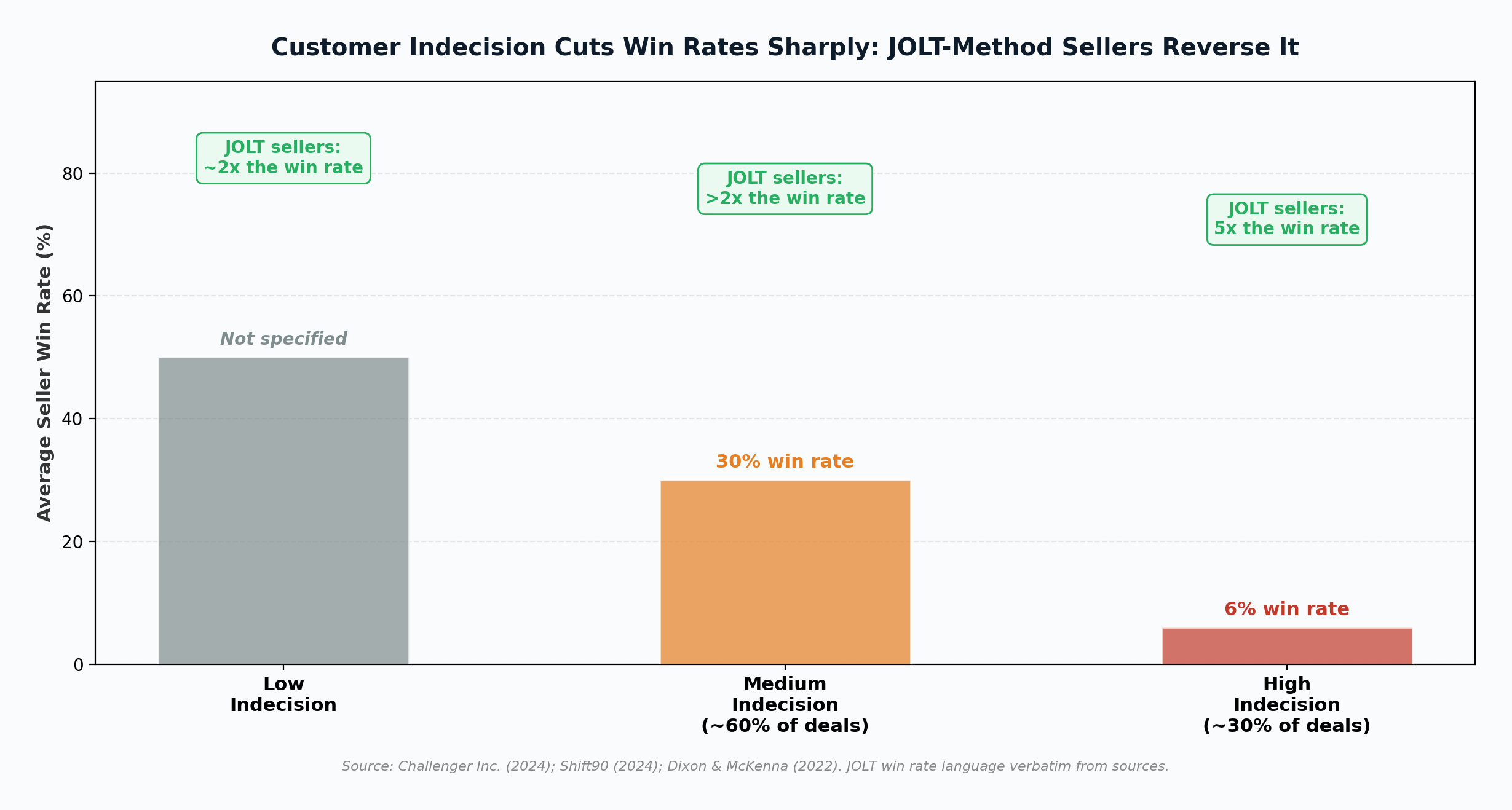
The JOLT method addresses this directly: Judge the level of indecision early, Offer a clear recommendation rather than a menu of options, Limit unnecessary exploration that creates choice overload, and Take risks off the table through guarantees, flexible policies, or staged commitments (Dixon & McKenna, 2022). Counterintuitively, providing every requested resource often makes indecision worse, not better. JOLT Effect research shows that doubling down on building the case against the status quo, the conventional sales response when buyers waver, backfired 84% of the time (JOLT Effect, 2024). Limiting options is more effective than expanding them.
Where Marketers Must Show Up
Three actionable implications follow from the 2024-2026 buyer-behavior data.
1. Mental availability before sales availability. Because most buyers complete the early steps independently, brands must be present and credible during problem recognition and information search. This means investing in SEO, thought leadership, third-party review platforms (G2, Capterra, TrustRadius), and AI-search optimization. The 2026 Gartner survey confirms that AI-driven buyer journeys are reshaping where influence happens; 45% of buyers used AI tools during their last purchase (Demand Gen Report, 2026). Brands that are not represented in those AI-generated answers may be invisible to nearly half of all buyers.
2. Reduce cognitive load with clarity, not volume. Comparison charts, short videos, and transparent pricing reduce the System 2 effort buyers must expend (Solomon & Russell, 2024). Tesla’s direct-to-consumer model exemplifies this: a high-involvement purchase ($40,000 to $100,000+) can be completed entirely online without ever speaking to a salesperson because every relevant comparison, configuration, and pricing detail is laid out clearly (Tesla, Inc., 2026). The brand removes friction by removing ambiguity, not by adding more options.
3. Use social proof to compress the research phase. Research on Referral Reward Programs shows that consumers are 4 times more likely to buy when referred by a strong tie, and referral leads are believed to be 25% more valuable in comparison to leads from traditional marketing sources (Bifkovics et al., 2024). For high-involvement products, the most effective RRPs reduce uncertainty rather than artificially incentivizing low-quality referrals.
A Critical Caveat: Not All Buyers Self-Educate
The 80% figure, like the 57% figure before it, is an average. Buyer behavior varies dramatically by product category, complexity, and individual circumstance. Earlier research on functional illiteracy showed that 21% to 23% of U.S. adults struggle with basic reading and numeracy, meaning they cannot effectively navigate complex online research or compare detailed product information (Viswanathan et al., 2005). More recent estimates from the National Center for Education Statistics indicate that 28% of U.S. adults perform at the lowest literacy levels (Level 1 or below). These consumers rely on in-person help, simple explanations, and visual cues from the very beginning of their purchase consideration. A marketing strategy that assumes “everyone researches online first” risks excluding tens of millions of potential customers.
Even highly educated B2B buyers often need vendor help earlier than the averages suggest. The takeaway is not that human sales is dead. It is that the role of human sales has shifted from gatekeeper of information to clarifier of complexity and reducer of indecision.
Synthesis
The 57% statistic was a wake-up call in 2015. The 80% figure in 2024 is closer to a warning siren, and AI-driven buying behavior is poised to push the figure further still. Buyers now do far more on their own, but they are not necessarily making better decisions. They are confident in their research yet paralyzed at the moment of commitment. The brands that win in this environment are those that make themselves discoverable during self-directed research, reduce the cognitive cost of evaluation, and intervene at the moment of decision with clarity rather than information.
Conclusion: Beyond the 57% Rule
The famous 57% rule was never a law. It was a snapshot of where information control had shifted at one point in the digital era. By 2024, that figure had moved to 80%, and the 2026 Gartner data on rep-free preference and AI usage suggests it will continue to climb. The five-stage purchase decision framework remains valid, but the locus of marketer influence has moved decisively to the early stages: problem recognition, information search, and evaluation of alternatives. What matters most is no longer how to control information but how to be discoverable when buyers are doing the controlling. Marketers who treat the 57% rule as a memorable historical statistic, while building strategies designed for the 80% reality, will be better positioned than those still clinging to a sales-first model. Buyers have moved on. Marketing must move with them.
References
Bifkovics, B., Malota, E., Faria, L. N., & Martinez, L. F. (2024). Customer-to-customer communication: Referral of high and low involvement products through stimulated word-of-mouth. Journal of Promotion Management, 30(2), 204-226. https://doi.org/10.1080/10496491.2023.2253235
Brixon Group. (2025, September 11). The modern B2B buying journey: Why buyers complete 80% of their journey alone and how you can still remain visible. https://brixongroup.com/en/the-modern-b2b-buying-journey
Challenger Inc. (2024, April 2). Why are you losing to customer indecision? The JOLT Effect. https://challengerinc.com/losing-to-customer-indecision/
Christensen, C. (2016). Know your customers’ “jobs to be done” [Video]. Harvard Business Review. https://hbr.org/video/5852531897001/know-your-customers-jobs-to-be-done
Demand Gen Report. (2026, March 17). Gartner: 67% of B2B buyers prefer a rep-free experience. https://www.demandgenreport.com/industry-news/news-brief/gartner-67-of-b2b-buyers-prefer-a-rep-free-experience/52142/
Dixon, M., & McKenna, T. (2022, June 24). Stop losing sales to customer indecision. Harvard Business Review. https://hbr.org/2022/06/stop-losing-sales-to-customer-indecision
JOLT Effect. (2024, October 9). What is the JOLT Effect? Everything you need to know. https://www.jolteffect.com/blog/what-is-the-jolt-effect
Shift90. (2024). The JOLT Effect and the high cost of buyer indecision. https://www.shift90.partners/blog/the-jolt-effect-and-the-high-cost-of-buyer-indecision
Solomon, M. R., & Russell, C. A. (2024). Consumer behavior: Buying, having, and being (14th ed.). Pearson.
Tesla, Inc. (2026). New vehicle inventory. https://www.tesla.com/inventory/new
Viswanathan, M., Rosa, J. A., & Harris, J. E. (2005). Decision making and coping of functionally illiterate consumers and some implications for marketing management. Journal of Marketing, 69(1), 15-31.
Wizdo, L. (2015, May 25). Myth-busting 101: Insights into the B2B buyer journey. Forrester. https://www.forrester.com/blogs/15-05-25-myth_busting_101_insights_intothe_b2b_buyer_journey/