
Stanford’s 2026 AI Index Report: U.S.-China Gap Closes as AI Investment Surges
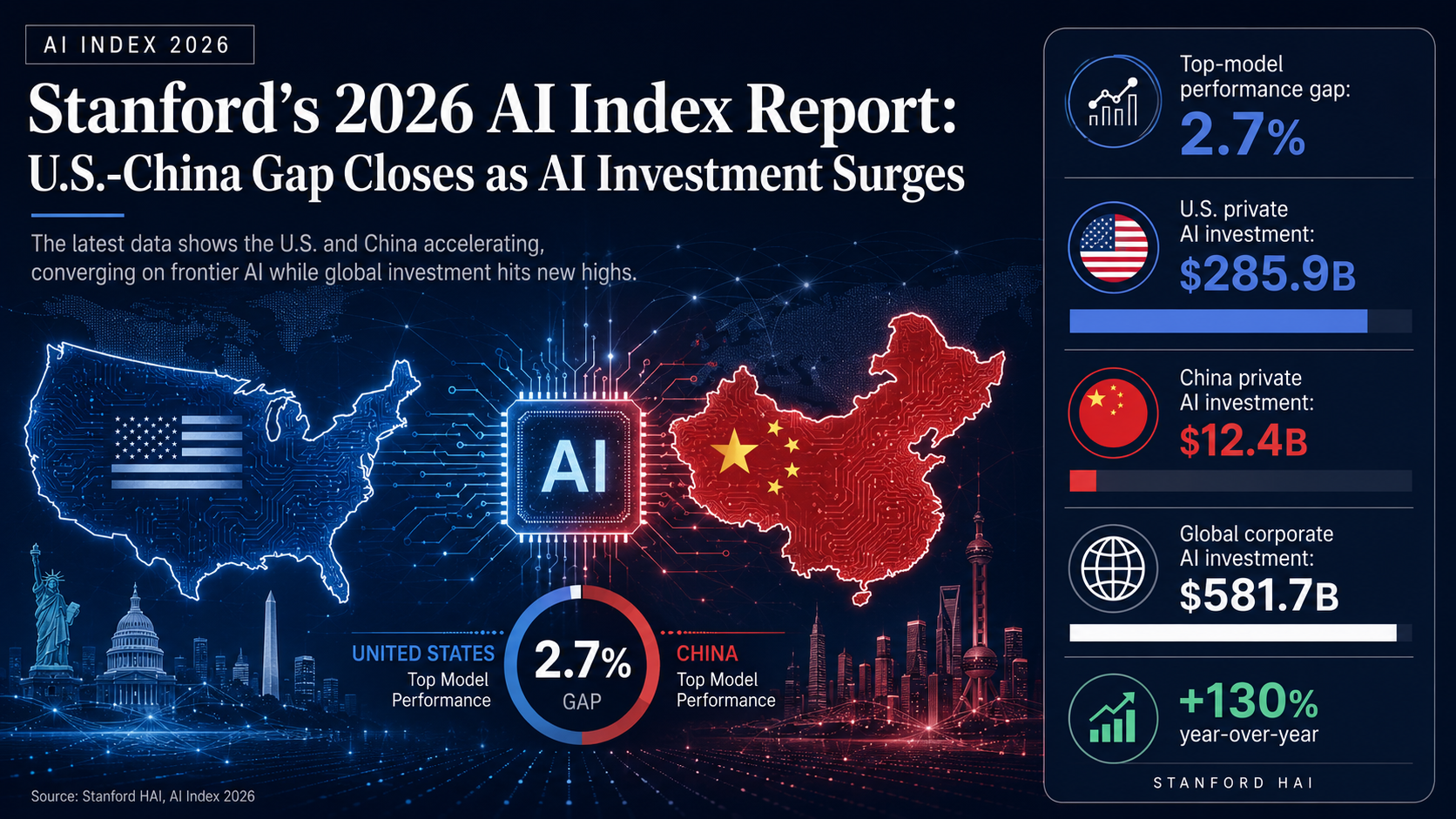
The ninth annual AI Index Report from Stanford University found artificial intelligence capability accelerating faster than ever, with the technology gap between the United States and China effectively closed, while private AI investment reached a record $285.9 billion. The 400-page report, published in May 2026, offers the most comprehensive data-driven snapshot of global AI progress to date.
Produced by the Stanford Institute for Human-Centered Artificial Intelligence, the 2026 AI Index spans nine chapters covering research and development, technical performance, responsible AI, economics, science, medicine, education, policy, and public opinion. The report’s findings challenge several assumptions about AI development, revealing a more balanced, more industrialized, and more unevenly trusted landscape than previous years.
Key Finding: U.S. private AI investment reached $285.9 billion in 2025, more than 23 times China’s $12.4 billion in private investment, although government-guided funds make China’s total harder to measure from the outside. Source: Stanford HAI AI Index Report 2026. Also cited in Stark Insider and IEEE Spectrum.
The U.S.-China AI Race: A New Equilibrium
The report’s analysis of the U.S.-China dynamic reveals a fundamental shift. For years, the United States maintained a clear lead in frontier model development. That lead has narrowed to the point where the two nations now compete on nearly equal footing across most capability metrics.
The strengths are divided by domain. The United States still produces more top-tier models and higher-impact patents, while China leads in publication volume, citations, patent output, and industrial robot installations. South Korea stands out for innovation density, leading the world in AI patents per capita. The same models that win gold at the International Mathematical Olympiad can correctly read an analog clock only 50.1 percent of the time, a finding that deserves to travel beyond the AI press.
Investment dominance. U.S. private AI investment reached $285.9 billion in 2025, more than double the $253 billion spent in 2024 and speeds past the previous record of $360 billion set in 2021. Unlike 2021, where investment was led by mergers and acquisitions, 2025’s record-setting result was led by private investment in AI companies. The United States still leads the world on capital and entrepreneurship, with 1,953 newly funded AI companies in 2025 alone.
Yet the competitive picture is more nuanced. While private investment flows heavily toward U.S. firms, government-guided funds in China make the full scope of its investment harder to measure from the outside. On the talent front, the count of AI researchers and developers moving to the United States has dropped 89 percent since 2017, with an 80 percent decline in the last year alone.
Methodology: The AI Index tracks 87 notable model releases from industry in 2025, compared to just seven from all other sources. Models released by industry now make up over 90 percent of all notable frontier models.
Industrial Takeover of AI Research
One of the report’s most significant findings is the complete industrialization of AI research. Nearly all notable models originated within industry rather than academic or government institutions. Epoch AI tracked 87 notable model releases from industry in 2025, compared to just seven from all other sources.
This represents a major long-term trend. Academic research no longer drives frontier capability — industry laboratories do the heavy lifting. The report notes that benchmarks may not always map to real-world results, and that a system scoring 75 percent on a legal reasoning benchmark tells us little about how well it actually functions in legal practice.
Trust and Regulation: A Fragmented Landscape
Public trust in institutions to regulate AI remains deeply fragmented. Among surveyed countries, the United States reported the lowest level of trust in its own government to regulate AI effectively, at just 31 percent. Globally, the EU is trusted more than the United States or China to regulate AI effectively.
This trust gap has real-world consequences. The White House postponed an executive order on AI model sharing in May 2026, pivoting toward “partnership” with companies rather than pursuing “government regulation.” Meanwhile, the EU AI Act moved ahead with aggressive enforcement timelines, signaling a regulatory divergence that will shape where AI companies choose to operate.
The report’s responsible AI findings reveal a troubling lag: responsible AI reporting has fallen behind capability reporting, and the gap between the two is where incidents come from. When a new model launches, the safety card matters as much as the benchmark chart, according to the report.
| Metric | United States | China | Global Lead |
|---|---|---|---|
| Frontier Model Production | Higher | Closing fast | Closing gap |
| Private AI Investment | $285.9B | $12.4B | United States (23x) |
| AI Researchers | Declining inflow | Growing outflow | Mixed trend |
| Trust in Gov. Regulation | 31% | N/A | EU leads trust |
| Patent Output | Highest per capita | Highest total | South Korea (per capita) |
What This Means Going Forward
The report makes clear that AI adoption is racing ahead of formal education. The people who know how to work with these tools, test their output, and recover from their mistakes have a real advantage at every stage of a career.
For policymakers, the data suggests a different challenge than expected. Rather than a nation-state race the United States is losing, the picture is more complex: dominant capital but declining talent inflow, leadership in innovation but lagging regulation trust, capability acceleration outpacing safety reporting. The report calls for more deliberate AI fluency education, more household and workplace policies on AI use, and more robust safety benchmarking alongside capability testing.
Conflict of interest: The reporting on this study was produced by the news staff of Acaderesearch.com. The Stanford AI Index Report is independently produced by the Stanford Institute for Human-Centered Artificial Intelligence (HAI), with annual updates since 2017.
References
- Stanford Institute for Human-Centered Artificial Intelligence (HAI). The 2026 AI Index Report. (2026). Available at: https://hai.stanford.edu/ai-index/2026-ai-index-report
- Stark Insider. Stanford’s 2026 AI Index: Where AI Actually Stands. (2026). Available at: https://www.starkinsider.com/2026/04/stanford-2026-ai-index-report.html
- IEEE Spectrum. Stanford’s AI Index for 2026 Shows the State of AI. (2026). Available at: https://spectrum.ieee.org/state-of-ai-index-2026
- AI Hub. 2026 AI Index Report Released. (2026). Available at: https://aihub.org/2026/04/15/2026-ai-index-report-released/
- MS Technology. Stanford AI Index: 12 Takeaways From the 2026 Report. (2026). Available at: https://www.msn.com/en-us/technology/artificial-intelligence/stanford-ai-index-12-takeaways-from-the-2026-report-on-how-ai-is-reshaping-the-economy/ar-AA22fNE9